PUBLISHER: Global Market Insights Inc. | PRODUCT CODE: 2083069

PUBLISHER: Global Market Insights Inc. | PRODUCT CODE: 2083069
Asia-Pacific Batch Mixer Market Opportunity, Growth Drivers, Industry Trend Analysis, and Forecast 2026 - 2035
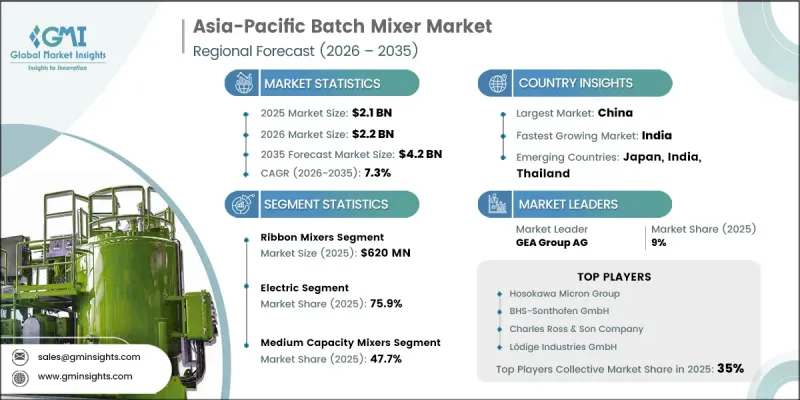
Asia-Pacific Batch Mixer Market was valued at USD 2.1 billion in 2025 and is estimated to grow at a CAGR of 7.3% to reach USD 4.2 billion by 2035.
Rising consumption of processed, packaged, and ready-to-use food products is creating substantial demand for advanced batch mixing equipment across the region. Food manufacturers are increasingly investing in efficient mixing technologies to maintain product consistency, enhance quality, and support higher production volumes. At the same time, expanding pharmaceutical manufacturing activities are contributing significantly to market growth, as precise blending processes remain essential for producing a wide range of pharmaceutical formulations. The growing focus on specialized drug development and higher production standards is accelerating demand for hygienic and high-accuracy mixing systems. Additionally, the rapid expansion of construction and infrastructure activities throughout the Asia-Pacific region is increasing the need for durable and high-capacity batch mixers used in material preparation processes. Beyond these sectors, batch mixers continue to gain importance across multiple manufacturing industries, including plastics, rubber, cosmetics, and industrial materials production. Ongoing advancements in automation technology are further transforming mixing operations by improving process control, production efficiency, and product uniformity. As industries prioritize operational efficiency and quality assurance, adoption of advanced batch mixing solutions is expected to remain strong throughout the forecast period, supporting sustained growth in the Asia-Pacific batch mixer market.
| Market Scope | |
|---|---|
| Start Year | 2025 |
| Forecast Year | 2026-2035 |
| Start Value | $2.1 Billion |
| Forecast Value | $4.2 Billion |
| CAGR | 7.3% |
The ribbon mixers segment accounted for 29.6% share, generating USD 620 million in 2025. The segment continues to benefit from growing demand across food manufacturing, pharmaceutical processing, and chemical production applications that require efficient horizontal mixing performance. Manufacturers increasingly favor ribbon mixers for their ability to deliver consistent blending results across dry powders, granules, and semi-solid materials. Their effectiveness in achieving uniform product composition has strengthened their position as a preferred mixing solution among industrial users seeking reliable and high-quality production outcomes.
Based on power source, the electric segment held a 75.9% share in 2025, accounting for USD 1.59 billion. Electric-powered batch mixers maintain strong demand due to their clean operating characteristics, energy-efficient performance, and suitability for large-scale industrial processing environments. These systems are widely adopted across industries that require dependable mixing operations and strict production standards. Their ability to support automation initiatives and handle substantial production volumes makes them particularly attractive to manufacturers focused on operational efficiency, product quality, and regulatory compliance.
China Batch Mixer held a 38.3% share, generating USD 790 million in 2025. China's market leadership is supported by its extensive industrial manufacturing base, growing pharmaceutical production capabilities, and accelerating adoption of automation technologies within food processing operations. Strong domestic demand for advanced mixing equipment continues to encourage investment in modern production infrastructure. As manufacturing standards evolve and operational sophistication increases, businesses across China are placing greater emphasis on high-performance batch mixing technologies that enhance productivity, consistency, and overall manufacturing quality. The country's ongoing industrial modernization efforts are expected to further strengthen demand for advanced batch mixer solutions over the coming years.
Major companies operating in the Asia-Pacific batch mixer market include Aichi Electric Co., Ltd., Amixon GmbH, Arvinda Blenders, BHS-Sonthofen GmbH, CEM International Pty Ltd, Charles Ross & Son Company, Freund Corporation, GEA Group AG, Gericke Group, Gustav Eirich GmbH & Co. KG, Hosokawa Micron Group, Kawata Manufacturing Co., Ltd., Lodige Industries GmbH, Nara Machinery Co., Ltd., PerMix Industrial Co. Ltd., Prism Industrial Systems Pvt. Ltd., Shanghai Shengli Machinery Co., Ltd., Shuanglong Group Co., Ltd., Silverson Machines Ltd., TOKUJU Corporation, and WAMGROUP S.p.A. Companies operating in the Asia-Pacific batch mixer market are implementing a range of strategic initiatives to strengthen their market presence and enhance competitiveness. Leading manufacturers are investing in product innovation to develop advanced mixing systems that deliver higher efficiency, improved automation, and greater process accuracy. Research and development activities are focused on optimizing equipment performance, reducing operating costs, and meeting evolving industry requirements. Strategic partnerships with distributors, industrial equipment providers, and manufacturing companies are helping expand regional reach and improve customer access. Many market participants are also increasing production capabilities and strengthening after-sales service networks to enhance customer satisfaction.
Table of Contents
Chapter 1 Methodology & Scope
- 1.1 Market scope and definition
- 1.2 Research design
- 1.2.1 Research approach
- 1.2.2 Data collection methods
- 1.3 Data mining sources
- 1.3.1 Global
- 1.3.2 Regional/Country
- 1.4 Base estimates and calculations
- 1.4.1 Base year calculation
- 1.4.2 Key trends for market estimation
- 1.5 Primary research and validation
- 1.5.1 Primary sources
- 1.6 Forecast model
- 1.7 Research assumptions and limitations
Chapter 2 Executive Summary
- 2.1 Industry 360° synopsis
- 2.2 Key market trends
- 2.2.1 Type
- 2.2.2 Power Source
- 2.2.3 Capacity
- 2.2.4 Operations
- 2.2.5 End-use
- 2.2.6 Distribution Channel
Chapter 3 Industry Insights
- 3.1 Industry ecosystem analysis
- 3.1.1 Supplier landscape
- 3.1.2 Profit margin
- 3.1.3 Value addition at each stage
- 3.1.4 Factor affecting the value chain
- 3.2 Industry impact forces
- 3.2.1 Growth drivers
- 3.2.2 Industry pitfalls & challenges
- 3.2.3 Opportunities
- 3.3 Growth potential analysis
- 3.3.1 Price volatility and market unpredictability
- 3.3.2 Quality assurance and equipment reliability concerns
- 3.4 Future market trends
- 3.5 Technology and innovation landscape
- 3.5.1 Current technological trends
- 3.5.2 Emerging technologies
- 3.6 Regulatory landscape
- 3.6.1 Standards and compliance requirements
- 3.6.2 Regional regulatory frameworks
- 3.6.3 Certification standards
- 3.7 Porter's analysis
- 3.8 PESTEL analysis
- 3.9 Pricing analysis (driven by primary research)
- 3.9.1 Historical Price Trend Analysis, 2019-2024 (Driven by Primary Research)
- 3.9.2 Pricing Strategy by Player Type (Driven by Primary Research)
- 3.10 Trade data analysis (driven by paid database)
- 3.10.1 Import/Export Volume & Value Trends (Driven by Primary Research)
- 3.10.2 Key Trade Corridors & Tariff Impact (Driven by Primary Research)
- 3.11 Impact of AI & Generative AI on the Market
- 3.11.1 AI-Driven Disruption of Existing Business Models
- 3.11.2 GenAI Use Cases & Adoption Roadmap by Segment
- 3.11.3 Risks, Limitations & Regulatory Considerations
- 3.12 Distribution Infrastructure & Channel Penetration Landscape (Driven by Primary Research)
- 3.12.1 Channel Coverage by Region & Format (Modern vs. Traditional Trade) (Driven by Primary Research)
- 3.12.2 Last-Mile Infrastructure Gaps & Emerging Channel Shifts (Driven by Primary Research)
Chapter 4 Competitive Landscape, 2025
- 4.1 Introduction
- 4.2 Company market share analysis
- 4.3 Company matrix analysis
- 4.4 Competitive analysis of major market players
- 4.5 Competitive positioning matrix
- 4.6 Key developments
- 4.6.1 Mergers & acquisitions
- 4.6.2 Partnerships & collaborations
- 4.6.3 New product launches
- 4.6.4 Expansion plans
Chapter 5 Market Estimates and Forecast, By type, 2022 - 2035 (USD Billion, Thousand Units)
- 5.1 Key trends
- 5.2 Ribbon mixers
- 5.3 Paddle mixers
- 5.4 Planetary mixers
- 5.5 Double cone mixers
- 5.6 Drum mixers
- 5.7 Others (twin shaft mixers, etc.)
Chapter 6 Market Estimates and Forecast, By Power Source, 2022 - 2035 (USD Billion, Thousand Units)
- 6.1 Key trends
- 6.2 Electric batch mixers
- 6.3 Diesel-powered mixers
- 6.4 Pneumatic batch mixers
- 6.5 Others (battery operated, etc.)
Chapter 7 Market Estimates and Forecast, By Capacity, 2022 - 2035 (USD Billion, Thousand Units)
- 7.1 Key trends
- 7.2 Low (less than 100 kg)
- 7.3 Medium (100 kg - 1000 kg)
- 7.4 High (above 1000 kg)
Chapter 8 Market Estimates and Forecast, By Operations, 2022 - 2035 (USD Billion, Thousand Units)
- 8.1 Key trends
- 8.2 Automatic
- 8.3 Semi-automatic
- 8.4 Manual
Chapter 9 Market Estimates and Forecast, By End-use, 2022 - 2035 (USD Billion, Thousand Units)
- 9.1 Key trends
- 9.2 Food & beverage
- 9.3 Pharmaceutical
- 9.4 Chemicals & petrochemicals
- 9.5 Construction
- 9.6 Mining and metallurgy
- 9.7 Agriculture
- 9.8 Others (cosmetics & personal care, etc.)
Chapter 10 Market Estimates and Forecast, By Distribution Channel, 2022 - 2035 (USD Billion, Thousand Units)
- 10.1 Key trends
- 10.2 Direct
- 10.3 Indirect
Chapter 11 Market Estimates and Forecast, By Country, 2022 - 2035 (USD Billion) (Thousand Units)
- 11.1 Key trends
- 11.2 China
- 11.3 India
- 11.4 Japan
- 11.5 South Korea
- 11.6 Taiwan
- 11.7 Indonesia
- 11.8 Thailand
- 11.9 Singapore
- 11.10 Australia
Chapter 12 Company Profiles
- 12.1 Top Global Player
- 12.1.1 GEA Group AG
- 12.1.2 Hosokawa Micron Group
- 12.1.3 Charles Ross & Son Company
- 12.1.4 Gustav Eirich GmbH & Co. KG
- 12.1.5 Silverson Machines Ltd.
- 12.1.6 BHS-Sonthofen GmbH
- 12.1.7 Lodige Industries GmbH
- 12.1.8 WAMGROUP S.p.A.
- 12.2 Regional Player
- 12.2.1 Kawata Manufacturing Co., Ltd.
- 12.2.2 TOKUJU Corporation
- 12.2.3 Shuanglong Group Co., Ltd.
- 12.2.4 PerMix Industrial Co. Ltd.
- 12.2.5 Nara Machinery Co., Ltd.
- 12.2.6 Aichi Electric Co., Ltd.
- 12.2.7 Gericke Group
- 12.2.8 Freund Corporation
- 12.2.9 Amixon GmbH
- 12.3 Emerging Players
- 12.3.1 Prism Industrial Systems Pvt. Ltd.
- 12.3.2 Arvinda Blenders
- 12.3.3 Shanghai Shengli Machinery Co., Ltd.
- 12.3.4 CEM International Pty Ltd

