PUBLISHER: Global Market Insights Inc. | PRODUCT CODE: 2083071

PUBLISHER: Global Market Insights Inc. | PRODUCT CODE: 2083071
Asia Pacific Urban Farming Market Opportunity, Growth Drivers, Industry Trend Analysis, and Forecast 2026 - 2035
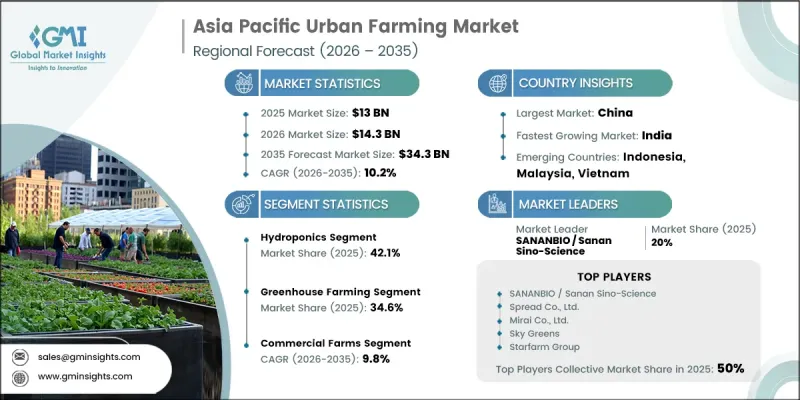
Asia Pacific Urban Farming Market was valued at USD 13 billion in 2025 and is estimated to grow at a CAGR of 10.2% to reach USD 34.3 billion by 2035.
Market growth is fueled by rapid urbanization, increasing pressure on arable land availability, and growing demand for resource-efficient agricultural practices capable of supporting densely populated regions. Controlled environment agriculture (CEA) has emerged as a critical solution for addressing food security challenges while optimizing land, water, and energy utilization. Technological advancements in cultivation systems, environmental controls, and digital farm management platforms are enabling operators to significantly improve productivity while reducing resource consumption. The industry is also benefiting from greater adoption of automation, predictive analytics, and intelligent monitoring systems that streamline operations and reduce labor requirements. While access to capital remains a challenge in several developing economies across the region, collaborative investment models involving public and private stakeholders are helping accelerate infrastructure development and market expansion. As governments and private investors continue to prioritize agricultural innovation and urban food resilience, the Asia Pacific Urban Farming Market is expected to maintain strong growth momentum throughout the forecast period.
| Market Scope | |
|---|---|
| Start Year | 2025 |
| Forecast Year | 2026-2035 |
| Start Value | $13 Billion |
| Forecast Value | $34.3 Billion |
| CAGR | 10.2% |
The hydroponics segment held a 42.1% share in 2025 and is projected to grow at a CAGR of 10.3% through 2035. The segment remains the most widely adopted cultivation technique and the most commercially established category within the market. Its leading position is supported by its flexibility across a variety of facility designs, production scales, and crop types. The ability to optimize nutrient delivery, improve resource efficiency, and support year-round cultivation continues to drive adoption among commercial operators. As urban farming projects expand across the region, hydroponic systems are expected to remain a preferred cultivation method due to their scalability and operational effectiveness.
The greenhouse farming segment accounted for 34.6% share in 2025 and is anticipated to grow at a CAGR of 9.6% through 2035. The segment remains the largest setup category by market share, primarily because it offers a comparatively accessible pathway for large-scale controlled environment agriculture deployment. Modern greenhouse facilities increasingly incorporate advanced environmental management technologies that improve growing conditions, enhance productivity, and support greater crop consistency. These operational advantages continue to strengthen the appeal of greenhouse farming among commercial agricultural operators seeking reliable and efficient production systems within urban and peri-urban environments.
China Urban Farming Market accounted for 56.7% share in 2025. Strong market growth is supported by long-term policy initiatives that prioritize agricultural modernization, technology adoption, and sustainable food production. Continued investment in urban agriculture infrastructure, innovation programs, and advanced cultivation technologies has helped establish China as the leading market within the region. Government-backed development initiatives and increasing private-sector participation are expected to further strengthen market expansion over the coming decade.
Major companies operating in the Asia Pacific Urban Farming Market include Starfarm Group, SANANBIO / Sanan Sino-Science, Sky Greens, Spread Co., Ltd., and Mirai Co., Ltd. Companies operating in the Asia Pacific Urban Farming Market are focusing on technological innovation, strategic partnerships, and infrastructure expansion to strengthen their competitive position. Investments in advanced cultivation technologies, automation systems, artificial intelligence, and data-driven farm management platforms are helping operators improve productivity and optimize resource utilization. Many companies are collaborating with government agencies, research institutions, and private investors to accelerate project development and expand operational capacity. Geographic expansion into high-growth urban centers and the establishment of large-scale controlled environment agriculture facilities remain important growth strategies.
Table of Contents
Chapter 1 Methodology and Scope
- 1.1 Market scope and definition
- 1.2 Research design
- 1.2.1 Research approach
- 1.2.2 Data collection methods
- 1.3 Data mining sources
- 1.3.1 Global
- 1.3.2 Regional/Country
- 1.4 Base estimates and calculations
- 1.4.1 Base year calculation
- 1.4.2 Key trends for market estimation
- 1.5 Primary research and validation
- 1.5.1 Primary sources
- 1.6 Forecast model
- 1.7 Research assumptions and limitations
Chapter 2 Executive Summary
- 2.1 Industry 360° synopsis
- 2.2 Key market trends
- 2.2.1 Country
- 2.2.2 Growing technique
- 2.2.3 Farm setup
- 2.2.4 Crop type
- 2.2.5 Component
- 2.2.6 End user
Chapter 3 Industry Insights
- 3.1 Industry ecosystem analysis
- 3.1.1 Supplier landscape
- 3.1.2 Profit margin
- 3.1.3 Value addition at each stage
- 3.1.4 Factor affecting the value chain
- 3.2 Industry impact forces
- 3.2.1 Growth drivers
- 3.2.1.1 Rapid urbanization & population density
- 3.2.1.2 Technological advancements
- 3.2.1.3 Rising demand for organic & local produce
- 3.2.2 Industry pitfalls & challenges
- 3.2.2.1 High capital expenditure
- 3.2.2.2 High energy consumption
- 3.2.3 Opportunities
- 3.2.3.1 Expansion of vertical farming
- 3.2.3.2 Growth in agritech ecosystem
- 3.2.1 Growth drivers
- 3.3 Growth potential analysis
- 3.4 Regulatory framework
- 3.4.1 Food safety & quality standards (FDA, EFSA, Codex Alimentarius)
- 3.4.2 Zoning & land use regulations for urban farms
- 3.4.3 Water use & environmental compliance standards
- 3.4.4 Organic certification frameworks for hydroponic/soilless produce
- 3.4.5 Government incentive programs & subsidies by country
- 3.5 Pricing analysis (driven by primary research)
- 3.5.1 Historical price trend analysis (2022-2025)
- 3.5.2 Pricing strategy by player type (premium / value / cost-plus)
- 3.6 Trade data analysis (driven by paid database)
- 3.6.1 Import/export volume & value trends - fresh produce from urban farms
- 3.6.2 Key trade corridors & tariff impact on urban farm equipment & inputs
- 3.7 Impact of AI & generative AI on the market
- 3.7.1 AI-driven disruption of existing business models
- 3.7.2 GenAI use cases & adoption roadmap by segment
- 3.7.3 Risks, limitations & regulatory considerations
- 3.8 Capacity & production landscape (driven by primary research)
- 3.8.1 Installed farm capacity by region & key commercial producer
- 3.8.2 Capacity utilization rates & expansion pipelines (announced projects 2025-2030)
Chapter 4 Competitive Landscape, 2025
- 4.1 Introduction
- 4.2 Company market share analysis
- 4.2.1 By country
- 4.2.1.1 China
- 4.2.1.2 India
- 4.2.1.3 Japan
- 4.2.1.4 South Korea
- 4.2.1.5 Australia
- 4.2.1.6 Malaysia
- 4.2.1.7 Indonesia
- 4.2.1.8 Vietnam
- 4.2.1 By country
- 4.3 Company matrix analysis
- 4.4 Competitive analysis of major market players
- 4.5 Competitive positioning matrix
- 4.6 Key developments
- 4.6.1 Mergers & acquisitions
- 4.6.2 Partnerships & collaborations
- 4.6.3 New product launches
- 4.6.4 Expansion plans
Chapter 5 Market Estimates and Forecast, By Growing Technique, 2022 - 2035 (USD Billion)
- 5.1 Key trends
- 5.2 Hydroponics
- 5.3 Aquaponics
- 5.4 Aeroponics
- 5.5 Soil-based farming
- 5.6 Others (fogponics, emerging hybrid methods)
Chapter 6 Market Estimates and Forecast, By Farm Setup, 2022 - 2035 (USD Billion)
- 6.1 Key trends
- 6.2 Vertical farming
- 6.3 Rooftop farming
- 6.4 Container farming
- 6.5 Greenhouse farming
- 6.6 Open ground/community plot
Chapter 7 Market Estimates and Forecast, By Crop Type, 2022 - 2035 (USD Billion)
- 7.1 Key trends
- 7.2 Vegetables
- 7.3 Fruits
- 7.4 Herbs & microgreens
- 7.5 Flowers & ornamentals
- 7.6 Grains & cereals
- 7.7 Others
Chapter 8 Market Estimates and Forecast, By Component, 2022 - 2035 (USD Billion)
- 8.1 Key trends
- 8.2 Lighting systems
- 8.3 Irrigation & fertigation systems
- 8.4 Climate control systems
- 8.5 Sensors & monitoring
- 8.6 Others
Chapter 9 Market Estimates and Forecast, By Distribution Channel, 2022 - 2035 (USD Billion)
- 9.1 Key trends
- 9.2 Commercial farms
- 9.3 Corporate & industrial
- 9.4 Community gardens & NGOs
- 9.5 Home/residential growers
- 9.6 Government & municipal bodies
- 9.7 Research & educational institutes
Chapter 10 Market Estimates and Forecast, By Country, 2022 - 2035 (USD Million) (Million Units)
- 10.1 Key trends
- 10.2 China
- 10.3 India
- 10.4 Japan
- 10.5 South Korea
- 10.6 Australia
- 10.7 Malaysia
- 10.8 Indonesia
- 10.9 Vietnam
Chapter 11 Company Profiles
- 11.1 Global players
- 11.1.1 Spread Co., Ltd.
- 11.1.2 Mirai Co., Ltd.
- 11.1.3 SANANBIO / Sanan Sino-Science
- 11.1.4 Sky Greens
- 11.1.5 Oishii Farm
- 11.1.6 Starfarm Group
- 11.1.7 Square Roots Japan
- 11.2 Regional players
- 11.2.1 Greenphyto
- 11.2.2 Stacked Farm
- 11.2.3 Supertani / Saturn Agtech Berhad
- 11.2.4 Archisen
- 11.2.5 Singrow
- 11.2.6 Kryzen Biotech
- 11.2.7 Eeki
- 11.3 Emerging players
- 11.3.1 InvertiGro
- 11.3.2 Grobrix
- 11.3.3 Honest Greens
- 11.3.4 Bhoomi Crop
- 11.3.5 4Climate
- 11.3.6 GRA & Green
- 11.3.7 FarmByte

