PUBLISHER: Global Market Insights Inc. | PRODUCT CODE: 2083082

PUBLISHER: Global Market Insights Inc. | PRODUCT CODE: 2083082
Premium Hair Care Market Opportunity, Growth Drivers, Industry Trend Analysis, and Forecast 2026 - 2035
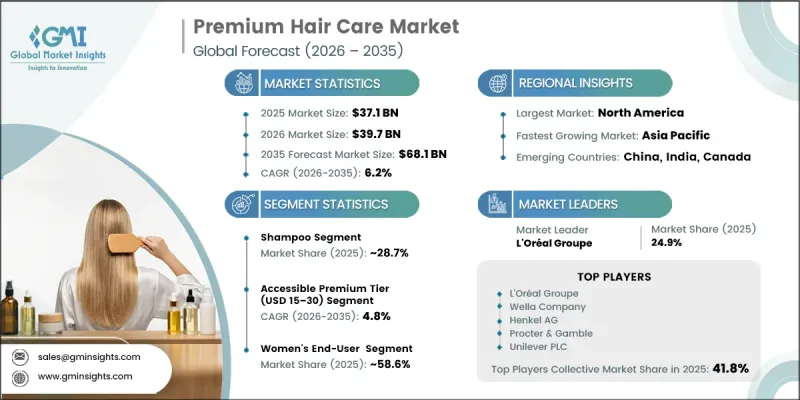
The Global Premium Hair Care Market was valued at USD 37.1 billion in 2025 and is estimated to grow at a CAGR of 6.2% to reach USD 68.1 billion by 2035.
Growth in the global premium hair care market is being fueled by rising consumer demand for high-performance hair care solutions, increasing disposable incomes, and the continued shift toward premium personal care products. Consumers are increasingly seeking formulations that offer superior ingredients, targeted benefits, and enhanced product performance, encouraging brands to expand their premium offerings across global markets. The growing popularity of clean beauty, ingredient transparency, and scientifically formulated products is further accelerating market expansion. In addition, the rapid growth of e-commerce platforms and specialty beauty retail has improved product accessibility while enabling brands to strengthen direct engagement with consumers. The expanding men's grooming category is also contributing to higher demand for premium hair care products, prompting manufacturers to diversify their product portfolios. Furthermore, increasing consumer focus on scalp health, professional-quality formulations, and personalized hair care routines continues to support long-term market growth across North America, Europe, Asia Pacific, Latin America, and the Middle East.
| Market Scope | |
|---|---|
| Start Year | 2025 |
| Forecast Year | 2026-2035 |
| Start Value | $37.1 Billion |
| Forecast Value | $68.1 Billion |
| CAGR | 6.2% |
The shampoo segment accounted for 28.7% share in 2025. Shampoo continues to dominate the market because it is the most frequently purchased product within daily hair care routines, providing brands with recurring sales opportunities and consistent consumer engagement. Growth within the premium shampoo category is being supported by increasing demand for specialized formulations that address scalp health, hair repair, and color protection while delivering enhanced performance compared with conventional products.
The accessible premium price segment, ranging from USD 15 to USD 30, held 38.1% share in 2025 and is expected to grow at a CAGR of 4.8% through 2035. This pricing category serves as the primary entry point for consumers transitioning from mass-market products to premium hair care solutions. Its broad affordability supports strong demand across both mature and emerging markets, making it the largest price segment while continuing to attract consumers seeking higher product quality without entering luxury pricing categories.
North America Premium Hair Care Market held 34.4% share, generating USD 12.8 billion in 2025, and is projected to grow at a CAGR of 4.5% through 2035, supported by high consumer spending on personal care products, a well-established specialty beauty retail network, and strong demand for innovative, premium-quality hair care solutions. Ongoing product innovation and increasing consumer preference for premium brands continue to reinforce the region's market leadership.
Major companies operating in the global premium hair care market include L'Oreal Groupe, Procter & Gamble, Unilever PLC, Henkel AG, Wella Company, Kao Corporation, Shiseido Company, Davines Group, AmorePacific Corporation, Weleda AG, Milbon Co., Ltd., LG Household & Health Care, Alfaparf Milano, Moroccanoil, Philip Kingsley Trichological, Vegamour, Prose, Act+Acre, Innersense Organic Beauty, Maria Nila, and Ceremonia. Companies operating in the premium hair care market are strengthening their market position by expanding premium product portfolios, investing in advanced ingredient research, and introducing innovative formulations that address specific hair and scalp concerns. Manufacturers are focusing on clean-label products, naturally derived ingredients, and scientifically supported formulations to meet evolving consumer preferences. Strategic investments in digital marketing, e-commerce platforms, and direct-to-consumer channels are helping brands improve customer engagement and expand global reach. Businesses are also increasing collaborations with salons, beauty professionals, and retail partners to enhance brand visibility and product credibility.
Table of Contents
Chapter 1 Research Methodology
- 1.1 Research approach
- 1.2 Quality Commitments
- 1.2.1 GMI AI policy & data integrity commitment
- 1.2.1.1 Source consistency protocol
- 1.2.1 GMI AI policy & data integrity commitment
- 1.3 Research Trail & Confidence Scoring
- 1.3.1 Research Trail Components
- 1.3.2 Scoring Components
- 1.4 Data Collection
- 1.4.1 Partial list of primary sources
- 1.5 Data mining sources
- 1.5.1 Paid sources
- 1.5.1.1 Sources, by region
- 1.5.1 Paid sources
- 1.6 Base estimates and calculations
- 1.6.1 Base year calculation for any one approach
- 1.7 Forecast model
- 1.7.1 Quantified market impact analysis
- 1.7.1.1 Mathematical impact of growth parameters on forecast
- 1.7.1 Quantified market impact analysis
- 1.8 Research transparency addendum
- 1.8.1 Source attribution framework
- 1.8.2 Quality assurance metrics
- 1.8.3 Our commitment to trust
Chapter 2 Executive Summary
- 2.1 Industry 360° synopsis, 2022 - 2035
- 2.2 Key market trends
- 2.2.1 Regional
- 2.2.2 Format type
- 2.2.3 Genre
- 2.2.4 End-User
- 2.2.5 Distribution Channel
Chapter 3 Industry Insights
- 3.1 Industry ecosystem analysis
- 3.1.1 Factor affecting the value chain
- 3.1.2 Profit margin analysis
- 3.1.3 Disruptions
- 3.1.4 Future outlook
- 3.1.5 Manufacturers
- 3.1.6 Distributors
- 3.2 Supplier landscape
- 3.3 Key news & initiatives
- 3.4 Technology & Innovation Landscape
- 3.5 Regulatory landscape
- 3.6 Impact on forces
- 3.6.1 Growth drivers
- 3.6.1.1 Rising disposable incomes increase premium hair care demand globally
- 3.6.1.2 Growing beauty consciousness boosts premium product adoption significantly
- 3.6.1.3 Expanding salon services promote premium hair care usage.
- 3.6.2 Industry pitfalls & challenges
- 3.6.2.1 High product pricing limits mass-market premium adoption globally
- 3.6.2.2 Intense competition increases brand differentiation challenges significantly
- 3.6.3 Opportunities
- 3.6.3.1 Smart packaging technologies create advanced machine upgrade opportunities
- 3.6.3.2 Sustainable packaging innovation supports eco-friendly machinery demand regionally.
- 3.6.1 Growth drivers
- 3.7 Porter's analysis
- 3.8 PESTEL analysis
- 3.9 Pricing analysis (driven by primary research)
- 3.9.1 Pricing analysis (driven by primary research)
- 3.9.2 Pricing architecture within the premium tier, accessible premium, mid-premium & prestige
- 3.9.3 Regional price variation for premium hair care - DACH, Middle East & Asia Pacific
- 3.9.4 Price elasticity & consumer willingness-to-pay within the premium tier
- 3.9.5 Historical price trend analysis within premium hair care, 2019-2025 (driven by primary research)
- 3.9.6 Pricing strategy by player type - natural heritage vs. clinical vs. salon prestige vs. biotech (driven by primary research)
- 3.10 Trade data analysis (driven by paid database)
- 3.10.1 Import & export volume & value trends - premium hair care products by HS code (driven by paid database)
- 3.10.2 Key trade corridors & tariff impact - Switzerland to DACH, Middle East & Asia Pacific (driven by paid database)
- 3.11 Impact of AI & generative AI on the market
- 3.11.1 AI-driven disruption - personalized scalp diagnostics, hair analysis tools & digital consultation platforms
- 3.11.2 GenAI use cases & adoption roadmap - virtual consultation, personalized regimen recommendation & ingredient transparency assistants
- 3.12 Distribution infrastructure & channel penetration landscape (driven by primary research)
- 3.12.1 Channel coverage by geography & format - pharmacy, specialty beauty retail, department store, e-commerce, salon & health & organic specialty (driven by primary research)
- 3.12.2 Last-mile infrastructure gaps & emerging channel shifts in premium hair care [focus: shopping channels] (driven by primary research)
- 3.12.3 E-commerce & D2C infrastructure penetration rate by market
- 3.12.4 Social commerce emergence & platform readiness for premium hair care
- 3.12.5 Salon & professional channel as a premium discovery & distribution route
Chapter 4 Competitive Landscape, 2025
- 4.1 Introduction
- 4.2 Company market share analysis
- 4.3 Competitive positioning matrix
- 4.4 Strategic outlook matrix
- 4.5 Competitive analysis of major market players
- 4.6 Key developments
- 4.6.1 Mergers & acquisitions
- 4.6.2 Partnerships & collaborations
- 4.6.3 New product launches
- 4.6.4 Expansion plans
Chapter 5 Market Estimates & Forecast, By Product Type, 2022-2035 (USD Billion) (Million Units)
- 5.1 Key trends
- 5.2 Shampoo
- 5.2.1 Scalp-Specific Shampoo
- 5.2.2 Anti-Hair Loss Shampoo
- 5.2.3 Repair & Strengthening Shampoo
- 5.2.4 Anti-Pollution & Environmental Protection Shampoo
- 5.3 Conditioner, Mask & Treatment
- 5.3.1 Rinse-out & Leave-in
- 5.3.2 Deep & Intensive Treatment
- 5.3.3 Color Protection Treatment Mask
- 5.4 Scalp Care Products
- 5.4.1 Scalp Tonic & Activating Serum
- 5.4.2 Scalp Intensive Fluid & Ampoule
- 5.4.3 Scalp Peel & Exfoliant
- 5.5 Hair Oil & Finishing Serum
- 5.5.1 Pre-Wash Treatment Oil
- 5.5.2 Finishing & Shine Serum
- 5.6 Premium Hair Styling Products
- 5.6.1 Cream & Leave-In Styler
- 5.6.2 Mousse & Foam
- 5.6.3 Finishing & Heat Protection Spray
- 5.7 Sun & Heat Protection
- 5.7.1 UV & Solar Hair Protector
- 5.7.2 Heat Defense & Thermal Protection Products
Chapter 6 Market Estimates & Forecast, By Hair & Scalp Concern, 2022-2035 (USD Billion) (Million Units)
- 6.1 Key trends
- 6.2 Hair Loss & Thinning
- 6.2.1 Caffeine & Botanical Actives-Based Anti-Hair Loss
- 6.2.2 Clinical & Dermo-Cosmetic Anti-Hair Loss
- 6.3 Scalp Health
- 6.3.1 Sensitive Scalp
- 6.3.2 Dandruff
- 6.3.3 Scalp Oiliness & Sebum Control
- 6.3.4 Scalp Dryness & Dehydration
- 6.3.5 Scalp Microbiome Balance & Probiotic-Enriched Care
- 6.4 Hair Damage & Repair
- 6.4.1 Breakage & Brittleness
- 6.4.2 Structural Restoration & Porosity Correction
- 6.5 Color & Chemical Treatment Care
- 6.5.1 Color Fade Prevention & Vibrancy Maintenance
- 6.5.2 Bleach & Chemical Damage Recovery
- 6.6 Environmental & Pollution Stress Protection
- 6.6.1 Anti-Pollution & Particulate Shield
- 6.6.2 Hard Water & Mineral Buildup Protection
- 6.7 Sun & UV Damage Protection
Chapter 7 Market Estimates & Forecast, By Price Tier, 2022-2035 (USD Billion) (Million Units)
- 7.1 Key trends
- 7.2 Accessible Premium (USD 15-30)
- 7.3 Mid-Premium (USD 30-60)
- 7.4 Prestige & Ultra-Luxury (Above USD 60)
Chapter 8 Market Estimates & Forecast, By Formulation, 2022-2035 (USD Billion) (Million Units)
- 8.1 Key trends
- 8.2 Natural and Botanical
- 8.2.1 Proprietary Herbal Extract Formulations
- 8.2.2 Vegan & Cruelty-Free Natural Formulations
- 8.2.3 Upcycled & Sustainably Sourced Ingredient Formulations
- 8.3 Certified Organic
- 8.3.1 COSMOS & NATRUE Certified Premium Formulations
- 8.3.2 BDIH & National Certification Body Equivalents
- 8.4 Clinical and Dermo-Cosmetic
- 8.4.1 Scalp-Specialist Clinical Formulations
- 8.4.2 Dermo-Cosmetic Bridge Formulations
- 8.5 Biotech & Advanced Science
- 8.5.1 Biomimetic & Peptide-Based Formulations
- 8.5.2 Biofermentation & Encapsulation Technology
Chapter 9 Market Estimates & Forecast, By End User, 2022-2035 (USD Billion) (Million Units)
- 9.1 Key trends
- 9.2 Women
- 9.3 Men
- 9.4 Unisex
Chapter 10 Market Estimates & Forecast, By Price Tier, 2022-2035 (USD Billion) (Million Units)
- 10.1 Key trends
- 10.2 Accessible Premium (USD 15-30)
- 10.3 Mid-Premium (USD 30-60)
- 10.4 Prestige & Ultra-Luxury (Above USD 60)
Chapter 11 Market Estimates & Forecast, By Region, 2022 - 2035, (USD Billion) (Million Units)
- 11.1 Key trends
- 11.2 North America
- 11.2.1 U.S.
- 11.2.2 Canada
- 11.3 Europe
- 11.3.1 Germany
- 11.3.2 U.K.
- 11.3.3 France
- 11.3.4 Italy
- 11.3.5 Spain
- 11.4 Asia Pacific
- 11.4.1 China
- 11.4.2 India
- 11.4.3 Japan
- 11.4.4 South Korea
- 11.4.5 Australia
- 11.5 Latin America
- 11.5.1 Brazil
- 11.5.2 Mexico
- 11.5.3 Argentina
- 11.6 MEA
- 11.6.1 UAE
- 11.6.2 Saudi Arabia
- 11.6.3 South Africa
Chapter 12 Company Profiles
- 12.1 Global players
- 12.1.1 L'Oreal Groupe
- 12.1.2 Procter & Gamble
- 12.1.3 Unilever PLC
- 12.1.4 Henkel AG
- 12.1.5 Wella Company
- 12.1.6 Kao Corporation
- 12.1.7 Shiseido Company
- 12.2 Regional players
- 12.2.1 Davines Group
- 12.2.2 Weleda AG
- 12.2.3 AmorePacific Corporation
- 12.2.4 Milbon Co., Ltd.
- 12.2.5 Alfaparf Milano
- 12.2.6 LG Household & Health Care
- 12.2.7 Moroccanoil
- 12.3 Emerging players
- 12.3.1 Act+Acre
- 12.3.2 Philip Kingsley Trichological
- 12.3.3 Vegamour
- 12.3.4 Prose
- 12.3.5 Innersense Organic Beauty
- 12.3.6 Maria Nila
- 12.3.7 Ceremonia

