PUBLISHER: Global Market Insights Inc. | PRODUCT CODE: 2083101

PUBLISHER: Global Market Insights Inc. | PRODUCT CODE: 2083101
North America Sustainable Cookware Market Opportunity, Growth Drivers, Industry Trend Analysis, and Forecast 2026 - 2035
North America Sustainable Cookware Market was valued at USD 4.4 billion in 2025 and is estimated to grow at a CAGR of 5.2% to reach USD 7.3 billion by 2035.
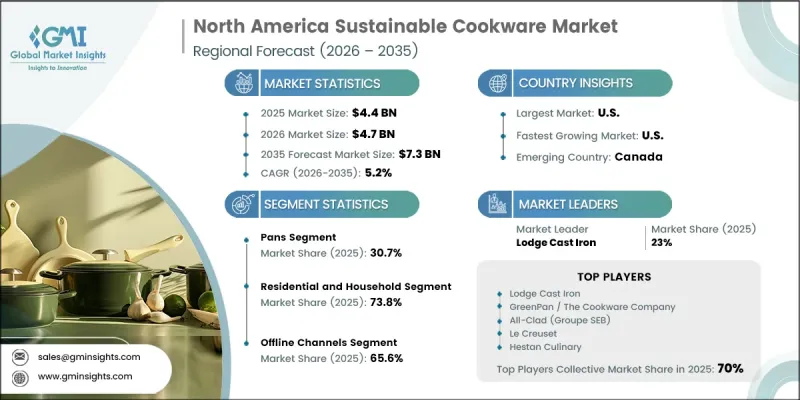
This growth reflects a long-term shift in cookware purchasing patterns, driven by rising awareness of sustainable materials, increasing demand for chemical-free cooking solutions, and a stronger focus on product transparency. Growing regulatory scrutiny surrounding per- and polyfluoroalkyl substances (PFAS) used in traditional cookware coatings has accelerated the movement toward alternative materials. At the same time, higher Home cooking participation across the US and Canada continues to support replacement and upgrade demand. Sustainable cookware products, particularly PFAS-free and responsibly manufactured options, are gaining wider acceptance across premium and mainstream retail channels as consumers increasingly evaluate durability, safety, and environmental impact before making purchases. The identification of PFAS-related concerns in conventional non-stick cookware, including polytetrafluoroethylene (PTFE) coatings and related production materials, has contributed to noticeable changes in consumer buying decisions throughout North America.
| Market Scope | |
|---|---|
| Start Year | 2025 |
| Forecast Year | 2026-2035 |
| Start Value | $4.4 Billion |
| Forecast Value | $7.3 Billion |
| CAGR | 5.2% |
The pans segment held 30.7% share in 2025. This strong performance is linked to the widespread use of frying pans and similar cookware formats in residential kitchens. As consumers move away from traditional PTFE-coated products, demand for ceramic-coated and other sustainable pan alternatives is influencing product innovation, pricing strategies, and retail offerings.
The residential and household segment generated 73.8% share in 2025 and is anticipated to grow at a CAGR of 5.1%. Household demand is primarily supported by replacement purchases, which remain the main reason consumers buy new cookware in the US market. However, upgrade-focused purchases are also increasing, with 19% of IHA-surveyed consumers identifying enhanced features such as induction compatibility and PFAS-free coatings as key factors influencing their cookware selection.
United States Sustainable Cookware Market held an 87.8% share in 2025, supported by evolving regulatory frameworks and growing consumer awareness. Actions taken by regulatory authorities, including the FDA's January 2025 decision that 35 FCNs associated with PFAS-containing food contact substances were no longer effective, have further encouraged manufacturers to accelerate reformulation efforts and adopt safer cookware technologies across their product portfolios.
Key players operating in the North America sustainable cookware market are Lodge Cast Iron, GreenPan / The Cookware Company, All-Clad (Groupe SEB), Le Creuset, Hestan Culinary, Paderno (Padinox Inc.), Heritage Steel, Field Company, Smithey Ironware, 360 Cookware, Lancaster Cast Iron, Stargazer Cast Iron, Austin Foundry Cookware, GOSO Cookware, and Strata Cookware. Companies operating in the North America sustainable cookware market are focusing on product innovation, material advancement, sustainable manufacturing practices, and stronger retail partnerships to improve their competitive position. Leading brands are investing in PFAS-free coating technologies, expanding cast iron and stainless-steel product lines, improving durability, and introducing cookware designed for modern cooking preferences, such as induction compatibility. Companies are also strengthening their market presence through direct-to-consumer platforms, premium product launches, brand collaborations, and sustainability-focused marketing campaigns. These strategies help businesses respond to changing consumer expectations while building long-term customer loyalty in an increasingly competitive market.
Table of Contents
Chapter 1 Methodology and Scope
- 1.1 Market scope and definition
- 1.2 Research design
- 1.2.1 Research approach
- 1.2.2 Data collection methods
- 1.3 Data mining sources
- 1.3.1 Global
- 1.3.2 Regional/Country
- 1.4 Base estimates and calculations
- 1.4.1 Base year calculation
- 1.4.2 Key trends for market estimation
- 1.5 Primary research and validation
- 1.5.1 Primary sources
- 1.6 Forecast model
- 1.7 Research assumptions and limitations
Chapter 2 Executive Summary
- 2.1 Industry 360° synopsis
- 2.2 Key market trends
- 2.2.1 Country
- 2.2.2 Product type
- 2.2.3 Material
- 2.2.4 Coating type
- 2.2.5 End user
- 2.2.6 Distribution channel
Chapter 3 Industry Insights
- 3.1 Industry ecosystem analysis
- 3.1.1 Supplier landscape
- 3.1.2 Profit margin
- 3.1.3 Value addition at each stage
- 3.1.4 Factor affecting the value chain
- 3.2 Industry impact forces
- 3.2.1 Growth drivers
- 3.2.1.1 Health & safety-driven consumption
- 3.2.1.2 Home cooking culture
- 3.2.1.3 Environmental awareness & conscious consumption
- 3.2.2 Industry pitfalls & challenges
- 3.2.2.1 High price
- 3.2.2.2 Greenwashing & consumer skepticism
- 3.2.3 Opportunities
- 3.2.3.1 Next-gen non-toxic materials
- 3.2.3.2 Smart & energy-efficient cookware
- 3.2.1 Growth drivers
- 3.3 Growth potential analysis
- 3.4 Regulatory framework
- 3.4.1 US PFAS cookware regulations (EPA, State-by-State Bans - MN, NY, CA, CO)
- 3.4.2 FDA 21 CFR 175.300 - indirect food additive safety compliance
- 3.4.3 Cookware & bakeware alliance (CBA) engineering standards
- 3.4.4 AHAM 7004-2017 sustainability standard for cooking appliances
- 3.4.5 ISO/TC 285 clean cookstoves & clean cooking solutions
- 3.4.6 Eco-label & green certification landscape (TUV Rheinland Green Mark, NSF)
- 3.5 Pricing analysis (driven by primary research)
- 3.5.1 Historical price trend analysis (2022-2025)
- 3.5.2 Pricing strategy by player type (premium / value / cost-plus)
- 3.6 Trade data analysis (driven by paid database)
- 3.6.1 Import/export volume & value trends
- 3.6.2 Key trade corridors & tariff impact
- 3.7 Impact of AI & generative AI on the market
- 3.7.1 AI-driven disruption of existing business models
- 3.7.2 GenAI use cases & adoption roadmap by segment (personalized shade matching, virtual try-on)
- 3.7.3 Risks, limitations & regulatory considerations
- 3.8 Distribution infrastructure & channel penetration landscape (driven by primary research)
- 3.8.1 Channel coverage by region & format (modern vs. Traditional trade)
- 3.8.2 Last-mile infrastructure gaps & emerging channel shifts
Chapter 4 Competitive Landscape, 2025
- 4.1 Introduction
- 4.2 Company market share analysis
- 4.2.1 By countries
- 4.2.1.1 U.S.
- 4.2.1.2 Canada
- 4.2.1 By countries
- 4.3 Company matrix analysis
- 4.4 Competitive analysis of major market players
- 4.5 Competitive positioning matrix
- 4.6 Key developments
- 4.6.1 Mergers & acquisitions
- 4.6.2 Partnerships & collaborations
- 4.6.3 New product launches
- 4.6.4 Expansion plans
Chapter 5 Market Estimates and Forecast, By Product Type, 2022 - 2035 (USD Billion) (Thousand Units)
- 5.1 Key trends
- 5.2 Pots
- 5.3 Pans
- 5.4 Bakeware
- 5.5 Pressure cookers & steamers
- 5.6 Specialty cookware
- 5.7 Cookware sets
Chapter 6 Market Estimates and Forecast, By Material, 2022 - 2035 (USD Billion) (Thousand Units)
- 6.1 Key trends
- 6.2 Stainless steel
- 6.3 Cast iron
- 6.4 Carbon steel
- 6.5 Copper
- 6.6 Hard-anodized aluminum
- 6.7 Pure / solid ceramic
- 6.8 Wood & bamboo
- 6.9 Others
Chapter 7 Market Estimates and Forecast, By Coating Type, 2022 - 2035 (USD Billion) (Thousand Units)
- 7.1 Key trends
- 7.2 Uncoated / bare
- 7.3 Pfas-free ceramic coating
- 7.4 Enamel coating (porcelain / vitreous)
- 7.5 Hard-anodized surface finish
- 7.6 Diamond-reinforced (PFAS-free)
- 7.7 Titanium-reinforced (PFAS-free)
- 7.8 Others (plasma/hybrid eco-coatings, bio-based surface treatments)
Chapter 8 Market Estimates and Forecast, By End User, 2022 - 2035 (USD Billion) (Thousand Units)
- 8.1 Key trends
- 8.2 Residential / Household
- 8.3 Commercial
- 8.4 Institutional
Chapter 9 Market Estimates and Forecast, By Distribution Channel, 2022 - 2035 (USD Billion) (Thousand Units)
- 9.1 Key trends
- 9.2 Online
- 9.2.1 E-commerce websites
- 9.2.2 Brand websites
- 9.3 Offline
- 9.3.1 Supermarkets & hypermarkets
- 9.3.2 Home improvement & kitchen specialty chains
- 9.3.3 Department stores
- 9.3.4 Others
Chapter 10 Market Estimates and Forecast, By Country, 2022 - 2035 (USD Million) (Million Units)
- 10.1 Key trends
- 10.2 U.S.
- 10.3 Canada
Chapter 11 Company Profiles
- 11.1 Global players
- 11.1.1 Lodge Cast Iron
- 11.1.2 All-Clad (Groupe SEB)
- 11.1.3 GreenPan / The Cookware Company
- 11.1.4 Le Creuset
- 11.1.5 Hestan Culinary
- 11.2 Regional players
- 11.2.1 Paderno (Padinox Inc.)
- 11.2.2 Heritage Steel
- 11.2.3 Field Company
- 11.2.4 Smithey Ironware
- 11.2.5 360 Cookware
- 11.3 Emerging players
- 11.3.1 Lancaster Cast Iron
- 11.3.2 Stargazer Cast Iron
- 11.3.3 Austin Foundry Cookware
- 11.3.4 GOSO Cookware
- 11.3.5 Strata Cookware

