PUBLISHER: Global Market Insights Inc. | PRODUCT CODE: 2083109

PUBLISHER: Global Market Insights Inc. | PRODUCT CODE: 2083109
North America Sustainable Packaging for E-commerce Market Opportunity, Growth Drivers, Industry Trend Analysis, and Forecast 2026 - 2035
North America Sustainable Packaging for E-Commerce Market was valued at USD 12.63 billion in 2025 and is estimated to grow at a CAGR of 6.6% to reach USD 24.11 billion in 2035.
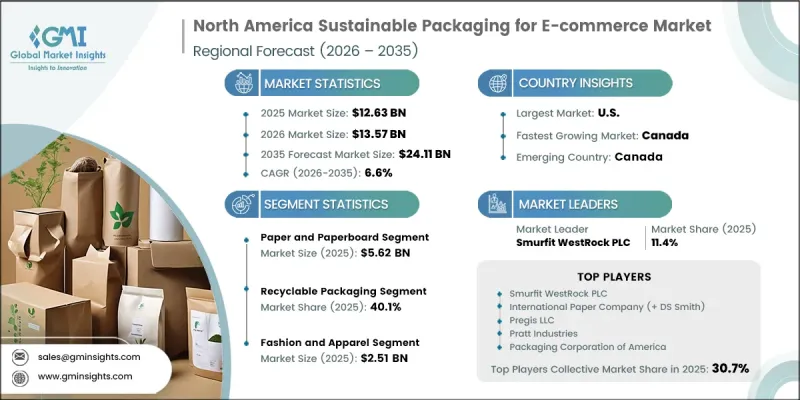
The North America sustainable packaging for e-commerce market is experiencing strong expansion as environmental compliance requirements, shifting consumer preferences, and the rapid growth of online retail reshape packaging demand across the region. Increasing pressure on businesses to reduce environmental impact is driving a transition away from traditional single-use packaging toward more sustainable alternatives across multiple material categories. Regulatory frameworks and sustainability commitments are pushing companies to adopt packaging solutions that improve recyclability, reduce material usage, and support circular economy goals. At the same time, e-commerce expansion across key retail sectors is significantly increasing packaging volumes, reinforcing the need for scalable and eco-friendly packaging systems. Consumer awareness regarding waste reduction and environmentally responsible brands is also influencing purchasing decisions, prompting retailers to redesign packaging strategies. Growing attention to municipal waste challenges and corporate sustainability reporting is further accelerating adoption. As digital commerce continues to grow, packaging innovation focused on renewable materials, efficient logistics, and reduced environmental footprint is expected to remain a central priority across North America's e-commerce ecosystem, supporting long-term market expansion.
| Market Scope | |
|---|---|
| Start Year | 2025 |
| Forecast Year | 2026-2035 |
| Start Value | $12.63 Billion |
| Forecast Value | $24.11 Billion |
| CAGR | 6.6% |
In 2025, the paper and paperboard segment held 44.5% share in 2025. The segment continues to dominate due to its strong compatibility with e-commerce logistics, protective performance, and widespread recyclability across established waste management systems. Its suitability for automated packaging operations and strong structural integrity for product protection further support its leading position in the market.
The recyclable packaging segment 40.1% share, generating USD 5.06 billion in 2025. The segment benefits from strong alignment with existing recycling systems and growing corporate focus on circular packaging models. Increasing preference for materials that can be efficiently recovered and reprocessed continues to reinforce demand across high-volume e-commerce operations.
U.S. Sustainable Packaging for E-Commerce Market accounted for 88.1% share in 2025. The country's dominance is supported by rapid expansion in online retail activity and strong adoption of sustainable packaging practices across major consumer sectors. Rising digital commerce penetration across retail categories continues to accelerate demand for eco-friendly packaging solutions and reinforces the country's leading position in the regional market.
Major companies operating in the North America sustainable packaging for e-commerce industry include Amcor PLC, Smurfit WestRock PLC, International Paper Company, Sealed Air Corporation, Graphic Packaging International, Sonoco Products Company, Huhtamaki Oyj, Packaging Corporation of America, Pratt Industries, Ranpak Holdings Corporation, Pregis LLC, Cascades Inc., Georgia-Pacific LLC, UFP Technologies, EcoEnclose LLC, Footprint, EcoPackables, Returnity Innovations, TemperPack, Salazar Packaging, and Elevate Packaging Inc. Companies operating in the North America sustainable packaging for e-commerce market are strengthening their competitive position through continuous investment in eco-friendly material innovation, lightweight packaging design, and circular economy-based solutions. Market participants are expanding production capabilities while focusing on improving recyclability, compostability, and material efficiency to meet regulatory requirements and sustainability targets. Businesses are also strengthening partnerships with e-commerce retailers and logistics providers to enhance supply chain integration and improve packaging performance across distribution networks.
Table of Contents
Chapter 1 Research Methodology
- 1.1 Research approach
- 1.2 Quality Commitments
- 1.2.1 GMI AI policy & data integrity commitment
- 1.2.1.1 Source consistency protocol
- 1.2.1 GMI AI policy & data integrity commitment
- 1.3 Research Trail & Confidence Scoring
- 1.3.1 Research Trail Components
- 1.3.2 Scoring Components
- 1.4 Data Collection
- 1.4.1 Partial list of primary sources
- 1.5 Data mining sources
- 1.5.1 Paid sources
- 1.5.1.1 Sources, by region
- 1.5.1 Paid sources
- 1.6 Base estimates and calculations
- 1.6.1 Base year calculation for any one approach
- 1.7 Forecast model
- 1.7.1 Quantified market impact analysis
- 1.7.1.1 Mathematical impact of growth parameters on forecast
- 1.7.1 Quantified market impact analysis
- 1.8 Research transparency addendum
- 1.8.1 Source attribution framework
- 1.8.2 Quality assurance metrics
- 1.8.3 Our commitment to trust
Chapter 2 Executive Summary
- 2.1 Industry 360° synopsis, 2022 - 2035
- 2.2 Key market trends
- 2.2.1 Country
- 2.2.2 Material Type
- 2.2.3 Packaging Format
- 2.2.4 Sustainability Attribute
- 2.2.5 End-Use Industry
Chapter 3 Industry Insights
- 3.1 Industry ecosystem analysis
- 3.1.1 Factor affecting the value chain
- 3.1.2 Profit margin analysis
- 3.1.3 Disruptions
- 3.1.4 Future outlook
- 3.1.5 Manufacturers
- 3.1.6 Distributors
- 3.2 Supplier landscape
- 3.3 Key news & initiatives
- 3.4 Technology & Innovation Landscape
- 3.5 Regulatory landscape
- 3.6 Impact on forces
- 3.6.1 Growth drivers
- 3.6.1.1 Rising environmental awareness increases sustainable e-commerce packaging demand.
- 3.6.1.2 Expanding e-commerce industry boosts sustainable packaging adoption.
- 3.6.1.3 Government regulations encourage environmentally friendly packaging material usage.
- 3.6.2 Industry pitfalls & challenges
- 3.6.2.1 High sustainable material costs limit widespread packaging adoption
- 3.6.2.2 Limited recycling infrastructure affects packaging waste management efficiency.
- 3.6.3 Opportunities
- 3.6.3.1 Innovation in biodegradable materials creates packaging growth opportunities.
- 3.6.3.2 Smart packaging technologies enhance sustainable shipping efficiency.
- 3.6.1 Growth drivers
- 3.7 Porter's analysis
- 3.8 PESTEL analysis
- 3.9 Pricing analysis (driven by primary research)
- 3.9.1 Historical price trend analysis (sustainable vs. conventional packaging substrates) (driven by primary research)
- 3.9.2 Pricing strategy by player type (premium sustainable-only / value hybrid / cost-plus mainstream) (driven by primary research)
- 3.10 Impact of AI & generative AI on the market
- 3.10.1 AI-driven disruption of existing business models (right-sizing, waste reduction, demand forecasting)
- 3.10.2 GenAI use cases & adoption roadmap by segment (structural design, material selection, custom print)
- 3.10.3 Risks, limitations & regulatory considerations for AI in packaging
- 3.11 Capacity & production landscape (driven by primary research)
- 3.11.1 Installed capacity by region & key producer (corrugated, molded fiber, bioplastic film) (driven by primary research)
- 3.11.2 Capacity utilization rates & expansion pipelines (greenfield & brownfield investments) (driven by primary research)
Chapter 4 Competitive Landscape, 2025
- 4.1 Introduction
- 4.2 Company market share analysis
- 4.3 Competitive positioning matrix
- 4.4 Strategic outlook matrix
- 4.5 Competitive analysis of major market players
- 4.6 Key developments
- 4.6.1 Mergers & acquisitions
- 4.6.2 Partnerships & collaborations
- 4.6.3 New product launches
- 4.6.4 Expansion plans
Chapter 5 Market Estimates & Forecast, By Material Type, 2022-2035 (USD Billion) (Million Units)
- 5.1 Key trends
- 5.2 Paper & paperboard
- 5.3 Bioplastics & compostable polymers
- 5.4 Recycled plastics
- 5.5 Metal
- 5.6 Others
Chapter 6 Market Estimates & Forecast, By Packaging Format, 2022-2035 (USD Billion) (Million Units)
- 6.1 Key trends
- 6.2 Corrugated boxes & cartons
- 6.3 Mailers & envelopes
- 6.4 Protective & void-fill packaging
- 6.5 Bags & pouches
- 6.6 Tapes, labels & sealing materials
- 6.7 Others
Chapter 7 Market Estimates & Forecast, By Sustainability Attribute, 2022-2035 (USD Billion) (Million Units)
- 7.1 Key trends
- 7.2 Recyclable packaging
- 7.3 Biodegradable & compostable packaging
- 7.4 Reusable packaging
- 7.5 Recycled-content packaging
Chapter 8 Market Estimates & Forecast, By End-Use Industry, 2022-2035 (USD Billion) (Million Units)
- 8.1 Key trends
- 8.2 Fashion & apparel
- 8.3 Consumer electronics
- 8.4 Food & beverage
- 8.5 Beauty & personal care
- 8.6 Pharmaceuticals & health
- 8.7 Home & furniture
- 8.8 Others
Chapter 9 Market Estimates & Forecast, By Country, 2022 - 2035, (USD Billion) (Million Units)
- 9.1 Key trends
- 9.2 U.S.
- 9.3 Canada
Chapter 10 Company Profiles
- 10.1 Global players
- 10.1.1 Amcor PLC
- 10.1.2 Smurfit WestRock PLC
- 10.1.3 International Paper Company
- 10.1.4 Sealed Air Corporation
- 10.1.5 Graphic Packaging International
- 10.1.6 Sonoco Products Company
- 10.1.7 Huhtamaki Oyj
- 10.2 Regional players
- 10.2.1 Packaging Corporation of America
- 10.2.2 Pratt Industries
- 10.2.3 Ranpak Holdings Corporation
- 10.2.4 Pregis LLC
- 10.2.5 Cascades Inc.
- 10.2.6 Georgia-Pacific LLC
- 10.2.7 UFP Technologies
- 10.3 Emerging players
- 10.3.1 EcoEnclose LLC
- 10.3.2 Footprint
- 10.3.3 EcoPackables
- 10.3.4 Returnity Innovations
- 10.3.5 TemperPack
- 10.3.6 Salazar Packaging
- 10.3.7 Elevate Packaging Inc.

