
PUBLISHER: Global Market Insights Inc. | PRODUCT CODE: 2083110

PUBLISHER: Global Market Insights Inc. | PRODUCT CODE: 2083110
Spice Adulteration Testing Market Opportunity, Growth Drivers, Industry Trend Analysis, and Forecast 2026 - 2035
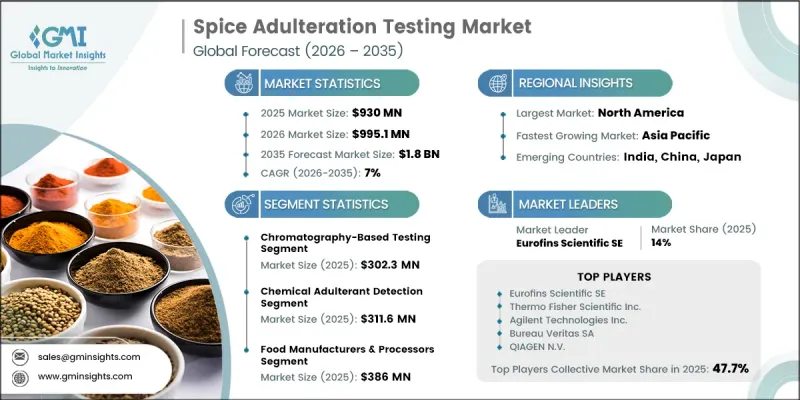
The Global Spice Adulteration Testing Market was valued at USD 930 million in 2025 and is estimated to grow at a CAGR of 7% to reach USD 1.8 billion by 2035.
Spice adulteration testing involves the scientific analysis of spice products to identify, verify, and quantify the presence of unauthorized materials, contaminants, or quality-compromising substances that may affect product integrity and regulatory compliance. Testing procedures utilize a range of advanced analytical techniques designed to evaluate product authenticity, composition, and safety throughout the supply chain, from sourcing and processing to distribution and final commercialization. Growing international trade in spices, coupled with the persistent economic motivation for product manipulation within global supply chains, continues to support demand for testing services. As product authenticity becomes increasingly important to manufacturers, regulators, and consumers, laboratory-based verification has emerged as a critical component of quality assurance programs. Technological progress has further accelerated market development by improving analytical accuracy, detection sensitivity, and operational efficiency. Modern testing platforms now provide faster turnaround times, enhanced traceability capabilities, and broader screening functionality, enabling stakeholders to address evolving quality standards while strengthening confidence in global spice supply networks.
| Market Scope | |
|---|---|
| Start Year | 2025 |
| Forecast Year | 2026-2035 |
| Start Value | $930 Million |
| Forecast Value | $1.8 Billion |
| CAGR | 7% |
The chromatography-based testing segment generated USD 302.3 million in 2025. This testing approach remains the benchmark analytical methodology for detecting and quantifying chemical adulterants across international regulatory frameworks. Its widespread adoption is supported by its high level of precision, reliability, sensitivity, and acceptance among regulatory authorities, making it a preferred solution for compliance-focused testing programs and comprehensive contaminant analysis.
The food manufacturers and processors segment accounted for USD 386 million in 2025. Their leading position is driven by stringent food safety obligations, extensive quality assurance requirements, and the need to protect product reputation within highly competitive markets. Routine testing has become an essential operational practice for companies involved in food production and ingredient sourcing, ensuring product authenticity, regulatory compliance, and supply chain integrity across domestic and international operations.
North America Spice Adulteration Testing Market is anticipated to reach USD 558 million by 2035. The region maintains the largest market share due to its comprehensive food safety framework, rigorous enforcement mechanisms, and widespread adoption of testing procedures throughout food manufacturing and import channels. Regulatory requirements mandate extensive verification and quality assessment processes, creating sustained demand for laboratory testing services. Continued expansion of food processing activities, increasing import monitoring efforts, and ongoing regulatory oversight are expected to further support market growth across North America during the forecast period.
Key companies operating in the Global Spice Adulteration Testing Market include SGS SA, Thermo Fisher Scientific Inc., Eurofins Scientific SE, Agilent Technologies Inc., Intertek Group plc, Bureau Veritas SA, QIAGEN N.V., TUV Rheinland Group, Merieux NutriSciences Corporation, Bio-Rad Laboratories Inc., Authen Technologies, and Genon Laboratories Ltd. Companies participating in the Spice Adulteration Testing Market are implementing a variety of strategic initiatives to strengthen their competitive position and expand their market presence. Investment in advanced analytical technologies remains a primary focus, enabling laboratories to improve testing accuracy, detection capabilities, and operational efficiency. Many organizations are expanding laboratory networks and increasing geographic coverage to better serve global food manufacturers, importers, and regulatory agencies. Strategic collaborations with food producers, supply chain stakeholders, and research institutions are helping companies enhance service offerings and accelerate innovation.
Table of Contents
Chapter 1 Methodology & Scope
- 1.1 Market scope and definition
- 1.2 Research design
- 1.2.1 Research approach
- 1.2.2 Data collection methods
- 1.3 Data mining sources
- 1.3.1 Global
- 1.3.2 Regional/Country
- 1.4 Base estimates and calculations
- 1.4.1 Base year calculation
- 1.4.2 Key trends for market estimation
- 1.5 Primary research and validation
- 1.5.1 Primary sources
- 1.6 Forecast model
- 1.7 Research assumptions and limitations
Chapter 2 Executive Summary
- 2.1 Industry 360° synopsis
- 2.2 Key market trends
- 2.2.1 Testing Technology
- 2.2.2 Adulteration Type
- 2.2.3 Spice Type
- 2.2.4 End User
- 2.2.5 Regional
- 2.3 TAM Analysis, 2026-2035
- 2.4 CXO perspectives: Strategic imperatives
- 2.5 Future outlook and strategic recommendations
Chapter 3 Industry Insights
- 3.1 Industry ecosystem analysis
- 3.1.1 Supplier landscape
- 3.1.2 Profit margin
- 3.1.3 Value addition at each stage
- 3.1.4 Factor affecting the value chain
- 3.1.5 Disruptions
- 3.2 Industry impact forces
- 3.2.1 Growth drivers
- 3.2.1.1 Rising concerns over food safety and adulteration
- 3.2.1.2 Stringent regulatory standards for food quality
- 3.2.1.3 Growing global spice trade and supply chain complexity
- 3.2.2 Industry pitfalls and challenges
- 3.2.2.1 High cost of advanced testing technologies
- 3.2.2.2 Limited access in developing regions
- 3.2.3 Market opportunities
- 3.2.3.1 Expansion of portable testing devices in producer-country markets
- 3.2.3.2 Growth of e-commerce spice trade increasing traceability demands
- 3.2.1 Growth drivers
- 3.3 Growth potential analysis
- 3.4 Regulatory landscape
- 3.4.1 North America
- 3.4.2 Europe
- 3.4.3 Asia Pacific
- 3.4.4 Latin America
- 3.4.5 Middle East & Africa
- 3.5 Porter's analysis
- 3.6 PESTEL analysis
- 3.7 Technology and innovation landscape
- 3.7.1 Current technological trends
- 3.7.2 Emerging technologies
- 3.8 Price trends
- 3.8.1 By region
- 3.8.2 By spice type
- 3.9 Future market trends
- 3.10 Patent landscape
- 3.11 Trade statistics (HS code)
- 3.11.1 Major importing countries
- 3.11.2 Major exporting countries
- 3.12 Sustainability and environmental aspects
- 3.12.1 Sustainable practices
- 3.12.2 Waste reduction strategies
- 3.12.3 Energy efficiency in production
- 3.12.4 Eco-friendly initiatives
- 3.13 Carbon footprint consideration
Chapter 4 Competitive Landscape, 2025
- 4.1 Introduction
- 4.2 Company market share analysis
- 4.2.1 By region
- 4.2.1.1 North America
- 4.2.1.2 Europe
- 4.2.1.3 Asia Pacific
- 4.2.1.4 LATAM
- 4.2.1.5 MEA
- 4.2.1 By region
- 4.3 Company matrix analysis
- 4.4 Competitive analysis of major market players
- 4.5 Competitive positioning matrix
- 4.6 Key developments
- 4.6.1 Mergers & acquisitions
- 4.6.2 Partnerships & collaborations
- 4.6.3 New product launches
- 4.6.4 Expansion plans
Chapter 5 Market Estimates and Forecast, By Testing Technology, 2022-2035 (USD Million) (Kilo Tons)
- 5.1 Key trends
- 5.2 Chromatography-based testing
- 5.3 Spectroscopy-based testing
- 5.4 Molecular / DNA-based testing
- 5.5 Immunoassay-based testing
- 5.6 Sensor & AI-enabled testing
- 5.7 Physical & microscopy-based testing
- 5.8 Others
Chapter 6 Market Estimates and Forecast, By Adulteration Type, 2022-2035 (USD Million) (Kilo Tons)
- 6.1 Key trends
- 6.2 Chemical adulterant detection
- 6.3 Biological / botanical adulterant detection
- 6.4 Contaminant detection
- 6.5 Microbiological contamination testing
- 6.6 Others
Chapter 7 Market Estimates and Forecast, By Spice Type, 2022-2035 (USD Million) (Kilo Tons)
- 7.1 Key trends
- 7.2 Seed spices
- 7.2.1 Black pepper
- 7.2.2 White pepper
- 7.2.3 Cumin
- 7.2.4 Coriander
- 7.2.5 Cardamom
- 7.2.6 Fenugreek
- 7.2.7 Mustard
- 7.2.8 Fennel
- 7.2.9 Others
- 7.3 Root & rhizome spices
- 7.3.1 Turmeric
- 7.3.2 Ginger
- 7.3.3 Horseradish
- 7.3.4 Galangal
- 7.3.5 Others
- 7.4 Fruit & berry spices
- 7.4.1 Chili / red chili
- 7.4.2 Paprika
- 7.4.3 Allspice
- 7.4.4 Sumac
- 7.4.5 Vanilla
- 7.4.6 Others
- 7.5 Flower & stigma spices
- 7.5.1 Saffron
- 7.5.2 Cloves
- 7.5.3 Capers
- 7.5.4 Others
- 7.6 Bark spices
- 7.6.1 Cinnamon
- 7.6.2 Cassia
- 7.6.3 Nutmeg / mace
- 7.6.4 Others
- 7.7 Herb-based spices & dried leaves
- 7.7.1 Oregano
- 7.7.2 Bay leaf
- 7.7.3 Curry leaf
- 7.7.4 Thyme
- 7.7.5 Rosemary
- 7.7.6 Others
- 7.8 Spice blends & mixed seasonings
- 7.8.1 Masala mixes
- 7.8.2 Curry powders
- 7.8.3 Seasoning blends
- 7.8.4 Mixed herb preparations
- 7.8.5 Others
- 7.9 Others
Chapter 8 Market Estimates and Forecast, By End User, 2022-2035 (USD Million) (Kilo Tons)
- 8.1 Key trends
- 8.2 Food manufacturers & processors
- 8.3 Third-party testing laboratories
- 8.4 Government & regulatory bodies
- 8.5 Research & academic institutions
- 8.6 Others
Chapter 9 Market Estimates and Forecast, By Region, 2022-2035 (USD Million) (Kilo Tons)
- 9.1 Key trends
- 9.2 North America
- 9.2.1 U.S.
- 9.2.2 Canada
- 9.3 Europe
- 9.3.1 Germany
- 9.3.2 UK
- 9.3.3 France
- 9.3.4 Spain
- 9.3.5 Italy
- 9.3.6 Rest of Europe
- 9.4 Asia Pacific
- 9.4.1 China
- 9.4.2 India
- 9.4.3 Japan
- 9.4.4 Australia
- 9.4.5 South Korea
- 9.4.6 Rest of Asia Pacific
- 9.5 Latin America
- 9.5.1 Brazil
- 9.5.2 Mexico
- 9.5.3 Argentina
- 9.5.4 Rest of Latin America
- 9.6 Middle East and Africa
- 9.6.1 Saudi Arabia
- 9.6.2 South Africa
- 9.6.3 UAE
- 9.6.4 Rest of Middle East and Africa
Chapter 10 Company Profiles
- 10.1 Thermo Fisher Scientific Inc.
- 10.2 Agilent Technologies Inc.
- 10.3 Eurofins Scientific SE
- 10.4 Bureau Veritas SA
- 10.5 QIAGEN N.V.
- 10.6 Intertek Group plc
- 10.7 SGS SA
- 10.8 TUV Rheinland Group
- 10.9 Merieux NutriSciences Corporation
- 10.10 Bio-Rad Laboratories Inc.
- 10.11 Authen Technologies
- 10.12 Genon Laboratories Ltd

