
PUBLISHER: Global Market Insights Inc. | PRODUCT CODE: 2083116

PUBLISHER: Global Market Insights Inc. | PRODUCT CODE: 2083116
Air-to-Air Missiles (AAM) Market Opportunity, Growth Drivers, Industry Trend Analysis, and Forecast 2026 - 2035
The Global Air-To-Air Missiles (AAM) Market was valued at USD 7.5 billion in 2025 and is estimated to grow at a CAGR of 8.7% to reach USD 17.5 billion by 2035.
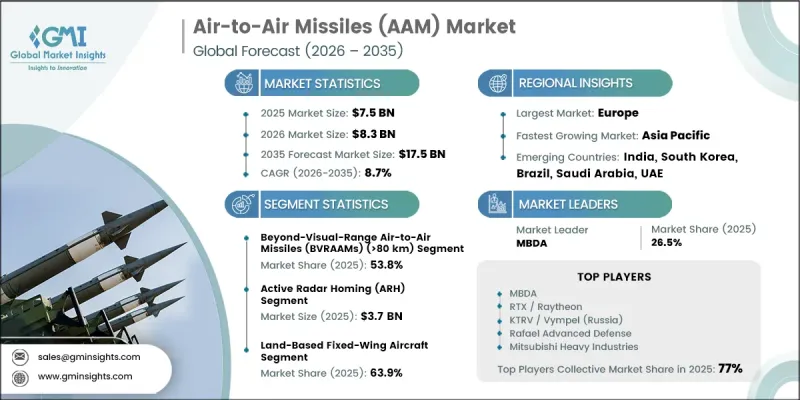
Growth in the air-to-air missiles market is driven by increasing investments in advanced combat aircraft fleets, rising concerns related to airspace security, growing geopolitical uncertainty, and continued military modernization initiatives across major defense economies. Expanding defense budgets and the adoption of advanced aerial warfare strategies are further supporting market expansion. In addition, the growing emphasis on beyond-visual-range combat capabilities is increasing demand for sophisticated missile systems capable of delivering enhanced operational effectiveness. The integration of air-to-air missiles across a broader range of airborne platforms is also contributing to market growth. A key long-term growth driver is the increasing deployment of next-generation fighter aircraft, which creates ongoing demand for compatible missile inventories and associated procurement programs. As defense organizations continue to replace aging platforms with technologically advanced alternatives, demand for modern missile systems is expected to remain strong. Furthermore, alliance commitments, strategic readiness requirements, and stockpile modernization programs are creating a stable procurement environment that supports sustained growth in the global air-to-air missiles market throughout the forecast period.
| Market Scope | |
|---|---|
| Start Year | 2025 |
| Forecast Year | 2026-2035 |
| Start Value | $7.5 Billion |
| Forecast Value | $17.5 Billion |
| CAGR | 8.7% |
The beyond-visual-range air-to-air missiles (BVRAAMs) segment held a 53.8% share in 2025. The segment's leadership is primarily attributed to the growing adoption of beyond-visual-range engagement strategies as a core element of modern air combat doctrine. These missile systems provide operational advantages by enabling target engagement at extended distances, making them a critical component of contemporary air superiority missions. Ongoing military modernization efforts and the increasing deployment of advanced fighter platforms continue to support robust procurement activity within this segment, ensuring its dominant position over the forecast period.
The active radar homing (ARH) segment generated USD 3.7 billion in 2025. Its strong market position is supported by autonomous target engagement capabilities, reliable performance across diverse operational conditions, and alignment with modern air combat requirements. Advanced radar-guided systems are increasingly preferred due to their ability to enhance mission effectiveness, improve target acquisition accuracy, and operate effectively in complex electronic warfare environments. As air forces continue to prioritize advanced guidance technologies, active radar homing systems are expected to remain the preferred guidance solution for long-range missile programs.
North America Air-To-Air Missiles (AAM) Market accounted for 28.8% share in 2025. The region maintains a leading position due to its extensive defense manufacturing capabilities, long-term procurement programs, and ongoing investment in advanced military technologies. Stable defense spending and established supply chains continue to support production activity across the region. In addition, international defense cooperation programs and long-term procurement commitments contribute to consistent demand, providing manufacturers with strong visibility into future production requirements. The region's emphasis on maintaining technological superiority and military readiness is expected to sustain growth in the North American air-to-air missiles market over the coming years.
Major companies operating in the global air-to-air missiles market include Raytheon Technologies (RTX), MBDA, Diehl Defence, Rafael Advanced Defense Systems, Mitsubishi Heavy Industries (MHI), Vympel NPO, Bharat Dynamics Limited (BDL), Denel Dynamics, Anduril Industries, LIG Nex1, NCSIST, and TUBITAK SAGE. Companies operating in the air-to-air missiles (AAM) market are focusing on technological innovation, strategic defense partnerships, and production capacity expansion to strengthen their competitive position. Significant investments in research and development are being directed toward enhancing missile range, precision, guidance systems, survivability, and interoperability with advanced airborne platforms. Defense contractors are also collaborating closely with government agencies and military organizations to secure long-term procurement contracts and modernization programs. Expanding manufacturing capabilities and strengthening supply chain resilience remain important priorities as global demand continues to increase. Many companies are pursuing international partnerships, joint development programs, and export opportunities to broaden their market reach.
Table of Contents
Chapter 1 Methodology and Scope
- 1.1 Market scope and definition
- 1.2 Research design
- 1.2.1 Research approach
- 1.2.2 Data collection methods
- 1.3 Data mining sources
- 1.3.1 Global
- 1.3.2 Regional/Country
- 1.4 Base estimates and calculations
- 1.4.1 Base year calculation
- 1.4.2 Key trends for market estimation
- 1.5 Primary research and validation
- 1.5.1 Primary sources
- 1.6 Forecast model
- 1.7 Research assumptions and limitations
Chapter 2 Executive Summary
- 2.1 Industry 360° synopsis, 2022 - 2035
- 2.2 Key market trends
- 2.2.1 Missile range trends
- 2.2.2 Guidance technology trends
- 2.2.3 Launch platform trends
- 2.2.4 End user trends
- 2.2.5 Regional trends
- 2.3 TAM Analysis, 2026-2035
- 2.4 CXO perspectives: Strategic imperatives
Chapter 3 Industry Insights
- 3.1 Industry ecosystem analysis
- 3.1.1 Supplier Landscape
- 3.1.2 Profit Margin
- 3.1.3 Cost structure
- 3.1.4 Value addition at each stage
- 3.1.5 Factor affecting the value chain
- 3.1.6 Disruptions
- 3.2 Industry impact forces
- 3.2.1 Growth drivers
- 3.2.1.1 Escalating geopolitical tensions and airspace security requirements
- 3.2.1.2 Ongoing military modernization and defense budget growth
- 3.2.1.3 Expansion of beyond-visual-range (BVR) combat doctrine
- 3.2.1.4 Increasing integration of air-to-air missiles across diverse airborne platforms
- 3.2.1.5 Rising procurement of advanced fighter aircraft fleets
- 3.2.2 Industry pitfalls and challenges
- 3.2.2.1 High development and integration costs of advanced missile systems
- 3.2.2.2 Stringent export controls and international regulatory restrictions
- 3.2.3 Market opportunities
- 3.2.3.1 Development of hypersonic-capable air combat and interception systems
- 3.2.3.2 Increasing investment in indigenous missile development and defense localization programs
- 3.2.1 Growth drivers
- 3.3 Growth potential analysis
- 3.4 Regulatory landscape
- 3.4.1 North America
- 3.4.2 Europe
- 3.4.3 Asia Pacific
- 3.4.4 Latin America
- 3.4.5 Middle East & Africa
- 3.5 Porter’s analysis
- 3.6 PESTEL analysis
- 3.7 Technology and Innovation landscape
- 3.7.1 Current technological trends
- 3.7.2 Emerging technologies
- 3.8 Price trends
- 3.8.1 By region
- 3.8.2 By product
- 3.9 Pricing Strategies
- 3.10 Emerging Business Models
- 3.11 Compliance Requirements
- 3.12 Patent and IP analysis
Chapter 4 Competitive Landscape, 2025
- 4.1 Introduction
- 4.2 Company market share analysis
- 4.2.1 By region
- 4.2.1.1 North America
- 4.2.1.2 Europe
- 4.2.1.3 Asia Pacific
- 4.2.1.4 Latin America
- 4.2.1.5 Middle East & Africa
- 4.2.2 Market concentration analysis
- 4.2.1 By region
- 4.3 Competitive benchmarking of key players
- 4.3.1 Financial performance comparison
- 4.3.1.1 Revenue
- 4.3.1.2 Profit margin
- 4.3.1.3 R&D
- 4.3.2 Product portfolio comparison
- 4.3.2.1 Product range breadth
- 4.3.2.2 Technology
- 4.3.2.3 Innovation
- 4.3.3 Geographic presence comparison
- 4.3.3.1 Global footprint analysis
- 4.3.3.2 Service network coverage
- 4.3.3.3 Market penetration by region
- 4.3.4 Competitive positioning matrix
- 4.3.4.1 Leaders
- 4.3.4.2 Challengers
- 4.3.4.3 Followers
- 4.3.4.4 Niche players
- 4.3.5 Strategic outlook matrix
- 4.3.1 Financial performance comparison
- 4.4 Key developments
- 4.4.1 Mergers and acquisitions
- 4.4.2 Partnerships and collaborations
- 4.4.3 Technological advancements
- 4.4.4 Expansion and investment strategies
- 4.4.5 Digital transformation initiatives
- 4.5 Emerging/ startup competitors landscape
Chapter 5 Market Estimates and Forecast, By Missile Range, 2022 - 2035 (USD Million)
- 5.1 Key trends
- 5.2 Short-range air-to-air missiles (SRAAMs) / within-visual-range (WVR) - (<20 km)
- 5.3 Medium-range air-to-air missiles (MRAAMs) - (20-80 km)
- 5.4 Beyond-visual-range air-to-air missiles (BVRAAMs) - (>80 km)
Chapter 6 Market Estimates and Forecast, By Guidance Technology, 2022 - 2035 (USD Million)
- 6.1 Key trends
- 6.2 Infrared (IR) guided
- 6.3 Active radar homing (ARH)
- 6.4 Dual-mode (IR + Radar)
Chapter 7 Market Estimates and Forecast, By Launch Platform, 2022 - 2035 (USD Million)
- 7.1 Key trends
- 7.2 Land-based fixed-wing aircraft
- 7.3 Carrier-based fixed-wing aircraft
- 7.4 Unmanned combat aerial vehicles (UCAVs)
- 7.5 Others
Chapter 8 Market Estimates and Forecast, By End User, 2022 - 2035 (USD Million)
- 8.1 Key trends
- 8.2 Air force
- 8.3 Naval aviation
- 8.4 Army aviation
- 8.5 Other defense organizations
Chapter 9 Market Estimates and Forecast, By Region, 2022 - 2035 (USD Million)
- 9.1 Key trends
- 9.2 North America
- 9.2.1 U.S.
- 9.2.2 Canada
- 9.3 Europe
- 9.3.1 Germany
- 9.3.2 UK
- 9.3.3 France
- 9.3.4 Spain
- 9.3.5 Italy
- 9.3.6 Russia
- 9.4 Asia Pacific
- 9.4.1 China
- 9.4.2 India
- 9.4.3 Japan
- 9.4.4 Australia
- 9.4.5 South Korea
- 9.5 Latin America
- 9.5.1 Brazil
- 9.5.2 Mexico
- 9.5.3 Argentina
- 9.6 Middle East and Africa
- 9.6.1 South Africa
- 9.6.2 Saudi Arabia
- 9.6.3 UAE
Chapter 10 Company Profiles
- 10.1 Global Key Players
- 10.1.1 MBDA
- 10.1.2 RTX / Raytheon
- 10.1.3 KTRV / Vympel (Russia)
- 10.1.4 Rafael Advanced Defense
- 10.1.5 Mitsubishi Heavy Industries
- 10.2 Regional key players
- 10.2.1 North America
- 10.2.1.1 Anduril Industries
- 10.2.2 Asia Pacific
- 10.2.2.1 Bharat Dynamics Limited (BDL)
- 10.2.2.2 LIG Nex1
- 10.2.2.3 NCSIST
- 10.2.3 Europe
- 10.2.3.1 Diehl Defence
- 10.2.3.2 TUBITAK SAGE
- 10.2.4 Middle East & Africa
- 10.2.4.1 Denel Dynamics
- 10.2.1 North America

