PUBLISHER: Global Market Insights Inc. | PRODUCT CODE: 2083123

PUBLISHER: Global Market Insights Inc. | PRODUCT CODE: 2083123
Mycelium Based Material Market Opportunity, Growth Drivers, Industry Trend Analysis, and Forecast 2026 - 2035
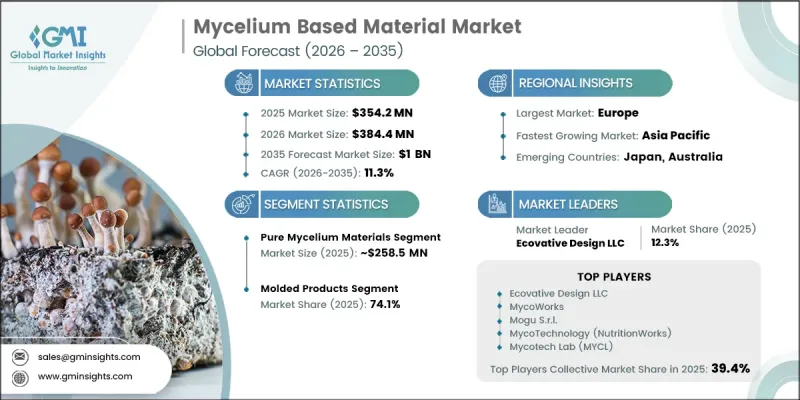
The Global Mycelium-Based Material Market was valued at USD 354.2 million in 2025 and is estimated to grow at a CAGR of 11.3% to reach USD 1 billion by 2035.
The expansion of the Mycelium-Based Material Market is driven by tightening environmental regulations, growing corporate sustainability commitments, and rising investments in biomaterial manufacturing infrastructure. As organizations seek environmentally responsible alternatives to conventional materials, mycelium-based solutions are gaining traction across multiple industries. Commercial production capabilities have advanced significantly, enabling the industry to move beyond early-stage development and into scalable manufacturing operations integrated within established supply chains. The market also benefits from the utilization of renewable biomass resources, reinforcing the role of mycelium materials within broader circular economy initiatives. Growing emphasis on reducing dependence on fossil fuel-derived materials is further accelerating adoption, particularly among industries focused on sustainable packaging, building materials, and consumer products. Regulatory initiatives promoting environmentally friendly materials and responsible resource management continue to create favorable market conditions. As sustainability targets become increasingly important across global value chains, demand for mycelium-based materials is expected to strengthen steadily over the coming decade.
| Market Scope | |
|---|---|
| Start Year | 2025 |
| Forecast Year | 2026-2035 |
| Start Value | $354.2 Million |
| Forecast Value | $1 Billion |
| CAGR | 11.3% |
The pure mycelium materials segment held a 73% share, generating USD 258.5 million in 2024. Its dominant position reflects the relatively advanced commercialization of pure mycelium products, supported by established manufacturing processes, streamlined customer qualification procedures, and strong economic justification for replacing conventional materials. Continued adoption across existing commercial applications is expected to remain a key contributor to segment growth over the forecast period.
The molded products segment held a 74.1% share in 2025. These products have gained widespread acceptance due to their ability to provide sustainable alternatives to traditional protective packaging materials while offering flexibility in design and production. Their compatibility with diverse packaging requirements and cost-efficient manufacturing processes continues to support market demand. Other product formats are increasingly utilized in sectors requiring environmentally responsible material solutions, although these applications generally involve higher production costs associated with premium sustainability attributes.
North America Mycelium-Based Material Market accounted for 22.1% share in 2025. The United States continues to serve as the primary contributor to regional revenue growth, supported by a strong ecosystem of commercial manufacturers and increasing adoption of sustainable material alternatives across the packaging and consumer goods industries. Regulatory developments encouraging the reduction of conventional non-biodegradable materials, combined with growing demand from retail and e-commerce sectors, continue to strengthen market expansion throughout the region.
Key companies operating in the Global Mycelium-Based Material Market include MycoWorks, Biohm, Ecovative Design LLC, Mogu S.r.l., Biomyc, Mycelia, Magical Mushroom Company, Nature's Fynd, Mycotech Lab (MYCL), Meati Foods, and MycoTechnology (NutritionWorks). Companies operating in the Mycelium-Based Material Market are focusing on innovation, capacity expansion, and strategic partnerships to strengthen their market presence and improve competitive positioning. Significant investments are being directed toward research and development activities aimed at enhancing material performance, scalability, and manufacturing efficiency. Many industry participants are expanding production facilities to meet rising demand from packaging, construction, consumer goods, and sustainable materials sectors. Collaborations with brand owners, manufacturers, and sustainability-focused organizations are helping accelerate commercialization and market adoption. Companies are also emphasizing product diversification to address a broader range of end-use applications while improving supply chain reliability through long-term sourcing strategies.
Table of Contents
Chapter 1 Methodology & Scope
- 1.1 Research approach
- 1.2 Quality Commitments
- 1.2.1 GMI AI policy & data integrity commitment
- 1.2.1.1 Source consistency protocol
- 1.2.1 GMI AI policy & data integrity commitment
- 1.3 Research Trail & Confidence Scoring
- 1.3.1 Research Trail Components
- 1.3.2 Scoring Components
- 1.4 Data Collection
- 1.4.1 Partial list of primary sources
- 1.5 Data mining sources
- 1.5.1 Paid sources
- 1.5.1.1 Sources, by region
- 1.5.1 Paid sources
- 1.6 Base estimates and calculations
- 1.6.1 Base year calculation for any one approach
- 1.7 Forecast model
- 1.7.1 Quantified market impact analysis
- 1.7.1.1 Mathematical impact of growth parameters on forecast
- 1.7.1 Quantified market impact analysis
- 1.8 Research transparency addendum
- 1.8.1 Source attribution framework
- 1.8.2 Quality assurance metrics
- 1.8.3 Our commitment to trust
Chapter 2 Executive Summary
- 2.1 Industry 360° synopsis
- 2.2 Key market trends
- 2.2.1 Regional
- 2.2.2 Material type
- 2.2.3 Product form
- 2.2.4 Application
Chapter 3 Industry Insights
- 3.1 Industry ecosystem analysis
- 3.1.1 Supplier landscape
- 3.1.2 Profit margin
- 3.1.3 Value addition at each stage
- 3.1.4 Factor affecting the value chain
- 3.1.5 Disruptions
- 3.2 Industry impact forces
- 3.2.1 Growth drivers
- 3.2.1.1 Increasing consumer awareness on health benefits
- 3.2.1.2 Growing food and beverage industry
- 3.2.1.3 Expansion of the pharmaceutical and nutraceutical industry
- 3.2.2 Industry pitfalls and challenges
- 3.2.2.1 Competition from synthetic alternatives
- 3.2.2.2 Seasonal availability
- 3.2.3 Market opportunities
- 3.2.3.1 Automotive bio-material qualification
- 3.2.3.2 Packaging EPS substitution
- 3.2.1 Growth drivers
- 3.3 Growth potential analysis
- 3.4 Regulatory landscape
- 3.4.1 North America
- 3.4.2 Europe
- 3.4.3 Asia Pacific
- 3.4.4 Latin America
- 3.4.5 Middle East & Africa
- 3.5 Porter's analysis
- 3.6 PESTEL analysis
- 3.7 Price trends
- 3.7.1 By region
- 3.7.2 By material type
- 3.8 Future market trends
- 3.9 Technology and innovation landscape
- 3.9.1 Current technological trends
- 3.9.2 Emerging technologies
- 3.10 Patent Landscape
- 3.11 Trade statistics (HS code)
- 3.11.1 Major importing countries
- 3.11.2 Major exporting countries
- 3.12 Sustainability and environmental aspects
- 3.12.1 Sustainable practices
- 3.12.2 Waste reduction strategies
- 3.12.3 Energy efficiency in production
- 3.12.4 Eco-friendly initiatives
- 3.13 Carbon footprint consideration
Chapter 4 Competitive Landscape, 2025
- 4.1 Introduction
- 4.2 Company market share analysis
- 4.2.1 By region
- 4.2.1.1 North America
- 4.2.1.2 Europe
- 4.2.1.3 Asia Pacific
- 4.2.1.4 LATAM
- 4.2.1.5 MEA
- 4.2.1 By region
- 4.3 Competitive analysis of major market players
- 4.4 Competitive positioning matrix
- 4.5 Key developments
- 4.5.1 Mergers & acquisitions
- 4.5.2 Partnerships & collaborations
- 4.5.3 New Product Launches
- 4.5.4 Expansion Plans
Chapter 5 Market Estimates and Forecast, By Material Type, 2022-2035 (USD Million) (Kilo Tons)
- 5.1 Key trends
- 5.2 Pure mycelium materials
- 5.3 Mycelium composites
- 5.4 Hybrid mycelium materials
Chapter 6 Market Estimates and Forecast, By Product Form, 2022-2035 (USD Million) (Kilo Tons)
- 6.1 Key trends
- 6.2 Foams
- 6.2.1 Packaging foams
- 6.2.2 Insulation foams
- 6.2.3 Acoustic foams
- 6.3 Panels & sheets
- 6.4 Powder & granules
- 6.5 Molded products
- 6.6 Others
Chapter 7 Market Estimates and Forecast, By Application, 2022-2035 (USD Million) (Kilo Tons)
- 7.1 Key trends
- 7.2 Packaging
- 7.3 Construction & building materials
- 7.4 Textiles, fashion & leather goods
- 7.5 Food & beverage
- 7.6 Automotive
- 7.6.1 Interior trim & dashboard components
- 7.6.2 Acoustic insulation panels
- 7.6.3 Seat cushioning & upholstery
- 7.6.4 Sustainable vehicle component alternatives
- 7.7 Furniture & interior design
- 7.8 Others
Chapter 8 Market Estimates and Forecast, By Region, 2022-2035 (USD Million) (Kilo Tons)
- 8.1 Key trends
- 8.2 North America
- 8.2.1 U.S.
- 8.2.2 Canada
- 8.3 Europe
- 8.3.1 Germany
- 8.3.2 UK
- 8.3.3 France
- 8.3.4 Spain
- 8.3.5 Italy
- 8.3.6 Rest of Europe
- 8.4 Asia Pacific
- 8.4.1 China
- 8.4.2 India
- 8.4.3 Japan
- 8.4.4 Australia
- 8.4.5 South Korea
- 8.4.6 Rest of Asia Pacific
- 8.5 Latin America
- 8.5.1 Brazil
- 8.5.2 Mexico
- 8.5.3 Argentina
- 8.5.4 Rest of Latin America
- 8.6 Middle East and Africa
- 8.6.1 Saudi Arabia
- 8.6.2 South Africa
- 8.6.3 UAE
- 8.6.4 Rest of Middle East and Africa
Chapter 9 Company Profiles
- 9.1 Biohm
- 9.2 Biomyc
- 9.3 Ecovative Design LLC
- 9.4 Magical Mushroom Company
- 9.5 Meati Foods
- 9.6 Mogu S.r.l.
- 9.7 Mycelia
- 9.8 Mycotech Lab (MYCL)
- 9.9 MycoTechnology (NutritionWorks)
- 9.10 MycoWorks
- 9.11 Nature's Fynd

