PUBLISHER: Global Market Insights Inc. | PRODUCT CODE: 2083124

PUBLISHER: Global Market Insights Inc. | PRODUCT CODE: 2083124
AI Assistant Market Opportunity, Growth Drivers, Industry Trend Analysis, and Forecast 2026 - 2035
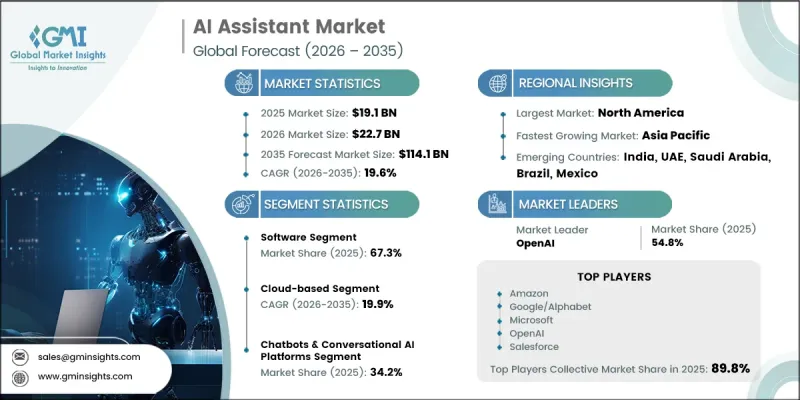
The Global AI Assistant Market was valued at USD 19.1 billion in 2025 and is estimated to grow at a CAGR of 19.6% to reach USD 114.1 billion by 2035.
The market's rapid evolution is driven by major advancements in artificial intelligence technologies that have substantially expanded the functionality and business value of AI-powered assistants. Organizations across industries are increasingly prioritizing digital transformation initiatives to improve productivity, streamline operations, and enhance decision-making processes. As a result, AI assistants have emerged as critical tools for automating workflows, organizing enterprise knowledge, and supporting business intelligence activities. The growing adoption of connected technologies, smart work environments, and digitally integrated ecosystems has further expanded the role of AI assistants beyond conventional software platforms. Modern AI assistants are now embedded across a broad range of digital environments, enabling seamless communication, intelligent task execution, operational monitoring, and automated decision support. Businesses are also leveraging AI-driven conversational solutions to strengthen customer engagement, improve service quality, and provide continuous support capabilities. The ability to deliver rapid responses, enhance user experiences, and maintain uninterrupted availability is contributing significantly to market growth while reinforcing the strategic importance of AI assistants within modern enterprise technology infrastructures.
| Market Scope | |
|---|---|
| Start Year | 2025 |
| Forecast Year | 2026-2035 |
| Start Value | $19.1 Billion |
| Forecast Value | $114.1 Billion |
| CAGR | 19.6% |
The software segment accounted for 67.3% share in 2025 and is anticipated to grow at a CAGR of 18.9% between 2026 and 2035. This segment encompasses AI assistant platforms, software-as-a-service solutions, application programming interfaces, embedded AI applications, and related software technologies. Strong demand for cloud-enabled AI solutions and growing enterprise adoption of advanced generative artificial intelligence capabilities continue to support segment growth. Organizations are increasingly implementing software-based AI assistants to improve operational efficiency, automate routine processes, and enhance business performance.
The cloud-based segment held a 73.4% share in 2025 and is forecast to grow at a CAGR of 19.9% from 2026 to 2035. Cloud deployment models offer significant advantages, including scalability, continuous performance enhancements, simplified implementation, and reduced infrastructure requirements. These benefits have accelerated adoption among organizations seeking flexible and cost-effective AI assistant solutions. The ability to rapidly deploy and update cloud-based platforms continues to strengthen the segment's leading market position.
U.S. AI Assistant Market generated USD 6.3 billion in 2025 and is expected to grow at a CAGR of 20.2% through 2035. The country represented the largest revenue contributor to the global market during the year, supported by a strong ecosystem of artificial intelligence innovators, technology providers, and cloud infrastructure companies. Rising investments in advanced AI technologies and enterprise automation initiatives are expected to create substantial growth opportunities over the coming decade. Increasing adoption across customer engagement, employee productivity enhancement, software engineering, and business process optimization applications is anticipated to remain a key driver of market expansion throughout the forecast period.
Major companies operating in the Global AI assistant market include Apple, Baidu, OpenAI, Amazon, Microsoft, Salesforce, and Google/Alphabet. Companies competing in the AI assistant market are implementing a range of strategic initiatives to strengthen their market presence and gain competitive advantages. Significant investments in research and development remain a primary focus as organizations work to improve language understanding, contextual awareness, personalization capabilities, and overall AI performance. Strategic partnerships, technology collaborations, and ecosystem expansion efforts are also helping companies broaden their customer reach and accelerate innovation. Many market participants are integrating AI assistants across enterprise applications, productivity platforms, and digital services to increase adoption and customer retention.
Table of Contents
Chapter 1 Methodology
- 1.1 Research approach
- 1.2 Quality Commitments
- 1.2.1 GMI AI policy & data integrity commitment
- 1.2.1.1 Source consistency protocol
- 1.2.1 GMI AI policy & data integrity commitment
- 1.3 Research Trail & Confidence Scoring
- 1.3.1 Research Trail Components
- 1.3.2 Scoring Components
- 1.4 Data Collection
- 1.4.1 Partial list of primary sources
- 1.5 Data mining sources
- 1.5.1 Paid sources
- 1.5.1.1 Sources, by region
- 1.5.1 Paid sources
- 1.6 Base estimates and calculations
- 1.6.1 Base year calculation
- 1.7 Forecast model
- 1.7.1 Quantified market impact analysis
- 1.7.1.1 Mathematical impact of growth parameters on forecast
- 1.7.1 Quantified market impact analysis
- 1.8 Research transparency addendum
- 1.8.1 Source attribution framework
- 1.8.2 Quality assurance metrics
- 1.8.3 Our commitment to trust
Chapter 2 Executive Summary
- 2.1 Industry 360° synopsis
- 2.2 Key market trends
- 2.2.1 Regional
- 2.2.2 Component
- 2.2.3 Deployment mode
- 2.2.4 Type
- 2.2.5 Application
- 2.2.6 End use
- 2.3 TAM analysis, 2026-2035
- 2.4 CXO perspectives: Strategic imperatives
Chapter 3 Industry Insights
- 3.1 Industry ecosystem analysis
- 3.1.1 Supplier landscape
- 3.1.2 Profit margin
- 3.1.3 Cost structure
- 3.1.4 Value addition at each stage
- 3.1.5 Factor affecting the value chain
- 3.1.6 Disruptions
- 3.2 Industry impact forces
- 3.2.1 Growth drivers
- 3.2.1.1 Rapid NLP & LLM advances
- 3.2.1.2 Enterprise digital transformation growth
- 3.2.1.3 IoT & smart devices proliferation
- 3.2.1.4 24/7 personalized engagement demand
- 3.2.2 Industry pitfalls and challenges
- 3.2.2.1 Data privacy & security concerns
- 3.2.2.2 Legacy system integration complexity
- 3.2.3 Market opportunities
- 3.2.3.1 Industry-specific AI assistants growth
- 3.2.3.2 Multimodal AI assistant expansion
- 3.2.3.3 Hybrid deployment adoption rising
- 3.2.3.4 Emerging market penetration increase
- 3.2.1 Growth drivers
- 3.3 Growth potential analysis
- 3.4 Technology and innovation landscape
- 3.4.1 Current technological trends
- 3.4.2 Emerging technologies
- 3.5 Cost breakdown analysis
- 3.6 Regulatory landscape
- 3.6.1 North America
- 3.6.1.1 National Institute of Standards and Technology (U.S.)
- 3.6.1.2 Artificial Intelligence and Data Act (Canada)
- 3.6.2 Europe
- 3.6.2.1 General Data Protection Regulation (Germany)
- 3.6.2.2 Italian Data Protection Authority (Italy)
- 3.6.3 Asia Pacific
- 3.6.3.1 Data Security Law (China)
- 3.6.3.2 IndiaAI Mission (India)
- 3.6.4 Latin America
- 3.6.4.1 National Data Protection Authority (Brazil)
- 3.6.4.2 National Digital Strategy (Mexico)
- 3.6.5 Middle East & Africa
- 3.6.5.1 UAE Personal Data Protection Law (Dubai)
- 3.6.5.2 Saudi Data and Artificial Intelligence Authority (Saudi Arabia)
- 3.6.1 North America
- 3.7 Porter’s analysis
- 3.8 PESTEL analysis
- 3.9 Patent analysis (Driven by primary research)
- 3.10 Impact of AI & Generative AI on the Market
- 3.10.1 AI-driven disruption of existing business models
- 3.10.2 Gen AI use cases & adoption roadmap by segment
- 3.10.3 Risks, limitations & regulatory considerations
- 3.11 Sustainability and environmental aspects
- 3.11.1 Sustainable practices
- 3.11.2 Waste reduction strategies
- 3.11.3 Energy efficiency in production
- 3.11.4 Eco-friendly initiatives
- 3.11.5 Carbon footprint considerations
- 3.12 Forecast assumptions & scenario analysis (Driven by primary research)
- 3.12.1 Base Case - key macro & industry variables driving CAGR
- 3.12.2 Optimistic Scenarios - Favorable macro and industry tailwinds
- 3.12.3 Pessimistic Scenario - Macroeconomic slowdown or industry headwinds
Chapter 4 Competitive Landscape, 2025
- 4.1 Introduction
- 4.2 Company market share analysis
- 4.2.1 North America
- 4.2.2 Europe
- 4.2.3 Asia Pacific
- 4.2.4 LATAM
- 4.2.5 MEA
- 4.3 Competitive analysis of major market players
- 4.4 Competitive positioning matrix
- 4.5 Key developments
- 4.5.1 Mergers & acquisitions
- 4.5.2 Partnerships & collaborations
- 4.5.3 New product launches
- 4.5.4 Expansion plans and funding
- 4.6 Company tier benchmarking
- 4.6.1 Tier classification criteria & qualifying thresholds
- 4.6.2 Tier positioning matrix by revenue, geography & innovation
Chapter 5 Market Estimates & Forecast, By Component, 2022 - 2035 ($Mn)
- 5.1 Key trends
- 5.2 Software
- 5.2.1 SaaS Platforms & Subscription-Based AI Assistants
- 5.2.2 APIs & SDKs for developer integration
- 5.2.3 Embedded AI software for devices
- 5.2.4 Others
- 5.3 Services
- 5.3.1 Professional services
- 5.3.2 Managed services
Chapter 6 Market Estimates & Forecast, By Deployment Mode, 2022 - 2035 ($Mn)
- 6.1 Key trends
- 6.2 Cloud-based
- 6.3 On-premises
- 6.4 Hybrid
Chapter 7 Market Estimates & Forecast, By Type, 2022 - 2035 ($Mn)
- 7.1 Key trends
- 7.2 Virtual assistants (IVA)
- 7.3 Voice assistants & smart speaker assistants
- 7.4 Chatbots & conversational AI platforms
- 7.5 Enterprise/workplace AI assistants
Chapter 8 Market Estimates & Forecast, By Application, 2022 - 2035 ($Mn)
- 8.1 Key trends
- 8.2 Customer support & service automation
- 8.3 Personal productivity & virtual assistance
- 8.4 Enterprise & business automation
- 8.5 Healthcare & clinical assistance
- 8.6 Smart home & IoT control
- 8.7 Automotive AI assistance
- 8.8 Education & E-learning
- 8.9 Others
Chapter 9 Market Estimates & Forecast, By End Use, 2022 - 2035 ($Mn)
- 9.1 Key Trends
- 9.2 IT & Telecom
- 9.3 Healthcare & life sciences
- 9.4 BFSI
- 9.5 Retail & E-commerce
- 9.6 Manufacturing
- 9.7 Education
- 9.8 Government & defense
- 9.9 Others
Chapter 10 Market Estimates & Forecast, By Region, 2022 - 2035 ($Mn)
- 10.1 Key trends
- 10.2 North America
- 10.2.1 U.S.
- 10.2.2 Canada
- 10.3 Europe
- 10.3.1 Germany
- 10.3.2 UK
- 10.3.3 France
- 10.3.4 Italy
- 10.3.5 Spain
- 10.3.6 Nordics
- 10.3.7 Russia
- 10.3.8 Netherlands
- 10.4 Asia Pacific
- 10.4.1 China
- 10.4.2 India
- 10.4.3 Japan
- 10.4.4 South Korea
- 10.4.5 Australia
- 10.4.6 Southeast Asia
- 10.5 LATAM
- 10.5.1 Brazil
- 10.5.2 Mexico
- 10.5.3 Argentina
- 10.6 MEA
- 10.6.1 South Africa
- 10.6.2 Saudi Arabia
- 10.6.3 UAE
Chapter 11 Company Profiles
- 11.1 Global players
- 11.1.1 Amazon
- 11.1.2 Google/Alphabet
- 11.1.3 IBM
- 11.1.4 Kore.ai
- 11.1.5 Microsoft
- 11.1.6 OpenAI
- 11.1.7 Salesforce
- 11.1.8 SoundHound AI
- 11.2 Regional players
- 11.2.1 Alibaba
- 11.2.2 Baidu
- 11.2.3 Cognigy
- 11.2.4 iFLYTEK
- 11.2.5 Mistral AI
- 11.2.6 SAP
- 11.2.7 Yandex
- 11.2.8 Yellow.ai
- 11.3 Emerging players
- 11.3.1 Anthropic
- 11.3.2 DeepSeek
- 11.3.3 ElevenLabs
- 11.3.4 Sierra AI

