PUBLISHER: Global Market Insights Inc. | PRODUCT CODE: 2083126

PUBLISHER: Global Market Insights Inc. | PRODUCT CODE: 2083126
Connected Vehicle Fintech Market Opportunity, Growth Drivers, Industry Trend Analysis, and Forecast 2026 - 2035
The Global Connected Vehicle Fintech Market was valued at USD 5.1 billion in 2025 and is estimated to grow at a CAGR of 10.6% to reach USD 13.8 billion by 2035.
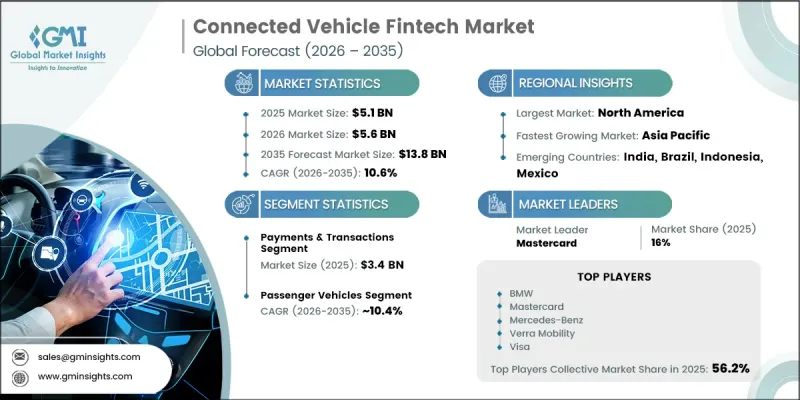
Growth is fueled by the accelerating deployment of connected vehicle ecosystems worldwide, increasing adoption of software-centric vehicle platforms, and the growing integration of digital financial services within automotive environments. As vehicles become increasingly connected, they are evolving beyond traditional transportation assets into continuously connected digital platforms capable of supporting a wide range of financial interactions. This transformation is creating new opportunities for payment providers, insurers, mobility operators, fleet managers, and automotive manufacturers. At the same time, automakers are actively diversifying revenue streams by expanding software-enabled services and subscription-based business models to offset mounting investments in vehicle electrification and advanced technologies. Consumer demand is also shifting toward seamless and automated purchasing experiences that occur naturally during vehicle usage, further strengthening the commercial potential of connected vehicle fintech solutions and supporting long-term market growth across global automotive and financial ecosystems.
| Market Scope | |
|---|---|
| Start Year | 2025 |
| Forecast Year | 2026-2035 |
| Start Value | $5.1 Billion |
| Forecast Value | $13.8 Billion |
| CAGR | 10.6% |
The payments and transactions segment generated USD 3.4 billion in 2025, representing 66.6% share, and is anticipated to grow at a CAGR of 10.5% through 2035. Segment growth is being supported by the wider implementation of embedded payment capabilities across various vehicle-related services and the continuous expansion of connected vehicle penetration worldwide. Increasing transaction activity and broader adoption of integrated financial services within vehicles are expected to further strengthen revenue generation throughout the forecast period.
The passenger vehicles segment reached USD 3.8 billion in 2025. The segment is forecast to grow at a CAGR of 10.4% through 2035. Its leadership position is largely attributed to the immense size of the global passenger vehicle fleet, which exceeds 1.3 billion units, along with rising connectivity adoption across new vehicle models. Growing integration of connected technologies in passenger cars continues to create favorable conditions for fintech applications, contributing significantly to segment growth.
U.S. Connected Vehicle Fintech Market generated USD 1.8 billion in 2025. High penetration of embedded connectivity technologies in newly sold vehicles has established a strong foundation for the adoption of vehicle-based financial services. The widespread availability of connected infrastructure, combined with growing consumer acceptance of digital automotive transactions, continues to position the United States as a key growth center for the connected-vehicle fintech industry.
Key participants operating in the global connected vehicle fintech market include Mastercard, Visa, Verra Mobility, Mercedes-Benz, BMW Group, Hyundai Motor, and PayPal. Companies operating in the connected vehicle fintech market are focusing on strategic initiatives designed to strengthen their competitive positions and expand market reach. Many industry participants are investing heavily in connected mobility platforms, digital payment integration, and software-driven vehicle ecosystems to enhance customer engagement and generate recurring revenue streams. Strategic partnerships between automotive manufacturers, payment technology providers, financial institutions, and mobility service companies are becoming increasingly common as organizations seek to accelerate innovation and improve service delivery. Companies are also prioritizing investments in cybersecurity, data protection, and secure transaction capabilities to build consumer trust and support regulatory compliance.
Table of Contents
Chapter 1 Methodology
- 1.1 Research approach
- 1.2 Quality Commitments
- 1.2.1 GMI AI policy & data integrity commitment
- 1.3 Research Trail & Confidence Scoring
- 1.3.1 Research Trail Components
- 1.3.2 Scoring Components
- 1.4 Data Collection
- 1.5 Data mining sources
- 1.5.1 Paid sources
- 1.6 Base estimates and calculations
- 1.6.1 Base year calculation
- 1.7 Forecast model
- 1.7.1 Quantified market impact analysis
- 1.8 Research transparency addendum
- 1.8.1 Source attribution framework
- 1.8.2 Quality assurance metrics
- 1.8.3 Our commitment to trust
Chapter 2 Executive Summary
- 2.1 Industry 360° synopsis
- 2.2 Key market trends
- 2.2.1 Regional
- 2.2.2 Solution
- 2.2.3 Vehicle
- 2.2.4 Application
- 2.2.5 End-Use
- 2.3 TAM analysis, 2026-2035
- 2.4 CXO perspectives: Strategic imperatives
Chapter 3 Industry Insights
- 3.1 Industry ecosystem analysis
- 3.1.1 Supplier landscape
- 3.1.2 Profit margin
- 3.1.3 Cost structure
- 3.1.4 Value addition at each stage
- 3.1.5 Factor affecting the value chain
- 3.1.6 Disruptions
- 3.2 Industry impact forces
- 3.2.1 Growth drivers
- 3.2.1.1 Rapid Growth in Connected Vehicle Adoption & IoT Penetration
- 3.2.1.2 Consumer Demand for Seamless, Frictionless Payment Experiences
- 3.2.1.3 OEM Focus on Recurring Revenue & Subscription Models
- 3.2.1.4 Acceleration of EV Adoption Requiring Integrated Charging Payments
- 3.2.2 Industry pitfalls and challenges
- 3.2.2.1 Payment Fragmentation & Lack of Interoperability Standards
- 3.2.2.2 Legacy Payment Infrastructure & Slow Settlement Times Capabilities
- 3.2.3 Market opportunities
- 3.2.3.1 Expansion into Emerging Markets with Growing Vehicle Connectivity
- 3.2.3.2 Fleet Management Fintech Solutions for Commercial Vehicles
- 3.2.3.3 Partnership Opportunities Between OEMs & Financial Institutions
- 3.2.1 Growth drivers
- 3.3 Technology and innovation landscape
- 3.3.1 Current technological trends
- 3.3.1.1 In-vehicle payment terminals (embedded card readers)
- 3.3.1.2 Mobile wallet integration
- 3.3.1.3 Telematics-based transaction systems
- 3.3.2 Emerging technologies
- 3.3.2.1 Blockchain-based payment and settlement
- 3.3.2.2 EV charging wallet integration
- 3.3.2.3 Vehicle-to-everything (V2X) payment ecosystems
- 3.3.1 Current technological trends
- 3.4 Growth potential analysis
- 3.5 Regulatory landscape
- 3.5.1 North America
- 3.5.1.1 US - NHTSA (National Highway Traffic Safety Administration)
- 3.5.1.2 US - CFPB (Consumer Financial Protection Bureau)
- 3.5.2 Europe
- 3.5.2.1 EU - EDPB / National DPAs (European Data Protection Board & Data Protection Authorities)
- 3.5.2.2 EU - ESMA (European Securities and Markets Authority)
- 3.5.3 Asia Pacific
- 3.5.3.1 China - MIIT (Ministry of Industry and Information Technology)
- 3.5.3.2 India - RBI (Reserve Bank of India)
- 3.5.4 LATAM
- 3.5.4.1 Brazil - BCB (Banco Central do Brasil)
- 3.5.4.2 Mexico - CNBV (Comision Nacional Bancaria y de Valores)
- 3.5.5 MEA
- 3.5.5.1 UAE - DFSA / ADGM (Dubai Financial Services Authority)
- 3.5.5.2 Saudi Arabia - SAMA (Saudi Central Bank)
- 3.5.1 North America
- 3.6 Porter’s analysis
- 3.7 PESTEL analysis
- 3.8 Patent analysis (Driven by Primary Research)
- 3.9 Impact of AI & generative AI on the market
- 3.9.1 AI-driven disruption of existing business models
- 3.9.2 GenAI use cases & adoption roadmap by segment
- 3.9.3 Risks, limitations & regulatory considerations
- 3.10 Cybersecurity & Functional Safety Analysis
- 3.10.1 Payment Security Standards (PCI DSS, Tokenization)
- 3.10.2 Vehicle Authentication & Authorization Protocols
- 3.10.3 Data Encryption & Privacy Protection
- 3.10.4 Cybersecurity Threat Landscape
- 3.11 Integration with Autonomous & ADAS Ecosystem
- 3.11.1 Autonomous Fleet Payment Orchestration
- 3.11.2 Ride-Hailing & Robotaxi Financial Integration
- 3.11.3 Vehicle-to-Everything (V2X) Payment Infrastructure
- 3.12 Forecast assumptions & scenario analysis (Driven by Primary Research)
- 3.12.1 Base Case- Key Macro & Industry Variables Driving CAGR
- 3.12.2 Optimistic Scenarios- Favorable macro and industry tailwinds
- 3.12.3 Pessimistic Scenario - Macroeconomic slowdown or industry headwinds
Chapter 4 Competitive Landscape, 2025
- 4.1 Introduction
- 4.2 Company market share analysis
- 4.2.1 North America
- 4.2.2 Europe
- 4.2.3 Asia Pacific
- 4.2.4 LATAM
- 4.2.5 MEA
- 4.3 Competitive analysis of major market players
- 4.4 Competitive positioning matrix
- 4.5 Key developments
- 4.5.1 Mergers & acquisitions
- 4.5.2 Partnerships & collaborations
- 4.5.3 New product launches
- 4.5.4 Expansion plans and funding
- 4.6 Company tier benchmarking
- 4.6.1 Tier classification criteria & qualifying thresholds
- 4.6.2 Tier positioning matrix by revenue, geography & innovation
Chapter 5 Market Estimates and Forecast, By Solution, 2022 - 2035 ($ Mn)
- 5.1 Key trends
- 5.2 Payments & Transactions
- 5.3 Insurance & Risk Services
- 5.4 Lending & Leasing
- 5.5 Mobility & Fintech Platforms
Chapter 6 Market Estimates and Forecast, By Vehicle, 2022 - 2035 ($ Mn)
- 6.1 Key trends
- 6.2 Passenger Vehicles
- 6.2.1 Hatchback
- 6.2.2 Sedan
- 6.2.3 SUV
- 6.3 Commercial Vehicles
- 6.3.1 Light Commercial Vehicles
- 6.3.2 Medium Commercial Vehicles
- 6.3.3 Heavy Commercial Vehicles
- 6.4 Two Wheelers
Chapter 7 Market Estimates and Forecast, By Application, 2022 - 2035 ($ Mn)
- 7.1 Key trends
- 7.2 In-Vehicle Payment
- 7.2.1 Charging & Refueling
- 7.2.2 Tolls & Parking
- 7.2.3 In-car commerce
- 7.2.4 Other
- 7.3 Mobility-as-a-Service (MaaS)
- 7.4 Vehicle Ownership & Financing
- 7.5 Vehicle Operations & Lifecycle Services
Chapter 8 Market Estimates and Forecast, By End-Use, 2022 - 2035 ($ Mn)
- 8.1 Key trends
- 8.2 OEMs
- 8.3 Commercial Fleets
- 8.4 Mobility Service Providers
- 8.5 Retail Consumers
- 8.6 Others
Chapter 9 Market Estimates & Forecast, By Region, 2022 - 2035 ($Mn)
- 9.1 Key trends
- 9.2 North America
- 9.2.1 US
- 9.2.2 Canada
- 9.3 Europe
- 9.3.1 Germany
- 9.3.2 UK
- 9.3.3 France
- 9.3.4 Italy
- 9.3.5 Spain
- 9.3.6 Poland
- 9.3.7 Norway
- 9.3.8 Netherlands
- 9.4 Asia Pacific
- 9.4.1 China
- 9.4.2 India
- 9.4.3 Japan
- 9.4.4 Australia
- 9.4.5 Indonesia
- 9.4.6 South Korea
- 9.4.7 Thailand
- 9.4.8 Vietnam
- 9.5 Latin America
- 9.5.1 Brazil
- 9.5.2 Mexico
- 9.5.3 Argentina
- 9.6 MEA
- 9.6.1 South Africa
- 9.6.2 Saudi Arabia
- 9.6.3 UAE
Chapter 10 Company Profiles
- 10.1 Global players
- 10.1.1 Mastercard
- 10.1.2 Visa
- 10.1.3 Mercedes-Benz
- 10.1.4 PayPal
- 10.1.5 Hyundai Motor
- 10.1.6 BMW
- 10.1.7 Parkopedia
- 10.1.8 Cerence AI
- 10.1.9 Aisin
- 10.2 Regional players
- 10.2.1 Verra Mobility
- 10.2.2 ryd
- 10.2.3 CarPay-Diem
- 10.2.4 PACE Telematics
- 10.2.5 Cubic3
- 10.3 Emerging players
- 10.3.1 Sheeva.AI
- 10.3.2 Car IQ
- 10.3.3 Aiden Automotive
- 10.3.4 Pairpoint

