PUBLISHER: Global Market Insights Inc. | PRODUCT CODE: 2083128

PUBLISHER: Global Market Insights Inc. | PRODUCT CODE: 2083128
North America Freezer Market Opportunity, Growth Drivers, Industry Trend Analysis, and Forecast 2026 - 2035
North America Freezer Market was valued at USD 3.1 billion in 2025 and is estimated to grow at a CAGR of 5.4% to reach USD 5.2 billion by 2035.
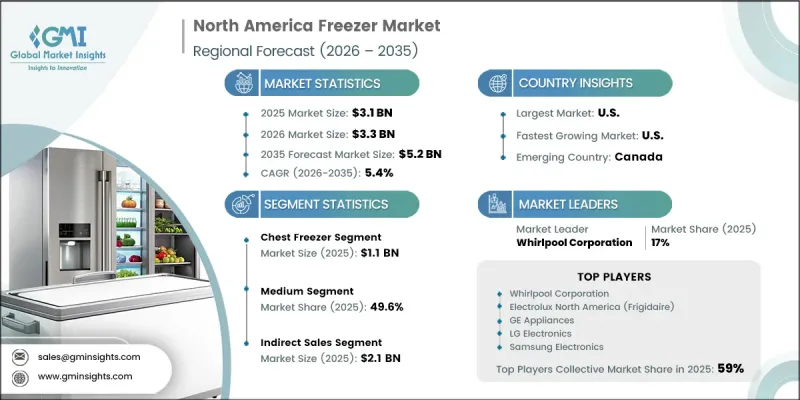
North America freezer market continues to expand as demand remains strong across residential, commercial, and industrial applications. Increasing consumption of frozen food products, continuous investment in cold chain infrastructure, and ongoing technological advancements in refrigeration systems are creating favorable conditions for market growth throughout the region. The market also benefits from a large installed base of refrigeration equipment serving households, foodservice establishments, retail outlets, and temperature-controlled storage facilities. Evolving environmental regulations governing refrigerants is encouraging manufacturers to develop more energy-efficient and sustainable products while accelerating innovation across the industry. At the same time, growing adoption of connected appliances equipped with advanced monitoring and digital control capabilities is reshaping consumer expectations and influencing product development strategies. Demand for ultra-low temperature freezers is also increasing steadily as pharmaceutical manufacturing, biotechnology research, healthcare facilities, and laboratory applications require highly reliable temperature-controlled storage solutions. Rising investments in life sciences, medical research, and specialized healthcare infrastructure continue to support procurement of advanced freezing equipment, strengthening long-term growth opportunities across the North America freezer market.
| Market Scope | |
|---|---|
| Start Year | 2025 |
| Forecast Year | 2026-2035 |
| Start Value | $3.1 Billion |
| Forecast Value | $5.2 Billion |
| CAGR | 5.4% |
In 2025, the chest freezer segment accounted for USD 1.1 billion, due to its affordability, efficient storage capacity, and lower energy consumption relative to available storage volume. Strong demand across residential households as well as commercial food storage applications continues to support high shipment volumes. The combination of practical design, dependable performance, and cost-efficient operation reinforces the segment's leading market position.
The medium-priced segment held 49.6% share in 2025. This pricing category serves a broad customer base by offering products that balance affordability with performance across residential and commercial applications. The segment represents the highest volume of unit sales within the market, supported by steady replacement demand and widespread customer preference for competitively priced freezer solutions that deliver reliable functionality and long-term value.
U.S. Freezer Market held 77.2% share, generating USD 2.4 billion in 2025. The country's leadership is supported by a well-established frozen food industry, a large installed base of residential refrigeration appliances, and strong demand from healthcare, pharmaceutical, and biotechnology sectors requiring specialized freezing equipment. Continued investments in cold storage infrastructure, expanding food distribution networks, and sustained replacement demand further contribute to the country's dominant position within the regional market.
Major companies operating in the North America freezer market include Whirlpool Corporation, Electrolux North America (Frigidaire), LG Electronics, Samsung Electronics, GE Appliances, Hussmann Corporation, Hoshizaki America, Inc., True Manufacturing, Traulsen, Beverage-Air, Master-Bilt Products, Zero Zone, Inc., Kolpak, Nor-Lake, Perlick Corporation, Atosa USA, Victory Refrigeration, American Panel Corporation, Bally Refrigerated Boxes, Howard-McCray, and Habco Industries. Companies operating in the North America freezer market are strengthening their competitive position by investing in product innovation, improving energy efficiency, and expanding refrigeration technologies that comply with evolving environmental regulations. Manufacturers continue to enhance product reliability, optimize storage performance, and integrate advanced digital monitoring and smart control features to meet changing customer requirements. Businesses are also broadening their distribution networks, strengthening relationships with commercial customers, and expanding service capabilities to improve market coverage. Strategic investments in manufacturing capacity, research and development, and sustainable refrigeration technologies enable companies to remain competitive while addressing regulatory requirements.
Table of Contents
Chapter 1 Methodology and Scope
- 1.1 Market scope and definition
- 1.2 Research design
- 1.2.1 Research approach
- 1.2.2 Data collection methods
- 1.3 Data mining sources
- 1.3.1 Global
- 1.3.2 Regional/Country
- 1.4 Base estimates and calculations
- 1.4.1 Base year calculation
- 1.4.2 Key trends for market estimation
- 1.5 Primary research and validation
- 1.5.1 Primary sources
- 1.6 Forecast model
- 1.7 Research assumptions and limitations
Chapter 2 Executive Summary
- 2.1 Industry 360° synopsis
- 2.2 Key market trends
- 2.2.1 Country
- 2.2.2 Product type
- 2.2.3 Technology
- 2.2.4 Access configuration
- 2.2.5 Capacity
- 2.2.6 Price
- 2.2.7 Application
- 2.2.8 Distribution channel
Chapter 3 Industry Insights
- 3.1 Industry ecosystem analysis
- 3.1.1 Supplier landscape
- 3.1.2 Profit margin
- 3.1.3 Value addition at each stage
- 3.1.4 Factor affecting the value chain
- 3.2 Industry impact forces
- 3.2.1 Growth drivers
- 3.2.1.1 Rising demand for frozen food
- 3.2.1.2 Expansion of cold chain infrastructure
- 3.2.1.3 Technological advancements
- 3.2.2 Industry pitfalls & challenges
- 3.2.2.1 High energy consumption concerns
- 3.2.2.2 Supply chain volatility
- 3.2.3 Opportunities
- 3.2.3.1 Growth in healthcare & biopharma cold storage
- 3.2.3.2 Smart & connected appliances
- 3.2.1 Growth drivers
- 3.3 Growth potential analysis
- 3.4 Regulatory framework
- 3.4.1 HFC refrigerant phase-down regulations (KIGALI amendment)
- 3.4.2 Energy efficiency standards (U.S. DOE standards, energy star)
- 3.4.3 Food safety compliance requirements (FDA FSMA)
- 3.4.4 Pharmaceutical cold chain compliance (WHO PQS, GDP guidelines for ULT storage)
- 3.4.5 Environmental disposal & recycling regulations (WEEE Directive)
- 3.5 Pricing analysis (driven by primary research)
- 3.5.1 Historical price trend analysis (2022-2025)
- 3.5.2 Pricing strategy by player type (premium / value / cost-plus)
- 3.6 Trade data analysis (driven by paid database)
- 3.6.1 Import/export volume & value trends
- 3.6.2 Key trade corridors & tariff impact (HS Code 8418 - refrigerators & freezers)
- 3.7 Impact of AI & generative AI on the market
- 3.7.1 AI-driven disruption of existing business models
- 3.7.2 GenAI use cases & adoption roadmap by segment
- 3.7.3 Risks, limitations & regulatory considerations
- 3.8 Capacity & production landscape (driven by primary research)
- 3.8.1 Installed capacity by country & key producer
- 3.8.2 Capacity utilization rates & expansion pipelines
Chapter 4 Competitive Landscape, 2025
- 4.1 Introduction
- 4.2 Company market share analysis
- 4.2.1 By country
- 4.2.1.1 U.S.
- 4.2.1.2 Canada
- 4.2.1 By country
- 4.3 Company matrix analysis
- 4.4 Competitive analysis of major market players
- 4.5 Competitive positioning matrix
- 4.6 Key developments
- 4.6.1 Mergers & acquisitions
- 4.6.2 Partnerships & collaborations
- 4.6.3 New product launches
- 4.6.4 Expansion plans
Chapter 5 Market Estimates and Forecast, By Product Type, 2022 - 2035 (USD Billion) (Thousand Units)
- 5.1 Key trends
- 5.2 Chest freezer
- 5.3 Upright/vertical freezer
- 5.4 Drawer freezer
- 5.5 Built-in/under-counter freezer
- 5.6 Portable/compact freezer
- 5.7 Walk-in freezer
- 5.8 Display/showcase freezer
- 5.9 Blast freezer
- 5.10 Others (contact/plate freezer, ultra-low temperature (ULT) freezer, etc.)
Chapter 6 Market Estimates and Forecast, By Technology, 2022 - 2035 (USD Billion) (Thousand Units)
- 6.1 Key trends
- 6.2 Direct cool
- 6.3 Frost free
- 6.4 Smart/IoT-connected
- 6.5 Cryogenic
- 6.6 Thermoelectric/absorption
Chapter 7 Market Estimates and Forecast, By Access Configuration, 2022 - 2035 (USD Billion) (Thousand Units)
- 7.1 Key trends
- 7.2 Single door
- 7.3 Double door
- 7.4 Multi-door (3-4 doors)
- 7.5 Top-opening lid (chest & portable types)
- 7.6 Walk-in entry
Chapter 8 Market Estimates and Forecast, By Capacity, 2022 - 2035 (USD Billion) (Thousand Units)
- 8.1 Key trends
- 8.2 Below 200L
- 8.3 200L - 300L
- 8.4 300L - 500L
- 8.5 500L - 700L
- 8.6 Above 700L
Chapter 9 Market Estimates and Forecast, By Price, 2022 - 2035 (USD Billion) (Thousand Units)
- 9.1 Key trends
- 9.2 Low
- 9.3 Medium
- 9.4 High
Chapter 10 Market Estimates and Forecast, By Application, 2022 - 2035 (USD Billion) (Thousand Units)
- 10.1 Key trends
- 10.2 Residential
- 10.3 Commercial
- 10.3.1 Hotels & restaurants
- 10.3.2 Supermarkets & grocery stores
- 10.3.3 Food processing & manufacturing
- 10.3.4 Specialty food stores
- 10.3.5 Convenience stores & others
- 10.4 Industrial
- 10.5 Healthcare & life sciences
Chapter 11 Market Estimates and Forecast, By Distribution Channel, 2022 - 2035 (USD Billion) (Thousand Units)
- 11.1 Key trends
- 11.2 Direct sales
- 11.3 Indirect sales
Chapter 12 Market Estimates and Forecast, By Country, 2022 - 2035 (USD Billion) (Thousand Units)
- 12.1 Key trends
- 12.2 U.S.
- 12.3 Canada
Chapter 13 Company Profiles
- 13.1 Global players
- 13.1.1 Whirlpool Corporation
- 13.1.2 Electrolux North America (Frigidaire)
- 13.1.3 LG Electronics
- 13.1.4 Samsung Electronics
- 13.1.5 GE Appliances
- 13.1.6 Hussmann Corporation
- 13.1.7 Hoshizaki America, Inc.
- 13.2 Regional players
- 13.2.1 True Manufacturing
- 13.2.2 Traulsen
- 13.2.3 Beverage-Air
- 13.2.4 Master-Bilt Products
- 13.2.5 Zero Zone, Inc.
- 13.2.6 Kolpak
- 13.2.7 Nor-Lake
- 13.3 Emerging players
- 13.3.1 Perlick Corporation
- 13.3.2 Atosa USA
- 13.3.3 Victory Refrigeration
- 13.3.4 American Panel Corporation
- 13.3.5 Bally Refrigerated Boxes
- 13.3.6 Howard-McCray
- 13.3.7 Habco Industries

