PUBLISHER: Global Market Insights Inc. | PRODUCT CODE: 2083133

PUBLISHER: Global Market Insights Inc. | PRODUCT CODE: 2083133
Multifunction Display Systems for Aircraft Market Opportunity, Growth Drivers, Industry Trend Analysis, and Forecast 2026 - 2035
The Global Multifunction Display Systems for Aircraft Market was valued at USD 1.7 billion in 2025 and is estimated to grow at a CAGR of 7.8% to reach USD 3.7 billion by 2035.
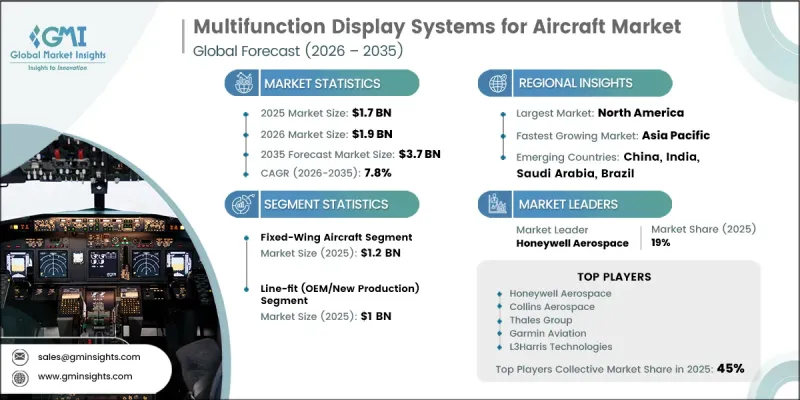
Growth in the Multifunction Display Systems for Aircraft Market is driven by evolving aviation regulations, increasing investments in cockpit modernization, and the rising demand for integrated avionics solutions across commercial, business, and defense aviation sectors. Aircraft operators and manufacturers are increasingly prioritizing advanced cockpit technologies that improve situational awareness, streamline flight operations, lower maintenance requirements, and support future connected and automated aviation capabilities. These factors are generating demand across both new aircraft production programs and retrofit installations. In addition, defense aviation continues to represent a significant source of revenue as military organizations invest in upgrading aging aircraft fleets with modern digital cockpit technologies. The transition from legacy flight instrumentation to advanced display architectures is enhancing operational efficiency, mission effectiveness, and pilot decision-making capabilities. At the same time, increasing global aircraft production levels are creating a strong foundation for sustained demand, supporting continued adoption of multifunction display systems across a broad range of aviation platforms worldwide.
| Market Scope | |
|---|---|
| Start Year | 2025 |
| Forecast Year | 2026-2035 |
| Start Value | $1.7 Billion |
| Forecast Value | $3.7 Billion |
| CAGR | 7.8% |
The fixed-wing aircraft segment accounted for USD 1.2 billion in 2025. The segment's leadership position is supported by widespread deployment across commercial aviation fleets and military aircraft modernization initiatives. Fixed-wing platforms continue to play a critical role in transportation, surveillance, and defense operations due to their operational versatility, efficiency, and payload capabilities. Ongoing investments in advanced aerospace technologies, fuel-efficient aircraft designs, and fleet modernization programs are expected to support continued growth across this segment.
The line-fit, or OEM/new production segment, generated USD 1 billion in 2025. Growth within this segment is being fueled by increasing aircraft manufacturing activity and the incorporation of sophisticated avionics technologies during the original production phase. Rising investments in next-generation aircraft programs, combined with growing demand for enhanced operational performance and efficiency, continue to strengthen the adoption of factory-installed multifunction display systems. Advancements in aerospace manufacturing processes and long-term fleet renewal initiatives are also contributing to sustained segment expansion.
United States Multifunction Display Systems for Aircraft Market reached USD 589.3 million in 2025, supported by extensive military avionics procurement programs, a large commercial aviation sector, and significant retrofit activity within business aviation. The combination of these demand sources creates a diversified market environment where revenue opportunities extend across defense contractors, commercial aircraft manufacturers, avionics suppliers, and aftermarket service providers, supporting continued industry development.
Key companies operating in the Multifunction Display Systems for Aircraft Market include Collins Aerospace, Honeywell Aerospace, Garmin Aviation, Thales Group, BAE Systems, Northrop Grumman, Elbit Systems, Leonardo DRS, Astronautics Corporation of America, ScioTeq, Aspen Avionics, Avidyne Corporation, Dynon Avionics, BendixKing, Genesys Aerosystems, Radiant Power, Safran Electronics & Defense, and L3Harris Technologies. Companies operating in the Multifunction Display Systems for Aircraft Market are focusing on technological innovation, strategic partnerships, and product portfolio expansion to strengthen their competitive position. Significant investments are being directed toward the development of advanced avionics platforms featuring enhanced display quality, greater system integration, improved connectivity, and support for next-generation flight operations. Many market participants are collaborating with aircraft manufacturers, defense organizations, and aviation operators to secure long-term supply agreements and expand their presence across both OEM and retrofit segments. Companies are also emphasizing software enhancements, cybersecurity capabilities, and digital cockpit solutions to address evolving operational requirements.
Table of Contents
Chapter 1 Methodology and Scope
- 1.1 Market scope and definition
- 1.2 Research design
- 1.2.1 Research approach
- 1.2.2 Data collection methods
- 1.3 Data mining sources
- 1.3.1 Global
- 1.3.2 Regional/Country
- 1.4 Base estimates and calculations
- 1.4.1 Base year calculation
- 1.4.2 Key trends for market estimation
- 1.5 Primary research and validation
- 1.5.1 Primary sources
- 1.6 Forecast model
- 1.7 Research assumptions and limitations
Chapter 2 Executive Summary
- 2.1 Industry 360° synopsis, 2022 - 2035
- 2.2 Key market trends
- 2.2.1 Display Technology trends
- 2.2.2 Platform trends
- 2.2.3 Fitment Type trends
- 2.2.4 End-user industry trends
- 2.2.5 Regional trends
- 2.3 TAM Analysis, 2026-2035
- 2.4 CXO perspectives: Strategic imperatives
Chapter 3 Industry Insights
- 3.1 Industry ecosystem analysis
- 3.1.1 Supplier Landscape
- 3.1.2 Profit Margin
- 3.1.3 Cost structure
- 3.1.4 Value addition at each stage
- 3.1.5 Factor affecting the value chain
- 3.1.6 Disruptions
- 3.2 Industry impact forces
- 3.2.1 Growth drivers
- 3.2.1.1 Increasing modernization of aircraft cockpit systems and avionics technologies
- 3.2.1.2 Growing adoption of next-generation commercial and business aircraft
- 3.2.1.3 Expansion of defense aviation modernization programs
- 3.2.1.4 Rising integration of connected cockpit and smart avionics technologies
- 3.2.1.5 Technological advancements in display processing and touchscreen interfaces
- 3.2.2 Industry pitfalls and challenges
- 3.2.2.1 High certification and development costs
- 3.2.2.2 Complex avionics integration requirements
- 3.2.3 Market opportunities
- 3.2.3.1 Growing demand for urban air mobility and autonomous aircraft
- 3.2.3.2 Increasing retrofit and aircraft upgrade activities
- 3.2.1 Growth drivers
- 3.3 Growth potential analysis
- 3.4 Pricing Analysis (Driven by Primary Research)
- 3.4.1 Historical Price Trend Analysis
- 3.4.2 Pricing Strategy by Player Type (Premium / Value / Cost-plus)
- 3.5 Regulatory landscape
- 3.5.1 North America
- 3.5.2 Europe
- 3.5.3 Asia Pacific
- 3.5.4 Latin America
- 3.5.5 Middle East & Africa
- 3.6 Porter’s analysis
- 3.7 PESTEL analysis
- 3.8 Technology and Innovation landscape
- 3.8.1 Current technological trends
- 3.8.2 Emerging technologies
- 3.9 Emerging Business Models
- 3.10 Compliance Requirements
- 3.11 Patent and IP analysis
- 3.12 Trade Data Analysis (Based on Paid Database)
- 3.12.1 Import/Export Volume & Value Trends
- 3.12.2 Key Trade Corridors & Tariff Impact
- 3.13 Impact of AI & Generative AI on the Market (Driven by Primary Research)
- 3.13.1 AI-Driven Disruption of Existing Business Models
- 3.13.2 GenAI Use Cases & Adoption Roadmap by Segment
- 3.14 Capacity & Production Landscape (Driven by Primary Research)
- 3.14.1 Production Capacity by Key Producer
- 3.14.2 Capacity Utilization Rates & Expansion Pipelines
Chapter 4 Competitive Landscape, 2025
- 4.1 Introduction
- 4.2 Company market share analysis, 2025
- 4.2.1 By Region
- 4.2.1.1 North America
- 4.2.1.2 Europe
- 4.2.1.3 Asia-Pacific
- 4.2.1.4 Latin America
- 4.2.1.5 Middle East and Africa
- 4.2.2 Market Concentration Analysis
- 4.2.1 By Region
- 4.3 Competitive analysis of major market players
- 4.4 Competitive positioning matrix
- 4.5 Key developments
- 4.5.1 Mergers & acquisitions
- 4.5.2 Partnerships & collaborations
- 4.5.3 New product launches
- 4.5.4 Expansion plans and funding
- 4.6 Company tier benchmarking
- 4.6.1 Tier classification criteria & qualifying thresholds
- 4.6.2 Tier positioning matrix by revenue, geography & innovation
Chapter 5 Market Estimates and Forecast, By Display Technology, 2022 - 2035 (USD Billion)
- 5.1 Key trends
- 5.2 LCD/AMLCD (Liquid Crystal Display/Active Matrix LCD)
- 5.3 OLED (Organic Light-Emitting Diode)
- 5.4 MicroLED
- 5.5 Other Display Technologies
Chapter 6 Market Estimates and Forecast, By Platform, 2022 - 2035 (USD Billion)
- 6.1 Key trends
- 6.2 Fixed-Wing Aircraft
- 6.3 Rotary-Wing Aircraft
- 6.4 Unmanned Aerial Vehicles (UAVs/UAS)
Chapter 7 Market Estimates and Forecast, By Fitment Type, 2022 - 2035 (USD Billion)
- 7.1 Key trends
- 7.2 Line-Fit (OEM/New Production)
- 7.3 Retrofit (Aftermarket/Upgrade)
Chapter 8 Market Estimates and Forecast, By End-User Industry, 2022 - 2035 (USD Billion)
- 8.1 Key trends
- 8.2 Commercial Aviation
- 8.3 Military Aviation
- 8.4 Business & General Aviation
- 8.5 Others
Chapter 9 Market Estimates and Forecast, By Region, 2022 - 2035 (USD Billion)
- 9.1 Key trends
- 9.2 North America
- 9.2.1 U.S.
- 9.2.2 Canada
- 9.3 Europe
- 9.3.1 Germany
- 9.3.2 UK
- 9.3.3 France
- 9.3.4 Spain
- 9.3.5 Italy
- 9.4 Asia Pacific
- 9.4.1 China
- 9.4.2 India
- 9.4.3 Japan
- 9.4.4 Australia
- 9.4.5 South Korea
- 9.5 Latin America
- 9.5.1 Brazil
- 9.5.2 Mexico
- 9.5.3 Argentina
- 9.6 Middle East and Africa
- 9.6.1 South Africa
- 9.6.2 Saudi Arabia
- 9.6.3 UAE
Chapter 10 Company Profiles
- 10.1 Global Key Players
- 10.1.1 Honeywell Aerospace
- 10.1.2 Collins Aerospace
- 10.1.3 Thales Group
- 10.1.4 Garmin Aviation
- 10.1.5 L3Harris Technologies
- 10.2 Regional key players
- 10.2.1 North America
- 10.2.1.1 Astronautics Corporation of America
- 10.2.1.2 Avidyne Corporation
- 10.2.1.3 Aspen Avionics
- 10.2.1.4 Dynon Avionics
- 10.2.2 Asia Pacific
- 10.2.2.1 Elbit Systems
- 10.2.2.2 Safran Electronics & Defense
- 10.2.3 Europe
- 10.2.3.1 BAE Systems
- 10.2.3.2 Leonardo DRS
- 10.3 Niche Players/Disruptors
- 10.3.1 ScioTeq
- 10.3.2 Genesys Aerosystems
- 10.2.1 North America

