PUBLISHER: Global Market Insights Inc. | PRODUCT CODE: 2083257

PUBLISHER: Global Market Insights Inc. | PRODUCT CODE: 2083257
Electronic Warfare Systems Market Opportunity, Growth Drivers, Industry Trend Analysis, and Forecast 2026 - 2035
The Global Electronic Warfare Systems Market was valued at USD 16.9 billion in 2025 and is estimated to grow at a CAGR of 12.8% to reach USD 55.8 billion by 2035.
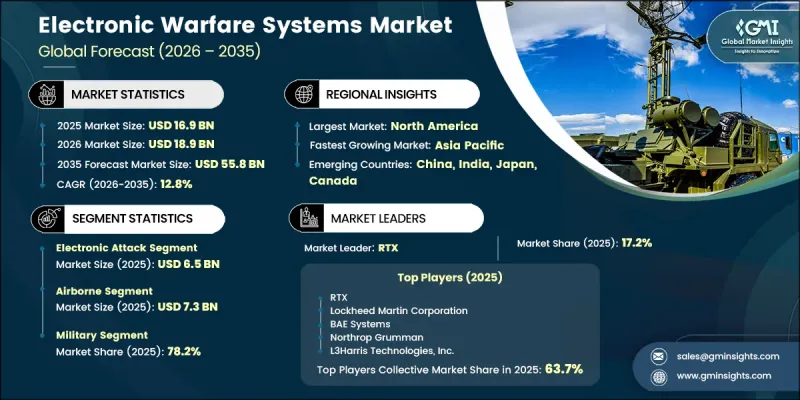
The electronic warfare systems market is experiencing strong expansion as modern defense strategies increasingly prioritize control and dominance of the electromagnetic spectrum. Governments and defense organizations are significantly increasing investments in electronic attack, electronic protection, and electronic support capabilities to enhance operational effectiveness in highly contested environments. The growing emphasis on spectrum superiority initiatives is accelerating procurement of next-generation electronic warfare technologies across allied defense networks. Ongoing military modernization programs and the global transition toward multi-domain operations are further supporting market growth. Armed forces are increasingly integrating electronic warfare capabilities across land, air, naval, space, and cyber domains to improve situational awareness, communication resilience, and mission effectiveness. Rising exposure to advanced threats such as unmanned systems, autonomous platforms, and electronic disruption techniques is further strengthening demand. The integration of artificial intelligence and machine learning is also reshaping the market by enabling cognitive electronic warfare systems capable of automated threat detection, classification, and response in complex electromagnetic environments.
| Market Scope | |
|---|---|
| Start Year | 2025 |
| Forecast Year | 2026-2035 |
| Start Value | $16.9 Billion |
| Forecast Value | $55.8 Billion |
| CAGR | 12.8% |
The electronic attack segment accounted for USD 6.5 billion in 2025. This segment's growth is driven by the rising deployment of jamming systems, electronic countermeasures, anti-radiation technologies, and suppression of enemy air defense capabilities. Electronic attack solutions are widely used to disrupt radar systems, communication networks, navigation signals, and command and control infrastructure. Increasing adoption of stand-off jamming technologies and platform-based electronic warfare systems across airborne, naval, and ground applications continues to strengthen segment expansion.
The military segment held a 78.2% share in 2025. This dominance is supported by rising defense budgets, increased geopolitical tensions, and the growing need for spectrum dominance in modern combat scenarios. Defense forces are expanding investments in electronic attack, electronic protection, and electronic support systems to counter evolving threats from advanced radar systems, drones, missiles, and communication networks. Electronic warfare plays a critical role in intelligence gathering, targeting, situational awareness, air and missile defense, and force protection across all operational domains.
North America Electronic Warfare Systems Market accounted for 43.2% share in 2025, owing to strong defense spending and large-scale modernization initiatives. The region continues to prioritize advancements in spectrum dominance technologies as part of broader military capability upgrades. Continuous investment in improving electronic attack, protection, and support systems is further enhancing operational readiness and reinforcing technological superiority across defense platforms.
Major companies operating in the global electronic warfare systems market include Northrop Grumman, L3Harris Technologies, Lockheed Martin Corporation, BAE Systems, RTX, Thales, Leonardo S.p.A., SAAB, Elbit Systems Ltd., Hensoldt AG, Indra Sistemas, S.A., Rheinmetall AG, Kongsberg Defence & Aerospace, ASELSAN A.S., Bharat Electronics Limited, China Electronics Technology Group Corporation, EDGE Group PJSC, Hanwha Systems Co., Ltd., IAI (Israel Aerospace Industries), and Mitsubishi Electric Corporation. Companies operating in the electronic warfare systems market are strengthening their competitive position through continuous investment in advanced signal processing technologies, artificial intelligence integration, and next-generation spectrum management solutions. Market participants are focusing on enhancing system interoperability across multi-domain defense platforms, enabling seamless coordination between air, land, naval, space, and cyber operations. Strategic partnerships with defense agencies and government organizations are supporting the development of advanced electronic warfare capabilities tailored to evolving threat environments. Companies are also investing in modular and scalable system architectures to improve deployment flexibility across multiple platforms.
Table of Contents
Chapter 1 Methodology and Scope
- 1.1 Market scope and definition
- 1.2 Research design
- 1.2.1 Research approach
- 1.2.2 Data collection methods
- 1.3 Data mining sources
- 1.3.1 Global
- 1.3.2 Regional/Country
- 1.4 Base estimates and calculations
- 1.4.1 Base year calculation
- 1.4.2 Key trends for market estimation
- 1.5 Primary research and validation
- 1.5.1 Primary sources
- 1.6 Forecast model
- 1.7 Research assumptions and limitations
Chapter 2 Executive Summary
- 2.1 Industry 360° synopsis, 2022 - 2035
- 2.2 Key market trends
- 2.2.1 Type trends
- 2.2.2 Platform trends
- 2.2.3 End-user trends
- 2.2.4 Regional trends
- 2.3 TAM Analysis, 2026-2035
- 2.4 CXO perspectives: Strategic imperatives
Chapter 3 Industry Insights
- 3.1 Industry ecosystem analysis
- 3.1.1 Supplier Landscape
- 3.1.2 Profit Margin
- 3.1.3 Cost structure
- 3.1.4 Value addition at each stage
- 3.1.5 Factor affecting the value chain
- 3.1.6 Disruptions
- 3.2 Industry impact forces
- 3.2.1 Growth drivers
- 3.2.1.1 Rising defense investments in electromagnetic spectrum dominance
- 3.2.1.2 Military modernization and multi-domain warfare programs
- 3.2.1.3 Growing demand for counter-drone and anti-UAS capabilities
- 3.2.1.4 Increasing NATO and allied interoperability initiatives
- 3.2.1.5 Adoption of AI-enabled and next-generation EW technologies
- 3.2.2 Industry pitfalls and challenges
- 3.2.2.1 High development and procurement costs
- 3.2.2.2 Rapidly evolving threat environment
- 3.2.3 Market opportunities
- 3.2.3.1 Expansion of AI-enabled cognitive electronic warfare systems
- 3.2.3.2 Growing deployment of counter-drone and autonomous defense solutions
- 3.2.1 Growth drivers
- 3.3 Growth potential analysis
- 3.4 Regulatory landscape
- 3.4.1 North America
- 3.4.2 Europe
- 3.4.3 Asia Pacific
- 3.4.4 Latin America
- 3.4.5 Middle East & Africa
- 3.5 Porter's analysis
- 3.6 PESTEL analysis
- 3.7 Technology and Innovation landscape
- 3.7.1 Current technological trends
- 3.7.2 Emerging technologies
- 3.8 Price trends
- 3.8.1 By region
- 3.8.2 By product
- 3.9 Pricing Strategies
- 3.10 Emerging Business Models
- 3.11 Compliance Requirements
- 3.12 Patent and IP analysis
Chapter 4 Competitive Landscape, 2025
- 4.1 Introduction
- 4.2 Company market share analysis
- 4.2.1 By region
- 4.2.1.1 North America
- 4.2.1.2 Europe
- 4.2.1.3 Asia Pacific
- 4.2.1.4 Latin America
- 4.2.1.5 Middle East & Africa
- 4.2.2 Market concentration analysis
- 4.2.1 By region
- 4.3 Competitive benchmarking of key players
- 4.3.1 Financial performance comparison
- 4.3.1.1 Revenue
- 4.3.1.2 Profit margin
- 4.3.1.3 R&D
- 4.3.2 Product portfolio comparison
- 4.3.2.1 Product range breadth
- 4.3.2.2 Technology
- 4.3.2.3 Innovation
- 4.3.3 Geographic presence comparison
- 4.3.3.1 Global footprint analysis
- 4.3.3.2 Service network coverage
- 4.3.3.3 Market penetration by region
- 4.3.4 Competitive positioning matrix
- 4.3.4.1 Leaders
- 4.3.4.2 Challengers
- 4.3.4.3 Followers
- 4.3.4.4 Niche players
- 4.3.5 Strategic outlook matrix
- 4.3.1 Financial performance comparison
- 4.4 Key developments
- 4.4.1 Mergers and acquisitions
- 4.4.2 Partnerships and collaborations
- 4.4.3 Technological advancements
- 4.4.4 Expansion and investment strategies
- 4.4.5 Digital transformation initiatives
- 4.5 Emerging/ startup competitors landscape
Chapter 5 Market Estimates and Forecast, By Type, 2022 - 2035 (USD Million)
- 5.1 Key trends
- 5.2 Electronic Attack
- 5.2.1 Radar jammers
- 5.2.2 Communication jammers
- 5.2.3 GNSS jammers
- 5.2.4 Directed energy weapons
- 5.2.5 Anti-radiation missiles
- 5.2.6 Decoy systems
- 5.2.7 Others
- 5.3 Electronic Protection
- 5.3.1 Self-protection suites
- 5.3.2 Infrared countermeasure systems (DIRCM)
- 5.3.3 Radar absorbing materials & stealth coatings
- 5.3.4 Frequency hopping & spread spectrum modules
- 5.3.5 Others
- 5.4 Electronic Support
- 5.4.1 Radar warning receivers (RWR)
- 5.4.2 Missile approach warning systems (MAWS)
- 5.4.3 Electronic intelligence (ELINT) receivers
- 5.4.4 Communication intelligence (COMINT) receivers
- 5.4.5 Direction finding systems & signal analysers
- 5.4.6 Electronic surveillance
- 5.4.7 Others
Chapter 6 Market Estimates and Forecast, By Platform, 2022 - 2035 (USD Million)
- 6.1 Key trends
- 6.2 Airborne
- 6.3 Naval
- 6.4 Ground
- 6.5 Space
Chapter 7 Market Estimates and Forecast, By End-User, 2022 - 2035 (USD Million)
- 7.1 Key trends
- 7.2 Military
- 7.3 Homeland Security
- 7.4 Commercial
Chapter 8 Market Estimates and Forecast, By Region, 2022 - 2035 (USD Million)
- 8.1 Key trends
- 8.2 North America
- 8.2.1 U.S.
- 8.2.2 Canada
- 8.3 Europe
- 8.3.1 Germany
- 8.3.2 UK
- 8.3.3 France
- 8.3.4 Spain
- 8.3.5 Italy
- 8.3.6 Netherlands
- 8.4 Asia Pacific
- 8.4.1 China
- 8.4.2 India
- 8.4.3 Japan
- 8.4.4 Australia
- 8.4.5 South Korea
- 8.5 Latin America
- 8.5.1 Brazil
- 8.5.2 Mexico
- 8.5.3 Argentina
- 8.6 Middle East and Africa
- 8.6.1 South Africa
- 8.6.2 Saudi Arabia
- 8.6.3 UAE
Chapter 9 Company Profiles
- 9.1 Global Key Players
- 9.1.1 RTX
- 9.1.2 BAE Systems
- 9.1.3 Northrop Grumman
- 9.1.4 L3Harris Technologies, Inc.
- 9.2 Regional key players
- 9.2.1 North America
- 9.2.1.1 Lockheed Martin Corporation
- 9.2.2 Asia Pacific
- 9.2.2.1 China Electronics Technology Group Corporation
- 9.2.2.2 Bharat Electronics Limited
- 9.2.2.3 Hanwha Systems Co., Ltd.
- 9.2.2.4 Mitsubishi Electric Corporation
- 9.2.3 Europe
- 9.2.3.1 Thales
- 9.2.3.2 Leonardo S.p.A.
- 9.2.3.3 Rheinmetall AG
- 9.2.3.4 Kongsberg Defence & Aerospace
- 9.2.3.5 SAAB
- 9.2.3.6 Indra Sistemas, S.A.
- 9.2.3.7 Hensoldt AG
- 9.2.1 North America
- 9.3 Niche Players/Disruptors
- 9.3.1 EDGE Group PJSC
- 9.3.2 Elbit Systems Ltd.
- 9.3.3 IAI
- 9.3.4 ASELSAN A.S.

