PUBLISHER: Global Market Insights Inc. | PRODUCT CODE: 2083268

PUBLISHER: Global Market Insights Inc. | PRODUCT CODE: 2083268
Tubeless Insulin Pump Market Opportunity, Growth Drivers, Industry Trend Analysis, and Forecast 2026 - 2035
The Global Tubeless Insulin Pump Market was valued at USD 2.2 billion in 2025 and is estimated to grow at a CAGR of 19.1% to reach USD 12 billion by 2035.
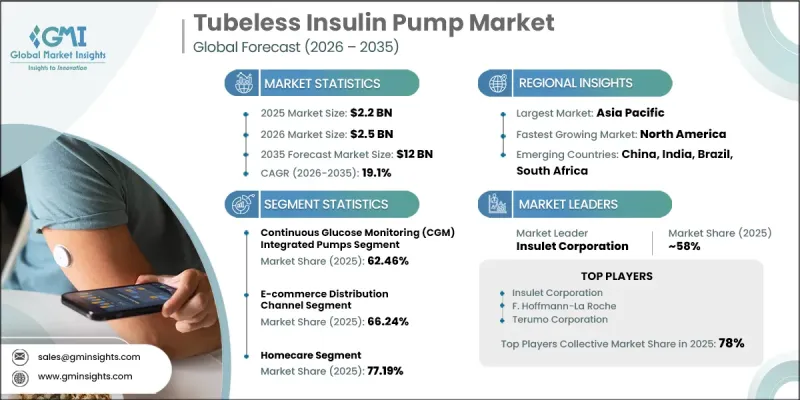
The market is expanding rapidly due to strong clinician and patient preference for tubeless, on-body patch pump systems that improve glycemic control, treatment adherence, and overall quality of life compared to traditional tethered insulin delivery methods. Increasing reimbursement support across key healthcare systems, particularly in the United States and Germany, combined with regulatory approvals for hybrid closed-loop systems that integrate continuous glucose monitoring with tubeless insulin delivery, is significantly lowering cost barriers that previously limited adoption to premium patient groups. The growing convergence of CGM integration, compact patch-based pump designs, and expanding digital diabetes management ecosystems is positioning tubeless insulin delivery as a mainstream clinical standard for ambulatory intensive insulin therapy in both Type 1 and insulin-dependent Type 2 diabetes populations. The global rise in diabetes prevalence continues to serve as the fundamental demand driver for this market. The integration of continuous glucose monitoring with tubeless pump systems is widely recognized as one of the most impactful advancements in modern diabetes care, reshaping long-term disease management approaches and improving patient outcomes at scale.
| Market Scope | |
|---|---|
| Start Year | 2025 |
| Forecast Year | 2026-2035 |
| Start Value | $2.2 Billion |
| Forecast Value | $12 Billion |
| CAGR | 19.1% |
The tubeless insulin pump market is further supported by continuous innovation in automated insulin delivery systems and smart diabetes management technologies. Increasing reliance on data-driven healthcare solutions is enabling more precise insulin dosing, real-time glucose monitoring, and improved predictive analytics for hypoglycemia prevention. Expanding adoption of digital health platforms is also enhancing remote patient monitoring and personalized therapy adjustments. These advancements are contributing to improved clinical outcomes, reduced disease complications, and greater patient independence in diabetes management. As healthcare systems continue to prioritize chronic disease management efficiency, demand for advanced tubeless insulin delivery systems is expected to strengthen globally.
The CGM-integrated tubeless pump segment accounted for 62.46% share in 2025, establishing it as the leading technology category. This dominance is driven by the strong clinical performance of integrated automated insulin delivery systems that combine continuous glucose monitoring with real-time insulin adjustment capabilities. The segment's growth is further supported by advanced algorithm-driven features that enhance treatment precision, including predictive glucose control, adaptive insulin modulation based on activity levels, and automated correction mechanisms. These innovations have demonstrated measurable improvements in glycemic outcomes, including reductions in HbA1c levels and fewer hypoglycemic events, reinforcing widespread clinical adoption across patient populations.
The e-commerce distribution channel held a 66.24% share in 2025, reflecting the increasing shift toward digital healthcare delivery models. This channel has become a key driver of market expansion due to its ability to streamline product access, improve supply continuity, and support subscription-based consumable delivery systems. Direct-to-patient distribution platforms enable manufacturers to maintain closer engagement with users while improving adherence tracking and service efficiency. The growing preference for online healthcare purchasing models is also enhancing operational transparency and reducing dependency on traditional intermediary distribution networks.
North America Tubeless Insulin Pump Market held 44.2% share in 2025 and is projected to grow at a CAGR of 17.3% during 2026-2035. The region's strong position is supported by high adoption rates of insulin pump therapies, advanced healthcare infrastructure, and well-established reimbursement systems. Coverage frameworks under public and private insurance programs have significantly improved patient access to tubeless insulin pump technologies, reducing financial barriers and expanding eligible user populations. Increasing integration of advanced diabetes care solutions into standard treatment protocols continues to reinforce regional market leadership.
Key companies operating in the Global Tubeless Insulin Pump Market include Insulet Corporation, F. Hoffmann-La Roche, Roche Diabetes Care, and Terumo Corporation. Companies operating in the tubeless insulin pump market are focusing on technological innovation, digital ecosystem expansion, and strategic healthcare partnerships to strengthen their competitive position. Continuous investment in automated insulin delivery algorithms, AI-powered glucose prediction systems, and next-generation CGM integration is enhancing product performance and clinical accuracy. Manufacturers are expanding direct-to-patient digital platforms to improve distribution efficiency and strengthen recurring revenue models. Strategic collaborations with healthcare providers and payers are supporting wider reimbursement coverage and improved patient access. Companies are also prioritizing user-centric design improvements, enhanced connectivity features, and seamless integration with mobile health applications to improve patient engagement. Expansion into emerging healthcare markets, combined with regulatory approvals and clinical validation studies, is further reinforcing long-term market positioning and accelerating global adoption of tubeless insulin pump technologies.
Table of Contents
Chapter 1 Methodology & Scope
- 1.1 Research approach
- 1.2 Quality commitments
- 1.2.1 GMI AI policy & data integrity commitment
- 1.2.1.1 Source consistency protocol
- 1.2.1 GMI AI policy & data integrity commitment
- 1.3 Research trail & confidence scoring
- 1.3.1 Research trail components
- 1.3.2 Scoring components
- 1.4 Data collection
- 1.4.1 Partial list of primary sources
- 1.5 Data mining sources
- 1.5.1 Paid sources
- 1.5.1.1 Sources, by region
- 1.5.1 Paid sources
- 1.6 Base estimates and calculations
- 1.6.1 Base year calculation for any one approach
- 1.7 Market estimates & forecasts parameters
- 1.8 Forecast model
- 1.8.1 Quantified market impact analysis
- 1.8.1.1 Mathematical impact of growth parameters on forecast
- 1.8.1 Quantified market impact analysis
- 1.9 Research transparency addendum
- 1.9.1 Source attribution framework
- 1.9.2 Quality assurance metrics
- 1.9.3 Our commitment to trust
- 1.10 Market definitions
Chapter 2 Executive Summary
- 2.1 Industry synopsis, 2022 - 2035
- 2.1.1 Business trends
- 2.1.2 Technology trends
- 2.1.3 Distribution channel trends
- 2.1.4 End use trends
- 2.1.5 Regional trends
Chapter 3 Industry Insights
- 3.1 Industry ecosystem analysis
- 3.2 Industry impact forces
- 3.2.1 Growth drivers
- 3.2.1.1 Global Diabetes Burden Expanding the Addressable Market for Intensive Insulin Delivery
- 3.2.1.2 CGM Integration Enabling Automated and Hybrid Closed-Loop Insulin Delivery Systems
- 3.2.1.3 Favourable Reimbursement Policies and Regulatory Frameworks in High-Income Markets
- 3.2.1.4 Patient-Led Preference for Discreet, Wearable, Catheter-Free Delivery Architectures
- 3.2.2 Industry pitfalls and challenges
- 3.2.2.1 High Device and Consumable Costs Limiting Adoption in Price-Sensitive Markets
- 3.2.2.2 Regulatory Complexity and Extended Approval Timelines for Class III Medical Devices
- 3.2.2.3 Limited Diabetes Management Infrastructure in Low- and Middle-Income Countries
- 3.2.3 Market opportunities
- 3.2.3.1 Expansion in Emerging Markets
- 3.2.3.2 Pediatric and Elderly Segment Growth
- 3.2.1 Growth drivers
- 3.3 Growth potential analysis
- 3.4 Regulatory landscape (Driven by primary research)
- 3.4.1 North America
- 3.4.2 Europe
- 3.4.3 Asia Pacific
- 3.4.4 Latin America
- 3.4.5 MEA
- 3.5 Technology landscape
- 3.5.1 Current technological trends
- 3.5.2 Emerging technologies
- 3.6 Pricing trend analysis (Driven by primary research)
- 3.7 Future market trends
- 3.8 Patent analysis
- 3.9 Porter's analysis
- 3.10 PESTEL analysis
- 3.11 Impact of AI and Generative AI on the market (Driven by primary research)
- 3.12 Value chain analysis (Driven by primary research)
- 3.13 Investment & funding analysis (Driven by primary research)
- 3.14 Consumer insights (Driven by primary research)
Chapter 4 Competitive Landscape, 2026
- 4.1 Introduction
- 4.2 Company market share analysis, by region, 2025
- 4.2.1 North America
- 4.2.2 Europe
- 4.2.3 Asia Pacific
- 4.2.4 Middle East & Africa
- 4.2.5 Latin America
- 4.3 Key developments
- 4.3.1 Key partnerships & collaborations
- 4.3.2 Major M&A activities
- 4.3.3 Product innovations & launches
- 4.3.4 Market expansion strategies
- 4.4 Competitive positioning matrix
Chapter 5 Market Size and Forecast, By Technology, 2022 - 2035 (USD Million)
- 5.1 Key trends
- 5.2 Continuous glucose monitoring (CGM) integrated pumps
- 5.3 Standard tubeless pumps
Chapter 6 Market Size and Forecast, By Distribution Channel, 2022 - 2035 (USD Million)
- 6.1 Key trends
- 6.2 Brick and mortar
- 6.3 E-commerce
Chapter 7 Market Size and Forecast, By End Use, 2022 - 2035 (USD Million)
- 7.1 Key trends
- 7.2 Homecare
- 7.3 Hospitals and clinics
- 7.4 Other end users
Chapter 8 Market Size and Forecast, By Region, 2022 - 2035 (USD Million)
- 8.1 Key trends
- 8.2 North America
- 8.2.1 U.S.
- 8.2.2 Canada
- 8.3 Europe
- 8.3.1 Germany
- 8.3.2 France
- 8.3.3 UK
- 8.3.4 Netherlands
- 8.3.5 Spain
- 8.3.6 Italy
- 8.4 Asia Pacific
- 8.4.1 China
- 8.4.2 Japan
- 8.4.3 South Korea
- 8.4.4 India
- 8.4.5 Australia
- 8.5 Middle East & Africa
- 8.5.1 Saudi Arabia
- 8.5.2 UAE
- 8.5.3 South Africa
- 8.6 Latin America
- 8.6.1 Brazil
- 8.6.2 Argentina
- 8.6.3 Mexico
Chapter 9 Company Profiles
- 9.1 Debiotech
- 9.2 EOFlow
- 9.3 Insulet Corporation
- 9.4 Medtrum Technologies
- 9.5 MicroTech Medical
- 9.6 Pharmasens
- 9.7 F. Hoffmann-La Roche
- 9.8 Terumo Corporation

