PUBLISHER: Global Market Insights Inc. | PRODUCT CODE: 2083270

PUBLISHER: Global Market Insights Inc. | PRODUCT CODE: 2083270
Renal Denervation Market Opportunity, Growth Drivers, Industry Trend Analysis, and Forecast 2026 - 2035
The Global Renal Denervation Market was valued at USD 550 million in 2025 and is estimated to grow at a CAGR of 27.8% to reach USD 6.4 billion by 2035.
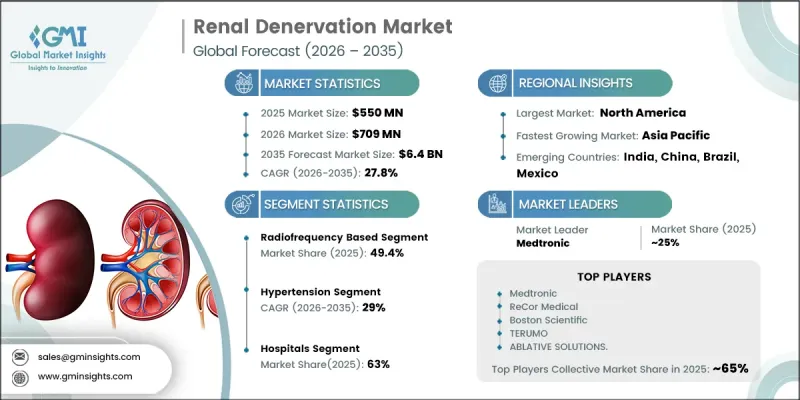
The remarkable growth trajectory places the renal denervation market among the fastest-growing segments within the broader cardiovascular device industry. Market expansion is being driven by a significant shift in the treatment approach for resistant hypertension, as healthcare providers increasingly adopt minimally invasive interventional procedures as an alternative to long-term medication intensification. Growing awareness of uncontrolled hypertension and its associated health risks is encouraging broader acceptance of renal denervation technologies among physicians and healthcare systems. Continuous technological advancements, expanding clinical validation, and increasing confidence in long-term treatment outcomes are further strengthening market momentum. In addition, favorable regulatory developments and expanding commercialization efforts across major healthcare markets are supporting wider adoption. The addressable patient population continues to increase due to demographic changes, rising rates of lifestyle-related health conditions, and the growing prevalence of chronic cardiovascular risk factors. By targeting the underlying mechanisms involved in blood pressure regulation, renal denervation offers a promising therapeutic option for patients who do not achieve optimal outcomes through conventional treatment approaches, supporting sustained market growth throughout the forecast period.
| Market Scope | |
|---|---|
| Start Year | 2025 |
| Forecast Year | 2026-2035 |
| Start Value | $550 Million |
| Forecast Value | $6.4 Billion |
| CAGR | 27.8% |
The radiofrequency-based technology segment held 49.4% share and is projected to grow at a CAGR of 29% through 2035. The segment's leadership position is attributed to its earlier commercialization, extensive clinical experience, and broad acceptance among healthcare professionals. Continued advancements in device design and procedural efficiency have strengthened adoption, while growing clinical evidence supporting safety and effectiveness continues to reinforce physician confidence. Technology enables targeted treatment delivery designed to achieve more comprehensive denervation outcomes, contributing to its strong market position and future growth potential.
The hospitals segment held a 63% share in 2025 and is expected to grow at a CAGR of 29% through 2035. The dominance of this segment reflects the specialized nature of renal denervation procedures, which require advanced imaging capabilities, dedicated cardiovascular care infrastructure, and comprehensive patient monitoring resources. High-volume healthcare facilities and specialized cardiovascular centers continue to perform many procedures due to their clinical expertise, multidisciplinary care teams, and ability to support complex interventional treatments.
North America Renal Denervation Market held 38.8% share and is projected to grow at a CAGR of 26.9% through 2035. The region's growth is supported by strong healthcare infrastructure, increasing physician awareness, expanding procedural adoption, and favorable regulatory developments. The United States represents the largest contributor to regional demand, benefiting from growing investment in advanced cardiovascular therapies and increasing integration of renal denervation programs within healthcare institutions. Improved reimbursement pathways and greater financial clarity for healthcare providers are also supporting wider adoption and long-term market expansion throughout the region.
Key companies operating in the global renal denervation market include Medtronic, Abbott, Boston Scientific, Johnson and Johnson, TERUMO, Recor Medical, Otsuka, VENUS MEDTECH, Mercator MedSystems, ABLATIVE SOLUTIONS, Symple Surgical, and SyMap Medical. Companies operating in the renal denervation market are implementing a variety of strategic initiatives to strengthen their competitive position and expand market presence. Significant investments in research and development remain a primary focus as manufacturers work to enhance procedural effectiveness, improve device performance, and simplify treatment delivery. Clinical trial expansion and evidence-generation programs continue to play a critical role in supporting physician adoption and demonstrating long-term therapeutic value. Strategic partnerships, collaborations with healthcare providers, and expansion of commercialization activities are helping companies increase market penetration and strengthen distribution networks. Many organizations are also investing in physician education programs, training initiatives, and awareness campaigns to accelerate procedural adoption.
Table of Contents
Chapter 1 Research Methodology
- 1.1 Market definitions and scope
- 1.2 Research approach
- 1.3 Quality commitments
- 1.3.1 GMI AI policy & data integrity commitment
- 1.3.1.1 Source consistency protocol
- 1.3.1 GMI AI policy & data integrity commitment
- 1.4 Research trail & confidence scoring
- 1.4.1 Research trail components
- 1.4.2 Scoring components
- 1.5 Data collection
- 1.5.1 Partial list of primary sources
- 1.6 Data mining sources
- 1.6.1 Paid sources
- 1.6.1.1 Sources, by region
- 1.6.1 Paid sources
- 1.7 Base estimates and calculations
- 1.7.1 Base year calculation
- 1.8 Forecast model
- 1.8.1 Quantified market impact analysis
- 1.8.1.1 Mathematical impact of growth parameters on forecast
- 1.8.1 Quantified market impact analysis
- 1.9 Research transparency addendum
- 1.9.1 Source attribution framework
- 1.9.2 Quality assurance metrics
- 1.9.3 Our commitment to trust
Chapter 2 Executive Summary
- 2.1 Industry 360° synopsis
- 2.2 Key market trends
- 2.2.1 Regional trends
- 2.2.2 Technology trends
- 2.2.3 Application trends
- 2.2.4 End use trends
- 2.3 CXO perspectives: Strategic imperatives
Chapter 3 Industry Insights
- 3.1 Industry ecosystem analysis
- 3.2 Industry impact forces
- 3.2.1 Growth drivers
- 3.2.1.1 Increasing Prevalence of Hypertension and Drug Resistant Hypertension
- 3.2.1.2 Rising Awareness About Minimally Invasive Procedures
- 3.2.1.3 Advancements in Renal Denervation Technologies
- 3.2.1.4 Favorable Clinical Trial Outcomes Showcasing Efficacy and Safety
- 3.2.2 Industry pitfalls and challenges
- 3.2.2.1 Concerns About Procedural Safety and Potential Complications
- 3.2.3 Opportunities
- 3.2.3.1 Integration of AI-driven precision technologies
- 3.2.3.2 Growing access in emerging markets
- 3.2.1 Growth drivers
- 3.3 Growth potential analysis
- 3.4 Regulatory landscape
- 3.5 Pricing trend analysis
- 3.6 Technology and innovation landscape (Driven by Primary Research)
- 3.6.1 Current technological trends
- 3.6.2 Emerging technologies
- 3.7 Future market trends (Driven by Primary Research)
- 3.8 Patent analysis
- 3.9 Reimbursement scenario
- 3.9.1 National Coverage Determinations(NCD) policy
- 3.10 Renal denervation procedure volume
- 3.11 Resistant hypertension epidemiology and patient population
- 3.12 Impact of AI & Generative AI on the Market (Driven by Primary Research)
- 3.13 Porter's analysis
- 3.14 PESTEL analysis
Chapter 4 Competitive Landscape, 2025
- 4.1 Introduction
- 4.2 Company matrix analysis
- 4.3 Company market share analysis (Driven by Primary Research)
- 4.3.1 Global
- 4.3.2 North America
- 4.3.3 Europe
- 4.3.4 Asia Pacific
- 4.3.5 LAMEA
- 4.4 Competitive analysis of major market players
- 4.5 Competitive positioning matrix
- 4.6 Key developments
- 4.6.1 Mergers & acquisitions
- 4.6.2 Partnerships & collaborations
- 4.6.3 New product launches
- 4.6.4 Expansion plans
Chapter 5 Market Estimates and Forecast, By Technology, 2022 - 2035 ($ Mn)
- 5.1 Key trends
- 5.2 Radiofrequency based
- 5.3 Ultrasound based
- 5.4 Micro-Infusion based
- 5.5 Other technologies
Chapter 6 Market Estimates and Forecast, By Application, 2022 - 2035 ($ Mn)
- 6.1 Key trends
- 6.2 Hypertension
- 6.3 Chronic kidney disease
- 6.4 Other applications
Chapter 7 Market Estimates and Forecast, By End Use, 2022 - 2035 ($ Mn)
- 7.1 Key trends
- 7.2 Hospitals
- 7.3 Ambulatory surgical centers
- 7.4 Specialty clinics
Chapter 8 Market Estimates and Forecast, By Region, 2022 - 2035 ($ Mn)
- 8.1 Key trends
- 8.2 North America
- 8.2.1 U.S.
- 8.2.2 Canada
- 8.3 Europe
- 8.3.1 Germany
- 8.3.2 UK
- 8.3.3 France
- 8.3.4 Spain
- 8.3.5 Italy
- 8.3.6 Netherlands
- 8.4 Asia Pacific
- 8.4.1 China
- 8.4.2 Japan
- 8.4.3 India
- 8.4.4 Australia
- 8.4.5 South Korea
- 8.5 Latin America
- 8.5.1 Brazil
- 8.5.2 Mexico
- 8.5.3 Argentina
- 8.6 MEA
- 8.6.1 South Africa
- 8.6.2 Saudi Arabia
- 8.6.3 UAE
Chapter 9 Company Profiles
- 9.1 Abbott
- 9.2 ABLATIVE SOLUTIONS
- 9.3 Boston Scientific
- 9.4 Johnson & Johnson
- 9.5 Medtronic
- 9.6 Mercator MedSystems
- 9.7 Otsuka
- 9.8 Recor
- 9.9 SyMap Medical
- 9.10 Symple Surgical
- 9.11 TERUMO
- 9.12 VENUS MEDTECH

