
PUBLISHER: Global Market Insights Inc. | PRODUCT CODE: 2083278

PUBLISHER: Global Market Insights Inc. | PRODUCT CODE: 2083278
Ride-Hailing Service Market Opportunity, Growth Drivers, Industry Trend Analysis, and Forecast 2026 - 2035
The Global Ride-Hailing Service Market was valued at USD 188.6 billion in 2025 and is estimated to grow at a CAGR of 9.7% to reach USD 489.5 billion by 2035.
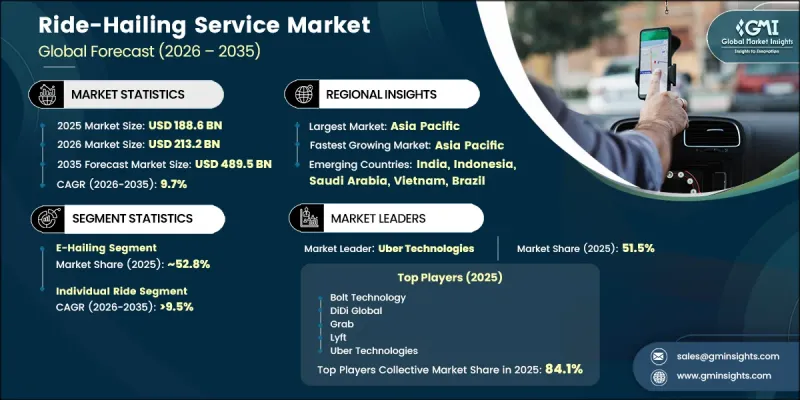
The ride-hailing service market is expanding as rapid urbanization, growing city populations, and increasing transportation challenges continue to reshape mobility preferences worldwide. Rising traffic congestion, limited parking availability, and higher vehicle ownership costs are encouraging consumers to adopt app-based transportation services that provide greater convenience and flexibility. Increasing smartphone adoption and broader internet accessibility have further accelerated the use of digital mobility platforms by allowing passengers to book rides instantly, monitor trips in real time, and complete secure digital payments through integrated applications. As mobile technology becomes more affordable and internet connectivity continues to improve, particularly across developing economies, access to ride-hailing platforms is expanding significantly. Growing consumer demand for efficient, technology-enabled transportation, combined with continuous advancements in digital mobility solutions, is creating favorable opportunities for market growth. These factors continue to strengthen the long-term outlook of the global ride-hailing service market, supported by rising demand for convenient, accessible, and on-demand transportation services.
| Market Scope | |
|---|---|
| Start Year | 2025 |
| Forecast Year | 2026-2035 |
| Start Value | $188.6 Billion |
| Forecast Value | $489.5 Billion |
| CAGR | 9.7% |
The e-hailing segment accounted for 52.8% share in 2025 and is expected to grow at a CAGR of 8.8% through 2035. This segment continues to dominate because it offers users a highly convenient and accessible transportation experience through mobile applications. E-hailing platforms enable passengers to request rides instantly, track vehicle locations in real time, make digital payments, and view transparent pricing before booking. Continued growth in smartphone ownership, improved internet connectivity, and increasing consumer demand for on-demand mobility services is expected to support the expansion of the e-hailing segment across both developed and emerging markets.
The individual ride segment represented 82.8% share in 2025 and is projected to grow at a CAGR of 9.5% between 2026 and 2035. This segment holds the largest market share because it provides passengers with private transportation, allowing individuals or personal travel groups to complete trips without sharing vehicles with other riders. Consumers continue to prefer individual ride services for their convenience, privacy, time efficiency, and overall travel comfort. Increasing urbanization, rising disposable incomes, and growing demand for personalized transportation experiences are expected to further strengthen the segment throughout the forecast period.
China Ride-Hailing Service Market held 52.2% share, generating USD 46.2 billion in 2025. Market growth is supported by the country's large urban population, widespread smartphone adoption, and highly developed digital payment ecosystem. Growing consumer preference for convenient urban mobility solutions, combined with the broad availability of app-based transportation platforms, continues to drive market expansion. In addition, ongoing advancements in artificial intelligence, real-time traffic management, and connected mobility technologies are improving service efficiency and enhancing the overall customer experience within the country's ride-hailing service market.
Major companies operating in the global ride-hailing service market include DiDi Global, Waymo, Bolt Technology, Grab, Lyft, GoTo, Uber Technologies, Careem Networks FZ, Yango, and inDrive. Companies operating in the ride-hailing service market are strengthening their competitive position by investing in advanced mobile technologies, artificial intelligence, and data analytics to improve operational efficiency and customer experience. Many service providers are expanding their geographic presence while enhancing platform capabilities through real-time route optimization, dynamic pricing, and improved driver-passenger matching systems. Strategic partnerships with payment providers, automotive companies, and technology firms are helping businesses broaden their service offerings and strengthen market reach. Companies are also focusing on customer retention through loyalty programs, subscription services, and personalized mobility solutions.
Table of Contents
Chapter 1 Methodology
- 1.1 Research approach
- 1.2 Quality Commitments
- 1.2.1 GMI AI policy & data integrity commitment
- 1.2.1.1 Source consistency protocol
- 1.2.1 GMI AI policy & data integrity commitment
- 1.3 Research Trail & Confidence Scoring
- 1.3.1 Research Trail Components
- 1.3.2 Scoring Components
- 1.4 Data Collection
- 1.4.1 Partial list of primary sources
- 1.5 Data mining sources
- 1.5.1 Paid sources
- 1.5.1.1 Sources, by region
- 1.5.1 Paid sources
- 1.6 Base estimates and calculations
- 1.6.1 Base year calculation
- 1.7 Forecast Model
- 1.7.1 Quantified market impact analysis
- 1.7.1.1 Mathematical impact of growth parameters on forecast
- 1.7.1 Quantified market impact analysis
- 1.8 Research transparency addendum
- 1.8.1 Source attribution framework
- 1.8.2 Quality assurance metrics
- 1.8.3 Our commitment to trust
Chapter 2 Executive Summary
- 2.1 Industry 360° synopsis, 2022 - 2035
- 2.2 Key market trends
- 2.2.1 Regional
- 2.2.2 Service
- 2.2.3 Vehicle type
- 2.2.4 Ride type
- 2.2.5 Propulsion
- 2.2.6 End-user
- 2.2.7 Payment mode
- 2.2.8 Distance
- 2.2.9 Booking channel
- 2.3 TAM Analysis, 2026-2035
- 2.4 CXO perspectives: Strategic imperatives
Chapter 3 Industry Insights
- 3.1 Industry ecosystem analysis
- 3.1.1 Supplier landscape
- 3.1.2 Profit margin analysis
- 3.1.3 Cost structure
- 3.1.4 Value addition at each stage
- 3.1.5 Factor affecting the value chain
- 3.1.6 Disruptions
- 3.2 Industry impact forces
- 3.2.1 Growth drivers
- 3.2.1.1 Rapid urbanization and traffic congestion
- 3.2.1.2 Increasing smartphone and internet penetration
- 3.2.1.3 Growing preference for on-demand transportation
- 3.2.1.4 Expansion of digital payment ecosystems
- 3.2.2 Industry pitfalls and challenges
- 3.2.2.1 Stringent regulatory and licensing requirements
- 3.2.2.2 Driver shortages and retention challenges
- 3.2.3 Market opportunities
- 3.2.3.1 Expansion into Tier-II and Tier-III cities
- 3.2.3.2 Development of autonomous ride-hailing services
- 3.2.3.3 Growth in corporate mobility solutions
- 3.2.3.4 Partnerships with public transportation systems
- 3.2.1 Growth drivers
- 3.3 Growth potential analysis
- 3.4 Technology and Innovation landscape
- 3.4.1 Current technological trends
- 3.4.2 Emerging technologies
- 3.5 Pricing Analysis (Driven by Primary Research)
- 3.5.1 Historical Price Trend Analysis
- 3.5.2 Pricing Strategy by Player Type (Premium / Value / Cost-plus)
- 3.6 Regulatory guideline
- 3.6.1 North America
- 3.6.1.1 U.S.: Transportation Network Company (TNC) Regulations & Driver Background Check Requirements
- 3.6.1.2 Canada: Provincial Ride-Hailing Licensing Frameworks & Passenger Safety Regulations.
- 3.6.2 Europe
- 3.6.2.1 Germany: Passenger Transportation Act (PBefG) & Ride-Hailing Operational Regulations
- 3.6.2.2 UK: Private Hire Vehicle (PHV) Licensing Regulations & Transport for London (TfL) Compliance Framework
- 3.6.2.3 France: Mobility Orientation Law (LOM) & VTC Licensing Requirements
- 3.6.2.4 Italy: Non-Scheduled Public Transport Regulations & Digital Mobility Compliance Standards
- 3.6.3 Asia Pacific
- 3.6.3.1 China: Online Ride-Hailing Service Administrative Measures & Data Security Regulations
- 3.6.3.2 India: Motor Vehicle Aggregator Guidelines, 2020 & Digital Transportation Platform Regulations
- 3.6.3.3 Japan: Road Transportation Act & Ride-Sharing Operational Guidelines
- 3.6.3.4 South Korea: Passenger Transport Service Act & Mobility Platform Regulations
- 3.6.3.5 Australia: Ride-Hailing Accreditation Frameworks & Passenger Transport Regulations
- 3.6.4 Latin America
- 3.6.4.1 Brazil: National Urban Mobility Policy & Ride-Hailing Platform Regulations
- 3.6.4.2 Mexico: Mobility Law & Transportation Network Company Operating Requirements
- 3.6.4.3 Argentina: Urban Transport Platform Regulations & Passenger Safety Compliance Standards
- 3.6.5 MEA
- 3.6.5.1 UAE: RTA Ride-Hailing Regulations & Smart Mobility Governance Framework
- 3.6.5.2 Saudi Arabia: Transport General Authority (TGA) Ride-Hailing Regulations & Digital Transport Standards
- 3.6.5.3 South Africa: National Land Transport Act & E-Hailing Regulatory Framework
- 3.6.1 North America
- 3.7 Porter's analysis
- 3.8 PESTEL analysis
- 3.9 Patent Landscape (Driven by Primary Research)
- 3.10 Impact of AI & Generative AI on the Market (Driven by Primary Research)
- 3.10.1 AI-Driven Disruption of Existing Business Models
- 3.10.2 GenAI Use Cases & Adoption Roadmap by Segment
- 3.10.3 Risks, Limitations & Regulatory Considerations
- 3.11 Sustainability and environmental aspects
- 3.11.1 Sustainable practices
- 3.11.2 Waste reduction strategies
- 3.11.3 Energy efficiency in production
- 3.11.4 Eco-friendly Initiatives
- 3.11.5 Carbon footprint considerations
- 3.12 Forecast assumptions & scenario analysis (Driven by Primary Research)
- 3.12.1 Base Case - Key Macro & Industry Variables Driving CAGR
- 3.12.2 Optimistic Scenarios - Favourable macro and industry tailwinds
- 3.12.3 Pessimistic Scenario - Macroeconomic slowdown or industry headwinds
Chapter 4 Competitive Landscape, 2025
- 4.1 Introduction
- 4.2 Company market share analysis
- 4.2.1 North America
- 4.2.2 Europe
- 4.2.3 Asia Pacific
- 4.2.4 Latin America
- 4.2.5 MEA
- 4.3 Competitive analysis of major market players
- 4.4 Competitive positioning matrix
- 4.5 Key developments
- 4.5.1 Mergers & acquisitions
- 4.5.2 Partnerships & collaborations
- 4.5.3 New Product Launches
- 4.5.4 Expansion Plans and funding
- 4.6 Company Tier Benchmarking
- 4.6.1 Tier Classification Criteria & Qualifying Thresholds
- 4.6.2 Tier Positioning Matrix by Revenue, Geography & Innovation
Chapter 5 Market Estimates & Forecast, By Service, 2022 - 2035 ($Bn)
- 5.1 Key trends
- 5.2 E-hailing
- 5.2.1 Standard e-hailing
- 5.2.2 Premium / executive e-hailing
- 5.3 Rental
- 5.3.1 Intra-city rental
- 5.3.2 Airport & transit hub rental
- 5.4 Outstation
- 5.4.1 One-way outstation
- 5.4.2 Round-trip outstation
- 5.5 Corporate mobility solutions
- 5.5.1 Employee commute programs
- 5.5.2 Business travel & event mobility
Chapter 6 Market Estimates & Forecast, By Vehicle, 2022 - 2035 ($Bn)
- 6.1 Key trends
- 6.2 Two-wheelers
- 6.2.1 Motorcycles
- 6.2.2 Scooters
- 6.3 Three-wheelers
- 6.3.1 Auto rickshaws
- 6.3.2 Cycle rickshaws
- 6.4 Four-wheelers
- 6.4.1 Hatchback & sedan
- 6.4.2 SUV & crossover
- 6.4.3 Vans & MPVs
- 6.5 Buses & shuttles
- 6.5.1 Fixed-route shuttles
- 6.5.2 On-demand micro-bus services
Chapter 7 Market Estimates & Forecast, By Ride Type, 2022 - 2035 ($Bn)
- 7.1 Key trends
- 7.2 Individual ride
- 7.3 Shared ride & pooling
Chapter 8 Market Estimates & Forecast, By Propulsion, 2022 - 2035 ($Bn)
- 8.1 Key trends
- 8.2 Internal combustion engine (ICE)
- 8.3 Electric vehicle (EV)
- 8.3.1 Battery electric vehicle (BEV)
- 8.3.2 Fuel cell electric vehicle (FCEV)
- 8.4 Hybrid vehicle
Chapter 9 Market Estimates & Forecast, By End Use, 2022 - 2035 ($Bn)
- 9.1 Key trends
- 9.2 Personal / individual
- 9.2.1 Daily commuters
- 9.2.2 Occasional / leisure users
- 9.3 Corporate & institutional
- 9.3.1 SMEs
- 9.3.2 Large enterprises & MNCs
- 9.3.3 Government & public sector
Chapter 10 Market Estimates & Forecast, By Payment Mode, 2022 - 2035 ($Bn)
- 10.1 Key trends
- 10.2 Cash
- 10.3 Credit/debit card
- 10.4 Digital wallets & UPI
- 10.5 Others
Chapter 11 Market Estimates & Forecast, By Distance, 2022 - 2035 ($Bn)
- 11.1 Key trends
- 11.2 Short distance (< 10 km)
- 11.3 Medium distance (10-30 km)
- 11.4 Long distance (> 30 km)
Chapter 12 Market Estimates & Forecast, By Booking Channel, 2022 - 2035 ($Bn)
- 12.1 Key trends
- 12.2 App-based
- 12.3 Web-based platform
- 12.4 Voice & phone-based
Chapter 13 Market Estimates & Forecast, By Region, 2022 - 2035 ($Bn)
- 13.1 Key trends
- 13.2 North America
- 13.2.1 US
- 13.2.2 Canada
- 13.3 Europe
- 13.3.1 Germany
- 13.3.2 UK
- 13.3.3 France
- 13.3.4 Italy
- 13.3.5 Spain
- 13.3.6 Russia
- 13.3.7 Netherlands
- 13.3.8 Belgium
- 13.4 Asia Pacific
- 13.4.1 China
- 13.4.2 India
- 13.4.3 Japan
- 13.4.4 Australia
- 13.4.5 South Korea
- 13.4.6 New Zealand
- 13.5 Latin America
- 13.5.1 Brazil
- 13.5.2 Mexico
- 13.5.3 Argentina
- 13.6 MEA
- 13.6.1 South Africa
- 13.6.2 Saudi Arabia
- 13.6.3 UAE
Chapter 14 Company Profiles
- 14.1 Global Players
- 14.1.1 Bolt Technology
- 14.1.2 Careem Networks FZ
- 14.1.3 DiDi Global
- 14.1.4 GoTo
- 14.1.5 Grab
- 14.1.6 inDrive
- 14.1.7 Lyft
- 14.1.8 Uber Technologies
- 14.1.9 Waymo
- 14.1.10 Yango
- 14.2 Regional Players
- 14.2.1 99 Tecnologia
- 14.2.2 ANI Technologies
- 14.2.3 Green SM
- 14.2.4 Kakao Mobility
- 14.2.5 Maxi Mobility
- 14.2.6 Yandex Go
- 14.2.7 Yassir
- 14.3 Emerging Players
- 14.3.1 Little
- 14.3.2 Rapido Transportation
- 14.3.3 SafeBoda

