
PUBLISHER: Global Market Insights Inc. | PRODUCT CODE: 2083283

PUBLISHER: Global Market Insights Inc. | PRODUCT CODE: 2083283
Space Situational Awareness Market Opportunity, Growth Drivers, Industry Trend Analysis, and Forecast 2026 - 2035
The Global Space Situational Awareness Market was valued at USD 1.8 billion in 2025 and is estimated to grow at a CAGR of 5.1% to reach USD 3 billion by 2035.
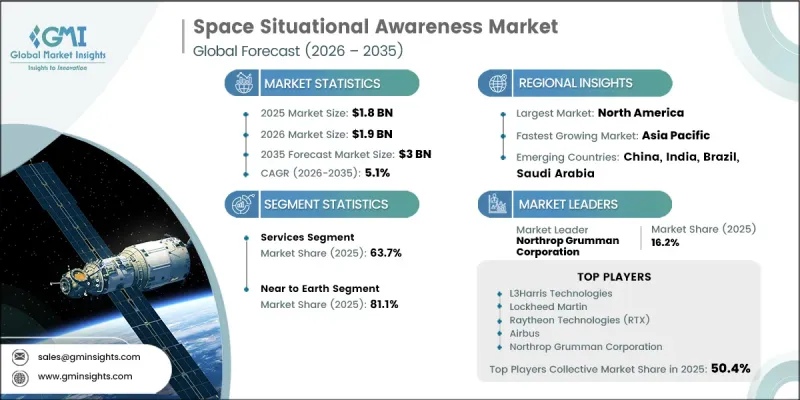
Growth in the space situational awareness market is driven by rising satellite deployments, increasing orbital congestion, and heightened concerns related to space debris and collision risks. Expanding defense investments and the introduction of advanced tracking and surveillance technologies are further strengthening market demand. The market provides critical capabilities including satellite monitoring, collision avoidance support, debris detection, orbital analysis, and space traffic management services. Increasing commercialization of space activities has intensified the need for reliable monitoring systems that ensure safe and efficient orbital operations. The rapid deployment of satellite constellations has further elevated the importance of continuous tracking solutions, as both government agencies and private operators prioritize operational safety and asset protection. Advancements in artificial intelligence, radar-based detection systems, and data analytics are enhancing tracking precision and improving real-time decision-making capabilities. These developments are enabling more efficient management of increasingly crowded orbital environments, reinforcing long-term market expansion across global space operations.
| Market Scope | |
|---|---|
| Start Year | 2025 |
| Forecast Year | 2026-2035 |
| Start Value | $1.8 Billion |
| Forecast Value | $3 Billion |
| CAGR | 5.1% |
The services segment accounted for 63.7% share in 2025. This dominance is driven by the growing reliance on outsourced monitoring, orbital tracking, and space traffic management functions. Continuous surveillance and real-time analytical support remain essential for maintaining safe orbital environments and minimizing collision risks. Demand for managed services is increasing as both government and commercial operators seek more advanced and reliable monitoring capabilities to support complex satellite operations and mission-critical applications.
The near-Earth orbit segment held a 81.1% share in 2025. This segment's dominance is linked to the high concentration of satellites operating in low and medium Earth orbit, which support communication, navigation, and Earth observation activities. Increasing satellite density in these orbital zones has intensified the need for continuous tracking, debris monitoring, and collision prevention systems. As orbital congestion continues to rise, demand for advanced situational awareness solutions in near-Earth space is expected to strengthen further.
North America Space Situational Awareness Market accounted for 40.8% share in 2025, maintaining the largest regional share. The region's leadership is supported by extensive space infrastructure, strong defense investments, and a highly developed satellite ecosystem. Growing adoption of satellite-based services across commercial and government applications continues to drive demand for advanced tracking and surveillance technologies. The presence of established aerospace capabilities and continuous investment in space monitoring systems further reinforces North America's dominant position in the global market.
Major companies operating in the Global Space Situational Awareness Market include Airbus Defence and Space, BAE Systems, Lockheed Martin, Northrop Grumman, Raytheon Technologies, L3Harris Technologies, Kratos Defense & Security Solutions, Peraton, ExoAnalytic Solutions, GMV Innovating Solutions, Telespazio S.P.A, The Aerospace Corporation, Schafer Corporation, SpaceNav, Northstar Earth & Space Inc, Elecnor Deimos Group, Applied Defense Solutions (ADS), Etamax Space, Globvision, Harris Geospatial Solutions, and Parson Corporation. Companies in the Space Situational Awareness Market are adopting multiple strategies to strengthen their market position and enhance technological capabilities. A primary focus is on advancing sensor technologies, AI-driven analytics, and radar-based monitoring systems to improve tracking accuracy and real-time decision-making. Strategic partnerships with government agencies and commercial satellite operators are helping expand service reach and operational integration. Firms are also investing in cloud-based data platforms and automated space traffic management solutions to improve scalability and efficiency.
Table of Contents
Chapter 1 Methodology and Scope
- 1.1 Market scope and definition
- 1.2 Research design
- 1.2.1 Research approach
- 1.2.2 Data collection methods
- 1.3 Data mining sources
- 1.3.1 Global
- 1.3.2 Regional/Country
- 1.4 Base estimates and calculations
- 1.4.1 Base year calculation
- 1.4.2 Key trends for market estimation
- 1.5 Primary research and validation
- 1.5.1 Primary sources
- 1.6 Forecast model
- 1.7 Research assumptions and limitations
Chapter 2 Executive Summary
- 2.1 Industry 360° synopsis, 2022 - 2035
- 2.2 Key market trends
- 2.2.1 Offering trends
- 2.2.2 Orbital Range trends
- 2.2.3 Object trends
- 2.2.4 End-user industry trends
- 2.2.5 Regional trends
- 2.3 TAM Analysis, 2026-2035
- 2.4 CXO perspectives: Strategic imperatives
Chapter 3 Industry Insights
- 3.1 Industry ecosystem analysis
- 3.1.1 Supplier Landscape
- 3.1.2 Profit Margin
- 3.1.3 Cost structure
- 3.1.4 Value addition at each stage
- 3.1.5 Factor affecting the value chain
- 3.1.6 Disruptions
- 3.2 Industry impact forces
- 3.2.1 Growth drivers
- 3.2.1.1 Increasing number of satellites launches and mega-constellations
- 3.2.1.2 Rising concerns regarding space debris and orbital congestion
- 3.2.1.3 Growing defense and national security investments in space programs
- 3.2.1.4 Technological advancements in AI, radar, and space surveillance systems
- 3.2.1.5 Expansion of commercial space activities and private space companies
- 3.2.2 Industry pitfalls and challenges
- 3.2.2.1 High deployment and infrastructure costs
- 3.2.2.2 Complexity in managing large volumes of orbital data
- 3.2.3 Market opportunities
- 3.2.3.1 Increasing focus on space traffic management and sustainability
- 3.2.3.2 Rising collaboration between government agencies and private space companies
- 3.2.1 Growth drivers
- 3.3 Growth potential analysis
- 3.4 Pricing Analysis (Driven by Primary Research)
- 3.4.1 Historical Price Trend Analysis
- 3.4.2 Pricing Strategy by Player Type (Premium / Value / Cost-plus)
- 3.5 Regulatory landscape
- 3.5.1 North America
- 3.5.2 Europe
- 3.5.3 Asia Pacific
- 3.5.4 Latin America
- 3.5.5 Middle East & Africa
- 3.6 Porter's analysis
- 3.7 PESTEL analysis
- 3.8 Technology and Innovation landscape
- 3.8.1 Current technological trends
- 3.8.2 Emerging technologies
- 3.9 Emerging Business Models
- 3.10 Compliance Requirements
- 3.11 Patent and IP analysis
- 3.12 Trade Data Analysis (Based on Paid Database)
- 3.12.1 Import/Export Volume & Value Trends
- 3.12.2 Key Trade Corridors & Tariff Impact
- 3.13 Impact of AI & Generative AI on the Market (Driven by Primary Research)
- 3.13.1 AI-Driven Disruption of Existing Business Models
- 3.13.2 GenAI Use Cases & Adoption Roadmap by Segment
- 3.14 Capacity & Production Landscape (Driven by Primary Research)
- 3.14.1 Production Capacity by Key Producer
- 3.14.2 Capacity Utilization Rates & Expansion Pipelines
Chapter 4 Competitive Landscape, 2025
- 4.1 Introduction
- 4.2 Company market share analysis, 2025
- 4.2.1 By Region
- 4.2.1.1 North America
- 4.2.1.2 Europe
- 4.2.1.3 Asia-Pacific
- 4.2.1.4 Latin America
- 4.2.1.5 Middle East and Africa
- 4.2.2 Market Concentration Analysis
- 4.2.1 By Region
- 4.3 Competitive analysis of major market players
- 4.4 Competitive positioning matrix
- 4.5 Key developments
- 4.5.1 Mergers & acquisitions
- 4.5.2 Partnerships & collaborations
- 4.5.3 New product launches
- 4.5.4 Expansion plans and funding
- 4.6 Company tier benchmarking
- 4.6.1 Tier classification criteria & qualifying thresholds
- 4.6.2 Tier positioning matrix by revenue, geography & innovation
Chapter 5 Market Estimates and Forecast, By Offering, 2022 - 2035 (USD Billion)
- 5.1 Key trends
- 5.2 Services
- 5.3 Solutions/Software
Chapter 6 Market Estimates and Forecast, By Orbital Range, 2022 - 2035 (USD Billion)
- 6.1 Key trends
- 6.2 Near to Earth
- 6.3 Deep Space
Chapter 7 Market Estimates and Forecast, By Object, 2022 - 2035 (USD Billion)
- 7.1 Key trends
- 7.2 Mission Related Debris
- 7.3 Rocket Bodies
- 7.4 Fragmentation Debris
- 7.5 Functional Spacecraft
- 7.6 Non-functional Spacecraft
Chapter 8 Market Estimates and Forecast, By End-User Industry, 2022 - 2035 (USD Billion)
- 8.1 Key trends
- 8.2 Commercial
- 8.3 Government and Military
- 8.4 Research and Academic Institutions
Chapter 9 Market Estimates and Forecast, By Region, 2022 - 2035 (USD Billion)
- 9.1 Key trends
- 9.2 North America
- 9.2.1 U.S.
- 9.2.2 Canada
- 9.3 Europe
- 9.3.1 Germany
- 9.3.2 UK
- 9.3.3 France
- 9.3.4 Spain
- 9.3.5 Italy
- 9.4 Asia Pacific
- 9.4.1 China
- 9.4.2 India
- 9.4.3 Japan
- 9.4.4 Australia
- 9.4.5 South Korea
- 9.5 Latin America
- 9.5.1 Brazil
- 9.5.2 Mexico
- 9.5.3 Argentina
- 9.6 Middle East and Africa
- 9.6.1 South Africa
- 9.6.2 Saudi Arabia
- 9.6.3 UAE
Chapter 10 Company Profiles
- 10.1 Global Key Players
- 10.1.1 Northrop Grumman
- 10.1.2 L3Harris Technologies
- 10.1.3 Lockheed Martin
- 10.1.4 Raytheon Technologies
- 10.1.5 Airbus Defense and Space
- 10.2 Regional key players
- 10.2.1 North America
- 10.2.1.1 Kratos Defense & Security Solutions
- 10.2.1.2 The Aerospace Corporation
- 10.2.1.3 Applied Defense Solutions (ADS)
- 10.2.2 Asia Pacific
- 10.2.2.1 SpaceNav
- 10.2.2.2 Globvision
- 10.2.2.3 Etamax Space
- 10.2.2.4 Europe
- 10.2.2.5 Elecnor Deimos Group
- 10.2.2.6 GMV Innovating Solutions
- 10.2.1 North America
- 10.3 Niche Players/Disruptors
- 10.3.1 ExoAnalytic Solutions
- 10.3.2 Harris Geospatial Solutions

