PUBLISHER: Global Market Insights Inc. | PRODUCT CODE: 2083290

PUBLISHER: Global Market Insights Inc. | PRODUCT CODE: 2083290
Grinding Machine Market Opportunity, Growth Drivers, Industry Trend Analysis, and Forecast 2026 - 2035
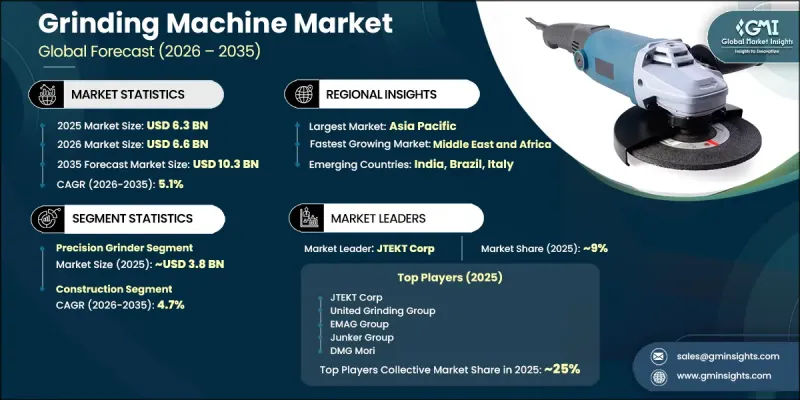
The Global Grinding Machine Market was valued at USD 6.3 billion in 2025 and is estimated to grow at a CAGR of 5.1% to reach USD 10.3 billion by 2035.
Grinding machines continue to play a crucial role in modern manufacturing by delivering accurate surface finishing, shaping, and material refinement with high precision. The rising requirement for components with strict dimensional accuracy across multiple industries is strengthening demand for advanced grinding solutions. Manufacturers are increasingly adopting these machines to support evolving production requirements, especially as industries move toward electrification, automation, and smart manufacturing. The integration of IoT connectivity, machine learning, and edge computing is transforming grinding equipment from conventional machinery into intelligent production systems capable of real-time monitoring and optimization. Advanced CNC grinding platforms now support automated adjustments, improved tool performance, thermal control, and predictive maintenance capabilities through connected data systems. Although AI-enabled grinding solutions with features such as in-process measurement, thermal correction, and cloud-based monitoring typically carry a 25-40% higher cost than conventional systems, their ability to improve productivity, reduce downtime, and increase operational efficiency is encouraging wider adoption across manufacturing sectors.
| Market Scope | |
|---|---|
| Start Year | 2025 |
| Forecast Year | 2026-2035 |
| Start Value | $6.3 Billion |
| Forecast Value | $10.3 Billion |
| CAGR | 5.1% |
The precision grinder segment generated USD 3.8 billion in 2025 and is expected to grow at a CAGR of 5.6% from 2026 to 2035. Growth in this segment is supported by rising demand from industries where superior accuracy and surface quality are essential manufacturing requirements. Increasing production of advanced components is creating greater demand for precision grinding technologies. The adoption of high-performance grinding materials, including cubic boron nitride (CBN) and diamond-based superabrasive wheels, is further enhancing machining efficiency and supporting segment expansion.
The construction segment represented 24.8% share in 2025 and is projected to grow at a CAGR of 4.7% between 2026 and 2035. Grinding machines are widely used in construction-related applications for manufacturing, repairing, and maintaining industrial equipment, metal structures, and specialized machinery components. Growing infrastructure development activities and expanding industrial projects are creating additional opportunities for grinding equipment suppliers. Increasing investments in developing economies are expected to support continued demand growth within this segment.
U.S. Grinding Machine Market reached USD 1.1 billion in 2025 and is forecast to grow at a CAGR of 5.7% from 2026 to 2035. Growth in the country is supported by increasing investment in advanced manufacturing and semiconductor production capabilities. Expanding fabrication initiatives by leading technology companies are generating demand for specialized grinding solutions used in precision manufacturing processes. The U.S. market is also experiencing a transition from traditional CNC grinding equipment toward advanced smart grinding systems designed to support the changing requirements of semiconductor, aerospace, and electric vehicle industries.
Major players operating in the grinding machine industry include DMG MORI; United Grinding Group; AMADA Co Ltd; JTEKT Corporation; Gleason Corporation; JUNKER Group; EMAG Group; Makino; Danobat Group; ROSA Ermando; Okuma Corporation; Schaudt (UGG); ELB-Schliff; TOS Hostivar; Geibel & Hotz; ACE Micromatic; Hanjiang Machine Tool; BFW; Lapmaster Wolters; Weldon Solutions; Nagel Precision; and Woohwa. Key strategies adopted by companies in the grinding machine market include continuous investment in automation, digital technologies, and advanced machining solutions to improve operational efficiency and product performance. Market participants are focusing on developing smart grinding systems with enhanced connectivity, predictive maintenance capabilities, and improved precision to meet changing customer requirements. Companies are also expanding their product portfolios, strengthening global distribution networks, and forming strategic collaborations to increase market reach. Innovation in grinding technologies, customized solutions, and investment in research and development remain important approaches for companies seeking to improve competitiveness and secure long-term market growth.
Table of Contents
Chapter 1 Research methodology
- 1.1 Research approach
- 1.2 Quality Commitments
- 1.2.1 GMI AI policy & data integrity commitment
- 1.2.1.1 Source consistency protocol
- 1.2.1 GMI AI policy & data integrity commitment
- 1.3 Research trail & confidence scoring
- 1.3.1 Research trail components
- 1.3.2 Scoring components
- 1.4 Data Collection
- 1.4.1 Partial list of primary sources
- 1.5 Data mining sources
- 1.5.1 Paid sources
- 1.5.1.1 Sources, by region
- 1.5.1 Paid sources
- 1.6 Base estimates and calculations
- 1.6.1 Base year calculation
- 1.7 Forecast model
- 1.7.1 Quantified market impact analysis
- 1.7.1.1 Mathematical impact of growth parameters on forecast
- 1.7.1 Quantified market impact analysis
- 1.8 Research transparency addendum
- 1.8.1 Source attribution framework
- 1.8.2 Quality assurance metrics
- 1.8.3 Our commitment to trust
Chapter 2 Executive Summary
- 2.1 Industry 360° synopsis
- 2.2 Business trends
- 2.3 Regional
- 2.4 Type
- 2.5 Automation
- 2.6 Material
- 2.7 Application
- 2.8 Distribution channel
Chapter 3 Industry Insights
- 3.1 Industry ecosystem analysis
- 3.1.1 Supplier landscape
- 3.1.2 Manufacturers
- 3.1.3 Distributors
- 3.1.4 Retailers
- 3.1.5 Profit margin analysis
- 3.1.6 Value addition at each stage
- 3.1.7 Factor affecting the value chain
- 3.2 Industry impact forces
- 3.2.1 Growth drivers
- 3.2.1.1 EV and automotive electrification transition
- 3.2.1.2 Manufacturing reshoring and industrial policy stimulus
- 3.2.1.3 Aerospace and defense sector expansion
- 3.2.2 Industry pitfalls & challenges
- 3.2.2.1 China industrial slowdown and domestic overcapacity
- 3.2.2.2 Additive manufacturing and non-abrasive process substitution
- 3.2.3 Opportunities
- 3.2.1 Growth drivers
- 3.3 Growth potential analysis
- 3.4 Technology and innovation landscape
- 3.4.1 Current technological trends
- 3.4.2 Emerging technologies
- 3.5 Pricing analysis (driven by primary research)
- 3.5.1 Historical price trend analysis by product category
- 3.5.2 Pricing strategy by player type (premium / value / cost-plus)
- 3.6 Trade data analysis (based on paid database)
- 3.6.1 Import/export volume & value trends
- 3.6.2 Key trade corridors & tariff impact
- 3.7 Regulatory landscape
- 3.7.1 Standards and compliance requirements
- 3.7.2 Regional regulatory frameworks
- 3.7.3 Certification standards
- 3.8 Porter's analysis
- 3.9 PESTEL analysis
- 3.10 Impact of AI & generative AI on the market
- 3.10.1 AI-driven disruption of existing business models
- 3.10.2 GenAI use cases & adoption roadmap by segment
- 3.10.3 Risks, limitations & regulatory considerations
Chapter 4 Competitive Landscape, 2025
- 4.1 Introduction
- 4.2 Company market share analysis
- 4.2.1 By Region
- 4.2.1.1 North America
- 4.2.1.2 Europe
- 4.2.1.3 Asia Pacific
- 4.2.1.4 Latin America
- 4.2.1.5 Middle East & Africa
- 4.2.1 By Region
- 4.3 Company matrix analysis
- 4.4 Competitive analysis of major market players
- 4.5 Competitive positioning matrix
- 4.6 Key developments
- 4.6.1 Mergers & acquisitions
- 4.6.2 Partnerships & collaborations
- 4.6.3 New product launches
- 4.6.4 Expansion plans
Chapter 5 Market Estimates & Forecast, By Product Type, 2022 - 2035, (USD Billion) (Units)
- 5.1 Key trends
- 5.2 Non-precision grinder
- 5.2.1 Bench grinder
- 5.2.2 Portable grinder
- 5.2.3 Pedestal grinder
- 5.2.4 Abrasive belt grinder
- 5.3 Precision grinder
- 5.3.1 Cylindrical grinding machines
- 5.3.2 Surface grinding machines
- 5.3.3 Centre-less grinding machines
- 5.3.4 Tool and cutter grinding machines
- 5.3.5 Others
- 5.4 Specialized grinding systems
Chapter 6 Market Estimates & Forecast, By Automation, 2022 - 2035, (USD Billion) (Units)
- 6.1 Key trends
- 6.2 Manual
- 6.3 Semi-automatic
- 6.4 Automatic
- 6.5 Robotic
Chapter 7 Market Estimates & Forecast, By Material, 2022 - 2035, (USD Billion) (Units)
- 7.1 Key trends
- 7.2 Ferrous metals
- 7.3 Non-ferrous metals
- 7.4 Ceramics and advanced materials
- 7.5 Composites and others
Chapter 8 Market Estimates & Forecast, By Application, 2022 - 2035, (USD Billion) (Units)
- 8.1 Key trends
- 8.2 Automotive
- 8.3 Aerospace
- 8.4 Medical
- 8.5 Construction
- 8.6 Industrial manufacturing
- 8.7 Electrical and electronics
- 8.8 Marine
- 8.9 Others
Chapter 9 Market Estimates & Forecast, By Distribution Channel, 2022 - 2035, (USD Billion) (Units)
- 9.1 Key trends
- 9.2 Direct sales
- 9.3 Indirect sales
Chapter 10 Market Estimates & Forecast, By Region, 2022 - 2035, (USD Billion) (Units)
- 10.1 Key trends
- 10.2 North America
- 10.2.1 U.S
- 10.2.2 Canada
- 10.3 Europe
- 10.3.1 Germany
- 10.3.2 UK
- 10.3.3 France
- 10.3.4 Italy
- 10.3.5 Spain
- 10.3.6 Sweden
- 10.3.7 Netherlands
- 10.4 Asia Pacific
- 10.4.1 China
- 10.4.2 India
- 10.4.3 Japan
- 10.4.4 South Korea
- 10.4.5 Australia
- 10.4.6 Indonesia
- 10.5 Latin America
- 10.5.1 Brazil
- 10.5.2 Mexico
- 10.5.3 Argentina
- 10.6 Middle East and Africa
- 10.6.1 Saudi Arabia
- 10.6.2 UAE
- 10.6.3 South Africa
Chapter 11 Company Profiles
- 11.1 Global Players
- 11.1.1 United Grinding Group
- 11.1.2 JUNKER Group
- 11.1.3 DMG MORI
- 11.1.4 JTEKT Corporation
- 11.1.5 Gleason Corporation
- 11.1.6 AMADA Co Ltd
- 11.1.7 EMAG Group
- 11.1.8 Makino
- 11.2 Regional Players
- 11.2.1 ROSA Ermando
- 11.2.2 Danobat Group
- 11.2.3 Schaudt (UGG)
- 11.2.4 TOS Hostivar
- 11.2.5 ELB-Schliff
- 11.2.6 Okuma Corporation
- 11.2.7 Geibel & Hotz
- 11.3 Emerging Players & Innovators
- 11.3.1 ACE Micromatic
- 11.3.2 BFW
- 11.3.3 Hanjiang Machine Tool
- 11.3.4 Lapmaster Wolters
- 11.3.5 Weldon Solutions
- 11.3.6 Nagel Precision
- 11.3.7 Woohwa

