PUBLISHER: Global Market Insights Inc. | PRODUCT CODE: 2083291

PUBLISHER: Global Market Insights Inc. | PRODUCT CODE: 2083291
Travel Accommodation Market Opportunity, Growth Drivers, Industry Trend Analysis, and Forecast 2026 - 2035
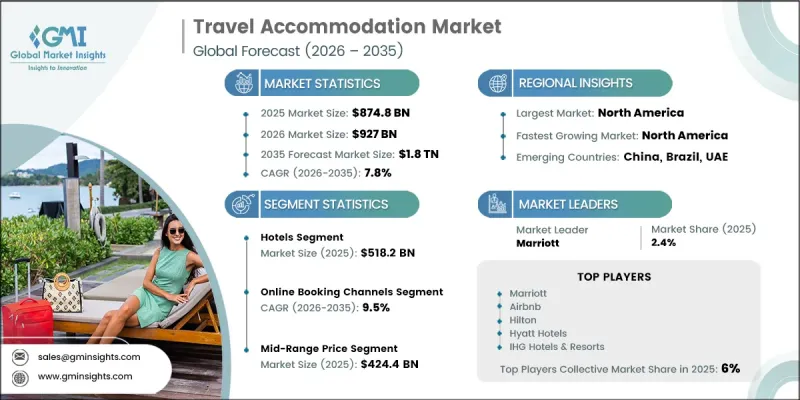
The Global Travel Accommodation Market was valued at USD 874.8 billion in 2025 and is estimated to grow at a CAGR of 7.8% to reach USD 1.8 trillion by 2035.
The market continues to expand as rising disposable incomes and the growing middle-class population encourage higher spending on leisure and business travel. Demand is increasing across hotels, resorts, vacation rentals, and budget lodging, supported by the steady growth of domestic and international tourism. Investment in hospitality infrastructure is also accelerating as tourism becomes an important contributor to economic development and employment generation. At the same time, accommodation providers continue to face labor-related challenges, as maintaining high-quality guest services limits the pace of operational automation. Profit margins remain influenced by rising labor costs and evolving customer expectations. The industry is also vulnerable to fluctuations in travel demand because room inventory cannot be stored for future sales. To improve resilience, operators are adopting flexible booking policies, dynamic pricing strategies, diversified distribution channels, and a stronger focus on domestic travelers. Alternative lodging options have also become an integral part of the travel accommodation market, contributing significantly to overall industry growth while expanding the range of choices available to travelers.
| Market Scope | |
|---|---|
| Start Year | 2025 |
| Forecast Year | 2026-2035 |
| Start Value | $874.8 Billion |
| Forecast Value | $1.8 Trillion |
| CAGR | 7.8% |
The hotels segment generated USD 518.2 billion in 2025, accounting for 59.2% share. Its leadership is supported by established brand recognition, customer loyalty programs, corporate partnerships, and extensive global distribution networks that continue to strengthen competitiveness. Hotels also benefit from strong demand across business travel, corporate events, airport stays, and short leisure trips where dependable service and convenient locations remain essential. In addition, digital innovations such as mobile check-in, smart room technology, and app-based guest services have become standard operational features that enhance customer experience and improve operational efficiency.
The online booking platforms segment generated USD 625.8 billion in 2025, representing 71.5% share. Increasing smartphone usage, secure digital payment systems, instant inventory visibility, and simplified online reservation processes continue to encourage consumers to book accommodations digitally. Revenue optimization technologies, including automated pricing models and personalized booking recommendations, are helping accommodation providers improve occupancy rates and maximize revenue, although pricing competition and distribution costs remain important considerations across the industry.
North America Travel Accommodation Market reached USD 294.5 billion in 2025. Growth continues to be supported by strong domestic travel activity, increasing international visitor arrivals, expanding sports tourism, convention-related travel, and a well-established hospitality infrastructure. Ongoing investments in hotel renovation and property upgrades are further enhancing accommodation capacity while improving guest experiences across the region.
Major companies operating in the global travel accommodation market include Marriott International, Hilton Worldwide, Hyatt Hotels, IHG Hotels & Resorts, Accor, Wyndham Hotels & Resorts, Airbnb, Four Seasons Hotels & Resorts, Vrbo, and BWH Hotels. Companies operating in the travel accommodation market are strengthening their competitive position by expanding their property portfolios, investing in digital transformation, and enhancing personalized guest experiences. Leading providers are adopting advanced revenue management systems, mobile booking applications, contactless services, and AI-driven customer engagement tools to improve operational efficiency and customer satisfaction. Many companies are renovating existing properties while introducing premium amenities and wellness-focused offerings to attract high-value travelers. Strategic partnerships with travel agencies, online booking platforms, and loyalty program providers are helping companies broaden their customer reach and improve occupancy rates.
Table of Contents
Chapter 1 Methodology & Scope
- 1.1 Research approach
- 1.2 Quality Commitments
- 1.2.1 GMI AI policy & data integrity commitment
- 1.2.1.1 Source consistency protocol
- 1.2.1 GMI AI policy & data integrity commitment
- 1.3 Research Trail & Confidence Scoring
- 1.3.1 Research Trail Components
- 1.3.2 Scoring Components
- 1.4 Data Collection
- 1.4.1 Partial list of primary sources
- 1.5 Data mining sources
- 1.5.1 Paid sources
- 1.5.1.1 Sources, by region
- 1.5.1 Paid sources
- 1.6 Base estimates and calculations
- 1.6.1 Base year calculation
- 1.7 Forecast
- 1.7.1 Quantified market impact analysis
- 1.7.1.1 Mathematical impact of growth parameters on forecast
- 1.7.1 Quantified market impact analysis
- 1.8 Research transparency addendum
- 1.8.1 Source attribution framework
- 1.8.2 Quality assurance metrics
- 1.8.3 Our commitment to trust
Chapter 2 Executive Summary
- 2.1 Industry 360° synopsis
- 2.2 Key market trends
- 2.2.1 Regional
- 2.2.2 Accommodation Type
- 2.2.3 Booking Channel
- 2.2.4 Price Category
- 2.2.5 Length of Stay
- 2.2.6 Traveler Type
- 2.3 TAM Analysis, 2026-2035
- 2.4 CXO perspectives: Strategic imperatives
Chapter 3 Industry Insights
- 3.1 Industry ecosystem analysis
- 3.1.1 Supplier landscape
- 3.1.1.1 Raw material suppliers
- 3.1.1.2 Component suppliers
- 3.1.1.3 Manufacturers
- 3.1.1.4 Service providers
- 3.1.1.5 Distribution channel
- 3.1.1.6 End Use
- 3.1.2 Cost structure
- 3.1.3 Profit margin
- 3.1.4 Value addition at each stage
- 3.1.5 Vertical integration trends
- 3.1.6 Disruptors
- 3.1.1 Supplier landscape
- 3.2 Industry impact forces
- 3.2.1 Growth drivers
- 3.2.1.1 Growth in international tourism and rising disposable incomes across emerging economies
- 3.2.1.2 Expansion of digital travel platforms and online travel agencies improving booking accessibility and convenience
- 3.2.1.3 Increasing investments in hospitality infrastructure, luxury resorts, and tourism development projects worldwide
- 3.2.1.4 Strong recovery and growth of leisure travel demand supported by experiential and destination-based tourism
- 3.2.2 Industry pitfalls & challenges
- 3.2.2.1 High operational costs including labor shortages, energy expenses, and property maintenance costs
- 3.2.2.2 Economic uncertainties, geopolitical tensions, and travel restrictions affecting travel demand and occupancy
- 3.2.3 Market opportunities
- 3.2.3.1 Expansion of alternative and experiential accommodations across vacation rentals, homestays, eco-lodges, and boutique guesthouses
- 3.2.3.2 Sustainability-certified lodging and low-impact hospitality formats
- 3.2.3.3 Bleisure travel, digital nomadism, and extended-stay accommodation demand
- 3.2.3.4 AI-enabled booking, dynamic pricing, and direct-channel personalization
- 3.2.1 Growth drivers
- 3.3 Growth potential analysis
- 3.4 Pricing Analysis (Driven by Primary Research)
- 3.4.1 Historical Price Trend Analysis
- 3.4.2 Pricing Strategy by Player Type (Premium / Value / Cost-plus)
- 3.5 Regulatory landscape
- 3.5.1 North America
- 3.5.1.1 US
- 3.5.1.1.1 State Departments of Revenue (State Lodging and Occupancy Tax Regulations)
- 3.5.1.1.2 Local City/County Planning and Zoning Departments
- 3.5.1.2 Canada - Provincial Housing Ministries
- 3.5.1.1 US
- 3.5.2 Europe
- 3.5.2.1 Germany - Municipal Housing Authorities (Wohnungsamt)
- 3.5.2.2 France - Ministere de la Cohesion des Territoires
- 3.5.2.3 European Commission (DG GROW)
- 3.5.2.4 National Consumer Protection Authorities
- 3.5.3 Asia-Pacific
- 3.5.3.1 China - Ministry of Culture and Tourism (MCT)
- 3.5.3.2 India - Ministry of Tourism, Government of India
- 3.5.3.3 Australia - State Planning Departments
- 3.5.4 Latin America
- 3.5.4.1 Brazil - EMBRATUR (Brazilian Tourism Board)
- 3.5.4.2 Mexico - SECTUR (Secretaria de Turismo)
- 3.5.5 Middle East & Africa
- 3.5.5.1 UAE - Department of Economy and Tourism (DET) - Dubai
- 3.5.1 North America
- 3.6 Technology and Innovation landscape
- 3.6.1 Current technologies
- 3.6.2 Emerging technologies
- 3.7 Porter's analysis
- 3.8 PESTEL analysis
- 3.9 Patent analysis (Driven by Primary Research)
- 3.10 Impact of AI & generative AI on the market
- 3.10.1 AI-Driven Disruption of Existing Business Models
- 3.10.2 Automated design optimization
- 3.10.3 Supply chain AI for demand forecasting
- 3.10.4 GenAI use cases & adoption roadmap by segment
- 3.10.5 Risks, Limitations & Regulatory Considerations
- 3.11 Sustainability and environmental aspects
- 3.11.1 Sustainable practices
- 3.11.2 Waste reduction strategies
- 3.11.3 Energy efficiency in production
- 3.11.4 Eco-friendly Initiatives
- 3.11.5 Carbon footprint considerations
- 3.12 Forecast assumptions & scenario analysis (Driven by Primary Research)
- 3.12.1 Base Case - key macro & industry variables driving CAGR
- 3.12.2 Optimistic Scenarios - Favorable Macro and Industry Tailwinds
- 3.12.3 Pessimistic Scenario - Macroeconomic slowdown or industry headwinds
Chapter 4 Competitive Landscape, 2025
- 4.1 Introduction
- 4.2 Company market share analysis
- 4.2.1 North America
- 4.2.2 Europe
- 4.2.3 Asia-Pacific
- 4.2.4 Latin America
- 4.2.5 Middle East & Africa
- 4.3 Competitive positioning matrix
- 4.4 Key developments
- 4.4.1 Mergers & acquisitions
- 4.4.2 Partnerships & collaborations
- 4.4.3 New product launches
- 4.4.4 Expansion plans and funding
- 4.5 Company tier benchmarking
- 4.5.1 Tier classification criteria & qualifying thresholds
- 4.5.2 Tier positioning matrix by revenue, geography & innovation
Chapter 5 Market Estimates & Forecast, By Accommodation Type, 2022 - 2035 ($Mn)
- 5.1 Key trends
- 5.2 Hotels
- 5.3 Resorts
- 5.4 Vacation Rentals & Holiday Homes
- 5.5 Hostels
- 5.6 Others (Serviced Apartments & Aparthotels)
Chapter 6 Market Estimates & Forecast, By Booking Channel, 2022 - 2035 ($Mn)
- 6.1 Key trends
- 6.2 Online
- 6.3 Offline
Chapter 7 Market Estimates & Forecast, By Price Category, 2022 - 2035 ($Mn)
- 7.1 Key trends
- 7.2 Budget/Economy
- 7.3 Mid-Range
- 7.4 Premium/Luxury
Chapter 8 Market Estimates & Forecast, By Length of Stay, 2022 - 2035 ($Mn)
- 8.1 Key trends
- 8.2 Short Stay (1-3 Nights)
- 8.3 Medium Stay (4-14 Nights)
- 8.4 Extended Stay (More than 14 Nights)
Chapter 9 Market Estimates & Forecast, By Traveler Type, 2022 - 2035 ($Mn)
- 9.1 Key trends
- 9.2 Leisure Travelers
- 9.3 Business Travelers
- 9.4 Group Travelers
- 9.5 Others
Chapter 10 Market Estimates & Forecast, By Region, 2022 - 2035 ($Mn)
- 10.1 North America
- 10.1.1 US
- 10.1.2 Canada
- 10.2 Europe
- 10.2.1 UK
- 10.2.2 Germany
- 10.2.3 France
- 10.2.4 Italy
- 10.2.5 Spain
- 10.2.6 Belgium
- 10.2.7 Netherlands
- 10.2.8 Sweden
- 10.2.9 Russia
- 10.3 Asia Pacific
- 10.3.1 China
- 10.3.2 India
- 10.3.3 Japan
- 10.3.4 Australia
- 10.3.5 Singapore
- 10.3.6 South Korea
- 10.3.7 Vietnam
- 10.3.8 Indonesia
- 10.3.9 Thailand
- 10.4 Latin America
- 10.4.1 Brazil
- 10.4.2 Mexico
- 10.4.3 Argentina
- 10.5 MEA
- 10.5.1 South Africa
- 10.5.2 Saudi Arabia
- 10.5.3 UAE
Chapter 11 Company Profiles
- 11.1 Global Players
- 11.1.1 Marriott International
- 11.1.2 Hilton Worldwide
- 11.1.3 Hyatt Hotels
- 11.1.4 IHG Hotels & Resorts
- 11.1.5 Accor
- 11.1.6 Wyndham
- 11.1.7 Airbnb
- 11.1.8 Four Seasons
- 11.1.9 Vrbo
- 11.1.10 BWH Hotels
- 11.2 Regional Players
- 11.2.1 OYO Rooms
- 11.2.2 Melia Hotels
- 11.2.3 Minor Hotels
- 11.2.4 Radisson Hotel
- 11.2.5 Whitbread
- 11.2.6 Sun International
- 11.2.7 Blueground
- 11.2.8 Casago
- 11.2.9 Evolve Vacation Rental
- 11.2.10 HomeToGo

