PUBLISHER: Global Market Insights Inc. | PRODUCT CODE: 2083293

PUBLISHER: Global Market Insights Inc. | PRODUCT CODE: 2083293
Teleradiology Market Opportunity, Growth Drivers, Industry Trend Analysis, and Forecast 2026 - 2035
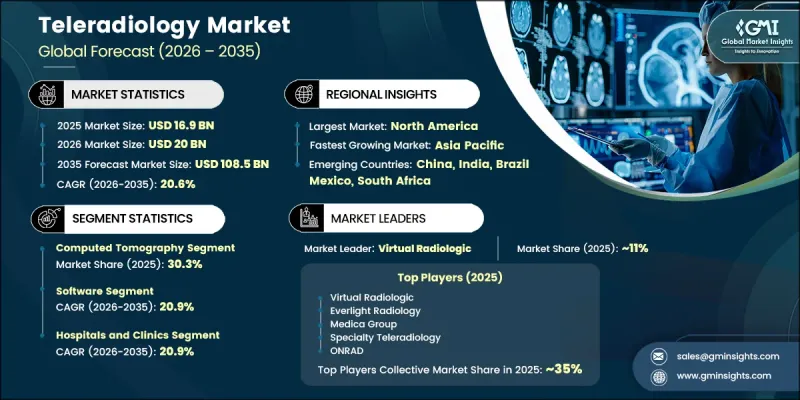
The Global Teleradiology Market was valued at USD 16.9 billion in 2025 and is estimated to grow at a CAGR of 20.6% to reach USD 108.5 billion by 2035.
The market is experiencing rapid expansion due to the rising need for faster diagnostic services, increasing demand for medical imaging procedures, and ongoing challenges related to radiologist availability across healthcare systems. Teleradiology has emerged as an important healthcare technology solution by enabling the secure digital exchange of medical images for remote analysis, consultation, and reporting by qualified specialists. The technology is transforming radiology operations by improving accessibility to expert interpretation, enhancing reporting efficiency, and supporting continuous diagnostic coverage. As healthcare providers manage increasing patient volumes and more complex diagnostic requirements, remote imaging solutions are becoming increasingly valuable for optimizing clinical workflows. The growing prevalence of chronic health conditions is further contributing to market development by increasing the need for regular imaging-based evaluation and monitoring. Healthcare organizations are adopting teleradiology platforms to improve resource utilization, reduce diagnostic delays, and maintain consistent patient care. Advancements in digital healthcare infrastructure, cloud-based technologies, and artificial intelligence integration are also strengthening adoption, positioning teleradiology as a key component of modern healthcare delivery systems.
| Market Scope | |
|---|---|
| Start Year | 2025 |
| Forecast Year | 2026-2035 |
| Start Value | $16.9 Billion |
| Forecast Value | $108.5 Billion |
| CAGR | 20.6% |
The computed tomography segment accounted for 30.3% share in 2025, and is expected to grow at a CAGR of 21% through 2035. The segment's growth is supported by the increasing reliance on CT imaging for critical diagnostic applications where timely interpretation is essential. Teleradiology services allow healthcare facilities to improve the efficiency of CT imaging operations by providing access to remote radiology expertise and reducing reporting delays. The continued advancement of CT technologies, including improved image quality, faster scanning processes, and enhanced imaging efficiency, is further encouraging the adoption of remote interpretation services. As healthcare systems continue to manage growing imaging volumes, CT-based teleradiology solutions are becoming increasingly important for improving workflow performance and diagnostic accessibility.
The software segment is projected to grow at a CAGR of 20.9% between 2026 and 2035. Software solutions represent a fundamental part of the teleradiology infrastructure by supporting image management, secure data exchange, workflow coordination, and diagnostic reporting processes. Increasing adoption of advanced imaging platforms, integrated radiology management systems, cloud-based solutions, and artificial intelligence-supported workflows is contributing to segment growth. Healthcare providers are increasingly shifting toward digital software environments that improve scalability, accessibility, and operational efficiency. The expansion of cloud-based architectures is further supporting market development by enabling seamless collaboration between healthcare facilities and remote radiology professionals while improving overall diagnostic workflow management.
North America Teleradiology Market held a 44.3% share in 2025. The region benefits from advanced healthcare infrastructure, widespread adoption of digital imaging technologies, and strong implementation of electronic healthcare systems. Rising demand for continuous radiology services, increasing diagnostic imaging volumes, and ongoing shortages of qualified radiology professionals are encouraging healthcare providers to implement remote interpretation solutions. The continued growth of telehealth adoption and the increasing integration of artificial intelligence-based diagnostic technologies are further improving the efficiency and scalability of teleradiology services across the region. These factors continue to support North America's leading position within the global teleradiology industry.
Major companies operating in the global teleradiology market include Siemens Healthineers, GE HealthCare, Koninklijke Philips, Radiology Partners, Virtual Radiologic, ONRAD, Medica Group, Dicom Systems, Aster Medical Imaging, Specialty Teleradiology, Everlight Radiology, Vesta Teleradiology, CompuMed, Experity, imeXHS, and Vision XRay Group. Companies operating in the teleradiology market are adopting multiple strategies to strengthen their market position and expand their global presence. Key players are focusing on technology innovation by developing advanced imaging platforms, artificial intelligence-enabled diagnostic tools, and cloud-based solutions that improve reporting efficiency. Strategic collaborations with healthcare providers and technology companies are helping organizations enhance service capabilities and expand their customer base. Companies are also investing in scalable digital infrastructure to support remote diagnostics and improve accessibility across healthcare networks. Expansion into emerging markets, enhancement of cybersecurity capabilities, and development of integrated healthcare solutions are additional focus areas.
Table of Contents
Chapter 1 Methodology & Scope
- 1.1 Market scope and definition
- 1.2 Research approach
- 1.3 Quality commitments
- 1.3.1 GMI AI policy and data integrity commitment
- 1.3.1.1 Source consistency protocol
- 1.3.1 GMI AI policy and data integrity commitment
- 1.4 Research trail and confidence scoring
- 1.4.1 Research trail components
- 1.4.2 Scoring components
- 1.5 Data collection
- 1.5.1 Partial list of primary sources
- 1.6 Data mining sources
- 1.6.1 Paid sources
- 1.6.1.1 Sources, by region
- 1.6.1 Paid sources
- 1.7 Base estimates and calculations
- 1.7.1 Revenue share analysis
- 1.7.2 Base year calculation
- 1.8 Forecast model
- 1.9 Research transparency addendum
- 1.9.1 Source attribution framework
- 1.9.2 Quality assurance metrics
- 1.9.3 Our commitment to trust
Chapter 2 Executive Summary
- 2.1 Industry 360° synopsis
- 2.2 Key market trends
- 2.2.1 Regional trends
- 2.2.2 Imaging technique trends
- 2.2.3 Technology trends
- 2.2.4 Component trends
- 2.2.5 Application trends
- 2.2.6 End use trends
- 2.3 CXO perspectives: Strategic imperatives
Chapter 3 Industry Insights
- 3.1 Industry ecosystem analysis
- 3.2 Industry impact forces
- 3.2.1 Growth drivers
- 3.2.1.1 Increasing demand for radiology services
- 3.2.1.2 Growing adoption of telemedicine
- 3.2.1.3 Advancement in imaging technologies
- 3.2.1.4 Increasing adoption of cloud-based teleradiology platforms
- 3.2.2 Industry pitfalls & challenges
- 3.2.2.1 Data security and privacy concerns
- 3.2.2.2 Regulatory and legal issues
- 3.2.3 Market opportunities
- 3.2.3.1 AI integrated teleradiology workflows
- 3.2.3.2 Expansion into emerging markets with limited radiology infrastructure
- 3.2.1 Growth drivers
- 3.3 Growth potential analysis
- 3.4 Technology and innovation landscape
- 3.5 Regulatory landscape
- 3.5.1 North America
- 3.5.2 Europe
- 3.5.3 Asia Pacific
- 3.5.4 Latin America
- 3.5.5 MEA
- 3.6 Future trends
- 3.7 Impact of AI and Generation AI on the market
- 3.8 Pricing analysis
- 3.9 Porter's analysis
- 3.10 PESTEL analysis
Chapter 4 Competitive Landscape, 2025
- 4.1 Introduction
- 4.2 Company market share analysis
- 4.3 Company matrix analysis
- 4.4 Competitive analysis of major market players
- 4.5 Competitive positioning matrix
- 4.6 Key developments
- 4.6.1 Merger and acquisition
- 4.6.2 Partnership and collaboration
- 4.6.3 New product launches
- 4.6.4 Expansion plans
Chapter 5 Market Estimates and Forecast, By Imaging Technique, 2022 - 2035 ($ Mn)
- 5.1 Key trends
- 5.2 X-ray
- 5.3 Computed tomography
- 5.4 Magnetic resonance imaging
- 5.5 Ultrasound
- 5.6 Nuclear imaging
- 5.7 Mammography
Chapter 6 Market Estimates and Forecast, By Technology, 2022 - 2035 ($ Mn)
- 6.1 Key trends
- 6.2 Cloud-based teleradiology
- 6.3 On-premise teleradiology
Chapter 7 Market Estimates and Forecast, By Component, 2022 - 2035 ($ Mn)
- 7.1 Key trends
- 7.2 Software
- 7.3 Services
Chapter 8 Market Estimates and Forecast, By Application, 2022 - 2035 ($ Mn)
- 8.1 Key trends
- 8.2 Cardiology
- 8.3 Neurology
- 8.4 Orthopedics
- 8.5 Oncology
- 8.6 Gastroenterology
- 8.7 Other applications
Chapter 9 Market Estimates and Forecast, By End Use, 2022 - 2035 ($ Mn)
- 9.1 Key trends
- 9.2 Hospitals and clinics
- 9.3 Diagnostic imaging centers
- 9.4 Ambulatory surgical centers
- 9.5 Other end users
Chapter 10 Market Estimates and Forecast, By Region, 2022 - 2035 ($ Mn)
- 10.1 Key trends
- 10.2 North America
- 10.2.1 U.S.
- 10.2.2 Canada
- 10.3 Europe
- 10.3.1 Germany
- 10.3.2 UK
- 10.3.3 France
- 10.3.4 Spain
- 10.3.5 Italy
- 10.3.6 Netherlands
- 10.4 Asia Pacific
- 10.4.1 Japan
- 10.4.2 China
- 10.4.3 India
- 10.4.4 Australia
- 10.4.5 South Korea
- 10.5 Latin America
- 10.5.1 Brazil
- 10.5.2 Mexico
- 10.5.3 Argentina
- 10.6 Middle East and Africa
- 10.6.1 South Africa
- 10.6.2 Saudi Arabia
- 10.6.3 UAE
Chapter 11 Company Profiles
- 11.1 Aster Medical Imaging
- 11.2 CompuMed
- 11.3 Dicom Systems
- 11.4 Everlight Radiology
- 11.5 Experity
- 11.6 GE HealthCare Technologies
- 11.7 imeXHS
- 11.8 Koninklijke Philips
- 11.9 Medica Group
- 11.10 ONRAD
- 11.11 Radiology partners
- 11.12 Siemens Healthineers
- 11.13 Specialty Teleradiology
- 11.14 Vesta Teleradiology
- 11.15 Virtual Radiologic
- 11.16 Vision XRay Group

