PUBLISHER: Global Market Insights Inc. | PRODUCT CODE: 2083308

PUBLISHER: Global Market Insights Inc. | PRODUCT CODE: 2083308
Contextual Advertising Market Opportunity, Growth Drivers, Industry Trend Analysis, and Forecast 2026 - 2035
The Global Contextual Advertising Market was valued at USD 222.8 million in 2025 and is estimated to grow at a CAGR of 9.5% to reach USD 565.4 million by 2035.
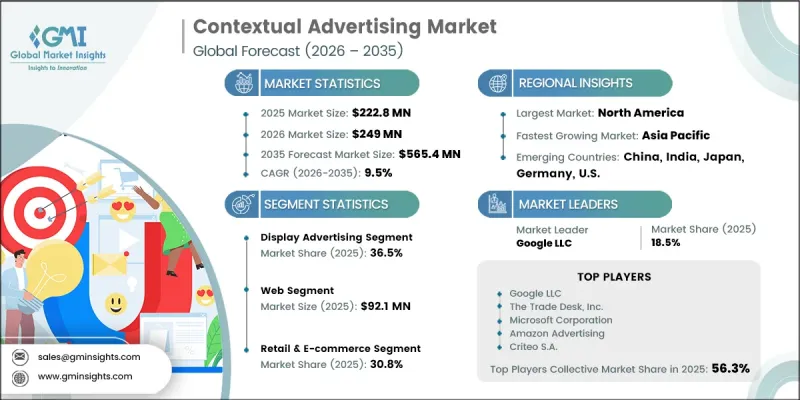
The market is expanding steadily as advertisers increasingly adopt privacy-focused advertising strategies in response to evolving global data protection regulations. The gradual decline of third-party cookie usage is encouraging businesses to implement contextual advertising solutions that deliver relevant advertisements based on webpage content instead of relying on individual user tracking. This transition enables organizations to maintain advertising performance while aligning with changing privacy requirements. In addition, the integration of artificial intelligence and machine learning into advertising platforms is improving contextual analysis by evaluating text, images, videos, and user intent in near real time, resulting in more accurate ad placements and improved campaign effectiveness. Growing adoption of Connected TV (CTV), digital video advertising, and streaming platforms is also creating new opportunities for contextual advertising as marketers shift budgets toward digital media channels. These trends, combined with increasing investments in intelligent advertising technologies and privacy-compliant marketing solutions, continue to strengthen the long-term growth outlook for the contextual advertising market.
| Market Scope | |
|---|---|
| Start Year | 2025 |
| Forecast Year | 2026-2035 |
| Start Value | $222.8 Million |
| Forecast Value | $565.4 Million |
| CAGR | 9.5% |
Based on advertising format, the display advertising segment accounted for 36.5% share in 2025. Its strong market position is supported by widespread deployment across digital publishing platforms, websites, mobile applications, and retail media environments. The increasing use of AI-powered contextual targeting technologies has further strengthened demand by enabling advertisers to deliver highly relevant advertisements based on surrounding content instead of personal user information. Broad audience reach, scalability, improved customer engagement, and compliance with evolving privacy standards continue to position display advertising as a preferred solution for brand awareness and digital marketing campaigns.
Based on end use, the retail & e-commerce segment captured 30.8% share in 2025, driven by the continued expansion of digital commerce platforms, retail media ecosystems, and personalized marketing initiatives designed to improve customer acquisition and conversion rates. Growing demand for privacy-focused advertising solutions is encouraging retailers and online businesses to adopt contextual targeting strategies that align advertisements with relevant content and purchasing intent. The increasing use of contextual advertising across online shopping platforms, retailer websites, and mobile commerce applications is further contributing to segment growth by enhancing campaign performance and customer engagement.
North America Contextual Advertising Market accounted for 36.9% share in 2025. Regional growth is supported by a mature digital advertising ecosystem, widespread adoption of programmatic advertising technologies, and rising demand for privacy-compliant marketing solutions. Continued investments in artificial intelligence-powered contextual targeting capabilities, along with the rapid expansion of retail media networks, Connected TV (CTV), digital commerce, and advanced advertising technologies, are accelerating the adoption of contextual advertising solutions throughout the region. The presence of a well-established digital advertising infrastructure continues to create favorable conditions for sustained market growth across North America.
Key companies operating in the global contextual advertising market include Google LLC, Microsoft Corporation, Amazon Advertising, The Trade Desk, Inc., Criteo S.A., Taboola.com Ltd., Outbrain Inc., DoubleVerify Holdings, Inc., GumGum, Inc., Integral Ad Science, Seedtag Advertising S.L., Adelaide Inc., Peer39, Silverpush, and Zefr, Inc. Leading participants in the contextual advertising market are strengthening their competitive position through continuous investments in artificial intelligence, machine learning, and advanced contextual intelligence technologies to improve advertising precision and campaign performance. Companies are expanding their privacy-first advertising capabilities to address changing regulatory requirements while reducing reliance on third-party cookies. Strategic partnerships, acquisitions, and product innovation remain important approaches for broadening market reach and enhancing platform capabilities. Vendors are also focusing on integrating contextual targeting with programmatic advertising, Connected TV (CTV), retail media, and digital video ecosystems to deliver more effective advertising solutions.
Table of Contents
Chapter 1 Methodology and Scope
- 1.1 Market scope and definition
- 1.2 Research design
- 1.2.1 Research approach
- 1.2.2 Data collection methods
- 1.3 Data mining sources
- 1.3.1 Global
- 1.3.2 Regional/Country
- 1.4 Base estimates and calculations
- 1.4.1 Base year calculation
- 1.4.2 Key trends for market estimation
- 1.5 Primary research and validation
- 1.5.1 Primary sources
- 1.6 Forecast model
- 1.7 Research assumptions and limitations
Chapter 2 Executive Summary
- 2.1 Industry 360° synopsis, 2022 - 2035
- 2.2 Key market trends
- 2.2.1 Ad format trends
- 2.2.2 Deployment platform trends
- 2.2.3 End-user industry trends
- 2.2.4 Advertising trends
- 2.2.5 Regional trends
- 2.3 TAM Analysis, 2026-2035
- 2.4 CXO perspectives: Strategic imperatives
Chapter 3 Industry Insights
- 3.1 Industry ecosystem analysis
- 3.1.1 Supplier Landscape
- 3.1.2 Profit Margin
- 3.1.3 Cost structure
- 3.1.4 Value addition at each stage
- 3.1.5 Factor affecting the value chain
- 3.1.6 Disruptions
- 3.2 Industry impact forces
- 3.2.1 Growth drivers
- 3.2.1.1 Increasing adoption of privacy-first advertising strategies
- 3.2.1.2 Growing deployment of AI-powered contextual targeting technologies
- 3.2.1.3 Expansion of retail media networks (RMNs)
- 3.2.1.4 Rising demand for Connected TV (CTV) and digital video advertising
- 3.2.1.5 Increasing focus on brand safety and content suitability
- 3.2.2 Industry pitfalls and challenges
- 3.2.2.1 Maintaining ad relevance and contextual accuracy
- 3.2.2.2 Brand safety and content suitability concerns
- 3.2.3 Market opportunities
- 3.2.3.1 Expansion of retail media networks
- 3.2.3.2 AI-powered contextual intelligence and semantic targeting
- 3.2.1 Growth drivers
- 3.3 Growth potential analysis
- 3.4 Regulatory landscape
- 3.4.1 North America
- 3.4.2 Europe
- 3.4.3 Asia Pacific
- 3.4.4 Latin America
- 3.4.5 Middle East & Africa
- 3.5 Porter’s analysis
- 3.6 PESTEL analysis
- 3.7 Technology and Innovation landscape
- 3.7.1 Current technological trends
- 3.7.2 Emerging technologies
- 3.8 Price trends
- 3.8.1 By region
- 3.8.2 By product
- 3.9 Pricing Strategies
- 3.10 Emerging Business Models
- 3.11 Compliance Requirements
- 3.12 Patent and IP analysis
Chapter 4 Competitive Landscape, 2025
- 4.1 Introduction
- 4.2 Company market share analysis
- 4.2.1 By region
- 4.2.1.1 North America
- 4.2.1.2 Europe
- 4.2.1.3 Asia Pacific
- 4.2.1.4 Latin America
- 4.2.1.5 Middle East & Africa
- 4.2.2 Market concentration analysis
- 4.2.1 By region
- 4.3 Competitive benchmarking of key players
- 4.3.1 Financial performance comparison
- 4.3.1.1 Revenue
- 4.3.1.2 Profit margin
- 4.3.1.3 R&D
- 4.3.2 Product portfolio comparison
- 4.3.2.1 Product range breadth
- 4.3.2.2 Technology
- 4.3.2.3 Innovation
- 4.3.3 Geographic presence comparison
- 4.3.3.1 Global footprint analysis
- 4.3.3.2 Service network coverage
- 4.3.3.3 Market penetration by region
- 4.3.4 Competitive positioning matrix
- 4.3.4.1 Leaders
- 4.3.4.2 Challengers
- 4.3.4.3 Followers
- 4.3.4.4 Niche players
- 4.3.5 Strategic outlook matrix
- 4.3.1 Financial performance comparison
- 4.4 Key developments
- 4.4.1 Mergers and acquisitions
- 4.4.2 Partnerships and collaborations
- 4.4.3 Technological advancements
- 4.4.4 Expansion and investment strategies
- 4.4.5 Digital transformation initiatives
- 4.5 Emerging/ startup competitors landscape
Chapter 5 Market Estimates and Forecast, By Ad Format, 2022 - 2035 (USD Million)
- 5.1 Key trends
- 5.2 Display advertising
- 5.3 Video advertising
- 5.4 Native advertising
- 5.5 Audio advertising
- 5.6 Others
Chapter 6 Market Estimates and Forecast, By Deployment Platform, 2022 - 2035 (USD Million)
- 6.1 Key trends
- 6.2 Web
- 6.3 Mobile applications
- 6.4 Connected TV (CTV) & Over-the-Top (OTT)
- 6.5 Digital Out-of-Home (DOOH)
Chapter 7 Market Estimates and Forecast, By End-User Industry, 2022 - 2035 (USD Million)
- 7.1 Key trends
- 7.2 Retail & e-commerce
- 7.3 Banking, financial services & insurance (BFSI)
- 7.4 Media & entertainment
- 7.5 Healthcare & pharmaceuticals
- 7.6 Automotive
- 7.7 Telecom & It
- 7.8 Travel & hospitality
- 7.9 Others
Chapter 8 Market Estimates and Forecast, By Advertising Type, 2022 - 2035 (USD Million)
- 8.1 Key trends
- 8.2 Activity-based advertising
- 8.2.1 Search-based contextual advertising
- 8.2.2 Content/topic-based contextual advertising
- 8.2.3 Behavioral context matching
- 8.3 Location-based advertising
- 8.3.1 Geotargeted contextual advertising
- 8.3.2 Proximity-based advertising
- 8.3.3 Hyper-local contextual ad delivery
Chapter 9 Market Estimates and Forecast, By Region, 2022 - 2035 (USD Million)
- 9.1 Key trends
- 9.2 North America
- 9.2.1 U.S.
- 9.2.2 Canada
- 9.3 Europe
- 9.3.1 Germany
- 9.3.2 UK
- 9.3.3 France
- 9.3.4 Spain
- 9.3.5 Italy
- 9.3.6 Netherlands
- 9.4 Asia Pacific
- 9.4.1 China
- 9.4.2 India
- 9.4.3 Japan
- 9.4.4 Australia
- 9.4.5 South Korea
- 9.5 Latin America
- 9.5.1 Brazil
- 9.5.2 Mexico
- 9.5.3 Argentina
- 9.6 Middle East and Africa
- 9.6.1 South Africa
- 9.6.2 Saudi Arabia
- 9.6.3 UAE
Chapter 10 Company Profiles
- 10.1 Global Key Players
- 10.1.1 Google LLC
- 10.1.2 The Trade Desk, Inc.
- 10.1.3 Microsoft Corporation
- 10.1.4 Amazon Advertising
- 10.1.5 Criteo S.A.
- 10.2 Regional key players
- 10.2.1 North America
- 10.2.1.1 Integral Ad Science
- 10.2.1.2 DoubleVerify Holdings, Inc.
- 10.2.1.3 GumGum, Inc.
- 10.2.1.4 Zefr, Inc.
- 10.2.2 Asia Pacific
- 10.2.2.1 Silverpush
- 10.2.3 Europe
- 10.2.3.1 Seedtag Advertising S.L.
- 10.2.1 North America
- 10.3 Niche Players/Disruptors
- 10.3.1 Outbrain Inc.
- 10.3.2 Taboola.com Ltd.
- 10.3.3 Peer39
- 10.3.4 Adelaide Inc.

