
PUBLISHER: Global Market Insights Inc. | PRODUCT CODE: 2083309

PUBLISHER: Global Market Insights Inc. | PRODUCT CODE: 2083309
Global DC-DC Converter Market Opportunity, Growth Drivers, Industry Trend Analysis, and Forecast 2026 - 2035
The Global DC-DC Converter Market was valued at USD 12.7 billion in 2025 and is estimated to grow at a CAGR of 8.4% to reach USD 28 billion in 2035.
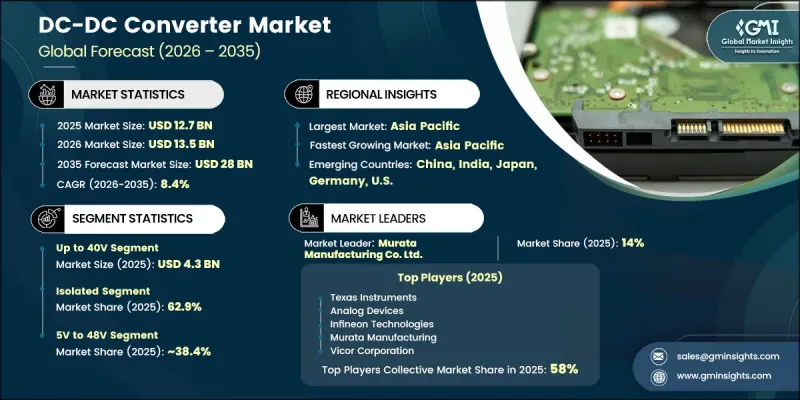
The market growth is driven by rising global demand for efficient power conversion and improved energy utilization across modern electronic systems. Expanding electrification trends across transportation, industrial automation, and power infrastructure are strengthening the adoption of DC-DC converters. Growing deployment in electric vehicles, renewable energy systems, and battery energy storage solutions is significantly boosting demand. Manufacturers are increasingly focusing on compact, high-efficiency designs that support higher power density and reduced energy losses. In addition, industrial digitalization and automation trends are further accelerating product integration across advanced machinery and smart systems. The continuous expansion of data centers, telecommunications infrastructure, and portable electronics is also contributing to sustained market momentum, as DC-DC converters play a critical role in stable voltage regulation and efficient power distribution across diverse applications.
| Market Scope | |
|---|---|
| Start Year | 2025 |
| Forecast Year | 2026-2035 |
| Start Value | $12.7 Billion |
| Forecast Value | $28 Billion |
| CAGR | 8.4% |
The up to 40V segment accounted for USD 4.3 billion in 2025, owing to widespread use in low and medium voltage electronic systems. This segment is widely adopted across consumer electronics, automotive electronics, industrial automation, telecommunications equipment, Internet of Things devices, and smart sensors. It supports stable voltage regulation in compact, energy-sensitive devices such as smartphones, laptops, and networking systems, where efficiency and space optimization are critical. Its advantages include reduced power loss, high conversion efficiency, compact design, and cost-effective power management, making it highly suitable for modern electronic applications requiring reliable low-power operation.
The isolated segment held a 62.9% share in 2025, driven by rising demand for electrical safety, noise reduction, and stable power conversion performance across critical industries. Isolated DC-DC converters provide galvanic separation between input and output circuits, protecting sensitive components from voltage spikes, ground loop issues, and electromagnetic interference. Their adoption is increasing across automotive systems, telecommunications networks, aerospace applications, renewable energy installations, and advanced medical equipment. Growing integration of electric mobility solutions, industrial automation technologies, and energy-efficient infrastructure is further reinforcing demand for isolated power conversion systems that ensure operational stability and compliance with strict safety requirements.
North America DC-DC Converter Market accounted for 31.1% share in 2025, supported by strong industrial and technological development across key sectors. The region demonstrates significant adoption across automotive electronics, telecommunications networks, aerospace and defense systems, industrial automation, cloud computing infrastructure, and renewable energy projects. Increasing investments in electric mobility, smart grid modernization, and advanced power management systems are accelerating market expansion. Rising demand for high-performance computing systems, medical electronics, and precision industrial machinery is further strengthening regional growth, as efficient and reliable power conversion remains essential for next-generation technologies.
Key players operating in the global DC-DC converter industry include Analog Devices Inc, Delta Electronics, Murata Manufacturing Co. Ltd., Texas Instruments Incorporated, Infineon Technologies AG, Vicor Corporation, Renesas Electronics Corporation, STMicroelectronics, TDK Lambda Corporation, NXP Semiconductors, RECOM Power GmbH, Cosel Co. Ltd, Traco Electronic AG, Bel Fuse Inc, Advanced Energy Industries Inc, ABB, Flex Ltd., FDK Corporation, Meggitt Plc, Crane Holdings Co, and Murata Manufacturing Co. Ltd. Companies in the DC-DC converter market are strengthening their position by focusing on high-efficiency, compact power conversion solutions designed for next-generation electronics. They are heavily investing in R&D to improve power density, thermal performance, and energy efficiency while reducing overall system losses. Strategic partnerships with automotive, telecom, and industrial OEMs are enabling deeper integration into end-use systems. Manufacturers are also expanding production capacity and optimizing global supply chains to improve delivery efficiency and cost competitiveness. In addition, firms are emphasizing customized and application-specific converter designs to meet diverse voltage and power requirements.
Table of Contents
Chapter 1 Methodology and Scope
- 1.1 Market scope and definition
- 1.2 Research design
- 1.2.1 Research approach
- 1.2.2 Data collection methods
- 1.3 Data mining sources
- 1.3.1 Global
- 1.3.2 Regional/Country
- 1.4 Base estimates and calculations
- 1.4.1 Base year calculation
- 1.4.2 Key trends for market estimation
- 1.5 Primary research and validation
- 1.5.1 Primary sources
- 1.6 Forecast model
- 1.7 Research assumptions and limitations
Chapter 2 Executive Summary
- 2.1 Industry 360° synopsis, 2022 - 2035
- 2.2 Key market trends
- 2.2.1 Type trends
- 2.2.2 Input voltage trends
- 2.2.3 Output voltage trends
- 2.2.4 Output power trends
- 2.2.5 End use trends
- 2.2.6 Regional trends
- 2.3 TAM Analysis, 2026-2035
- 2.4 CXO perspectives: Strategic imperatives
Chapter 3 Industry Insights
- 3.1 Industry ecosystem analysis
- 3.1.1 Supplier Landscape
- 3.1.2 Profit Margin
- 3.1.3 Cost structure
- 3.1.4 Value addition at each stage
- 3.1.5 Factor affecting the value chain
- 3.1.6 Disruptions
- 3.2 Industry impact forces
- 3.2.1 Growth drivers
- 3.2.1.1 Rapid growth of electric vehicle production
- 3.2.1.2 Increase of renewable energy capacity
- 3.2.1.3 Rapid growth of data center and ai infrastructure.
- 3.2.1.4 Increasing adoption of industrial automation and industry 4.0.
- 3.2.1.5 Progress of gan and sic power semiconductor technology.
- 3.2.2 Industry pitfalls and challenges
- 3.2.2.1 Thermal management and power losses
- 3.2.2.2 Unstable semiconductor supply chain
- 3.2.3 Market opportunities
- 3.2.3.1 Gan & sic technology adoption
- 3.2.3.2 Ev charging infrastructure rollout
- 3.2.1 Growth drivers
- 3.3 Growth potential analysis
- 3.4 Regulatory landscape
- 3.4.1 North America
- 3.4.2 Europe
- 3.4.3 Asia Pacific
- 3.4.4 Latin America
- 3.4.5 Middle East & Africa
- 3.5 Porter's analysis
- 3.6 PESTEL analysis
- 3.7 Technology and Innovation landscape
- 3.7.1 Current technological trends
- 3.7.2 Emerging technologies
- 3.8 Price trends (Based on paid Database)
- 3.8.1 Historical Price Analysis (2022-2025)
- 3.8.2 Price Trend Drivers
- 3.8.3 Regional Price Variations
- 3.8.4 Price Forecast (2026-2035)
- 3.9 Trade Data Analysis (Driven by Primary Research)
- 3.9.1 Import/Export Volume & Value Trends
- 3.9.2 Key Trade Corridors & Tariff Impact
- 3.10 Impact of AI & Generative AI on the Market
- 3.10.1 AI-Driven Disruption of Existing Business Models
- 3.10.2 GenAI Use Cases & Adoption Roadmap by Segment
- 3.10.3 Risks, Limitations & Regulatory Considerations
- 3.11 Capacity & Production Landscape (Driven by Primary Research)
- 3.11.1 Installed Capacity by Region & Key Producer
- 3.11.2 Capacity Utilization Rates & Expansion Pipelines
Chapter 4 Competitive Landscape, 2025
- 4.1 Introduction
- 4.2 Company market share analysis
- 4.2.1 By region
- 4.2.1.1 North America
- 4.2.1.2 Europe
- 4.2.1.3 Asia Pacific
- 4.2.1.4 Latin America
- 4.2.1.5 Middle East & Africa
- 4.2.2 Market concentration analysis
- 4.2.1 By region
- 4.3 Competitive analysis of major market players
- 4.4 Competitive positioning matrix
- 4.5 Key developments
- 4.5.1 Mergers & acquisitions
- 4.5.2 Partnerships & collaborations
- 4.5.3 New product launches
- 4.5.4 Expansion plans and funding
- 4.6 Company tier benchmarking
- 4.6.1 Tier classification criteria & qualifying thresholds
- 4.6.2 Tier positioning matrix by revenue, geography & innovation
Chapter 5 Market Estimates and Forecast, By Type, 2022 - 2035 (USD Billion & Units)
- 5.1 Key trends
- 5.2 Isolated
- 5.3 Non-Isolated
Chapter 6 Market Estimates and Forecast, By Input Voltage, 2022 - 2035 (USD Billion & Units)
- 6.1 Up to 40V
- 6.2 40V to 100V
- 6.3 100V to 500V
- 6.4 500V to 1,000V
Chapter 7 Market Estimates and Forecast, By Output Voltage, 2022 - 2035 (USD Billion & Units)
- 7.1 Up to 5V
- 7.2 5V to 48V
- 7.3 48V to 100V
- 7.4 100V to 500V
- 7.5 500V to 1,000V
Chapter 8 Market Estimates and Forecast, By Output Power, 2022 - 2035 (USD Billion & Units)
- 8.1 Up to 10W
- 8.2 10W to 50W
- 8.3 50W to 250W
- 8.4 250W to 500W
- 8.5 500W to 1,000W
- 8.6 Above 1,000W
Chapter 9 Market Estimates and Forecast, By End Use, 2022 - 2035 (USD Billion & Units)
- 9.1 Telecommunication
- 9.2 Automotive
- 9.3 Consumer electronics
- 9.4 Energy & power
- 9.5 Aerospace & defense
- 9.6 Healthcare
- 9.7 Others
Chapter 10 Market Estimates and Forecast, By Region, 2022 - 2035 (USD Million & Units)
- 10.1 Key trends
- 10.2 North America
- 10.2.1 U.S.
- 10.2.2 Canada
- 10.3 Europe
- 10.3.1 Germany
- 10.3.2 UK
- 10.3.3 France
- 10.3.4 Spain
- 10.3.5 Italy
- 10.3.6 Netherlands
- 10.3.7 Rest of Europe
- 10.4 Asia Pacific
- 10.4.1 China
- 10.4.2 India
- 10.4.3 Japan
- 10.4.4 Australia
- 10.4.5 South Korea
- 10.4.6 Rest of Asia Pacific
- 10.5 Latin America
- 10.5.1 Brazil
- 10.5.2 Mexico
- 10.5.3 Argentina
- 10.5.4 Rest of Latin America
- 10.6 Middle East and Africa
- 10.6.1 South Africa
- 10.6.2 Saudi Arabia
- 10.6.3 UAE
- 10.6.4 Rest of MEA
Chapter 11 Company Profiles
- 11.1 Global Key Players
- 11.1.1 Texas Instruments Incorporated
- 11.1.2 Analog Devices Inc
- 11.1.3 Infineon Technologies AG
- 11.1.4 Delta Electronics Inc
- 11.1.5 Murata Manufacturing Co. Ltd
- 11.1.6 NXP Semiconductors N.V
- 11.1.7 Renesas Electronics Corporation
- 11.1.8 STMicroelectronics N.V
- 11.1.9 TDK Corporation
- 11.1.10 ABB Ltd
- 11.2 Regional players
- 11.2.1 Advanced Energy Industries Inc
- 11.2.2 Bel Fuse Inc
- 11.2.3 Flex Ltd
- 11.2.4 TDK Lambda Corporation
- 11.2.5 Vicor Corporation
- 11.2.6 Cosel Co., Ltd
- 11.2.7 Meggitt Plc
- 11.3 Niche players
- 11.3.1 Crane Holdings Co
- 11.3.2 RECOM Power GmbH
- 11.3.3 Traco Electronic AG

