PUBLISHER: Global Market Insights Inc. | PRODUCT CODE: 2083310

PUBLISHER: Global Market Insights Inc. | PRODUCT CODE: 2083310
Hand Dryer Market Opportunity, Growth Drivers, Industry Trend Analysis, and Forecast 2026 - 2035
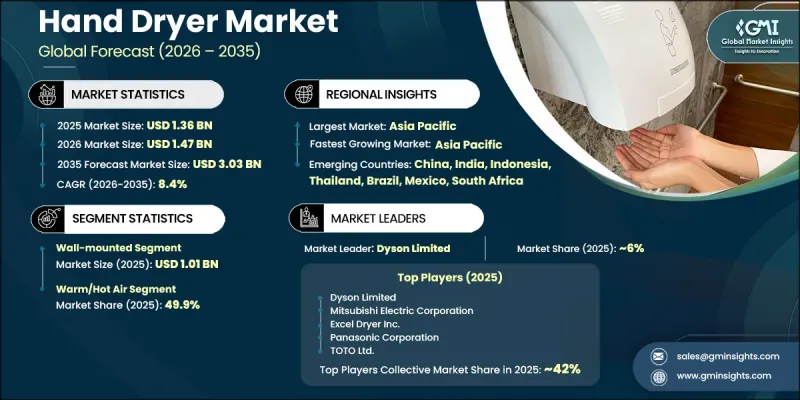
The Global Hand Dryer Market was valued at USD 1.36 billion in 2025 and is estimated to grow at a CAGR of 8.4% to reach USD 3.03 billion by 2035.
The hand dryer market is undergoing a notable structural transformation driven by tightening hygiene requirements across healthcare, hospitality, and public infrastructure environments. At the same time, stricter energy efficiency regulations embedded in modern building codes are accelerating the adoption of low-energy washroom solutions. The increasing deployment of smart building ecosystems in regions such as Asia Pacific and the Middle East is further reshaping product expectations, shifting hand dryers from basic utility devices to connected, sensor-based systems integrated into broader facility management platforms. Features such as touchless operation, air filtration systems, and IoT-enabled monitoring are increasingly influencing procurement decisions among institutional buyers. Sustainability requirements tied to green building certifications are also playing a major role in shaping demand, with organizations prioritizing energy-efficient and compliant equipment in large-scale infrastructure projects. As a result, demand for advanced, certified, and digitally integrated hand drying systems continues to expand across commercial and institutional end-use sectors, reinforcing steady long-term growth for the hand dryer market.
| Market Scope | |
|---|---|
| Start Year | 2025 |
| Forecast Year | 2026-2035 |
| Start Value | $1.36 Billion |
| Forecast Value | $3.03 Billion |
| CAGR | 8.4% |
The wall-mounted segment generated USD 1.01 billion in 2025. This configuration continues to dominate the hand dryer market due to its widespread adoption across diverse commercial washroom environments, ranging from small retail facilities to high-traffic public infrastructure locations. Its leadership position is supported by ease of installation, standardized design compatibility, and broad availability across manufacturers. Wall-mounted systems remain the preferred choice for institutional buyers due to their practicality, durability, and suitability for high-usage environments, reinforcing their long-standing dominance in global installations.
The warm and hot air segment accounted for 49.9% share in 2025, maintaining the largest revenue share despite growing competitive pressure from more energy-efficient alternatives. This segment continues to benefit from its established presence across mid-tier commercial, educational, and retail facilities where replacement costs and familiarity strongly influence purchasing decisions. However, evolving energy efficiency standards and shifting preferences toward faster-drying technologies are gradually reshaping market dynamics, influencing long-term product adoption patterns across commercial washroom applications.
China Hand Dryer Market held a 24.6% share in 2025. Market growth in the country is supported by large-scale infrastructure modernization programs, expansion of smart city projects, and continuous development of commercial real estate and transportation facilities. Increasing investments in public infrastructure and urban facility upgrades are generating sustained demand for modern washroom solutions, contributing significantly to regional market expansion.
Major companies operating in the global hand dryer market include Dyson Limited, Panasonic Corporation, Bobrick Washroom Equipment, Inc., Mitsubishi Electric Corporation, Excel Dryer Inc., Bradley Corporation, TOTO Ltd., Hokwang Industries Co., Ltd., Dan Dryer A/S, Mediclinics S.A., World Dryer, Veltia, Jaquar & Company Pvt. Ltd., Airdri Group Ltd., Electrostar GmbH, JVD SAS, Euronics Industries Pvt. Ltd., Dolphy India Pvt. Ltd., Interhasa, Taishan Jieda Electrical Co., Ltd., and Zhejiang AIKE Appliances Co., Ltd. Companies operating in the hand dryer market are strengthening their market position by focusing on energy-efficient product development, advanced sensor-based technologies, and integration with smart building systems. Manufacturers are increasingly investing in research and development to introduce high-speed, low-noise, and hygienic drying solutions that comply with evolving environmental and safety regulations. Strategic partnerships with facility management companies and commercial infrastructure developers are helping expand product deployment across large-scale projects. Firms are also enhancing product durability, design aesthetics, and maintenance efficiency to improve long-term value for institutional buyers.
Table of Contents
Chapter 1 Methodology and Scope
- 1.1 Market scope and definition
- 1.2 Research design
- 1.2.1 Research approach
- 1.2.2 Data collection methods
- 1.3 Data mining sources
- 1.3.1 Global
- 1.3.2 Regional/Country
- 1.4 Base estimates and calculations
- 1.4.1 Base year calculation
- 1.4.2 Key trends for market estimation
- 1.5 Primary research and validation
- 1.5.1 Primary sources
- 1.6 Forecast model
- 1.7 Research assumptions and limitations
Chapter 2 Executive Summary
- 2.1 Industry 360° synopsis
- 2.2 Key market trends
- 2.2.1 Regional
- 2.2.2 Mounting Type
- 2.2.3 Battery Type
- 2.2.4 Technology
- 2.2.5 Operation Mode
- 2.2.6 Power Rating
- 2.2.7 Price Range
- 2.2.8 End User
- 2.2.9 Distribution Channel
Chapter 3 Industry Insights
- 3.1 Industry ecosystem analysis
- 3.1.1 Supplier landscape
- 3.1.2 Profit margin
- 3.1.3 Value addition at each stage
- 3.1.4 Factor affecting the value chain
- 3.2 Industry impact forces
- 3.2.1 Growth drivers
- 3.2.2 Industry pitfalls & challenges
- 3.2.3 Opportunities
- 3.3 Growth potential analysis
- 3.3.1 Price volatility and market unpredictability
- 3.3.2 Quality assurance and equipment reliability concerns
- 3.4 Future market trends
- 3.5 Technology and innovation landscape
- 3.5.1 Current technological trends
- 3.5.2 Emerging technologies
- 3.6 Pricing Analysis (Driven by Primary Research)
- 3.6.1 Historical Price Trend Analysis (Driven by Primary Research)
- 3.6.2 Pricing Strategy by Player Type (Premium/Value/Cost-plus) (Driven by Primary Research)
- 3.6.3 Average Selling Price by Product Type & Capacity
- 3.7 Regulatory landscape
- 3.7.1 Standards and compliance requirements
- 3.7.2 Regional regulatory frameworks
- 3.7.3 Certification standards
- 3.8 Porter's analysis
- 3.9 PESTEL analysis
- 3.10 Trade Data Analysis (Driven by Primary Research)
- 3.10.1 Import/Export Volume & Value Trends by Region (HS Code Level) (Driven by Primary Research)
- 3.10.2 Key Trade Corridors (China-North America, China-Europe) & Tariff Impact (Driven by Primary Research)
- 3.11 Impact of AI & Generative AI on the Hand Dryer Market
- 3.11.1 AI-Driven Disruption of Existing Business Models
- 3.11.2 GenAI Use Cases & Adoption Roadmap by Segment
- 3.11.3 Risks, Limitations & Regulatory Considerations
- 3.12 Capacity and Production Landscape - Asia Pacific (Driven by Primary Research)
- 3.12.1 Installed Capacity by Country and Key Producer - Asia Pacific (Driven by Primary Research)
- 3.12.2 Capacity Utilization Rates and Expansion Pipelines (Driven by Primary Research)
Chapter 4 Competitive Landscape, 2025
- 4.1 Introduction
- 4.2 Company market share analysis
- 4.2.1 By region
- 4.2.1.1 North America
- 4.2.1.2 Europe
- 4.2.1.3 Asia Pacific
- 4.2.1.4 Latin America
- 4.2.1.5 Middle East and Africa
- 4.2.1 By region
- 4.3 Company matrix analysis
- 4.4 Competitive analysis of major market players
- 4.5 Competitive positioning matrix
- 4.6 Key developments
- 4.6.1 Mergers & acquisitions
- 4.6.2 Partnerships & collaborations
- 4.6.3 New product launches
- 4.6.4 Expansion plans
Chapter 5 Market Estimates & Forecast, By Mounting Type, 2022 - 2035, (USD Billion) (Thousand Units)
- 5.1 Key trends
- 5.2 Wall-Mounted
- 5.3 Surface-Mounted
- 5.4 Recessed
- 5.5 Floor-Standing/Pedestal
Chapter 6 Market Estimates & Forecast, By Technology, 2022 - 2035, (USD Billion) (Thousand Units)
- 6.1 Key trends
- 6.2 Warm/Hot Air Hand Dryers
- 6.3 Jet Air Hand Dryers
- 6.4 Blade/Dual-Sided Hand Dryers
Chapter 7 Market Estimates & Forecast, By Operation Mode, 2022 - 2035, (USD Billion) (Thousand Units)
- 7.1 Key trends
- 7.2 Automatic/Touchless (Sensor)
- 7.3 Manual (Push-Button)
- 7.4 Wave Sensor
Chapter 8 Market Estimates & Forecast, By Power Rating, 2022 - 2035, (USD Billion) (Thousand Units)
- 8.1 Key trends
- 8.2 Up to 1,000W
- 8.3 1,000W - 2,000W
- 8.4 Above 2,000W
Chapter 9 Market Estimates & Forecast, By Price Range, 2022 - 2035, (USD Billion) (Thousand Units)
- 9.1 Key trends
- 9.2 Below USD 150
- 9.3 USD 150 - USD 500
- 9.4 Above USD 500
Chapter 10 Market Estimates & Forecast, By End Use, 2022 - 2035, (USD Billion) (Thousand Units)
- 10.1 Key trends
- 10.2 Hotels & Hospitality
- 10.3 Hospitals & Healthcare
- 10.4 Food Processing & Service Industry
- 10.5 Commercial Complexes & Shopping Malls
- 10.6 Office Buildings
- 10.7 Educational Institutions
- 10.8 Transportation Hubs
- 10.9 Others
Chapter 11 Market Estimates & Forecast, By Distribution Channel, 2022 - 2035, (USD Billion) (Thousand Units)
- 11.1 Key trends
- 11.2 Online
- 11.2.1 E-commerce platforms
- 11.2.2 Company websites
- 11.3 Offline
- 11.3.1 Retail stores
- 11.3.2 Specialty stores
Chapter 12 Market Estimates and Forecast, By Region, 2022 - 2035 (USD Billion) (Thousand Units)
- 12.1 Key trends
- 12.2 North America
- 12.2.1 U.S.
- 12.2.2 Canada
- 12.3 Europe
- 12.3.1 Germany
- 12.3.2 UK
- 12.3.3 France
- 12.3.4 Italy
- 12.3.5 Spain
- 12.4 Asia Pacific
- 12.4.1 China
- 12.4.2 Japan
- 12.4.3 India
- 12.4.4 Australia
- 12.4.5 South Korea
- 12.5 Latin America
- 12.5.1 Brazil
- 12.5.2 Mexico
- 12.5.3 Argentina
- 12.6 Middle East and Africa
- 12.6.1 South Africa
- 12.6.2 Saudi Arabia
- 12.6.3 UAE
Chapter 13 Company Profiles
- 13.1 Top Global Player
- 13.1.1 Dyson Limited
- 13.1.2 Mitsubishi Electric Corporation
- 13.1.3 Excel Dryer Inc.
- 13.1.4 Panasonic Corporation
- 13.1.5 TOTO Ltd.
- 13.1.6 World Dryer
- 13.2 Regional Player
- 13.2.1 Airdri Group Ltd.
- 13.2.2 Mediclinics S.A.
- 13.2.3 Hokwang Industries Co., Ltd.
- 13.2.4 Zhejiang AIKE Appliances Co., Ltd.
- 13.2.5 JVD SAS
- 13.2.6 Electrostar GmbH
- 13.2.7 Dan Dryer A/S
- 13.2.8 Jaquar & Company Pvt. Ltd.
- 13.2.9 Euronics Industries Pvt. Ltd.
- 13.2.10 Bobrick Washroom Equipment, Inc.
- 13.3 Emerging Players
- 13.3.1 Veltia
- 13.3.2 Interhasa
- 13.3.3 Dolphy India Pvt. Ltd.
- 13.3.4 Taishan Jieda Electrical Co., Ltd.
- 13.3.5 Bradley Corporation

