PUBLISHER: Global Market Insights Inc. | PRODUCT CODE: 2083319

PUBLISHER: Global Market Insights Inc. | PRODUCT CODE: 2083319
Decentralized Clinical Trials Market Opportunity, Growth Drivers, Industry Trend Analysis, and Forecast 2026 - 2035
The Global Decentralized Clinical Trials Market was valued at USD 8 billion in 2025 and is estimated to grow at a CAGR of 13.7% to reach USD 28.4 billion by 2035.
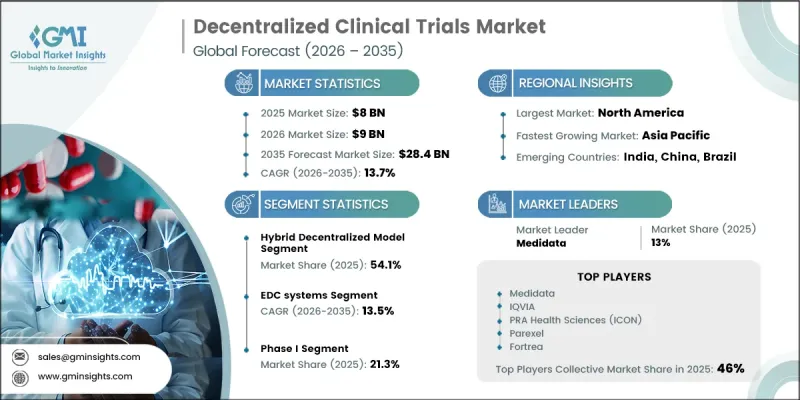
Market growth is driven by greater regulatory acceptance, continuous advancements in digital health technologies, and increasing demand from sponsors for more efficient, cost-effective, and diverse clinical trial designs. The growing availability of telehealth platforms, electronic patient-reported outcome solutions, remote monitoring technologies, and digital data collection tools has significantly improved the feasibility of decentralized trial execution. As regulatory agencies place greater emphasis on patient accessibility, engagement, and diversity, pharmaceutical companies and research organizations are increasingly incorporating decentralized capabilities into their study frameworks. Remote trial management reduces operational burdens associated with traditional research sites while improving participant convenience and retention. These advantages are particularly valuable in large-scale studies that involve extensive patient populations across multiple geographic locations, where decentralized approaches can streamline operations, reduce costs, and accelerate study timelines.
| Market Scope | |
|---|---|
| Start Year | 2025 |
| Forecast Year | 2026-2035 |
| Start Value | $8 Billion |
| Forecast Value | $28.4 Billion |
| CAGR | 13.7% |
The hybrid decentralized model segment accounted for 54.1% share in 2025 and is expected to grow at a CAGR of 13.7% through 2035. This model has emerged as the preferred trial design across numerous mid-stage and late-stage clinical studies because it combines remote patient engagement capabilities with essential in-person clinical assessments. By integrating selected decentralized elements while maintaining necessary site-based activities, sponsors can balance participant convenience with regulatory and operational requirements. The hybrid approach enables organizations to improve patient recruitment, increase retention rates, and enhance study efficiency while preserving the oversight needed for critical clinical procedures and data collection activities.
Phase I studies segment held a 21.3% share in 2025 and is projected to grow at a CAGR of 13.6% through 2035. Adoption of decentralized methodologies within this phase remains more selective due to the intensive monitoring, safety assessments, and detailed data collection requirements associated with early-stage clinical research. Many studies at this stage continue to require direct clinical supervision and controlled environments to ensure participant safety and accurate evaluation of investigational therapies. Nevertheless, ongoing advancements in remote monitoring technologies and digital health platforms are creating opportunities for broader implementation of decentralized components within early-phase research programs.
North America Decentralized Clinical Trials Market captured a 44.2% share in 2025 and is anticipated to grow at a CAGR of 13.8% through 2035. The region remains the leading market for decentralized clinical research due to its advanced healthcare infrastructure, strong clinical research ecosystem, widespread adoption of digital health technologies, and favorable regulatory environment. The United States continues to account for the largest share of regional revenue, supported by significant clinical trial activity, robust technology deployment, and the presence of major industry participants focused on decentralized research solutions.
Key companies operating in the global decentralized clinical trials market include Curebase, Florence Healthcare, OpenClinica, Trialize, Reify Health, Signant Health, Clinical Research IO, Sanguine Bio, Medable, Propharma, Parexel, Medidata, IQVIA, ClinOne, Fortrea, Veeva Systems, ClinTex, Sano Genetics, Covance, Bio-Optronics, Mahalo Health, Science 37, PRA Health Sciences (ICON), and PPD (Thermo Fisher Scientific). Companies operating in the decentralized clinical trials market are focusing on technology innovation, strategic collaborations, and service expansion to strengthen their market position. Leading organizations are investing in advanced digital platforms that support remote patient monitoring, virtual site management, electronic data capture, and real-time analytics. Partnerships with pharmaceutical companies, contract research organizations, healthcare providers, and technology firms are helping market participants expand their service capabilities and geographic reach. Businesses are also enhancing interoperability, cybersecurity, and patient engagement tools to improve trial efficiency and participant experiences. In addition, companies are expanding cloud-based solutions, artificial intelligence capabilities, and data integration platforms to streamline clinical operations.
Table of Contents
Chapter 1 Methodology & Scope
- 1.1 Research approach
- 1.2 Quality commitments
- 1.2.1 GMI AI policy & data integrity commitment
- 1.2.1.1 Source consistency protocol
- 1.2.1 GMI AI policy & data integrity commitment
- 1.3 Research trail & confidence scoring
- 1.3.1 Research trail components
- 1.3.2 Scoring components
- 1.4 Data collection
- 1.4.1 Partial list of primary sources
- 1.5 Data mining sources
- 1.5.1 Paid sources
- 1.5.1.1 Sources, by region
- 1.5.1 Paid sources
- 1.6 Base estimates and calculations
- 1.6.1 Base year calculation for any one approach
- 1.7 Market estimates & forecasts parameters
- 1.8 Forecast model
- 1.8.1 Quantified market impact analysis
- 1.8.1.1 Mathematical impact of growth parameters on forecast
- 1.8.1 Quantified market impact analysis
- 1.9 Research transparency addendum
- 1.9.1 Source attribution framework
- 1.9.2 Quality assurance metrics
- 1.9.3 Our commitment to trust
Chapter 2 Executive Summary
- 2.1 Industry 360° synopsis
- 2.1.1 Business trends
- 2.1.2 Decentralization model trends
- 2.1.3 Technology trends
- 2.1.4 Therapeutic area trends
- 2.1.5 Study phase trends
- 2.1.6 Regional trends
- 2.2 CXO perspectives: Strategic imperatives
Chapter 3 Industry Insights
- 3.1 Industry ecosystem analysis
- 3.2 Industry impact forces
- 3.2.1 Growth drivers
- 3.2.1.1 Technological advancement in digital health
- 3.2.1.2 Cost efficiency and accelerated timelines
- 3.2.1.3 Regulatory support and framework development
- 3.2.1.4 Improved patient accessibility and diversity
- 3.2.2 Industry pitfalls and challenges
- 3.2.2.1 Data integrity and standardization
- 3.2.2.2 Regulatory complexity and regional inconsistencies
- 3.2.3 Market opportunities
- 3.2.3.1 Integration of AI and wearables
- 3.2.3.2 Expansion into underserved and emerging markets
- 3.2.1 Growth drivers
- 3.3 Growth potential analysis
- 3.4 Regulatory landscape (Driven by primary research)
- 3.4.1 North America
- 3.4.2 Europe
- 3.4.3 Asia Pacific
- 3.4.4 Latin America
- 3.4.5 MEA
- 3.5 Technology landscape
- 3.5.1 Current technological trends
- 3.5.2 Emerging technologies
- 3.6 Operational architecture of hybrid trial designs
- 3.7 Future market trends
- 3.8 Data capture and technology integration
- 3.8.1 Standardizing Electronic patient-reported outcomes (ePRO) within central clinical data repositories
- 3.8.2 Device interoperability: Technical integration of wearable sensors and digital health technologies (DHTs)
- 3.8.3 Technical strategies for preserving data integrity, managing device variance, and mitigating missing data
- 3.9 Porter's analysis
- 3.10 PESTEL analysis
- 3.11 Impact of AI and Generative AI on the market (Driven by primary research)
Chapter 4 Competitive Landscape, 2025
- 4.1 Introduction
- 4.2 Company market share analysis
- 4.2.1 North America
- 4.2.2 Europe
- 4.2.3 Asia Pacific
- 4.3 Company matrix analysis
- 4.4 Competitive analysis of major market players
- 4.5 Competitive positioning matrix
- 4.6 Key developments
- 4.6.1 Merger and acquisition
- 4.6.2 Partnership and collaboration
- 4.6.3 New product launches
- 4.6.4 Expansion plans
Chapter 5 Market Estimates and Forecast, By Decentralization Model, 2022 - 2035 (USD Million)
- 5.1 Key trends
- 5.2 Hybrid
- 5.3 Fully
- 5.4 Site-based decentralized model
Chapter 6 Market Estimates and Forecast, By Technology, 2022 - 2035 (USD Million)
- 6.1 Key trends
- 6.2 Telemedicine platforms
- 6.3 Wearable devices
- 6.4 Mobile health applications
- 6.5 Electronic data capture (EDC) systems
- 6.6 Electronic patient-reported outcomes (ePRO)
- 6.7 Other technologies
Chapter 7 Market Estimates and Forecast, By Therapeutic Area, 2022 - 2035 (USD Million)
- 7.1 Key trends
- 7.2 Oncology
- 7.3 Cardiology
- 7.4 Neurology
- 7.5 Infectious diseases
- 7.6 Respiratory disorders
- 7.7 Other chronic conditions
Chapter 8 Market Estimates and Forecast, By Study Phase, 2022 - 2035 (USD Million)
- 8.1 Key trends
- 8.2 Phase I
- 8.3 Phase II
- 8.4 Phase III
- 8.5 Phase IV
Chapter 9 Market Estimates and Forecast, By Region, 2022 - 2035 (USD Million)
- 9.1 Key trends
- 9.2 North America
- 9.2.1 U.S.
- 9.2.2 Canada
- 9.3 Europe
- 9.3.1 Germany
- 9.3.2 France
- 9.3.3 UK
- 9.3.4 Netherlands
- 9.3.5 Spain
- 9.3.6 Italy
- 9.4 Asia Pacific
- 9.4.1 China
- 9.4.2 Japan
- 9.4.3 South Korea
- 9.4.4 India
- 9.4.5 Australia
- 9.5 Latin America
- 9.5.1 Brazil
- 9.5.2 Argentina
- 9.5.3 Mexico
- 9.6 Middle East & Africa
- 9.6.1 Saudi Arabia
- 9.6.2 UAE
- 9.6.3 South Africa
Chapter 10 Company Profiles
- 10.1 Bio-Optronics
- 10.2 Clinical Research IO
- 10.3 ClinOne
- 10.4 ClinTex
- 10.5 Covance
- 10.6 Curebase
- 10.7 Florence Healthcare
- 10.8 Fortrea
- 10.9 IQVIA
- 10.10 Mahalo Health
- 10.11 Medable
- 10.12 Medidata
- 10.13 OpenClinica
- 10.14 Parexel
- 10.15 PPD (Thermo Fisher Scientific)
- 10.16 PRA Health Sciences (ICON)
- 10.17 Propharma
- 10.18 Reify Health
- 10.19 Sanguine Bio
- 10.20 Sano Genetics
- 10.21 Science 37
- 10.22 Signant Health
- 10.23 Trialize
- 10.24 Veeva Systems

