PUBLISHER: Global Market Insights Inc. | PRODUCT CODE: 2083325

PUBLISHER: Global Market Insights Inc. | PRODUCT CODE: 2083325
Onsite Hydrogen Generator Market Opportunity, Growth Drivers, Industry Trend Analysis, and Forecast 2026 - 2035
The Global Onsite Hydrogen Generator Market was valued at USD 591.3 million in 2025 and is estimated to grow at a CAGR of 6.8% to reach USD 1.13 billion by 2035.
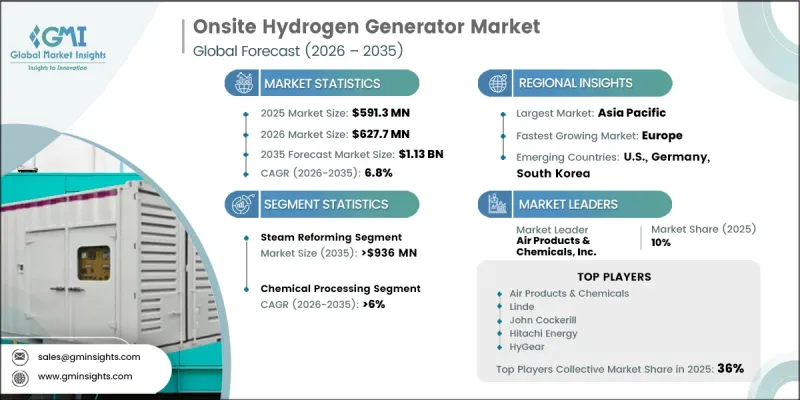
The market is witnessing steady growth as industries increasingly adopt localized hydrogen production systems to improve supply reliability, enhance operational efficiency, and reduce dependence on external hydrogen distribution networks. Rising demand for clean energy solutions, decarbonization initiatives, and the transition toward sustainable industrial operations are creating strong opportunities for onsite hydrogen generation technologies. Industrial sectors are increasingly investing in hydrogen systems to ensure a consistent supply of high-purity hydrogen while addressing supply chain challenges. Supportive government policies, energy transition programs, and growing emphasis on low-carbon technologies are further encouraging the adoption of these systems. The expansion of hydrogen fuel cell applications is also strengthening demand for decentralized hydrogen production infrastructure. Onsite hydrogen generators provide a flexible and scalable solution for meeting increasing hydrogen requirements while reducing transportation-related complexities. Additionally, industries requiring high-purity hydrogen are adopting these systems to improve process reliability, maintain quality standards, and achieve greater production efficiency, supporting long-term market development.
| Market Scope | |
|---|---|
| Start Year | 2025 |
| Forecast Year | 2026-2035 |
| Start Value | $591.3 Million |
| Forecast Value | $1.13 Billion |
| CAGR | 6.8% |
The onsite hydrogen generator market is gaining momentum due to increasing utilization across multiple industrial applications and the growing need for secure hydrogen availability. The rising deployment of hydrogen fuel cell technologies is supporting demand for localized production systems used in energy, mobility, and backup power applications. Companies are increasingly focusing on onsite generation solutions as they help reduce logistical challenges associated with hydrogen supply while offering greater control over production capacity. Technological improvements in generator efficiency, system integration, and scalability are further enhancing adoption. Growing industrial requirements for ultra-high-purity hydrogen are also contributing to market expansion, as onsite systems provide dependable hydrogen output with improved purity levels. These advantages are encouraging industries to integrate hydrogen generation technologies into their operations to improve reliability and optimize overall performance.
The steam reforming segment is expected to reach USD 936 million by 2035. Growth in this segment is supported by the increasing demand for dependable hydrogen supply systems that reduce reliance on external suppliers and improve operational continuity. Industries are adopting onsite steam reforming technologies to enhance supply security, minimize transportation-related challenges, and reduce production interruptions. Continuous advancements in catalyst technology, thermal management, and system optimization are improving efficiency while lowering long-term operating costs, making onsite deployment more attractive for industrial users.
The chemical processing segment is projected to grow at a CAGR of 6% through 2035. Increasing efforts to lower carbon emissions and comply with stricter environmental requirements are encouraging industrial users to adopt hydrogen-based power solutions. Onsite hydrogen generators are gaining attention due to their ability to provide cleaner energy options while improving energy flexibility. Advancements in fuel cell technology, including improvements in efficiency, durability, and integration capabilities, are accelerating the adoption of compact and modular hydrogen generation systems across various applications.
U.S. Onsite Hydrogen Generator Market accounted for an 84.1% share in 2025 and is anticipated to reach USD 142 million by 2035. The market is expanding as demand increases for cleaner, reliable, and decentralized energy solutions. Industries are exploring onsite hydrogen production to reduce environmental impact while improving energy security. Rising fuel costs and stricter emission regulations are encouraging a shift away from traditional power generation methods toward hydrogen-based alternatives. The integration of renewable energy sources with onsite hydrogen production is gaining traction as organizations focus on reducing carbon emissions. Government incentives, funding initiatives, and support for demonstration projects involving hydrogen production, storage, and utilization are further improving adoption prospects and strengthening industry growth.
Leading companies operating in the global onsite hydrogen generator industry are: Linde, HYGEAR, Air Products and Chemicals, Mitsubishi Kakoki Kaisha, Element 1, John Cockerill, Peak Scientific Instruments, Hitachi Energy, OneH2, F-DGSi, Teledyne Technologies, HYDGEN, Kanadevia Corporation, OSAKA GAS CO., LTD, LNI S.r.l., Gastek Engineering, Idroenergy, MAHLER AGS, EPOCH Energy Technology Corp, and MVS Engineering. Companies operating in the onsite hydrogen generator market are strengthening their market position through technology development, strategic partnerships, and expansion of product capabilities. Market participants are investing in advanced hydrogen production technologies to improve efficiency, reliability, and scalability while addressing the growing demand for decentralized energy solutions. Businesses are focusing on developing compact and modular systems that can serve diverse industrial requirements and support flexible deployment. Strategic collaborations with energy providers, industrial users, and technology companies are helping firms expand their customer base and accelerate commercialization.
Table of Contents
Chapter 1 Methodology & Scope
- 1.1 Research design
- 1.2 Quality commitment
- 1.2.1 GMI AI policy & data integrity commitment
- 1.2.1.1 Source consistency protocol
- 1.2.1 GMI AI policy & data integrity commitment
- 1.3 Research trail & confidence scoring
- 1.3.1 Research trail components
- 1.3.2 Scoring components
- 1.4 Data collection
- 1.4.1 Partial list of primary sources
- 1.5 Data mining sources
- 1.5.1 Paid sources
- 1.5.1.1 Sources, by region
- 1.5.1 Paid sources
- 1.6 Base estimates and calculations
- 1.6.1 Base year calculation for any one approach
- 1.7 Forecast model
- 1.8 Research transparency addendum
- 1.8.1 Source attribution framework
- 1.8.2 Quality assurance metrics
- 1.8.3 Our commitment to trust
- 1.9 Market definitions
Chapter 2 Executive Summary
- 2.1 Industry synopsis, 2022 - 2035
- 2.2 Business trends
- 2.3 Process trends
- 2.4 Capacity trends
- 2.5 Application trends
- 2.6 Regional trends
Chapter 3 Industry Insights
- 3.1 Industry ecosystem
- 3.1.1 Raw material availability & sourcing analysis
- 3.1.2 Manufacturing capacity assessment
- 3.1.3 Supply chain resilience & risk factors
- 3.1.4 Distribution network analysis
- 3.2 Regulatory landscape
- 3.2.1 North America
- 3.2.2 Europe
- 3.2.3 Asia Pacific
- 3.2.4 Middle East & Africa
- 3.2.5 Latin America
- 3.3 Industry impact forces
- 3.3.1 Growth drivers
- 3.3.2 Industry pitfalls & challenges
- 3.4 Growth potential analysis
- 3.5 Porter's analysis
- 3.5.1 Bargaining power of suppliers
- 3.5.2 Bargaining power of buyers
- 3.5.3 Threat of new entrants
- 3.5.4 Threat of substitutes
- 3.6 PESTEL analysis
- 3.6.1 Political factors
- 3.6.2 Economic factors
- 3.6.3 Social factors
- 3.6.4 Technological factors
- 3.6.5 Legal factors
- 3.6.6 Environmental factors
- 3.7 Cost structure analysis
- 3.8 Trade data analysis (Driven by Primary Research)
- 3.8.1 Import/export value trends
- 3.8.2 Key trade corridors & tariff impact
- 3.9 Price trend analysis (Driven by Primary Research)
- 3.9.1 Historic price trend analysis
- 3.9.2 Pricing strategy by key player
- 3.10 Impact of AI & generative AI on the market [Driven by Primary Research]
- 3.10.1 Predictive maintenance & fault detection
- 3.10.2 Grid optimization & load forecasting
- 3.10.3 Digital twin simulation & testing
- 3.10.4 Risks, limitations & regulatory considerations
- 3.11 Emerging opportunities & trends
- 3.12 Digitalization & IoT integration
- 3.13 Investment analysis and future outlook
Chapter 4 Competitive landscape, 2026
- 4.1 Introduction
- 4.2 Company market share analysis, by region, 2025
- 4.2.1 North America
- 4.2.2 Europe
- 4.2.3 Asia Pacific
- 4.2.4 Middle East & Africa
- 4.2.5 Latin America
- 4.3 Competitive analysis of major market players
- 4.4 Competitive positioning matrix
- 4.5 Key developments
- 4.5.1 Mergers & acquisitions
- 4.5.2 Partnerships & collaborations
- 4.5.3 New product launches
- 4.5.4 Expansion plans & funding
- 4.6 Company tier benchmarking
- 4.6.1 Tier classification criteria & qualifying thresholds
- 4.6.2 Tier positioning matrix by revenue, geography & innovation
Chapter 5 Market Size and Forecast, By Process, 2022 - 2035 (USD Million)
- 5.1 Key trends
- 5.2 Steam reforming
- 5.3 Electrolysis
- 5.4 Others
Chapter 6 Market Size and Forecast, By Capacity, 2022 - 2035 (USD Million)
- 6.1 Key trends
- 6.2 < 100 Nm3/h
- 6.3 100-2,000 Nm3/h
- 6.4 >2,000 Nm3/h
Chapter 7 Market Size and Forecast, By Application, 2022 - 2035 (USD Million)
- 7.1 Key trends
- 7.2 Chemical processing
- 7.3 Petroleum recovery
- 7.4 Fuel cells
- 7.5 Refinery
- 7.6 Others
Chapter 8 Market Size and Forecast, By Region, 2022 - 2035 (USD Million)
- 8.1 Key trends
- 8.2 North America
- 8.2.1 U.S.
- 8.2.2 Canada
- 8.3 Europe
- 8.3.1 Germany
- 8.3.2 UK
- 8.3.3 France
- 8.3.4 Sweden
- 8.3.5 Italy
- 8.3.6 Netherlands
- 8.4 Asia Pacific
- 8.4.1 China
- 8.4.2 Japan
- 8.4.3 South Korea
- 8.4.4 India
- 8.5 Middle East & Africa
- 8.6 Latin America
- 8.6.1 Brazil
Chapter 9 Company Profiles
- 9.1 Air Products and Chemicals
- 9.2 Element 1
- 9.3 EPOCH Energy Technology Corp
- 9.4 F-DGSi
- 9.5 Gastek Engineering
- 9.6 Hitachi Energy
- 9.7 HYDGEN
- 9.8 HYGEAR
- 9.9 Idroenergy
- 9.10 John Cockerill
- 9.11 Kanadevia Corporation
- 9.12 Linde
- 9.13 LNI S.r.l.
- 9.14 MAHLER AGS
- 9.15 Mitsubishi Kakoki Kaisha
- 9.16 MVS ENGINEERING
- 9.17 OneH2
- 9.18 OSAKA GAS CO.,LTD
- 9.19 Peak Scientific Instruments
- 9.20 Teledyne Technologies

