PUBLISHER: Global Market Insights Inc. | PRODUCT CODE: 2083332

PUBLISHER: Global Market Insights Inc. | PRODUCT CODE: 2083332
Active Speaker Market Opportunity, Growth Drivers, Industry Trend Analysis, and Forecast 2026 - 2035
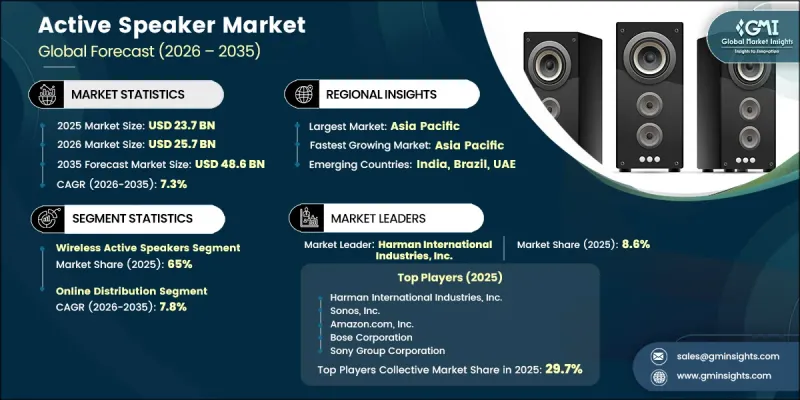
The Global Active Speaker Market was valued at USD 23.7 billion in 2025 and is estimated to grow at a CAGR of 7.3% to reach USD 48.6 billion by 2035.
Growth is shaped by two core structural trends: rising premium demand for high-quality home audio experiences across developed regions such as North America, Europe, and East Asia, and the growing use of integrated active speaker systems in commercial environments that prioritize simplified, all-in-one audio solutions without separate amplification components. Advancements in wireless technologies, particularly Bluetooth Low Energy (LE) Audio, are redefining performance standards and enhancing connectivity efficiency across devices. At the same time, automotive manufacturers are increasingly embedding active speaker systems into in-vehicle entertainment platforms, creating a steady OEM-driven revenue stream alongside traditional retail and commercial audio channels. Commercial AV installations continue to represent a high-value segment, with enterprises upgrading meeting rooms and collaboration spaces to integrated active audio systems. Public venues such as theatres, conference centers, hotels, and retail complexes are also increasing the adoption of high-output active speaker systems to meet advanced acoustic requirements and improve user experience in large spaces.
| Market Scope | |
|---|---|
| Start Year | 2025 |
| Forecast Year | 2026-2035 |
| Start Value | $23.7 Billion |
| Forecast Value | $48.6 Billion |
| CAGR | 7.3% |
The wireless active speakers segment accounted for 65% share in 2025 and is projected to grow at a CAGR of 7.1% through 2035. This segment continues to dominate due to widespread adoption across residential, commercial, and portable applications, supported by decades of continuous improvements in wireless audio transmission technologies that have narrowed the performance gap with wired systems while improving ease of installation and mobility.
The online distribution channels held 54.9% share in 2025 and is expected to grow at a CAGR of 7.8% through 2035. The strength of online sales is driven by broader product availability, competitive pricing in mid-range categories, and seamless integration between digital platforms and manufacturer ecosystems. Direct-to-consumer strategies are increasingly shaping the market, with major brands using proprietary digital storefronts to enhance customer engagement and control the purchasing experience.
North America Active Speaker Market accounted for 31.9% share in 2025 and is projected to grow at a CAGR of 7.1% through 2035. The United States remains the primary contributor to regional demand, supported by high consumer spending on premium audio systems, consistent upgrade cycles in home entertainment setups, and a mature commercial AV infrastructure across enterprise and institutional environments.
Key companies operating in the global active speaker market include Harman International Industries, Inc., Bose Corporation, Apple Inc., Amazon.com, Inc., Logitech International S.A., KEF, Marshall Group AB, Genelec Oy, Klipsch Audio Technologies, Devialet, Focal (Vervent Audio Group), Adam Audio GmbH, Alphabet Inc., and Beijing Edifier Technology Co., Ltd. Companies in the active speaker market are strengthening their competitive positioning through continuous innovation in acoustic performance, wireless connectivity, and smart integration capabilities. A strong focus is placed on enhancing user experience through AI-enabled sound optimization, multi-room synchronization, and seamless compatibility with smart home ecosystems. Manufacturers are expanding product portfolios across entry-level, mid-range, and premium categories to target diverse consumer segments and increase market penetration. Strategic partnerships with automotive OEMs and commercial AV integrators are supporting long-term embedded demand streams. Companies are also investing in direct-to-consumer sales models and digital ecosystems to strengthen brand control and improve customer engagement.
Table of Contents
Chapter 1 Methodology & Scope
- 1.1 Research approach
- 1.2 Quality Commitments
- 1.2.1 GMI AI policy & data integrity commitment
- 1.2.1.1 Source consistency protocol
- 1.2.1 GMI AI policy & data integrity commitment
- 1.3 Research Trail & Confidence Scoring
- 1.3.1 Research Trail Components
- 1.3.2 Scoring Components
- 1.4 Data Collection
- 1.4.1 Partial list of primary sources
- 1.5 Data mining sources
- 1.5.1 Paid sources
- 1.5.1.1 Sources, by region
- 1.5.1 Paid sources
- 1.6 Base estimates and calculations
- 1.6.1 Base year calculation for any one approach
- 1.7 Forecast model
- 1.7.1 Quantified market impact analysis
- 1.7.1.1 Mathematical impact of growth parameters on forecast
- 1.7.1 Quantified market impact analysis
- 1.8 Research transparency addendum
- 1.8.1 Source attribution framework
- 1.8.2 Quality assurance metrics
- 1.8.3 Our commitment to trust
Chapter 2 Executive Summary
- 2.1 Industry 360° synopsis, 2022 - 2035
- 2.2 Key market trends
- 2.2.1 Country
- 2.2.2 Product Type
- 2.2.3 Technology
- 2.2.4 Connectivity Type
- 2.2.5 Application
- 2.2.6 Distribution Channel
Chapter 3 Industry Insights
- 3.1 Industry ecosystem analysis
- 3.1.1 Supplier landscape
- 3.1.2 Profit margin
- 3.1.3 Value addition at each stage
- 3.1.4 Factor affecting the value chain
- 3.2 Industry impact forces
- 3.2.1 Growth drivers
- 3.2.1.1 Increasing demand for high-quality audio solutions in commercial venues.
- 3.2.1.2 Growing adoption of active speakers in home entertainment systems.
- 3.2.1.3 Rising popularity of wireless and Bluetooth-enabled active speakers for convenience and flexibility.
- 3.2.1.4 Expansion of automotive audio applications
- 3.2.2 Industry pitfalls & challenges
- 3.2.2.1 Market saturation and competition.
- 3.2.2.2 Quality control issues.
- 3.2.3 Opportunities
- 3.2.3.1 Expansion of smart and connected audio ecosystems
- 3.2.3.2 Growth in commercial and professional installed audio solutions
- 3.2.1 Growth drivers
- 3.3 Growth potential analysis
- 3.4 Regulatory framework
- 3.4.1 Standards & compliance requirements
- 3.4.2 Regional regulatory frameworks
- 3.4.3 Certification standards
- 3.5 Major market trends and disruptions
- 3.6 Technology/innovation landscape
- 3.6.1 Current trends
- 3.6.2 Emerging trends
- 3.7 Pricing Analysis (driven by primary research)
- 3.7.1 Historical price trend analysis (driven by primary research)
- 3.7.2 Pricing strategy by player type (premium / value / cost- plus) (driven by primary research)
- 3.8 Future market trends
- 3.9 Trade data analysis (driven by paid database) (HS Code-85182200)
- 3.9.1 Import/export volume & value trends (driven by primary research)
- 3.9.2 Key trade corridors & tariff impact (driven by primary research)
- 3.10 Impact of AI & Generative AI on the Market
- 3.10.1 AI- driven disruption of existing business models
- 3.10.2 Gen- AI use cases & adoption roadmap by segment
- 3.10.3 Risks, limitations & regulatory considerations
- 3.11 Porter’s analysis
- 3.12 PESTEL analysis
- 3.13 Distribution infrastructure & channel penetration landscape (driven by primary research)
- 3.13.1 Channel coverage by country & format (modern vs. Traditional trade) (driven by primary research)
- 3.13.2 Last- mile infrastructure gaps & emerging channel shifts (driven by primary research)
Chapter 4 Competitive Landscape, 2025
- 4.1 Introduction
- 4.2 Company market share analysis
- 4.2.1 By Region
- 4.2.1.1 North America
- 4.2.1.2 Europe
- 4.2.1.3 Asia Pacific
- 4.2.1.4 Middle East and Africa
- 4.2.1.5 Latin America
- 4.2.1 By Region
- 4.3 Company matrix analysis
- 4.4 Competitive analysis of major market players
- 4.5 Competitive positioning matrix
- 4.6 Key developments
- 4.6.1 Mergers & acquisitions
- 4.6.2 Partnerships & collaborations
- 4.6.3 New product launches
- 4.6.4 Expansion plans
Chapter 5 Market Estimates & Forecast, By Product Type, 2022-2035 (USD Billion) (Thousand Units)
- 5.1 Key trends
- 5.2 Portable & Bluetooth Speakers
- 5.2.1 Battery-powered portable speakers
- 5.2.2 True wireless portable systems
- 5.3 Smart Speakers (Voice / AI-Integrated)
- 5.3.1 Voice-assistant-integrated speakers
- 5.3.2 Multi-room audio systems
- 5.4 Desktop & Bookshelf Speakers
- 5.4.1 Consumer-grade desktop/bookshelf
- 5.4.2 Near-field prosumer monitors
- 5.5 Studio Monitor Speakers (Professional)
- 5.5.1 Near-field studio monitors
- 5.5.2 Mid-field & far-field monitors
- 5.6 PA & Live Sound Systems (Professional)
- 5.6.1 Portable PA systems
- 5.6.2 Fixed installation PA systems
- 5.7 Soundbar Systems
- 5.7.1 2.0 & 2.1 channel soundbars
- 5.7.2 Dolby Atmos / multi-channel soundbars
Chapter 6 Market Estimates & Forecast, By Technology, 2022-2035 (USD Billion) (Thousand Units)
- 6.1 Key trends
- 6.2 Analog active speakers
- 6.3 Digital Signal Processing (DSP)
- 6.3.1 Class D amplification
- 6.3.2 Class A/B amplification
- 6.3.3 Class H amplification
- 6.4 Smart / AI-Integrated Technology
- 6.4.1 Voice-controlled active speaker systems
- 6.4.2 Adaptive room correction & automatic EQ technology
Chapter 7 Market Estimates & Forecast, By Connectivity Type, 2022-2035 (USD Billion) (Thousand Units)
- 7.1 Key trends
- 7.2 Wired
- 7.2.1 XLR / balanced (professional applications)
- 7.2.2 RCA / unbalanced (consumer applications)
- 7.2.3 USB & digital optical
- 7.3 Wireless
- 7.3.1 Bluetooth (2.4 GHz / Bluetooth 5.x)
- 7.3.2 Wi-Fi / AirPlay / Networked Audio
- 7.3.3 RF & other wireless protocols
Chapter 8 Market Estimates & Forecast, By Application, 2022-2035 (USD Billion) (Thousand Units)
- 8.1 Key trends
- 8.2 Household
- 8.2.1 Smart homes
- 8.2.2 TVs
- 8.2.3 Computers
- 8.2.4 Music players
- 8.3 Commercial
- 8.3.1 Retail stores
- 8.3.2 Restaurants and bars
- 8.3.3 Conference rooms
- 8.3.4 Public transportation
- 8.4 Professional Audio
- 8.4.1 Live sound & events
- 8.4.2 Recording studios & broadcast production
- 8.4.3 Houses of worship & institutional venues
- 8.5 Automotive
- 8.5.1 OEM factory-installed audio systems
- 8.5.2 Aftermarket audio upgrades
Chapter 9 Market Estimates & Forecast, By Distribution Channel, 2022-2035 (USD Billion) (Thousand Units)
- 9.1 Key trends
- 9.2 Online
- 9.2.1 Brand direct-to-consumer (DTC) websites
- 9.2.2 E-commerce marketplaces
- 9.3 Offline
- 9.3.1 Electronics stores
- 9.3.2 Audio retailers
- 9.3.3 Brand outlets
- 9.3.4 Professional audio dealers & system integrators
Chapter 10 Market Estimates & Forecast, By Region, 2022-2035 (USD Billion) (Thousand Units)
- 10.1 Key trends
- 10.2 North America
- 10.2.1 U.S.
- 10.2.2 Canada
- 10.3 Europe
- 10.3.1 UK
- 10.3.2 Germany
- 10.3.3 France
- 10.3.4 Italy
- 10.3.5 Spain
- 10.4 Asia Pacific
- 10.4.1 China
- 10.4.2 India
- 10.4.3 Japan
- 10.4.4 South Korea
- 10.4.5 Australia
- 10.5 Latin America
- 10.5.1 Brazil
- 10.5.2 Mexico
- 10.5.3 Argentina
- 10.6 MEA
- 10.6.1 South Africa
- 10.6.2 Saudi Arabia
- 10.6.3 UAE
Chapter 11 Company Profiles
- 11.1 Global Companies
- 11.1.1 Alphabet Inc. (Google)
- 11.1.1.1 Business Overview
- 11.1.1.2 Financial Data
- 11.1.1.3 Product Landscape
- 11.1.1.4 Strategic Outlook
- 11.1.1.5 SWOT Analysis
- 11.1.2 Amazon.com, Inc.
- 11.1.3 Apple Inc.
- 11.1.4 Bose Corporation
- 11.1.5 Harman International Industries, Inc.
- 11.1.6 Logitech International S.A.
- 11.1.7 Sony Group Corporation
- 11.1.8 Sonos, Inc.
- 11.1.9 Yamaha Corporation
- 11.1.1 Alphabet Inc. (Google)
- 11.2 Regional Companies
- 11.2.1 Beijing Edifier Technology Co., Ltd.
- 11.2.2 Focal (Vervent Audio Group)
- 11.2.3 KEF
- 11.2.4 Klipsch Audio Technologies
- 11.2.5 Mackie (Loud Audio LLC)
- 11.2.6 Marshall Group AB
- 11.2.7 Pyle Audio (Pyle USA)
- 11.2.8 Rockville Audio
- 11.2.9 QSC Audio Products LLC
- 11.3 Emerging Companies
- 11.3.1 Adam Audio GmbH
- 11.3.2 Devialet
- 11.3.3 Genelec Oy

