PUBLISHER: Global Market Insights Inc. | PRODUCT CODE: 2083334

PUBLISHER: Global Market Insights Inc. | PRODUCT CODE: 2083334
Hydraulic Filters Market Opportunity, Growth Drivers, Industry Trend Analysis, and Forecast 2026 - 2035
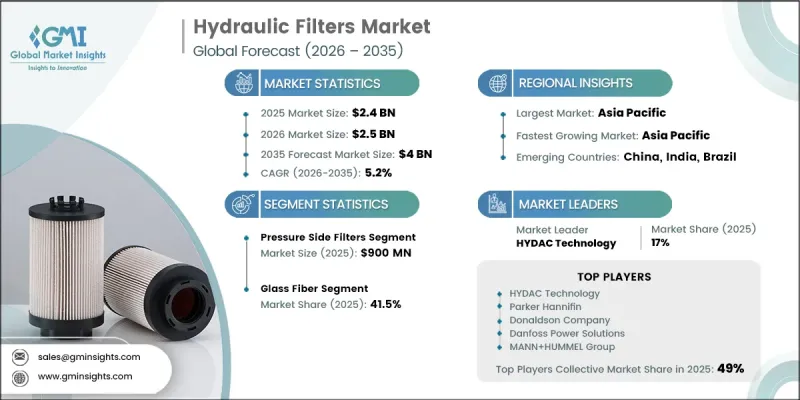
The Global Hydraulic Filters Market was valued at USD 2.4 billion in 2025 and is estimated to grow at a CAGR of 5.2% to reach USD 4 billion by 2035.
The hydraulic filters market continues to expand steadily as industries place greater emphasis on equipment reliability, operational efficiency, and long-term asset protection. Hydraulic filtration systems play a critical role in maintaining fluid cleanliness, helping reduce component wear, extend machinery lifespan, and minimize unexpected downtime across a broad range of industrial applications. As industrial automation and heavy equipment usage continue to rise, organizations are increasingly investing in dependable filtration solutions that support uninterrupted performance while lowering maintenance costs. Manufacturers are responding by developing filters with enhanced durability, broader equipment compatibility, and simplified installation and servicing features. The market is also benefiting from growing awareness of preventive maintenance strategies, where clean hydraulic fluid is recognized as essential for maximizing system efficiency and minimizing repair expenses. Rather than being viewed as optional components, hydraulic filters have become a standard requirement for protecting high-value equipment, creating consistent replacement demand and supporting stable market growth across both developed and emerging industrial economies.
| Market Scope | |
|---|---|
| Start Year | 2025 |
| Forecast Year | 2026-2035 |
| Start Value | $2.4 Billion |
| Forecast Value | $4 Billion |
| CAGR | 5.2% |
The pressure side filters generated USD 900 million in 2025. Their strong market position is supported by their ability to maintain fluid cleanliness under high operating pressures while protecting critical hydraulic components from contamination. As industries increasingly prioritize preventive maintenance over costly repairs, pressure side filters continue to gain preference because they help sustain reliable equipment performance, minimize operational interruptions, and reduce maintenance expenses. Their capability to provide continuous protection during demanding operating conditions further reinforces their widespread adoption across industrial applications.
The glass fiber segment accounted for 41.5% share in 2025, representing the largest share among filtration media. Glass fiber remains the preferred material because it delivers an effective combination of filtration efficiency, durability, and cost-effectiveness. Its ability to capture extremely fine contaminants while maintaining smooth hydraulic fluid flow helps improve overall system performance without creating unnecessary pressure loss. This balance of reliability and operational efficiency enables equipment owners to reduce machine downtime, improve productivity, and lower long-term maintenance costs, supporting the segment's continued market leadership.
U.S. Hydraulic Filters Market held an 89.9% share, generating USD 583.3 million in 2025. Regional market growth is supported by a well-established industrial sector and extensive utilization of advanced hydraulic machinery across manufacturing, construction, agriculture, and other heavy industries. Businesses throughout North America continue to prioritize equipment longevity, workplace safety, and operational efficiency, driving consistent investment in high-performance filtration systems. Preventive maintenance practices remain deeply integrated into industrial operations, making hydraulic filters an essential component for protecting valuable equipment and maintaining uninterrupted productivity.
Companies operating in the hydraulic filters market are strengthening their market position by expanding product portfolios with advanced filtration technologies that improve contaminant removal efficiency, durability, and compatibility with modern hydraulic systems. Manufacturers are investing in research and development to introduce longer-lasting filter media, high-performance materials, and products designed for demanding industrial environments. Strategic partnerships with original equipment manufacturers (OEMs), expansion of global distribution networks, and strengthening aftermarket service capabilities remain key priorities. Many companies are also focusing on customized filtration solutions for specific industrial applications while improving manufacturing efficiency to remain cost-competitive. In addition, businesses continue to enhance customer support, preventive maintenance programs, and technical consulting services to build long-term relationships, increase replacement sales, and strengthen their competitive presence across both mature and emerging regional markets.
Table of Contents
Chapter 1 Methodology
- 1.1 Research approach
- 1.2 Quality Commitments
- 1.2.1 GMI AI policy & data integrity commitment
- 1.2.1.1 Source consistency protocol
- 1.2.1 GMI AI policy & data integrity commitment
- 1.3 Research Trail & Confidence Scoring
- 1.3.1 Research Trail Components
- 1.3.2 Scoring Components
- 1.4 Data Collection
- 1.4.1 Partial list of primary sources
- 1.5 Data mining sources
- 1.5.1 Paid sources
- 1.5.1.1 Sources, by region
- 1.5.1 Paid sources
- 1.6 Base estimates and calculations
- 1.6.1 Base year calculation for any one approach
- 1.7 Forecast model
- 1.7.1 Quantified market impact analysis
- 1.7.1.1 Mathematical impact of growth parameters on forecast
- 1.7.1 Quantified market impact analysis
- 1.8 Research transparency addendum
- 1.8.1 Source attribution framework
- 1.8.2 Quality assurance metrics
- 1.8.3 Our commitment to trust
Chapter 2 Executive Summary
- 2.1 Industry snapshot
- 2.2 Business trends
- 2.3 Filter type trends
- 2.4 Filter medium trends
- 2.5 Application trends
- 2.6 Distribution channel trends
- 2.7 Regional trends
Chapter 3 Industry Insights
- 3.1 Industry ecosystem and value chain analysis
- 3.1.1 Industry ecosystem/value chain analysis
- 3.1.2 Raw material suppliers
- 3.1.3 Component manufacturers
- 3.1.4 OEM integrators & system assemblers
- 3.1.5 Distributors & MRO channel
- 3.1.6 End-use industries
- 3.2 Industry impact forces
- 3.2.1 Market Driver
- 3.2.2 Market challenges/pitfalls
- 3.2.3 Market opportunities
- 3.3 Growth potential analysis
- 3.4 Industry ecosystem analysis
- 3.5 Regulatory framework
- 3.5.1 U.S. (EPA, OSHA, ISO 16889 standards)
- 3.5.2 Europe (EU machinery directive, CE marking, ATEX)
- 3.5.3 Asia Pacific (China GB standards, Japan JIS)
- 3.5.4 Cross-border trade & tariff regulations
- 3.6 Pricing analysis (driven by primary research)
- 3.6.1 Historical price trend analysis (2018-2024) (driven by primary research)
- 3.6.2 Pricing strategy by player type (premium/value/cost-plus) (driven by primary research)
- 3.7 Technology and innovation landscape
- 3.7.1 Emerging filter media technologies
- 3.7.2 Smart & condition-monitoring enabled filters
- 3.7.3 High-pressure & high-efficiency filtration innovations
- 3.8 Porter’s Analysis
- 3.9 PESTEL Analysis
- 3.10 Trade data analysis (driven by primary research)
- 3.10.1 Import/export volume & value trends (HS code 8421.39)
- 3.10.2 Key trade corridors & tariff impact
- 3.11 Impact of AI and generative AI on the market
- 3.11.1 AI-driven disruption of existing business models (predictive maintenance, fluid condition monitoring)
- 3.11.2 GenAI use cases & adoption roadmap by segment (smart filter design, digital twin integration)
- 3.11.3 Risks, limitations & regulatory considerations
- 3.12 Capacity and production landscape (driven by primary research)
- 3.12.1 Installed capacity by region & key producer (driven by primary research)
- 3.12.2 Capacity utilization rates & expansion pipelines (driven by primary research)
Chapter 4 Competitive Landscape, 2025
- 4.1 Introduction
- 4.2 Company market share analysis
- 4.2.1 North America
- 4.2.2 Europe
- 4.2.3 APAC
- 4.2.4 LATAM
- 4.2.5 MEA
- 4.3 Company matrix analysis
- 4.4 Competitive analysis of major market players
- 4.5 Competitive positioning matrix
- 4.6 Key developments
- 4.6.1 Mergers & acquisitions
- 4.6.2 Partnerships & collaborations
- 4.6.3 New product launches
- 4.6.4 Expansion plans
Chapter 5 Market Estimates and Forecast, By Filter Type, 2022 - 2035 ($ Billion) (Thousand Units)
- 5.1 Key trends
- 5.2 Pressure side filters
- 5.2.1 High-pressure filters (>200 bar)
- 5.2.2 Medium-pressure filters (70-200 bar)
- 5.2.3 Low-pressure filters (<70 bar)
- 5.3 Return side filters
- 5.3.1 Tank-top mounted return filters
- 5.3.2 In-line return filters
- 5.4 Suction side filters (strainers)
- 5.4.1 Fixed suction strainers
- 5.4.2 Cleanable suction strainers
- 5.5 Off-line filters (kidney loop)
- 5.5.1 Portable off-line filtration units
- 5.5.2 Permanent bypass loop filters
- 5.6 In-tank breather filters
- 5.6.1 Standard breather filters
- 5.6.2 Desiccant breather filters
Chapter 6 Market Estimates and Forecast, By Filter Medium, 2022 - 2035 ($ Billion) (Thousand Units)
- 6.1 Key trends
- 6.2 Glass fiber
- 6.2.1 Borosilicate glass fiber
- 6.2.2 Micro glass fiber (high efficiency)
- 6.3 Cellulose
- 6.3.1 Standard cellulose
- 6.3.2 High-alpha cellulose (refined)
- 6.4 Blended & composite media
- 6.4.1 Cellulose-synthetic blend
- 6.4.2 Multi-layer composite media
- 6.5 Stainless steel mesh
- 6.5.1 Woven wire mesh
- 6.5.2 Sintered stainless steel
- 6.6 Synthetic fiber
- 6.6.1 Polyester
- 6.6.2 Polypropylene
- 6.7 Others
Chapter 7 Market Estimates and Forecast, By Application, 2022 - 2035 ($ Billion) (Thousand Units)
- 7.1 Key trends
- 7.2 Construction equipment
- 7.2.1 Excavators & earthmoving equipment
- 7.2.2 Cranes & lifting equipment
- 7.3 General manufacturing & factory automation
- 7.3.1 Machine tools & CNC equipment
- 7.3.2 Hydraulic presses & injection molding
- 7.3.3 Metal forming & stamping equipment
- 7.4 Automotive
- 7.4.1 Passenger vehicles
- 7.4.2 Commercial vehicles & heavy trucks
- 7.5 Aerospace & defense (incl. All military: air, ground & naval)
- 7.5.1 Civil & commercial aviation
- 7.5.2 Military & defense systems
- 7.6 Marine
- 7.6.1 Commercial shipping & cargo vessels
- 7.6.2 Recreational & specialty marine vessels
- 7.7 Mining
- 7.7.1 Surface mining equipment
- 7.7.2 Underground mining machinery
- 7.8 Oil & gas / petrochemical (incl. All offshore operations)
- 7.8.1 Upstream drilling & extraction (onshore & offshore)
- 7.8.2 Refinery & downstream process equipment
- 7.9 Agriculture
- 7.9.1 Tractors & harvesters
- 7.9.2 Irrigation & specialty farm equipment
- 7.10 Others
Chapter 8 Market Estimates and Forecast, By Distribution Channel, 2022 - 2035 ($ Billion) (Thousand Units)
- 8.1 Key trends
- 8.2 Direct sales
- 8.3 Indirect sales
Chapter 9 Market Estimates and Forecast, By Region, 2022 - 2035 ($ Billion) (Thousand Units)
- 9.1 Key trends
- 9.2 North America
- 9.2.1 US
- 9.2.2 Canada
- 9.3 Europe
- 9.3.1 Germany
- 9.3.2 UK
- 9.3.3 France
- 9.3.4 Italy
- 9.3.5 Spain
- 9.3.6 Netherlands
- 9.4 Asia Pacific
- 9.4.1 China
- 9.4.2 India
- 9.4.3 Japan
- 9.4.4 Australia
- 9.4.5 South Korea
- 9.5 Latin America
- 9.5.1 Brazil
- 9.5.2 Mexico
- 9.6 Middle East and Africa
- 9.6.1 South Africa
- 9.6.2 Saudi Arabia
- 9.6.3 UAE
Chapter 10 Company Profiles
- 10.1 Global Players
- 10.1.1 Parker Hannifin
- 10.1.2 Donaldson Company
- 10.1.3 Pall Corporation
- 10.1.4 HYDAC Technology
- 10.1.5 Mahle GmbH
- 10.1.6 MANN+HUMMEL Group
- 10.1.7 Danfoss Power Solutions
- 10.2 Regional Players
- 10.2.1 MP Filtri S.p.A.
- 10.2.2 UFI Filters Hydraulics
- 10.2.3 YAMASHIN-FILTER Corp.
- 10.2.4 Hengst SE
- 10.2.5 STAUFF
- 10.2.6 FILTREC S.p.A.
- 10.2.7 China LEEMIN Hydraulic Co., Ltd.
- 10.3 Niche & Specialist Players
- 10.3.1 ARGO-HYTOS
- 10.3.2 Schroeder Industries
- 10.3.3 Boll & Kirch Filterbau
- 10.3.4 Lenz Inc.
- 10.3.5 Taisei Kogyo Co., Ltd.
- 10.3.6 Triple R Europe N.V.

