PUBLISHER: Global Market Insights Inc. | PRODUCT CODE: 2083337

PUBLISHER: Global Market Insights Inc. | PRODUCT CODE: 2083337
Veterinary Diagnostics Market Opportunity, Growth Drivers, Industry Trend Analysis, and Forecast 2026 - 2035
The Global Veterinary Diagnostics Market was valued at USD 5.3 billion in 2025 and is estimated to grow at a CAGR of 9.1% to reach USD 12.6 billion by 2035.
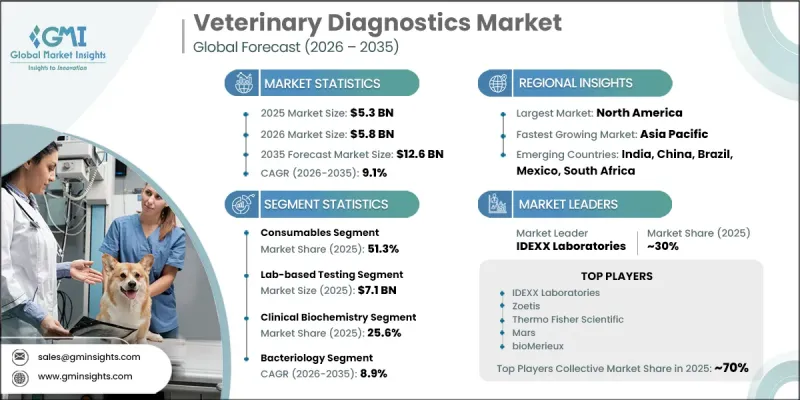
Market expansion is driven by the rising incidence of infectious, zoonotic, and chronic diseases across both companion and livestock animal populations, along with growing awareness of preventive veterinary healthcare. The increasing frequency of disease outbreaks continues to reinforce the need for accurate and rapid diagnostic solutions. Over recent years, the market has shown consistent growth, supported by higher expenditure on companion animal healthcare and continuous advancements in diagnostic technologies. The growing burden of emerging and transboundary animal diseases is further accelerating demand for reliable testing solutions. Rising global populations of companion animals and production livestock are also strengthening overall market demand. Pet ownership is increasing steadily, particularly for dogs and cats, while owners are showing greater willingness to invest in routine wellness screening and preventive care. At the same time, technological progress in molecular diagnostics, PCR-based methods, next-generation sequencing, biomarker assays, and portable point-of-care systems is improving the speed, precision, and accessibility of disease detection.
| Market Scope | |
|---|---|
| Start Year | 2025 |
| Forecast Year | 2026-2035 |
| Start Value | $5.3 Billion |
| Forecast Value | $12.6 Billion |
| CAGR | 9.1% |
The consumables segment accounted for a 51.3% share in 2025 and continues to grow at a CAGR of 9.2% during 2026-2035. This dominance is driven by its essential role across diagnostic workflows and its recurring revenue structure. Consumables include reagents, diagnostic kits, assay cartridges, blood collection tubes, slides, calibration tools, and control materials, which are widely used across veterinary hospitals, clinics, diagnostic laboratories, and research centers.
The lab-based testing segment is projected to reach USD 7.1 billion by 2035. This segment remains widely preferred due to its ability to support advanced diagnostic procedures, including molecular testing, microbiological analysis, immunoassays, toxicology screening, and specialized pathology evaluations. These tests require advanced laboratory infrastructure, skilled professionals, and controlled environments to ensure high accuracy and reliability in disease detection.
North America Veterinary Diagnostics Market held 46.5% share in 2025. The region's dominance is supported by advanced veterinary healthcare infrastructure, high pet ownership levels, strong diagnostic adoption rates, and widespread use of innovative animal health technologies. The presence of established diagnostic companies, extensive laboratory networks, and well-developed veterinary care systems further reinforces regional market strength and sustained growth.
Key industry participants include Zoetis, IDEXX Laboratories, bioMerieux, Bio-Rad Laboratories, Thermo Fisher Scientific, Neogen, QIAGEN, Virbac, Randox Laboratories, Fujifilm, Mindray Animal Medical Technology, BioNote, IDvet, INDICAL Bioscience, MEGACOR Diagnostik, Eurolyser Diagnostica, Agrolabo, Biochek, and GD Animal Health (Royal GD). Companies in the veterinary diagnostics market are strengthening their market position by focusing on continuous innovation in diagnostic technologies that improve the speed, accuracy, and reliability of test results. Many players are expanding their portfolios with advanced molecular diagnostics, multiplex testing platforms, and automated laboratory systems. Strategic collaborations with veterinary clinics, hospitals, and diagnostic laboratories are helping companies improve distribution reach and service integration. Firms are also investing heavily in research and development to introduce next-generation sequencing, biomarker-based assays, and portable diagnostic solutions. Expansion into emerging markets with growing pet populations and livestock industries is another key focus area.
Table of Contents
Chapter 1 Methodology and Scope
- 1.1 Market scope and definition
- 1.2 Research approach
- 1.3 Quality commitments
- 1.3.1 GMI AI policy & data integrity commitment
- 1.3.1.1 Source consistency protocol
- 1.3.1 GMI AI policy & data integrity commitment
- 1.4 Research trail & confidence scoring
- 1.4.1 Research trail components
- 1.4.2 Scoring components
- 1.5 Data collection
- 1.5.1 Partial list of primary sources
- 1.6 Data mining sources
- 1.6.1 Paid sources
- 1.6.1.1 Sources, by region
- 1.6.1 Paid sources
- 1.7 Base estimates and calculations
- 1.7.1 Base year calculation for any one approach
- 1.8 Forecast model
- 1.8.1 Quantified market impact analysis
- 1.8.1.1 Mathematical impact of growth parameters on forecast
- 1.8.1 Quantified market impact analysis
- 1.9 Research transparency addendum
- 1.9.1 Source attribution framework
- 1.9.2 Quality assurance metrics
- 1.9.3 Our commitment to trust
Chapter 2 Executive Summary
- 2.1 Industry 360° synopsis
- 2.2 Key market trends
- 2.2.1 Business trends
- 2.2.2 Product trends
- 2.2.3 Modality trends
- 2.2.4 Technology trends
- 2.2.5 Application trends
- 2.2.6 Animal type trends
- 2.2.7 End use trends
- 2.2.8 Regional trends
- 2.3 CXO perspectives: Strategic imperatives
Chapter 3 Industry Insights
- 3.1 Industry ecosystem analysis
- 3.1.1 Supplier landscape
- 3.1.2 Value addition at each stage
- 3.1.3 Factors affecting the value chain
- 3.2 Industry impact forces
- 3.2.1 Growth drivers
- 3.2.1.1 Growing trend of adopting pet animals
- 3.2.1.2 Rising prevalence of foodborne and zoonotic diseases
- 3.2.1.3 Favorable government initiatives
- 3.2.1.4 Advancements in companion diagnostics
- 3.2.1.5 Increasing adoption of pet insurance
- 3.2.2 Industry pitfalls and challenges
- 3.2.2.1 Prohibitive cost associated with animal tests
- 3.2.2.2 Low out of pocket expenditure on veterinary care
- 3.2.3 Market opportunities
- 3.2.3.1 Expansion of point-of-care (POC) diagnostic solutions
- 3.2.3.2 Integration of AI and data analytics in diagnostics
- 3.2.1 Growth drivers
- 3.3 Growth potential analysis
- 3.4 Technological and innovation landscape
- 3.4.1 Current technological trends
- 3.4.2 Emerging technologies (Driven by Primary Research)
- 3.5 Pricing analysis (Driven by Primary Research)
- 3.5.1 Historic price trend analysis
- 3.5.2 Pricing analysis, by drug type
- 3.6 Regulatory landscape (Driven by Primary Research)
- 3.6.1 North America
- 3.6.2 Europe
- 3.6.3 Asia Pacific
- 3.6.4 Latin America
- 3.6.5 MEA
- 3.7 Porter's analysis
- 3.8 PESTEL analysis
- 3.9 Impact of AI and Generative AI on the market (Driven by Primary Research)
- 3.10 Investment and funding landscape (Driven by Primary Research)
- 3.11 Future market trends (Driven by Primary Research)
- 3.12 Pet population statistics
Chapter 4 Competitive Landscape, 2025
- 4.1 Introduction
- 4.2 Company market share analysis
- 4.2.1 North America
- 4.2.2 Europe
- 4.2.3 Asia Pacific
- 4.3 Company matrix analysis
- 4.4 Competitive analysis of major market players
- 4.5 Competitive positioning matrix
- 4.6 Key developments
- 4.6.1 Merger and acquisition
- 4.6.2 Partnership and collaboration
- 4.6.3 New product launches
- 4.6.4 Expansion plans
Chapter 5 Market Estimates and Forecast, By Product, 2022 - 2035 ($ Mn)
- 5.1 Key trends
- 5.2 Consumables
- 5.3 Instruments
- 5.4 Softwares
Chapter 6 Market Estimates and Forecast, By Modality, 2022 - 2035 ($ Mn)
- 6.1 Key trends
- 6.2 Point-of-care testing (POC)
- 6.3 Lab-based testing
Chapter 7 Market Estimates and Forecast, By Technology, 2022 - 2035 ($ Mn)
- 7.1 Key trends
- 7.2 Clinical biochemistry
- 7.2.1 Glucose monitoring
- 7.2.2 Blood gas and electrolyte analysis
- 7.2.3 Other clinical biochemistry tests
- 7.3 Immunodiagnostics
- 7.3.1 Lateral flow assays
- 7.3.2 ELISA
- 7.3.3 Immunoassay analyzers
- 7.3.4 Other immunodiagnostic tests
- 7.4 Molecular diagnostics
- 7.4.1 PCR
- 7.4.2 Microarrays
- 7.4.3 Other molecular diagnostic tests
- 7.5 Hematology
- 7.6 Urinalysis
- 7.7 Diagnostic imaging (inclusive of AI assisted)
- 7.8 Other technologies
Chapter 8 Market Estimates and Forecast, By Application, 2022 - 2035 ($ Mn)
- 8.1 Key trends
- 8.2 Bacteriology
- 8.3 Pathology
- 8.4 Parasitology
- 8.5 Other applications
Chapter 9 Market Estimates and Forecast, By Animal Type, 2022 - 2035 ($ Mn)
- 9.1 Key trends
- 9.2 Companion animals
- 9.2.1 Dogs
- 9.2.2 Cats
- 9.2.3 Horses
- 9.2.4 Other companion animals
- 9.3 Farm animals
- 9.3.1 Cattle
- 9.3.2 Swine
- 9.3.3 Poultry
- 9.3.4 Other farm animals
Chapter 10 Market Estimates and Forecast, By End Use, 2022 - 2035 ($ Mn)
- 10.1 Key trends
- 10.2 Veterinary hospitals and clinics
- 10.3 Diagnostic labs
- 10.4 Home care settings
- 10.5 Other end users
Chapter 11 Market Estimates and Forecast, By Region, 2022 - 2035 ($ Mn)
- 11.1 Key trends
- 11.2 North America
- 11.2.1 U.S.
- 11.2.2 Canada
- 11.3 Europe
- 11.3.1 Germany
- 11.3.2 UK
- 11.3.3 France
- 11.3.4 Italy
- 11.3.5 Spain
- 11.3.6 Netherlands
- 11.4 Asia Pacific
- 11.4.1 China
- 11.4.2 Japan
- 11.4.3 India
- 11.4.4 Australia
- 11.4.5 South Korea
- 11.5 Latin America
- 11.5.1 Brazil
- 11.5.2 Mexico
- 11.5.3 Argentina
- 11.6 Middle East and Africa
- 11.6.1 South Africa
- 11.6.2 Saudi Arabia
- 11.6.3 UAE
Chapter 12 Company Profiles
- 12.1 Agrolabo
- 12.2 Bio-Rad Laboratories
- 12.3 bioMerieux
- 12.4 BioNote
- 12.5 Biochek
- 12.6 Eurolyser Diagnostica
- 12.7 Fujifilm
- 12.8 GD Animal Health (Royal GD)
- 12.9 IDEXX Laboratories
- 12.10 IDvet
- 12.11 INDICAL Bioscience
- 12.12 MEGACOR Diagnostik
- 12.13 Mindray Animal Medical Technology
- 12.14 Neogen
- 12.15 QIAGEN
- 12.16 Randox Laboratories
- 12.17 Thermo Fisher Scientific
- 12.18 Virbac
- 12.19 Zoetis

