PUBLISHER: Global Market Insights Inc. | PRODUCT CODE: 2083341

PUBLISHER: Global Market Insights Inc. | PRODUCT CODE: 2083341
Supercapacitor Market Opportunity, Growth Drivers, Industry Trend Analysis, and Forecast 2026 - 2035
The Global Supercapacitor Market was valued at USD 1.1 billion in 2025 and is estimated to grow at a CAGR of 9.8% to reach USD 2.8 billion by 2035.
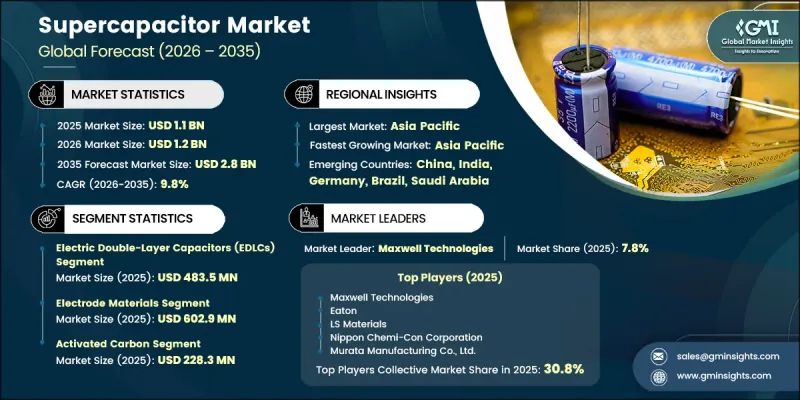
Market expansion is fueled by the accelerating adoption of electric vehicles, increasing investments in renewable energy infrastructure, the rapid rollout of fast-charging networks, rising industrial automation, and continuous innovations in energy storage materials, including activated carbon and graphene. Demand for supercapacitors continues to rise as industries seek energy storage technologies that offer high power density, rapid charging and discharging capabilities, and extended operational life. The growing shift toward electrified transportation has significantly increased the use of supercapacitors for power assistance and energy recovery applications, while the global focus on improving energy efficiency and reducing carbon emissions continues to create favorable growth opportunities. In addition, ongoing modernization of power infrastructure and the expansion of renewable energy projects are reinforcing market demand. Continuous technological advancements are further improving device performance, durability, and efficiency, allowing supercapacitors to serve a broader range of industrial, automotive, consumer electronics, and energy storage applications, supporting long-term market growth worldwide.
| Market Scope | |
|---|---|
| Start Year | 2025 |
| Forecast Year | 2026-2035 |
| Start Value | $1.1 Billion |
| Forecast Value | $2.8 Billion |
| CAGR | 9.8% |
The electrode materials segment generated USD 602.9 million in 2025. Growth in this segment is driven by increasing demand for advanced energy storage solutions across electric vehicles, industrial equipment, renewable energy systems, and consumer electronics. Electrode materials play a critical role in improving energy density, power output, charging speed, and cycle life. Continuous development of advanced materials, including activated carbon, graphene, and conductive polymers, is enhancing overall device performance, reliability, and operating efficiency, supporting sustained segment growth.
The Transportation & Electric Vehicles segment accounted for USD 270 million in 2025. Rising adoption of electric and hybrid vehicles, growing emphasis on environmentally sustainable transportation, and increasing demand for high-performance energy storage technologies continue to support segment expansion. Supercapacitors are increasingly utilized to improve energy efficiency, enhance power delivery, reduce battery stress, and optimize vehicle performance through rapid charging and discharging capabilities. Ongoing investments in electric mobility infrastructure and continuous advancements in vehicle electrification technologies are expected to sustain strong demand for supercapacitors across the transportation sector over the forecast period.
North America Supercapacitor Market captured 23.4% share in 2025. The region remains a major hub for market growth due to substantial investments in energy storage technologies, industrial automation, and electric mobility solutions. Strong research capabilities, advanced manufacturing infrastructure, and ongoing technological innovation continue to strengthen regional market development. Increasing deployment of renewable energy systems and the growing adoption of advanced energy storage technologies are further supporting market expansion across North America.
Major companies operating in the global supercapacitor market include Murata Manufacturing Co., Ltd., Panasonic Corporation, KEMET Corporation (Yageo), AVX Corporation (Kyocera), Vishay Intertechnology, Maxwell Technologies (UCAP/Clarios), VinaTech Co., Ltd., Skeleton Technologies, LS Materials, Nippon Chemi-Con Corporation, Eaton, Samwha Capacitor Group, Jinzhou Kaimei (KAMCAP), Ningbo CRRC New Energy, Beijing HCC Energy Tech, Jianghai Capacitor Co., Ltd., Cornell Dubilier (Knowles), Elna Co., Ltd., CAP-XX, and Yunasko. Companies operating in the supercapacitor market are strengthening their market position by investing heavily in research and development to improve energy density, charging speed, operational life, and overall device performance. Manufacturers are expanding production capacity while developing advanced electrode materials and next-generation energy storage technologies to address evolving customer requirements. Strategic collaborations with automotive manufacturers, industrial equipment suppliers, and energy storage solution providers are helping companies broaden their market reach. Businesses are also focusing on expanding global distribution networks, improving manufacturing efficiency, and introducing customized solutions for electric mobility, renewable energy, industrial automation, and consumer electronics applications.
Table of Contents
Chapter 1 Methodology and Scope
- 1.1 Market scope and definition
- 1.2 Research design
- 1.2.1 Research approach
- 1.2.2 Data collection methods
- 1.3 Data mining sources
- 1.3.1 Global
- 1.3.2 Regional/Country
- 1.4 Base estimates and calculations
- 1.4.1 Base year calculation
- 1.4.2 Key trends for market estimation
- 1.5 Primary research and validation
- 1.5.1 Primary sources
- 1.6 Forecast model
- 1.7 Research assumptions and limitations
Chapter 2 Executive Summary
- 2.1 Industry 360° synopsis, 2022 - 2035
- 2.2 Key market trends
- 2.2.1 Product Type trends
- 2.2.2 Material Type trends
- 2.2.3 Electrode Material trend
- 2.2.4 Electrolytes Material trend
- 2.2.5 Capacitance Range trend
- 2.2.6 Application trends
- 2.2.7 Regional trends
- 2.3 TAM Analysis, 2026-2035
- 2.4 CXO perspectives: Strategic imperatives
Chapter 3 Industry Insights
- 3.1 Industry ecosystem analysis
- 3.1.1 Supplier Landscape
- 3.1.2 Profit Margin
- 3.1.3 Cost structure
- 3.1.4 Value addition at each stage
- 3.1.5 Factor affecting the value chain
- 3.1.6 Disruptions
- 3.2 Industry impact forces
- 3.2.1 Growth drivers
- 3.2.1.1 Rising adoption of electric vehicles and hybrid vehicles
- 3.2.1.2 Expansion of renewable energy and smart grid infrastructure
- 3.2.1.3 Growth of fast-charging infrastructure
- 3.2.1.4 Increasing industrial automation and backup power requirements
- 3.2.1.5 Advancements in graphene-based and next-generation supercapacitor technologies
- 3.2.2 Industry pitfalls and challenges
- 3.2.2.1 Lower energy density compared to batteries
- 3.2.2.2 High material and manufacturing costs
- 3.2.3 Market opportunities
- 3.2.3.1 Integration with fast-charging EV infrastructure
- 3.2.3.2 Growing adoption in renewable energy and smart grid systems
- 3.2.1 Growth drivers
- 3.3 Growth potential analysis
- 3.4 Pricing Analysis (Driven by Primary Research)
- 3.4.1 Historical Price Trend Analysis
- 3.4.2 Pricing Strategy by Player Type (Premium / Value / Cost-plus)
- 3.5 Regulatory landscape
- 3.5.1 North America
- 3.5.2 Europe
- 3.5.3 Asia Pacific
- 3.5.4 Latin America
- 3.5.5 Middle East & Africa
- 3.6 Porter's analysis
- 3.7 PESTEL analysis
- 3.8 Trade Data Analysis (Based on Paid Database)
- 3.8.1 Import/Export Volume & Value Trends
- 3.8.2 Key Trade Corridors & Tariff Impact
- 3.9 Impact of AI & Generative AI on the Market (Driven by Primary Research)
- 3.9.1 AI-Driven Disruption of Existing Business Models
- 3.9.2 GenAI Use Cases & Adoption Roadmap by Segment
- 3.10 Capacity & Production Landscape (Driven by Primary Research)
- 3.10.1 Production Capacity by Key Producer
- 3.10.2 Capacity Utilization Rates & Expansion Pipeline
Chapter 4 Competitive Landscape, 2025
- 4.1 Introduction
- 4.2 Company market share analysis, 2025
- 4.2.1 By Region
- 4.2.1.1 North America
- 4.2.1.2 Europe
- 4.2.1.3 Asia-Pacific
- 4.2.1.4 Latin America
- 4.2.1.5 Middle East and Africa
- 4.2.2 Market Concentration Analysis
- 4.2.1 By Region
- 4.3 Competitive analysis of major market players
- 4.4 Competitive positioning matrix
- 4.5 Key developments
- 4.5.1 Mergers & acquisitions
- 4.5.2 Partnerships & collaborations
- 4.5.3 New product launches
- 4.5.4 Expansion plans and funding
- 4.6 Company tier benchmarking
- 4.6.1 Tier classification criteria & qualifying thresholds
- 4.6.2 Tier positioning matrix by revenue, geography & innovation
Chapter 5 Market Estimates and Forecast, By Product Type, 2022 - 2035 (USD Million & Units)
- 5.1 Key trends
- 5.2 Electric Double-Layer Capacitors (EDLC)
- 5.3 Pseudocapacitors
- 5.4 Hybrid Capacitors
Chapter 6 Market Estimates and Forecast, By Material Type, 2022 - 2035 (USD Million & Units)
- 6.1 Key trends
- 6.2 Electrode Materials
- 6.3 Electrolytes
Chapter 7 Market Estimates and Forecast, By Electrode Materials, 2022 - 2035 (USD Million & Units)
- 7.1 Key trends
- 7.2 Activated Carbon
- 7.3 Graphene
- 7.4 Carbon Nanotubes
- 7.5 Metal Oxides
- 7.6 Conducting Polymers
Chapter 8 Market Estimates and Forecast, By Electrolytes Materials, 2022 - 2035 (USD Million & Units)
- 8.1 Key trends
- 8.2 Aqueous Electrolytes
- 8.3 Organic Electrolytes
- 8.4 Ionic Liquid Electrolytes
Chapter 9 Market Estimates and Forecast, By Capacitance Range, 2022 - 2035 (USD Million & Units)
- 9.1 Key trends
- 9.2 Below 10 Farads
- 9.3 10-100 Farads
- 9.4 100-1,000 Farads
- 9.5 Above 1,000 Farads
Chapter 10 Market Estimates and Forecast, By Application, 2022 - 2035 (USD Million & Units)
- 10.1 Key trends
- 10.2 Transportation & Electric Vehicles
- 10.3 Consumer Electronics
- 10.4 Industrial Equipment & Automation
- 10.5 Energy Storage & Grid Infrastructure
- 10.6 Military & Defense
- 10.7 Healthcare & Medical Devices
- 10.8 Others
Chapter 11 Market Estimates and Forecast, By Region, 2022 - 2035 (USD Million & Units)
- 11.1 Key trends
- 11.2 North America
- 11.2.1 U.S.
- 11.2.2 Canada
- 11.3 Europe
- 11.3.1 Germany
- 11.3.2 UK
- 11.3.3 France
- 11.3.4 Spain
- 11.3.5 Italy
- 11.3.6 Netherlands
- 11.3.7 Rest of Europe
- 11.4 Asia Pacific
- 11.4.1 China
- 11.4.2 India
- 11.4.3 Japan
- 11.4.4 Australia
- 11.4.5 South Korea
- 11.4.6 Rest of Asia Pacific
- 11.5 Latin America
- 11.5.1 Brazil
- 11.5.2 Mexico
- 11.5.3 Argentina
- 11.5.4 Rest of Latin America
- 11.6 Middle East and Africa
- 11.6.1 South Africa
- 11.6.2 Saudi Arabia
- 11.6.3 UAE
- 11.6.4 Rest of MEA
Chapter 12 Company Profiles
- 12.1 Global Key Players
- 12.1.1 Murata Manufacturing Co., Ltd.
- 12.1.2 Panasonic Corporation
- 12.1.3 KEMET Corporation (Yageo)
- 12.1.4 AVX Corporation (Kyocera)
- 12.1.5 Maxwell Technologies (UCAP / Clarios)
- 12.1.6 Nippon Chemi-Con Corporation
- 12.1.7 Eaton
- 12.2 Regional players
- 12.2.1 Vishay Intertechnology
- 12.2.2 VinaTech Co., Ltd.
- 12.2.3 LS Materials
- 12.2.4 Samwha Capacitor Group
- 12.2.5 Jianghai Capacitor Co., Ltd.
- 12.2.6 Ningbo CRRC New Energy
- 12.2.7 Beijing HCC Energy Tech
- 12.2.8 Jinzhou Kaimei (KAMCAP)
- 12.3 Niche players
- 12.3.1 Skeleton Technologies
- 12.3.2 CAP-XX
- 12.3.3 Yunasko
- 12.3.4 Cornell Dubilier (Knowles)
- 12.3.5 Elna Co., Ltd.

