PUBLISHER: Global Market Insights Inc. | PRODUCT CODE: 2083350

PUBLISHER: Global Market Insights Inc. | PRODUCT CODE: 2083350
Coffee Grinder Market Opportunity, Growth Drivers, Industry Trend Analysis, and Forecast 2026 - 2035
The Global Coffee Grinder Market was valued at USD 2.2 billion in 2025 and is estimated to grow at a CAGR of 5.7% to reach USD 3.9 billion by 2035.
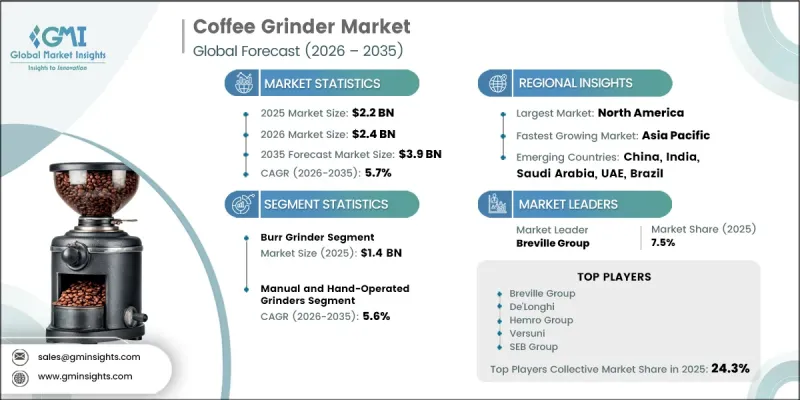
Growth in the coffee grinder market is increasingly characterized by value-led expansion, where premium burr grinders are contributing more significantly to revenue growth compared to overall unit sales. In 2025, burr grinders accounted for 64% of total market share, supported by strong demand in the mid- to high-end residential segment, particularly within the USD 200-600 pricing range, where consumers are actively investing in better brewing equipment and cafe-style experiences at home. At the regional level, Asia Pacific is emerging as the most dynamic and fastest-growing market, supported by the rapid expansion of branded coffee outlets and rising cafe culture penetration. The significant rise in commercial coffee shop density, particularly in China, is reshaping procurement patterns for commercial-grade grinders across both global chains and independent specialty coffee operators. This expansion is reinforcing long-term equipment demand as coffee consumption habits shift toward freshly ground and premium-quality beverages across urban centers.
| Market Scope | |
|---|---|
| Start Year | 2025 |
| Forecast Year | 2026-2035 |
| Start Value | $2.2 Billion |
| Forecast Value | $3.9 Billion |
| CAGR | 5.7% |
The manual and hand-operated grinders segment generated USD 1.9 billion in 2025 and accounted for 87% share. This segment is projected to grow at a CAGR of 5.6% through 2035, supported by widespread consumer adoption and strong demand for entry-level and mid-range grinding solutions. Their popularity is driven by affordability, ease of use, and their role as an entry point for consumers transitioning into specialty coffee preparation at home. This category continues to benefit from the global rise in home brewing culture and increasing interest in freshly ground coffee across developing and developed markets alike.
North America Coffee Grinder Market held 38% share in 2025, generating USD 800 million and is projected to grow at a CAGR of 5.4% through 2035. The United States remains the key growth engine in the region, supported by consistently high coffee consumption levels and strong penetration of specialty coffee culture. Consumer preference for high-quality brewing experiences and advanced home coffee equipment continues to support steady demand for both residential and commercial grinder solutions across the region.
Major companies operating in the global coffee grinder market include SEB Group, De'Longhi, Breville Group, Hemro Group, BSH Hausgerate, Hamilton Beach Brands, Versuni, Mazzer Luigi, Fiorenzato M.C., Ceado, Rancilio, Conti Valerio, Santos, Wilfa, and Timemore Technology. Companies operating in the coffee grinder market are focusing on product innovation, premiumization, and expanding distribution networks to strengthen their competitive position. Manufacturers are investing in advanced burr grinding technologies, noise reduction systems, and precision control features to enhance user experience and product performance. Strategic emphasis on design differentiation and smart connectivity is helping brands attract both residential and commercial consumers. Companies are also expanding their presence in specialty coffee channels, including cafes and boutique retailers, to strengthen brand visibility.
Table of Contents
Chapter 1 Methodology and scope
- 1.1 Research approach
- 1.2 Quality Commitments
- 1.2.1 GMI AI policy & data integrity commitment
- 1.2.1.1 Source consistency protocol
- 1.2.1 GMI AI policy & data integrity commitment
- 1.3 Research Trail & Confidence Scoring
- 1.3.1 Research Trail Components
- 1.3.2 Scoring Components
- 1.4 Data Collection
- 1.4.1 Partial list of primary sources
- 1.5 Data mining sources
- 1.5.1 Paid sources
- 1.5.1.1 Sources, by region
- 1.5.1 Paid sources
- 1.6 Base estimates and calculations
- 1.6.1 Base year calculation for any one approach
- 1.7 Forecast model
- 1.7.1 Quantified market impact analysis
- 1.7.1.1 Mathematical impact of growth parameters on forecast
- 1.7.1 Quantified market impact analysis
- 1.8 Research transparency addendum
- 1.8.1 Source attribution framework
- 1.8.2 Quality assurance metrics
- 1.8.3 Our commitment to trust
Chapter 2 Executive summary
- 2.1 Industry 360° synopsis
- 2.2 Key market trends
- 2.2.1 Regional
- 2.2.2 Product type
- 2.2.3 Mode of operation
- 2.2.4 Price range
- 2.2.5 End users
- 2.2.6 Distribution channel
Chapter 3 Industry insights
- 3.1 Industry ecosystem analysis
- 3.1.1 Supplier landscape
- 3.1.2 Profit margin
- 3.1.3 Value addition at each stage
- 3.1.4 Factor affecting the value chain
- 3.1.5 Disruptions
- 3.2 Industry impact forces
- 3.2.1 Growth drivers
- 3.2.2 Industry pitfalls & challenges
- 3.2.3 Opportunities
- 3.3 Growth potential analysis
- 3.4 Price trends
- 3.4.1 Historical price trend analysis
- 3.4.2 Pricing strategy by player type
- 3.5 Regulatory framework
- 3.5.1 U.S. trade & tariff regulations (Section 301, HS Code 8509.40 import classification)
- 3.5.2 EU Ecodesign for Sustainable Products Directive
- 3.5.3 WEEE (Waste Electrical & Electronic Equipment) Directive: compliance & e-waste obligations
- 3.5.4 REACH & RoHS compliance (nickel, chromium & hazardous substance restrictions on burrs)
- 3.5.5 Food contact material safety standards (FDA 21 CFR, EU Regulation 1935/2004, EFSA)
- 3.5.6 Electrical safety & product certifications (UL, CE, PSE, SAA, KC)
- 3.5.7 Right-to-repair legislation: emerging regulatory landscape & market implications
- 3.6 Porter's five forces analysis
- 3.7 PESTEL analysis
- 3.8 Trade Data Analysis (Based on Paid Database) (HS Code: 851671)
- 3.8.1 Import/export volume & value trends
- 3.8.2 Key trade corridors & tariff impact
- 3.9 Impact of AI & generative AI on the market
- 3.9.1 AI-driven disruption of traditional business models
- 3.9.2 GenAI use cases & adoption roadmap by customer segment
- 3.9.3 Risks, limitations & regulatory considerations
- 3.10 Future market trends
- 3.11 Technology and innovation landscape
- 3.11.1 Current technological trends
- 3.11.2 Emerging technologies
- 3.12 Consumer behavior analysis
- 3.12.1 Purchasing patterns
- 3.12.2 Preference analysis
- 3.12.3 Regional variations in consumer behavior
- 3.12.4 Impact of e-commerce on buying decisions
Chapter 4 Competitive landscape, 2025
- 4.1 Introduction
- 4.2 Company market share analysis
- 4.2.1 North America
- 4.2.2 Europe
- 4.2.3 Asia Pacific
- 4.2.4 Latin America
- 4.2.5 MEA
- 4.3 Company matrix analysis
- 4.4 Competitive analysis of major market players
- 4.5 Competitive positioning matrix
- 4.6 Key developments
- 4.6.1 Mergers & acquisitions
- 4.6.2 Partnerships & collaborations
- 4.6.3 New product launches
- 4.6.4 Expansion plans
Chapter 5 Market Estimates & Forecast, By Product Type, 2022 - 2035 ($Billion, Thousand Units)
- 5.1 Key trends
- 5.2 Burr grinders
- 5.2.1 Flat burr grinders
- 5.2.2 Conical burr grinders
- 5.3 Blade grinders
Chapter 6 Market Estimates & Forecast, By Mode of Operation, 2022 - 2035 ($Billion, Thousand Units)
- 6.1 Key trends
- 6.2 Manual / hand-operated grinders
- 6.3 Electric grinders
Chapter 7 Market Estimates & Forecast, By Price Range, 2022 - 2035 ($Billion, Thousand Units)
- 7.1 Key trends
- 7.2 Low (below USD 100)
- 7.3 Medium (USD 100-499)
- 7.4 High (USD 500 and above)
Chapter 8 Market Estimates & Forecast, By End Users, 2022 - 2035 ($Billion, Thousand Units)
- 8.1 Key trends
- 8.2 Residential / household
- 8.3 Commercial food service
- 8.4 Cafes & specialty coffee shops
- 8.5 Restaurants & hotels
- 8.6 Office coffee services
- 8.7 Industrial
Chapter 9 Market Estimates & Forecast, By Distribution Channel, 2022 - 2035 ($Billion, Thousand Units)
- 9.1 Key trends
- 9.2 Online
- 9.2.1 E-commerce
- 9.2.2 Company websites
- 9.3 Offline
- 9.3.1 Supermarkets/hypermarket
- 9.3.2 Specialty stationery & bookstores
- 9.3.3 Others (school supply chains & campus stores etc.)
Chapter 10 Market Estimates & Forecast, By Region, 2022 - 2035 ($Billion, Thousand Units)
- 10.1 Key trends
- 10.2 North America
- 10.2.1 U.S.
- 10.2.2 Canada
- 10.3 Europe
- 10.3.1 Germany
- 10.3.2 UK
- 10.3.3 France
- 10.3.4 Spain
- 10.3.5 Italy
- 10.3.6 Netherlands
- 10.4 Asia Pacific
- 10.4.1 China
- 10.4.2 Japan
- 10.4.3 India
- 10.4.4 Australia
- 10.4.5 South Korea
- 10.5 Latin America
- 10.5.1 Brazil
- 10.5.2 Mexico
- 10.5.3 Argentina
- 10.6 MEA
- 10.6.1 South Africa
- 10.6.2 Saudi Arabia
- 10.6.3 UAE
Chapter 11 Company Profiles
- 11.1 Global Key Players
- 11.1.1 Breville Group
- 11.1.2 BSH Hausgerate
- 11.1.3 De'Longhi
- 11.1.4 Hamilton Beach Brands
- 11.1.5 Hemro Group
- 11.1.6 SEB Group
- 11.1.7 Versuni
- 11.2 Regional Players
- 11.2.1 Ceado
- 11.2.2 Conti Valerio
- 11.2.3 Fiorenzato M.C.
- 11.2.4 Mazzer Luigi
- 11.2.5 Rancilio
- 11.2.6 Santos
- 11.2.7 Wilfa
- 11.3 Emerging/Niche Specialists
- 11.3.1 Comandante Grinder
- 11.3.2 Kafatek
- 11.3.3 Kinu
- 11.3.4 Niche Coffee
- 11.3.5 Orphan Espresso (OE)
- 11.3.6 Timemore Technology
- 11.3.7 Weber Workshops

