PUBLISHER: Global Market Insights Inc. | PRODUCT CODE: 2083352

PUBLISHER: Global Market Insights Inc. | PRODUCT CODE: 2083352
Enterprise File Sync and Share Market Opportunity, Growth Drivers, Industry Trend Analysis, and Forecast 2026 - 2035
The Global Enterprise File Sync and Share Market was valued at USD 13.3 billion in 2025 and is estimated to grow at a CAGR of 22.3% to reach USD 96.3 billion by 2035.
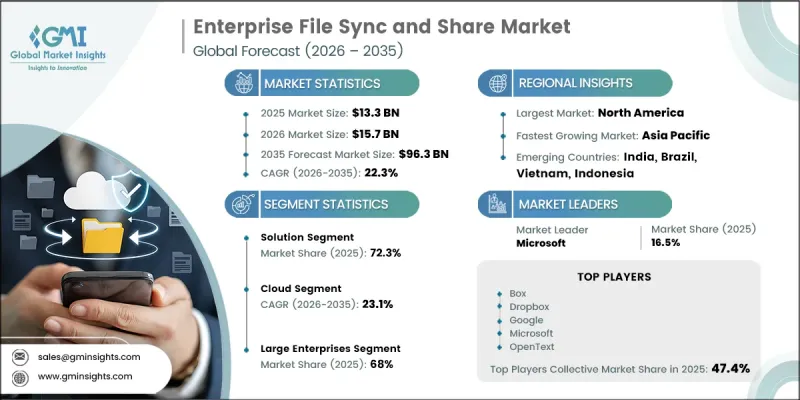
Market expansion is driven by the growing adoption of cloud-based collaboration technologies, the continued rise of remote and hybrid work environments, and ongoing enterprise digital transformation initiatives. Organizations are increasingly prioritizing secure file sharing and efficient content management solutions to support modern business operations while maintaining strong data governance standards. As businesses continue to embrace digital workplaces, investments in enterprise file sync and share (EFSS) platforms are accelerating to improve workforce productivity, streamline collaboration across geographically dispersed teams, and strengthen information security. The growing demand for centralized file management, seamless cross-device synchronization, and secure access to business-critical information is further supporting market growth. Enterprises are also focusing on scalable solutions that simplify content sharing while ensuring regulatory compliance and business continuity. These evolving workplace requirements, combined with continuous advancements in cloud technologies and enterprise collaboration platforms, are expected to create substantial long-term growth opportunities for the enterprise file sync and share market throughout the forecast period.
| Market Scope | |
|---|---|
| Start Year | 2025 |
| Forecast Year | 2026-2035 |
| Start Value | $13.3 Billion |
| Forecast Value | $96.3 Billion |
| CAGR | 22.3% |
A key factor driving the enterprise file sync and share market is the rapid adoption of remote and hybrid work models across organizations worldwide. Businesses are increasingly relying on cloud-enabled platforms to securely store, synchronize, and distribute files while allowing employees to access business information from multiple devices and locations. As flexible workplace strategies become a permanent part of enterprise operations, demand continues to rise for scalable EFSS platforms that support real-time collaboration, secure external file access, mobile workforce enablement, and centralized document management. The continued expansion of hybrid work environments is reinforcing the need for enterprise-grade collaboration infrastructure capable of delivering secure, reliable, and efficient file-sharing capabilities across distributed workforces.
Based on component, the solutions segment accounted for 72.3% share in 2025 and is projected to grow at a CAGR of 21.5% between 2026 and 2035. Organizations are increasingly adopting centralized storage platforms that enable employees to securely access, synchronize, and share files across multiple devices and locations. Cloud-based storage solutions continue to gain widespread acceptance because they offer scalability, automated backup capabilities, disaster recovery support, and reduced infrastructure expenses. Their ability to integrate seamlessly with enterprise productivity software, workflow management platforms, and business collaboration tools is further accelerating adoption across organizations of all sizes.
Based on deployment mode, the cloud segment captured 65.4% share in 2025 and is expected to register a CAGR of 23.1% during the 2026-2035 forecast period. Organizations are increasingly adopting cloud deployment because it provides a cost-effective and flexible alternative to traditional IT infrastructure. Cloud-based platforms enable employees to work securely from virtually any location while simplifying system administration and supporting remote workforce requirements. Continuous software enhancements, simplified maintenance, subscription-based pricing models, and greater operational flexibility are among the primary factors encouraging businesses to transition toward cloud-based enterprise file sync and share solutions.
U.S. Enterprise File Sync and Share Market is anticipated to grow at a CAGR of 23.5% from 2026 to 2035. Market growth is supported by the widespread adoption of enterprise collaboration platforms, content management solutions, cloud computing technologies, and secure digital workplace initiatives across multiple industries. Rising demand for secure collaboration environments, continued expansion of hybrid work models, and increasing investments in workplace digitalization, cloud infrastructure, and cybersecurity are driving broader adoption of enterprise file sync and share solutions throughout the United States.
Key companies operating in the global enterprise file sync and share market include Microsoft, Dropbox, IBM, OpenText, Box, Zoho, Egnyte, Google (Alphabet), Nextcloud, and Progress Software (ShareFile). Leading companies in the enterprise file sync and share market are strengthening their competitive position by investing in cloud-native technologies, expanding artificial intelligence capabilities, and enhancing platform security to address evolving enterprise requirements. Vendors are continuously improving collaboration features, strengthening encryption technologies, and integrating advanced data governance capabilities to deliver more comprehensive file management solutions. Strategic partnerships, product innovation, acquisitions, and expansion into new regional markets remain important growth strategies. Companies are also focusing on seamless integration with enterprise applications, workflow automation, scalable deployment models, and enhanced user experience to improve customer retention. Ongoing investments in cybersecurity, compliance capabilities, and research and development continue to help market participants expand their presence across diverse industries while addressing the growing demand for secure enterprise collaboration solutions.
Table of Contents
Chapter 1 Research Methodology
- 1.1 Research approach
- 1.2 Quality Commitments
- 1.2.1 GMI AI policy & data integrity commitment
- 1.2.1.1 Source consistency protocol
- 1.2.1 GMI AI policy & data integrity commitment
- 1.3 Research Trail & Confidence Scoring
- 1.3.1 Research Trail Components
- 1.3.2 Scoring Components
- 1.4 Data Collection
- 1.4.1 Partial list of primary sources
- 1.5 Data mining sources
- 1.5.1 Paid sources
- 1.5.1.1 Sources, by region
- 1.5.1 Paid sources
- 1.6 Base estimates and calculations
- 1.6.1 Base year calculation for any one approach
- 1.7 Forecast model
- 1.7.1 Quantified market impact analysis
- 1.7.1.1 Mathematical impact of growth parameters on forecast
- 1.7.1 Quantified market impact analysis
- 1.8 Research transparency addendum
- 1.8.1 Source attribution framework
- 1.8.2 Quality assurance metrics
- 1.8.3 Our commitment to trust
Chapter 2 Executive Summary
- 2.1 Industry 360° synopsis, 2022 - 2035
- 2.2 Key market trends
- 2.2.1 Regional
- 2.2.2 Component
- 2.2.3 Deployment mode
- 2.2.4 Enterprise size
- 2.2.5 Application
- 2.2.6 End use
- 2.3 TAM Analysis, 2026-2035
- 2.4 CXO perspectives: Strategic imperatives
Chapter 3 Industry Insights
- 3.1 Industry ecosystem analysis
- 3.1.1 Supplier landscape
- 3.1.2 Profit margin analysis
- 3.1.3 Cost structure
- 3.1.4 Value addition at each stage
- 3.1.5 Factor affecting the value chain
- 3.1.6 Disruptions
- 3.2 Industry impact forces
- 3.2.1 Growth drivers
- 3.2.1.1 Remote & hybrid work growth
- 3.2.1.2 Stringent compliance requirements
- 3.2.1.3 Cloud migration acceleration
- 3.2.1.4 BYOD device proliferation
- 3.2.2 Industry pitfalls and challenges
- 3.2.2.1 Data privacy concerns
- 3.2.2.2 Legacy integration complexity
- 3.2.3 Market opportunities
- 3.2.3.1 AI driven content management
- 3.2.3.2 SME cloud adoption growth
- 3.2.3.3 Emerging market cloud expansion
- 3.2.3.4 Edge computing based file access
- 3.2.1 Growth drivers
- 3.3 Growth potential analysis
- 3.4 Technology and innovation landscape
- 3.4.1 Current technological trends
- 3.4.1.1 Edge computing & federated data management
- 3.4.1.2 Core EFSS technology architecture
- 3.4.2 Emerging technologies
- 3.4.2.1 Zero trust security
- 3.4.2.2 Blockchain-based file integrity & AI-driven automation
- 3.4.1 Current technological trends
- 3.5 Regulatory landscape
- 3.5.1 North America
- 3.5.1.1 FedRAMP Compliance Framework
- 3.5.1.2 U.S. CLOUD Act
- 3.5.1.3 HIPAA Cloud Compliance Requirements
- 3.5.2 Europe
- 3.5.2.1 EU General Data Protection Regulation
- 3.5.2.2 EU NIS2 Cybersecurity Directive
- 3.5.2.3 EU Data Act
- 3.5.3 Asia Pacific
- 3.5.3.1 India Digital Personal Data Protection Act
- 3.5.3.2 China Cybersecurity Law
- 3.5.3.3 Japan Energy Conservation Act
- 3.5.4 Latin America
- 3.5.4.1 Brazil General Data Protection Law
- 3.5.4.2 Mexico Federal Data Protection Law
- 3.5.5 Middle East & Africa
- 3.5.5.1 UAE Personal Data Protection Law
- 3.5.5.2 Saudi Vision 2030 Digital Transformation Programs
- 3.5.5.3 South Africa POPIA
- 3.5.1 North America
- 3.6 Porter's analysis
- 3.7 PESTEL analysis
- 3.8 Patent analysis (Driven by primary research)
- 3.9 Cost breakdown analysis
- 3.10 Sustainability and environmental aspects
- 3.10.1 Sustainable practices
- 3.10.2 Waste reduction strategies
- 3.10.3 Energy efficiency in production
- 3.10.4 Eco-friendly Initiatives
- 3.10.5 Carbon footprint considerations
- 3.11 Impact of AI and Generative AI on the market
- 3.11.1 AI driven disruption of existing business models
- 3.11.2 GenAI use cases and adoption roadmap by segment
- 3.11.3 Risks limitations and regulatory considerations
- 3.12 Forecast assumptions & scenario analysis (Driven by Primary Research)
- 3.12.1 Base Case- Key Macro & Industry Variables Driving CAGR
- 3.12.2 Optimistic Scenarios- Favorable macro and industry tailwinds
- 3.12.3 Pessimistic Scenario - Macroeconomic slowdown or industry headwinds
Chapter 4 Competitive Landscape, 2025
- 4.1 Introduction
- 4.2 Company market share analysis
- 4.2.1 Asia Pacific
- 4.2.2 Europe
- 4.2.3 North America
- 4.2.4 LATAM
- 4.2.5 MEA
- 4.3 Competitive analysis of major market players
- 4.4 Competitive positioning matrix
- 4.5 Key developments
- 4.5.1 Mergers & acquisitions
- 4.5.2 Partnerships & collaborations
- 4.5.3 New product launches
- 4.5.4 Expansion plans and funding
- 4.6 Company tier benchmarking
- 4.6.1 Tier classification criteria & qualifying thresholds
- 4.6.2 Tier positioning matrix by revenue, geography & innovation
Chapter 5 Market Estimates & Forecast, By Component, 2022 - 2035 (USD Mn)
- 5.1 Key trends
- 5.2 Solution
- 5.2.1 File storage & synchronization
- 5.2.2 File sharing & collaboration
- 5.2.3 Content management
- 5.2.4 Security & compliance
- 5.2.5 Others
- 5.3 Services
- 5.3.1 Professional services
- 5.3.2 Managed services
Chapter 6 Market Estimates & Forecast, By Deployment Mode, 2022 - 2035 (USD Mn)
- 6.1 Key trends
- 6.2 On-premises
- 6.3 Cloud
- 6.4 Hybrid
Chapter 7 Market Estimates & Forecast, By Enterprise Size, 2022 - 2035 (USD Mn)
- 7.1 Key trends
- 7.2 SMEs
- 7.3 Large enterprises
Chapter 8 Market Estimates & Forecast, By Application, 2022 - 2035 (USD Mn)
- 8.1 Key trends
- 8.2 File storage & backup
- 8.3 Document collaboration
- 8.4 Mobile access & productivity
- 8.5 Analytics & reporting
- 8.6 Others
Chapter 9 Market Estimates & Forecast, By End Use, 2022 - 2035 (USD Mn)
- 9.1 Key trends
- 9.2 BFSI
- 9.3 IT & telecommunications
- 9.4 Healthcare & life sciences
- 9.5 Government & public sector
- 9.6 Manufacturing
- 9.7 Retail & e-commerce
- 9.8 Media & entertainment
- 9.9 Education
- 9.10 Transportation & logistics
- 9.11 Others
Chapter 10 Market Estimates & Forecast, By Region, 2022 - 2035 (USD Mn)
- 10.1 Key trends
- 10.2 North America
- 10.2.1 U.S.
- 10.2.2 Canada
- 10.3 Europe
- 10.3.1 Germany
- 10.3.2 UK
- 10.3.3 France
- 10.3.4 Italy
- 10.3.5 Spain
- 10.3.6 Russia
- 10.3.7 Switzerland
- 10.3.8 Netherlands
- 10.4 Asia Pacific
- 10.4.1 China
- 10.4.2 India
- 10.4.3 Japan
- 10.4.4 South Korea
- 10.4.5 Australia
- 10.4.6 Singapore
- 10.4.7 Malaysia
- 10.4.8 Indonesia
- 10.4.9 Thailand
- 10.5 Latin America
- 10.5.1 Brazil
- 10.5.2 Mexico
- 10.5.3 Argentina
- 10.6 MEA
- 10.6.1 South Africa
- 10.6.2 Saudi Arabia
- 10.6.3 UAE
- 10.6.4 Turkey
Chapter 11 Company Profiles
- 11.1 Global Players
- 11.1.1 Box
- 11.1.2 Dropbox
- 11.1.3 Egnyte
- 11.1.4 Google
- 11.1.5 IBM
- 11.1.6 Microsoft
- 11.1.7 OpenText
- 11.1.8 ShareFile
- 11.2 Regional Players
- 11.2.1 BlackBerry
- 11.2.2 Kiteworks
- 11.2.3 Nextcloud
- 11.2.4 OwnCloud
- 11.2.5 Seafile
- 11.2.6 Syncplicity
- 11.2.7 Tresorit
- 11.2.8 Zoho
- 11.3 Emerging Players
- 11.3.1 CTERA Networks
- 11.3.2 Hyland Software
- 11.3.3 M-Files
- 11.3.4 Pydio SAS

