PUBLISHER: Global Market Insights Inc. | PRODUCT CODE: 2083353

PUBLISHER: Global Market Insights Inc. | PRODUCT CODE: 2083353
Asia Pacific Door Invisible Hinges Market Opportunity, Growth Drivers, Industry Trend Analysis, and Forecast 2026 - 2035
Asia Pacific Door Invisible Hinges Market was valued at USD 281.7 million in 2025 and is estimated to grow at a CAGR of 6.1% to reach USD 511.5 million by 2035.
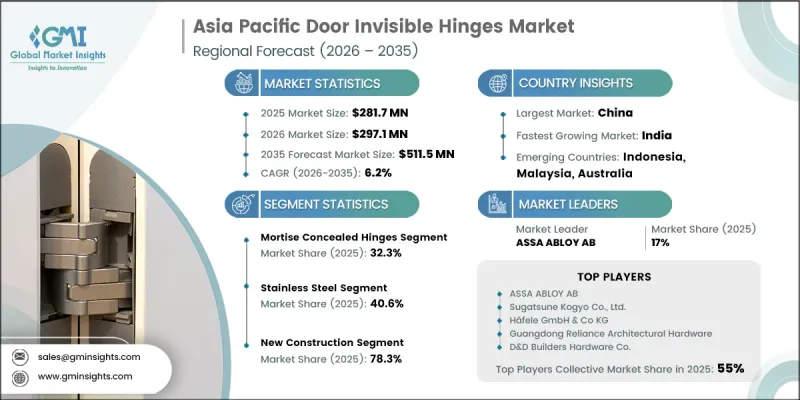
The market growth is supported by continuous construction development across residential, commercial, and hospitality sectors throughout the region. Increasing preference for modern interior designs, seamless door systems, and concealed architectural hardware is accelerating the adoption of invisible hinges in new building projects. The expansion of modular furniture production in key Asian manufacturing hubs and the rising demand for high-quality precision hardware in premium residential developments is further strengthening market growth. Invisible hinges are gradually becoming a mainstream component in contemporary construction as architects and developers prioritize clean aesthetics, space optimization, and enhanced functionality. The growing adoption of integrated door solutions is transforming these products from optional design enhancements into standard hardware specifications across an increasing number of projects. The demand for concealed hardware is also being influenced by evolving architectural trends that emphasize minimal visual disruption while maintaining durability, performance, and installation flexibility.
| Market Scope | |
|---|---|
| Start Year | 2025 |
| Forecast Year | 2026-2035 |
| Start Value | $281.7 Million |
| Forecast Value | $511.5 Million |
| CAGR | 6.1% |
Architectural designs across the Asia Pacific region are increasingly incorporating concealed door hardware solutions as developers seek streamlined and sophisticated interiors. Invisible hinges support these requirements by delivering a hidden appearance while maintaining structural performance and meeting functional demands associated with modern door systems. Their ability to provide reliable operation, improved aesthetics, and compatibility with contemporary building designs has increased adoption across multiple construction applications.
The mortise concealed hinges segment held a 32.3% share in 2025. The strong performance of mortise concealed hinges is linked to their suitability for demanding commercial applications where durability, complete concealment, and precise adjustment capabilities are required. These hinges are fitted within the door and frame structure, enabling effective weight support, three-dimensional adjustment, and a fully concealed appearance without affecting door dimensions or performance standards. Demand for these products remains strong in commercial developments where advanced hardware specifications are prioritized.
The stainless steel segment held a 40.6% share in 2025, growing at a CAGR of 6.9% through 2035. The segment's growth is driven by the material's strong resistance to corrosion, long-term load-bearing capability, and ability to maintain appearance throughout extended building lifecycles. Stainless steel also aligns with the requirements of premium residential and commercial projects where durable and visually appealing hardware solutions are preferred. Its widespread use across high-quality construction projects continues to support its dominant market position.
China Door Invisible Hinges Market generated USD 95 million in 2025, growing at a CAGR of 5.9% through 2035. The country's market growth is supported by continued commercial construction activity and increasing demand for advanced architectural hardware solutions. While residential construction activity in major cities has experienced moderation due to changes in the property sector, commercial developments continue to create significant opportunities for invisible hinge manufacturers. Office complexes, mixed-use projects, and hospitality developments are driving demand for high-performance concealed hardware systems that meet modern design and functionality requirements.
Major players operating in the Asia Pacific door invisible hinges industry are Hafele GmbH & Co KG, Simonswerk GmbH, SOSS Door Hardware, ASSA ABLOY AB, Sugatsune Kogyo Co., Ltd., SFS Group AG, Krona Koblenz S.p.A., AGB - Alban Giacomo S.p.A., Guangdong Reliance Architectural Hardware, D&D Builders Hardware Co., SDH Hardware (Shengda Hardware), and D&D Hardware Industrial Co., Ltd. Companies operating in the Asia Pacific door invisible hinges market are adopting strategies centered on product innovation, regional expansion, manufacturing improvements, and strategic partnerships to strengthen their market presence. Leading manufacturers are focusing on developing durable, adjustable, and aesthetically refined hinge solutions that address changing architectural requirements. Businesses are also expanding distribution networks, enhancing production capabilities, and collaborating with builders, architects, and interior designers to increase product adoption. Investments in advanced materials, customized hardware solutions, and improved customer support services are helping companies differentiate their offerings and establish stronger positions across competitive regional markets.
Table of Contents
Chapter 1 Methodology and Scope
- 1.1 Market scope and definition
- 1.2 Research design
- 1.2.1 Research approach
- 1.2.2 Data collection methods
- 1.3 Data mining sources
- 1.3.1 Global
- 1.3.2 Regional/Country
- 1.4 Base estimates and calculations
- 1.4.1 Base year calculation
- 1.4.2 Key trends for market estimation
- 1.5 Primary research and validation
- 1.5.1 Primary sources
- 1.6 Forecast model
- 1.7 Research assumptions and limitations
Chapter 2 Executive Summary
- 2.1 Industry 360° synopsis
- 2.2 Key market trends
- 2.2.1 Country
- 2.2.2 Product type
- 2.2.3 Technology
- 2.2.4 Grade level
- 2.2.5 Material type
- 2.2.6 Price
- 2.2.7 Application
- 2.2.8 End use industry
- 2.2.9 Distribution channel
Chapter 3 Industry Insights
- 3.1 Industry ecosystem analysis
- 3.1.1 Supplier landscape
- 3.1.2 Profit margin
- 3.1.3 Value addition at each stage
- 3.1.4 Factor affecting the value chain
- 3.2 Industry impact forces
- 3.2.1 Growth drivers
- 3.2.1.1 Rising demand for minimalist & modern architecture
- 3.2.1.2 Growth in modular furniture
- 3.2.1.3 Increasing focus on premiumization
- 3.2.2 Industry pitfalls & challenges
- 3.2.2.1 High cost vs. Conventional hinges
- 3.2.2.2 High installation complexity
- 3.2.3 Opportunities
- 3.2.3.1 Growth in luxury & high-end residential projects
- 3.2.3.2 Integration with smart & functional doors
- 3.2.1 Growth drivers
- 3.3 Growth potential analysis
- 3.4 Regulatory & licensing framework
- 3.4.1 Standards and compliance requirements
- 3.4.2 Regional regulatory frameworks
- 3.4.3 Certification standards
- 3.5 Pricing analysis (driven by primary research)
- 3.5.1 By country
- 3.5.2 By product type
- 3.5.3 Historical price trend analysis
- 3.5.4 Pricing strategy by player type (premium / value / cost-plus)
- 3.6 Trade data analysis (driven by paid database)
- 3.6.1 Import/export volume & value trends by HS Code (8302)
- 3.6.2 Key trade corridors & tariff impact (Asia Pacific)
- 3.7 Impact of AI & generative AI on the market
- 3.7.1 AI-driven disruption of existing business models
- 3.7.2 GenAI use cases & adoption roadmap by segment
- 3.7.3 Risks, limitations & regulatory considerations
- 3.8 Capacity & production landscape (driven by primary research)
- 3.8.1 Installed production capacity by region & key producer
- 3.8.2 Capacity utilization rates & expansion pipelines
Chapter 4 Competitive Landscape, 2025
- 4.1 Introduction
- 4.2 Company market share analysis
- 4.2.1 By country
- 4.2.1.1 China
- 4.2.1.2 India
- 4.2.1.3 Japan
- 4.2.1.4 South Korea
- 4.2.1.5 Australia
- 4.2.1.6 Malaysia
- 4.2.1.7 Indonesia
- 4.2.1.8 Vietnam
- 4.2.1 By country
- 4.3 Company matrix analysis
- 4.4 Competitive analysis of major market players
- 4.5 Competitive positioning matrix
- 4.6 Key developments
- 4.6.1 Mergers & acquisitions
- 4.6.2 Partnerships & collaborations
- 4.6.3 New product launches
- 4.6.4 Expansion plans
Chapter 5 Market Estimates and Forecast, By Product Type, 2022 - 2035 (USD Million) (Million Units)
- 5.1 Key trends
- 5.2 European hinges
- 5.3 Mortise concealed hinges
- 5.4 Pivot concealed hinges
- 5.5 Barrel/cylindrical concealed Hinges
- 5.6 Concealed hinges
- 5.7 Concealed spring door hinges
Chapter 6 Market Estimates and Forecast, By Technology, 2022 - 2035 (USD Million) (Million Units)
- 6.1 Key trends
- 6.2 Basic concealed hinges
- 6.3 Self-closing hinges
- 6.4 Soft-close hinges
- 6.5 3D adjustable hinges
- 6.6 Heavy-duty hinges
- 6.7 Quick-release hinges
- 6.8 Fire-rated hinges
Chapter 7 Market Estimates and Forecast, By Grade Level, 2022 - 2035 (USD Million) (Million Units)
- 7.1 Key trends
- 7.2 Grade 1 (Premium)
- 7.3 Grade 2 (Standard)
- 7.4 Grade 3 (Basic)
- 7.5 Industrial grade
Chapter 8 Market Estimates and Forecast, By Material Type, 2022 - 2035 (USD Million) (Million Units)
- 8.1 Key trends
- 8.2 Stainless steel
- 8.3 Zinc alloy
- 8.4 Carbon steel
- 8.5 Brass/bronze
- 8.6 Aluminum alloy
Chapter 9 Market Estimates and Forecast, By Price, 2022 - 2035 (USD Million) (Million Units)
- 9.1 Key trends
- 9.2 Low
- 9.3 Medium
- 9.4 High
Chapter 10 Market Estimates and Forecast, By Application, 2022 - 2035 (USD Million) (Million Units)
- 10.1 Key trends
- 10.2 Residential
- 10.3 Commercial
- 10.4 Institutional
- 10.5 Industrial
Chapter 11 Market Estimates and Forecast, By End Use Industry, 2022 - 2035 (USD Million) (Million Units)
- 11.1 Key trends
- 11.2 New construction
- 11.3 Retrofit/renovation
Chapter 12 Market Estimates and Forecast, By Distribution Channel, 2022 - 2035 (USD Million) (Million Units)
- 12.1 Key trends
- 12.2 Direct sales
- 12.3 Indirect sales
Chapter 13 Market Estimates and Forecast, By Country, 2022 - 2035 (USD Million) (Million Units)
- 13.1 Key trends
- 13.2 China
- 13.3 India
- 13.4 Japan
- 13.5 South Korea
- 13.6 Australia
- 13.7 Malaysia
- 13.8 Indonesia
- 13.9 Vietnam
Chapter 14 Company Profiles
- 14.1 Global players
- 14.1.1 Simonswerk GmbH
- 14.1.2 ASSA ABLOY AB
- 14.1.3 Hafele GmbH & Co KG
- 14.1.4 SFS Group AG
- 14.1.5 SOSS Door Hardware (Allegion)
- 14.1.6 Krona Koblenz S.p.A.
- 14.1.7 AGB - Alban Giacomo S.p.A.
- 14.2 Regional players
- 14.2.1 Sugatsune Kogyo Co., Ltd.
- 14.2.2 D&D Builders Hardware Co.
- 14.2.3 Guangdong Reliance Architectural Hardware
- 14.2.4 SDH Hardware
- 14.2.5 D&D Hardware Industrial Co., Ltd.
- 14.2.6 JinKaiLi Hardware Products Co., Ltd.
- 14.2.7 Jusheng Hardware
- 14.3 Emerging players
- 14.3.1 Jibang / ADWORK Shenzhen Technology
- 14.3.2 SH Pivot
- 14.3.3 SMED Hardware
- 14.3.4 ZIRCON Hardware
- 14.3.5 IPSA Group
- 14.3.6 Guangdong Canhuang Precision Hardware
- 14.3.7 Hongfeng Hydraulic Hinge (HFZ)

