
PUBLISHER: Global Market Insights Inc. | PRODUCT CODE: 2083360

PUBLISHER: Global Market Insights Inc. | PRODUCT CODE: 2083360
IOT Sensors Market Opportunity, Growth Drivers, Industry Trend Analysis, and Forecast 2026 - 2035
The Global IoT Sensors Market was valued at USD 23.9 billion and is estimated to grow at a CAGR of 37.6% to reach USD 549.2 billion by 2035.
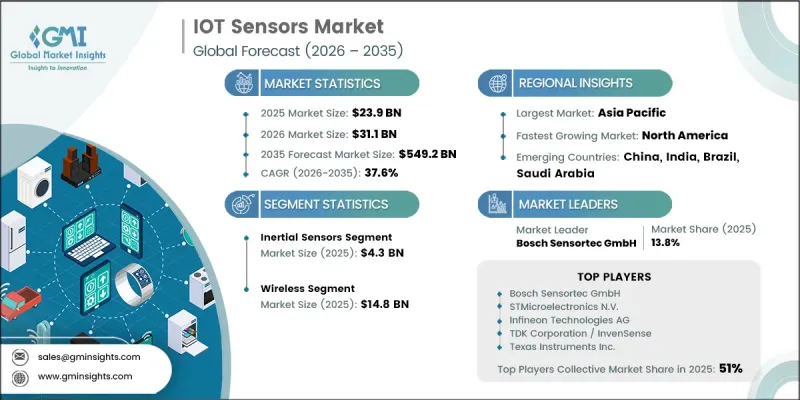
The IoT sensors market is witnessing exponential growth driven by the rapid acceleration of digital transformation across industries and the widespread integration of connected technologies. Increasing adoption of Industry 4.0 frameworks is transforming manufacturing environments into highly automated and data-driven ecosystems. Expanding smart city infrastructure projects are further boosting sensor deployment across transportation, utilities, and public safety systems. The growing use of predictive maintenance solutions is enabling enterprises to reduce operational downtime and improve asset efficiency. Rising demand for connected healthcare applications is also strengthening market expansion by enabling real-time patient monitoring and remote diagnostics. The continuous increase in connected devices globally is reinforcing the importance of IoT sensors as a core enabling technology for real-time data collection, automation, and intelligent decision-making across industrial, commercial, and public sectors. Advancements in cloud computing, edge analytics, and artificial intelligence are further enhancing the functionality and scalability of IoT sensor networks, supporting their integration into complex digital ecosystems.
| Market Scope | |
|---|---|
| Start Year | 2025 |
| Forecast Year | 2026-2035 |
| Start Value | $23.9 Billion |
| Forecast Value | $549.2 Billion |
| CAGR | 37.6% |
The inertial sensors segment accounted for USD 4.3 billion in 2025, maintaining a strong position within the IoT sensors market. This segment includes accelerometers, gyroscopes, and magnetometers that are widely used across consumer electronics, industrial systems, automotive platforms, wearables, and drones. These sensors enable critical functions such as motion tracking, navigation, orientation detection, and asset monitoring. Growing adoption of MEMS-based inertial technologies in industrial automation and automotive systems continues to strengthen the segment's market presence.
The wireless segment captured USD 14.8 billion in 2025. This dominance is supported by the rapid expansion of smart homes, industrial IoT ecosystems, connected healthcare devices, smart infrastructure projects, and wearable technologies. Wireless sensor systems offer cost efficiency, installation flexibility, and seamless integration with cloud and edge computing platforms. Increasing deployment of connectivity technologies such as Wi-Fi, Bluetooth Low Energy, Zigbee, LoRaWAN, NB-IoT, and 5G is further accelerating adoption across multiple application areas.
North America IoT Sensors Market held 25.5% share in 2025, driven by early adoption of industrial automation technologies and strong implementation of IoT-enabled solutions across key industries. The region benefits from significant investments in smart infrastructure and digital transformation initiatives across manufacturing, healthcare, transportation, and utilities. A strong ecosystem of semiconductor manufacturers, technology providers, and cloud service companies is further supporting regional growth and accelerating the adoption of advanced sensing technologies.
Major companies operating in the global IoT sensors market include STMicroelectronics N.V., Bosch Sensortec GmbH, Texas Instruments Inc., Infineon Technologies AG, Analog Devices, Inc. (ADI), Murata Manufacturing Co., Ltd., TDK Corporation / InvenSense, ROHM Co., Ltd., Sensirion AG, Melexis NV, Vishay Intertechnology Inc., Panasonic Corporation, PixArt Imaging Inc., Seiko Epson Corporation, and MEMSIC Semiconductor Co., Ltd. Companies operating in the IoT sensors market are strengthening their market position through continuous innovation in sensor miniaturization, energy efficiency, and multi-functional integration. Market participants are increasingly investing in MEMS technology advancements and next-generation sensing platforms to enhance accuracy, durability, and performance across diverse applications. Strategic partnerships with semiconductor firms, cloud service providers, and industrial automation companies are enabling faster integration of sensor data into advanced analytics ecosystems. Companies are also expanding production capacities to support rising demand from automotive, industrial, and consumer electronics sectors.
Table of Contents
Chapter 1 Methodology and Scope
- 1.1 Market scope and definition
- 1.2 Research design
- 1.2.1 Research approach
- 1.2.2 Data collection methods
- 1.3 Data mining sources
- 1.3.1 Global
- 1.3.2 Regional/Country
- 1.4 Base estimates and calculations
- 1.4.1 Base year calculation
- 1.4.2 Key trends for market estimation
- 1.5 Primary research and validation
- 1.5.1 Primary sources
- 1.6 Forecast model
- 1.7 Research assumptions and limitations
Chapter 2 Executive Summary
- 2.1 Industry 360° synopsis, 2022 - 2035
- 2.2 Key market trends
- 2.2.1 Sensor type trends
- 2.2.2 Network type trends
- 2.2.3 End-use trends
- 2.2.4 Regional trends
- 2.3 TAM Analysis, 2026-2035
- 2.4 CXO perspectives: Strategic imperatives
Chapter 3 Industry Insights
- 3.1 Industry ecosystem analysis
- 3.1.1 Supplier Landscape
- 3.1.2 Profit Margin
- 3.1.3 Cost structure
- 3.1.4 Value addition at each stage
- 3.1.5 Factor affecting the value chain
- 3.1.6 Disruptions
- 3.2 Industry impact forces
- 3.2.1 Growth drivers
- 3.2.1.1 Adoption of Smart Manufacturing and Industry 4.0
- 3.2.1.2 Expansion of Smart City Infrastructure
- 3.2.1.3 Rising Adoption of Predictive Maintenance Solutions
- 3.2.1.4 Growth of Connected Healthcare and Remote Patient Monitoring
- 3.2.1.5 Rapid Increase in Connected IoT Devices Worldwide
- 3.2.2 Industry pitfalls and challenges
- 3.2.2.1 Data Security and Privacy Concerns
- 3.2.2.2 Interoperability and Connectivity Challenges
- 3.2.3 Market opportunities
- 3.2.3.1 AI-Enabled Smart Sensors and Edge Computing
- 3.2.3.2 Expansion of Industrial IoT (IIoT) and Smart Infrastructure
- 3.2.1 Growth drivers
- 3.3 Growth potential analysis
- 3.4 Pricing Analysis (Driven by Primary Research) [Representation on page no. 32]
- 3.4.1 Historical Price Trend Analysis
- 3.4.2 Pricing Strategy by Player Type (Premium / Value / Cost-plus)
- 3.5 Regulatory landscape
- 3.5.1 North America
- 3.5.2 Europe
- 3.5.3 Asia Pacific
- 3.5.4 Latin America
- 3.5.5 Middle East & Africa
- 3.6 Porter's analysis
- 3.7 PESTEL analysis
- 3.8 Trade Data Analysis (Based on Paid Database)
- 3.8.1 Import/Export Volume & Value Trends
- 3.8.2 Key Trade Corridors & Tariff Impact
- 3.9 Impact of AI & Generative AI on the Market (Driven by Primary Research)
- 3.9.1 AI-Driven Disruption of Existing Business Models
- 3.9.2 GenAI Use Cases & Adoption Roadmap by Segment
- 3.10 Capacity & Production Landscape (Driven by Primary Research)
- 3.10.1 Production Capacity by Key Producer
- 3.10.2 Capacity Utilization Rates & Expansion Pipelines
Chapter 4 Competitive Landscape, 2025
- 4.1 Introduction
- 4.1.1 By Region
- 4.1.1.1 North America
- 4.1.1.2 Europe
- 4.1.1.3 Asia-Pacific
- 4.1.1.4 Latin America
- 4.1.1.5 Middle East and Africa
- 4.1.2 Market Concentration Analysis
- 4.1.1 By Region
- 4.2 Competitive analysis of major market players
- 4.3 Competitive positioning matrix
- 4.4 Key developments
- 4.4.1 Mergers & acquisitions
- 4.4.2 Partnerships & collaborations
- 4.4.3 New product launches
- 4.4.4 Expansion plans and funding
- 4.5 Company tier benchmarking
- 4.5.1 Tier classification criteria & qualifying thresholds
- 4.5.2 Tier positioning matrix by revenue, geography & innovation
Chapter 5 Market Estimates and Forecast, By Sensor Type, 2022 - 2035 (USD Billion)
- 5.1 Key trends
- 5.2 Temperature Sensors
- 5.3 Pressure Sensors
- 5.4 Humidity Sensors
- 5.5 Flow Sensors
- 5.6 Inertial Sensors (Accelerometers, Gyroscopes & Magnetometers)
- 5.7 Image Sensors
- 5.8 Touch Sensors
- 5.9 Proximity Sensors
- 5.10 Acoustic & Ultrasonic Sensors
- 5.11 Gas & Chemical Sensors
- 5.12 Others
Chapter 6 Market Estimates and Forecast, By Network Type, 2022 - 2035 (USD Billion)
- 6.1 Key trends
- 6.2 Wired
- 6.3 Wireless
Chapter 7 Market Estimates and Forecast, By End-Use Industry, 2022 - 2035 (USD Billion)
- 7.1 Key trends
- 7.2 Industrial & Manufacturing
- 7.3 Automotive & Transportation
- 7.4 Healthcare & Medical Devices
- 7.5 Consumer Electronics & Wearables
- 7.6 Smart Buildings (Residential, Commercial & Institutional)
- 7.7 Agriculture & Environmental Monitoring
- 7.8 Energy & Utilities
- 7.9 Smart Cities & Public Infrastructure
- 7.10 Retail, Warehousing & Logistics
Chapter 8 Market Estimates and Forecast, By Region, 2022 - 2035 (USD Billion)
- 8.1 Key trends
- 8.2 North America
- 8.2.1 U.S.
- 8.2.2 Canada
- 8.3 Europe
- 8.3.1 Germany
- 8.3.2 UK
- 8.3.3 France
- 8.3.4 Spain
- 8.3.5 Italy
- 8.4 Asia Pacific
- 8.4.1 China
- 8.4.2 India
- 8.4.3 Japan
- 8.4.4 Australia
- 8.4.5 South Korea
- 8.5 Latin America
- 8.5.1 Brazil
- 8.5.2 Mexico
- 8.5.3 Argentina
- 8.6 Middle East and Africa
- 8.6.1 South Africa
- 8.6.2 Saudi Arabia
- 8.6.3 UAE
Chapter 9 Company Profiles
- 9.1 Global Key Players
- 9.1.1 Bosch Sensortec GmbH
- 9.1.2 STMicroelectronics N.V.
- 9.1.3 Infineon Technologies AG
- 9.1.4 Texas Instruments Inc.
- 9.1.5 TDK Corporation / InvenSense
- 9.2 Regional key players
- 9.2.1 North America
- 9.2.1.1 Analog Devices, Inc. (ADI)
- 9.2.1.2 Vishay Intertechnology Inc.
- 9.2.1.3 MEMSIC Semiconductor Co., Ltd.
- 9.2.2 Asia Pacific
- 9.2.2.1 Murata Manufacturing Co., Ltd.
- 9.2.2.2 ROHM Co., Ltd.
- 9.2.2.3 Seiko Epson Corporation
- 9.2.2.4 Panasonic Corporation
- 9.2.3 Europe
- 9.2.3.1 Sensirion AG
- 9.2.3.2 Melexis NV
- 9.2.1 North America
- 9.3 Niche Players/Disruptors
- 9.3.1 PixArt Imaging Inc.

