PUBLISHER: Global Market Insights Inc. | PRODUCT CODE: 2083368

PUBLISHER: Global Market Insights Inc. | PRODUCT CODE: 2083368
Down Jacket Market Opportunity, Growth Drivers, Industry Trend Analysis, and Forecast 2026 - 2035
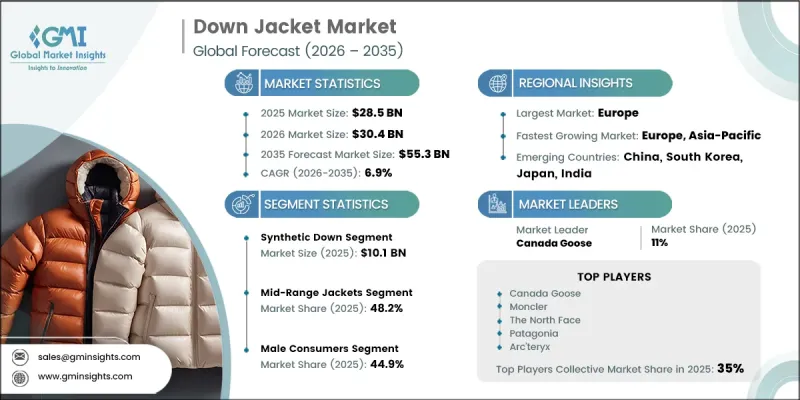
The Global Down Jacket Market was valued at USD 28.5 billion in 2025 and is estimated to grow at a CAGR of 6.9% to reach USD 55.3 billion by 2035.
The down jacket industry is experiencing consistent growth as consumers increasingly prioritize warmth, comfort, durability, and stylish outerwear solutions. The rising popularity of functional apparel designed for cold climates, combined with changing fashion preferences and increased awareness of performance-based clothing, is supporting market expansion. Down jackets are widely preferred due to their lightweight construction, strong insulation capabilities, and ability to provide protection in low-temperature environments. Demand continues to rise as consumers seek premium winter apparel that delivers both practical performance and modern design appeal. The market is also benefiting from growing interest in outdoor lifestyles, adventure activities, and seasonal travel, which is encouraging customers to invest in reliable cold-weather clothing. In addition, sustainability has become a significant factor influencing product development, with manufacturers focusing on responsible sourcing, improved materials, and environmentally conscious production approaches. The increasing preference for durable products that provide long-term value is further strengthening demand across global markets.
| Market Scope | |
|---|---|
| Start Year | 2025 |
| Forecast Year | 2026-2035 |
| Start Value | $28.5 Billion |
| Forecast Value | $55.3 Billion |
| CAGR | 6.9% |
The synthetic down segment held a 35.6% share in 2025, generating USD 10.1 billion. Synthetic insulation continues to gain traction because it delivers consistent warmth, maintains performance in damp conditions, and provides better moisture resistance compared with traditional insulation materials. These characteristics make synthetic down jackets suitable for consumers who require dependable outerwear across varying weather conditions. Synthetic-filled jackets also offer advantages in terms of durability, maintenance, and long-term usability, as the insulation maintains its structure after repeated use and washing. Faster drying capability and resistance to losing shape have increased consumer acceptance of synthetic down products, particularly among buyers looking for practical and cost-effective winter apparel options.
Mid-range down jackets segment accounted for 48.2% share in 2025. This category continues to attract consumers by offering a combination of performance, product quality, and reasonable pricing. Buyers in this segment increasingly prefer jackets that provide reliable insulation, comfort, and durability while also considering sustainable material options such as recycled down instead of conventional alternatives. The mid-range category has expanded the accessibility of high-quality outdoor apparel by attracting a wider customer base beyond specialized outdoor users. Brands operating in this segment are strengthening their market presence by offering products that balance affordability with advanced features.
U.S. Down Jacket Market accounted for 87.3% share in 2025, valued at USD 7.2 billion. Market growth is supported by cold climate conditions, strong outdoor recreation participation, and consumer interest in premium performance clothing. The United States remains a major contributor to regional demand as customers increasingly seek winter apparel that combines insulation, durability, weather resistance, and style. Demand is supported by consumers purchasing down jackets for different cold-weather needs, including outdoor activities and everyday use in colder regions. The preference for high-performance outerwear continues to encourage manufacturers to introduce advanced designs, improved materials, and versatile products suited for changing consumer expectations.
Major players operating in the global down jacket industry are Moncler, Canada Goose, Columbia, The North Face, Patagonia, Arc'teryx Equipment, Inc., Mammut, Woolrich, Bosideng, Descente, Jack Wolfskin, Helly Hansen, Pyrenex, Nobis, Outdoor Voices, Atom, Save The Duck, Uniqlo, and Duvetic. Companies in the down jacket market are strengthening their position through strategies focused on product innovation, sustainability initiatives, brand expansion, and improved customer engagement. Manufacturers are investing in advanced insulation technologies, lightweight designs, and weather-resistant materials to improve product performance. Leading brands are expanding their product portfolios across premium, mid-range, and affordable segments to reach diverse consumer groups. Companies are also adopting sustainable practices, including responsible sourcing and eco-friendly manufacturing processes, to align with changing customer preferences. Digital marketing, e-commerce expansion, collaborations, and direct-to-consumer sales channels are helping brands increase visibility and strengthen customer relationships.
Table of Contents
Chapter 1 Methodology and Scope
- 1.1 Market scope and definition
- 1.2 Research design
- 1.2.1 Research approach
- 1.2.2 Data collection methods
- 1.3 Data mining sources
- 1.3.1 Region
- 1.3.2 Regional/Country
- 1.4 Base estimates and calculations
- 1.4.1 Base year calculation
- 1.4.2 Key trends for market estimation
- 1.5 Primary research and validation
- 1.5.1 Primary sources
- 1.6 Forecast model
- 1.7 Research assumptions and limitations
Chapter 2 Executive Summary
- 2.1 Industry 360° synopsis
- 2.2 Key market trends
- 2.2.1 Country
- 2.2.2 Material
- 2.2.3 Consumer Group
- 2.2.4 Price range
- 2.2.5 Distribution Channel
Chapter 3 Industry Insights
- 3.1 Industry ecosystem analysis
- 3.1.1 Raw material suppliers
- 3.1.2 Down processing & cleaning facilities
- 3.1.3 Jacket manufacturers & OEMs
- 3.1.4 Brand owners & designers
- 3.1.5 Distributors & wholesalers
- 3.1.6 Retail channels
- 3.1.7 End consumers
- 3.1.8 Profit margin analysis by value chain stage (driven by primary research)
- 3.1.9 Value addition at each stage
- 3.1.10 Factors affecting the value chain
- 3.2 Industry impact forces
- 3.2.1 Growth drivers
- 3.2.2 Industry pitfalls & challenges
- 3.2.3 Opportunities
- 3.3 Growth potential analysis
- 3.4 Future market trends
- 3.5 Technology and innovation landscape
- 3.5.1 Current technological trends
- 3.5.2 Emerging technologies
- 3.5.3 Advanced fabric technologies
- 3.5.4 Smart textile integration
- 3.5.5 Sustainable manufacturing technologies
- 3.5.6 Recycled down processing innovations
- 3.6 Price trends, 2025
- 3.6.1 By product type
- 3.6.2 Historical Price Trend Analysis (Driven by Primary Research)
- 3.6.3 Pricing Strategy by Player Type (Premium / Mid-Range / Budget)
- 3.6.4 Regional Price Variations
- 3.6.5 Material Cost Impact on Retail Pricing
- 3.6.6 Price Elasticity by Consumer Segment
- 3.7 Regulatory landscape
- 3.7.1 Standards and compliance requirements
- 3.7.1.1 North America
- 3.7.1.2 Europe
- 3.7.1.3 Asia Pacific
- 3.7.2 Certification Standards
- 3.7.3 Environmental & Sustainability Regulations
- 3.7.1 Standards and compliance requirements
- 3.8 Supply chain analysis
- 3.8.1 Raw material sourcing dynamics
- 3.8.2 Manufacturing hub concentration
- 3.8.3 Logistics & distribution networks
- 3.8.4 Supply chain vulnerabilities & risk factors
- 3.8.5 Vertical integration trends
- 3.8.6 Nearshoring & reshoring dynamics
- 3.9 Trade Data Analysis (Driven by Paid database)
- 3.9.1 Import/export volume & value trends by region
- 3.9.2 Key trade corridors & tariff impact
- 3.9.3 Major exporting countries
- 3.9.4 Major importing countries
- 3.9.5 Trade policy changes & impact assessment
- 3.10 Impact of AI & generative AI on the market
- 3.10.1 AI-driven disruption of existing business models
- 3.10.2 Genai use cases & adoption roadmap
- 3.10.2.1 Demand forecasting & inventory optimization
- 3.10.2.2 Personalized design & customization
- 3.10.2.3 Supply chain optimization
- 3.10.2.4 Virtual try-on & customer experience
- 3.10.3 Risks, limitations & regulatory considerations
- 3.11 Distribution infrastructure & channel penetration landscape (driven by primary research)
- 3.11.1 Channel coverage by region
- 3.11.2 Last-mile infrastructure gaps & emerging channel shifts
- 3.11.3 E-commerce penetration & digital infrastructure maturity
- 3.11.4 Omnichannel retail strategy adoption
- 3.12 Porter’s analysis
- 3.13 PESTEL analysis
- 3.14 Consumer buying behaviour analysis
- 3.14.1 Demographic trends
- 3.14.2 Factors affecting buying decisions
- 3.14.3 Purchase Decision Journey Mapping
- 3.14.4 Emerging Consumer Trends
- 3.14.5 Consumer product adoption
- 3.14.6 Preferred distribution channel
Chapter 4 Competitive Landscape, 2025
- 4.1 Introduction
- 4.2 Company market share analysis
- 4.2.1 North America
- 4.2.2 Europe
- 4.2.3 Asia Pacific
- 4.2.4 Latin America
- 4.2.5 MEA
- 4.3 Company matrix analysis
- 4.4 Competitive analysis of major market players
- 4.5 Competitive positioning matrix
- 4.6 Key developments
- 4.6.1 Mergers & acquisitions
- 4.6.2 Partnerships & collaborations
- 4.6.3 New product launches
- 4.6.4 Expansion plans
Chapter 5 Estimates & Forecast, By Material, 2022 - 2035 (USD Billion) (Thousand Units)
- 5.1 Key trends
- 5.2 Duck down
- 5.3 Goose down
- 5.4 Synthetic down
Chapter 6 Estimates & Forecast, By Consumer Group 2022 - 2035 (USD Billion) (Thousand Units)
- 6.1 Key trends
- 6.2 Male
- 6.3 Female
- 6.4 Kids
Chapter 7 Market Estimates and Forecast, By Price Range, 2022 - 2035 (USD Billion) (Thousand Units)
- 7.1 Key trends
- 7.2 Budget
- 7.3 Mid-range
- 7.4 Premium
Chapter 8 Estimates & Forecast, By Distribution Channel 2022 - 2035 (USD Billion) (Thousand Units)
- 8.1 Key trends
- 8.2 Online
- 8.2.1 E-commerce websites
- 8.2.2 Company websites
- 8.3 Offline
- 8.3.1 Hypermarket/supermarket
- 8.3.2 Departmental stores
- 8.3.3 Others
Chapter 9 Market Estimates and Forecast, By Region, 2022 - 2035 (USD Billion) (Thousand Units)
- 9.1 Key trends
- 9.2 North America
- 9.2.1 U.S.
- 9.2.2 Canada
- 9.3 Europe
- 9.3.1 UK
- 9.3.2 Germany
- 9.3.3 France
- 9.3.4 Italy
- 9.3.5 Spain
- 9.3.6 Rest of Europe
- 9.4 Asia Pacific
- 9.4.1 China
- 9.4.2 India
- 9.4.3 Japan
- 9.4.4 South Korea
- 9.4.5 Australia
- 9.4.6 Rest of Asia Pacific
- 9.5 Latin America
- 9.5.1 Brazil
- 9.5.2 Mexico
- 9.5.3 Rest of Latin America
- 9.6 MEA
- 9.6.1 Saudi Arabia
- 9.6.2 UAE
- 9.6.3 South Africa
- 9.6.4 Rest of MEA
Chapter 10 Company Profiles
- 10.1 Top Global Players
- 10.1.1 Canada Goose
- 10.1.2 Moncler
- 10.1.3 The North Face
- 10.1.4 Columbia
- 10.1.5 Patagonia
- 10.1.6 Arc'teryx
- 10.1.7 Mammut
- 10.1.8 Woolrich
- 10.2 Regional Champions
- 10.2.1 Bosideng
- 10.2.2 Descente
- 10.2.3 Jack Wolfskin
- 10.2.4 Helly Hansen
- 10.2.5 Pyrenex
- 10.2.6 Nobis
- 10.3 Emerging Players
- 10.3.1 Outdoor Voices
- 10.3.2 Atom
- 10.3.3 Save The Duck
- 10.3.4 Uniqlo
- 10.3.5 Duvetica

