PUBLISHER: Global Market Insights Inc. | PRODUCT CODE: 2083375

PUBLISHER: Global Market Insights Inc. | PRODUCT CODE: 2083375
Electro Optical System Market Opportunity, Growth Drivers, Industry Trend Analysis, and Forecast 2026 - 2035
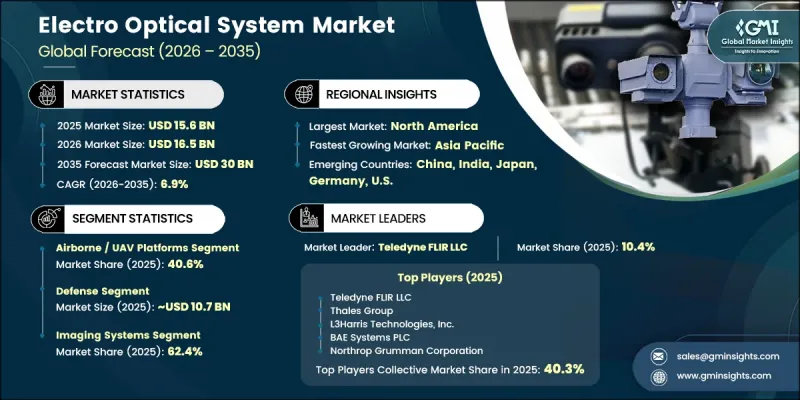
The Global Electro Optical Systems Market was valued at USD 15.6 billion in 2025 and is estimated to grow at a CAGR of 6.9% to reach USD 30 billion by 2035.
Market growth is supported by increasing commercial aircraft production, rising demand for aftermarket replacement components, ongoing military aircraft modernization programs, and the expanding use of advanced materials, including polycarbonate and acrylic laminates. The growing backlog of commercial aircraft deliveries is encouraging higher production rates, creating additional demand for electro optical systems integrated into aviation platforms. These systems play an important role in enhancing aircraft performance through advanced vision capabilities, surveillance functions, cockpit display technologies, and onboard monitoring applications. Defense modernization initiatives across multiple countries are also accelerating the deployment of electro optical technologies in military platforms to strengthen operational effectiveness and mission readiness. Furthermore, increasing investments in border security, maritime surveillance, and critical infrastructure monitoring are driving demand for advanced electro-optical sensors, thermal imaging systems, and long-range imaging technologies. Continuous technological advancements and rising defense and aerospace investments are expected to create sustained growth opportunities for the electro optical systems market throughout the forecast period.
| Market Scope | |
|---|---|
| Start Year | 2025 |
| Forecast Year | 2026-2035 |
| Start Value | $15.6 Billion |
| Forecast Value | $30 Billion |
| CAGR | 6.9% |
The airborne/UAV platforms segment accounted for 40.6% share in 2025. Strong demand is driven by the extensive use of electro optical technologies in intelligence, surveillance, reconnaissance (ISR), target acquisition, navigation, and situational awareness applications. Modern military aircraft, helicopters, and unmanned aerial vehicles increasingly incorporate electro-optical and infrared (EO/IR) sensors, thermal imaging systems, laser designation technologies, and advanced imaging solutions to enhance operational performance and mission effectiveness across diverse defense operations.
The defense segment generated USD 10.7 billion in 2025. Continued military modernization initiatives, increasing procurement of advanced defense platforms, and rising demand for intelligence, surveillance, reconnaissance (ISR), and precision targeting capabilities are driving segment growth. The expanding deployment of electro-optical and infrared (EO/IR) technologies across fighter aircraft, armored vehicles, naval platforms, and unmanned systems continues to strengthen market demand. Rising defense expenditures across multiple countries are further supporting investments in next-generation electro optical technologies.
North America Electro Optical Systems Market accounted for 35.3% share in 2025. Market growth across the region is supported by substantial defense spending, a well-established aerospace and defense manufacturing industry, and continued investments in intelligence, surveillance, and reconnaissance capabilities. Ongoing procurement of advanced military aircraft, naval systems, and unmanned platforms is further accelerating demand for electro optical technologies. Strong investments in defense modernization and aerospace innovation continue to reinforce North America's position as a major contributor to global market growth.
Key companies operating in the global electro optical systems market include Thales Group, Airbus Defence & Space, Leonardo S.p.A., Safran Electronics & Defense, BAE Systems PLC, Rheinmetall AG, Hensoldt AG, Saab AB, Kongsberg Defence & Aerospace, Indra Sistemas S.A., Jenoptik AG, AIM Infrarot-Module GmbH, LYNRED, Exosens (Photonis brand), PCO S.A., Senop Oy, and Theon International S.A. Leading companies in the electro optical systems market are strengthening their competitive position by investing heavily in research and development to enhance imaging performance, sensor accuracy, and system reliability. Manufacturers are expanding their portfolios with advanced electro-optical and infrared technologies while integrating artificial intelligence, automation, and enhanced image processing capabilities into next-generation systems. Strategic partnerships, defense contracts, technology collaborations, and geographic expansion remain key approaches for increasing market presence. Companies are also focusing on developing lightweight, energy-efficient, and highly durable solutions that meet evolving aerospace and defense requirements.
Table of Contents
Chapter 1 Methodology and Scope
- 1.1 Market scope and definition
- 1.2 Research design
- 1.2.1 Research approach
- 1.2.2 Data collection methods
- 1.3 Data mining sources
- 1.3.1 Global
- 1.3.2 Regional/Country
- 1.4 Base estimates and calculations
- 1.4.1 Base year calculation
- 1.4.2 Key trends for market estimation
- 1.5 Primary research and validation
- 1.5.1 Primary sources
- 1.6 Forecast model
- 1.7 Research assumptions and limitations
Chapter 2 Executive Summary
- 2.1 Industry 360° synopsis, 2022 - 2035
- 2.2 Key market trends
- 2.2.1 System trends
- 2.2.2 Component trends
- 2.2.3 Application trends
- 2.2.4 Platform trends
- 2.2.5 End use trend
- 2.2.6 Regional trends
- 2.3 TAM Analysis, 2026-2035
- 2.4 CXO perspectives: Strategic imperatives
Chapter 3 Industry Insights
- 3.1 Industry ecosystem analysis
- 3.1.1 Supplier Landscape
- 3.1.2 Profit Margin
- 3.1.3 Cost structure
- 3.1.4 Value addition at each stage
- 3.1.5 Factor affecting the value chain
- 3.1.6 Disruptions
- 3.2 Industry impact forces
- 3.2.1 Growth drivers
- 3.2.1.1 Increasing commercial aircraft deliveries and production backlogs
- 3.2.1.2 Military aircraft modernization and defense procurement programs
- 3.2.1.3 Rising deployment of unmanned aerial vehicles (UAVs)
- 3.2.1.4 Growing border surveillance and homeland security investments
- 3.2.1.5 Increasing adoption of advanced targeting and precision-guided systems
- 3.2.2 Industry pitfalls and challenges
- 3.2.2.1 High acquisition and lifecycle costs of advanced EO systems
- 3.2.2.2 Complex integration with multi-domain defense platforms
- 3.2.3 Market opportunities
- 3.2.3.1 Growing adoption of AI-enabled electro-optical surveillance systems
- 3.2.3.2 Expansion of electro-optical payloads for unmanned systems
- 3.2.1 Growth drivers
- 3.3 Growth potential analysis
- 3.4 Regulatory landscape
- 3.4.1 North America
- 3.4.2 Europe
- 3.4.3 Asia Pacific
- 3.4.4 Latin America
- 3.4.5 Middle East & Africa
- 3.5 Porter's analysis
- 3.6 PESTEL analysis
- 3.7 Technology and Innovation landscape
- 3.7.1 Current technological trends
- 3.7.2 Emerging technologies
- 3.8 Price trends
- 3.8.1 By region
- 3.8.2 By product
- 3.9 Pricing Strategies
- 3.10 Emerging Business Models
- 3.11 Compliance Requirements
- 3.12 Patent and IP analysis
Chapter 4 Competitive Landscape, 2025
- 4.1 Introduction
- 4.2 Company market share analysis
- 4.2.1 By region
- 4.2.1.1 North America
- 4.2.1.2 Europe
- 4.2.1.3 Asia Pacific
- 4.2.1.4 Latin America
- 4.2.1.5 Middle East & Africa
- 4.2.2 Market concentration analysis
- 4.2.1 By region
- 4.3 Competitive benchmarking of key players
- 4.3.1 Financial performance comparison
- 4.3.1.1 Revenue
- 4.3.1.2 Profit margin
- 4.3.1.3 R&D
- 4.3.2 Product portfolio comparison
- 4.3.2.1 Product range breadth
- 4.3.2.2 Technology
- 4.3.2.3 Innovation
- 4.3.3 Geographic presence comparison
- 4.3.3.1 Global footprint analysis
- 4.3.3.2 Service network coverage
- 4.3.3.3 Market penetration by region
- 4.3.4 Competitive positioning matrix
- 4.3.4.1 Leaders
- 4.3.4.2 Challengers
- 4.3.4.3 Followers
- 4.3.4.4 Niche players
- 4.3.5 Strategic outlook matrix
- 4.3.1 Financial performance comparison
- 4.4 Key developments
- 4.4.1 Mergers and acquisitions
- 4.4.2 Partnerships and collaborations
- 4.4.3 Technological advancements
- 4.4.4 Expansion and investment strategies
- 4.4.5 Digital transformation initiatives
- 4.5 Emerging/ startup competitors landscape
Chapter 5 Market Estimates and Forecast, By System, 2022 - 2035 (USD Million)
- 5.1 Key trends
- 5.2 Imaging systems
- 5.2.1 Visible light imaging systems
- 5.2.2 Infrared / thermal imaging systems
- 5.2.2.1 LWIR - uncooled systems
- 5.2.2.2 MWIR - cooled systems
- 5.2.2.3 Swir systems
- 5.2.3 Multi-spectral and hyperspectral imaging systems
- 5.3 Non-imaging systems
- 5.3.1 Laser-based systems
- 5.3.2 Electronic sensing & detection systems
Chapter 6 Market Estimates and Forecast, By Component Type, 2022 - 2035 (USD Million)
- 6.1 Key trends
- 6.2 Infrared / thermal sensors & detectors
- 6.2.1 Cooled detectors (InSb, HgCdTe/MCT)
- 6.2.2 Uncooled detectors (VOx, a-Si Microbolometers)
- 6.3 Cameras & imagers
- 6.3.1 Thermal / IR camera modules
- 6.3.2 Visible & day-night camera modules
- 6.3.3 Multispectral camera systems
- 6.4 Lasers & laser rangefinders
- 6.4.1 Laser rangefinder (LRF) modules
- 6.4.2 Laser designators & target markers
- 6.4.3 LiDAR systems
- 6.5 Optics & lenses
- 6.5.1 Thermal / IR optics
- 6.5.2 Visible light optics
- 6.5.3 Motorized zoom & continuous zoom lens systems
- 6.6 Image processing units & embedded electronics
- 6.7 Other components
Chapter 7 Market Estimates and Forecast, By Application, 2022 - 2035 (USD Million)
- 7.1 Key trends
- 7.2 ISR (intelligence, surveillance & reconnaissance)
- 7.2.1 Airborne ISR - UAV-mounted and manned aircraft systems
- 7.2.2 Ground-based ISR systems
- 7.2.3 Maritime / naval ISR systems
- 7.3 Targeting & fire control systems
- 7.3.1 Airborne targeting (turrets, targeting pods)
- 7.3.2 Vehicle-mounted targeting systems
- 7.3.3 Naval fire control and targeting
- 7.4 Navigation & guidance
- 7.5 Border & perimeter surveillance
- 7.5.1 Land border surveillance infrastructure
- 7.5.2 Maritime / coastal patrol systems
- 7.6 Search & rescue / emergency response
- 7.7 Other applications (industrial inspection, firefighting, law enforcement)
Chapter 8 Market Estimates and Forecast, By Platform of Sales, 2022 - 2035 (USD Million)
- 8.1 Key trends
- 8.2 Airborne / UAV platforms
- 8.2.1 Fixed-wing UAVS
- 8.2.1.1 Male
- 8.2.1.2 Hale
- 8.2.1.3 Tactical / mini UAVS
- 8.2.2 Rotary-wing uavs
- 8.2.2.1 Manned fixed-wing aircraft
- 8.2.2.2 Manned rotary-wing
- 8.2.1 Fixed-wing UAVS
- 8.3 Ground platforms
- 8.3.1 Armored vehicles
- 8.3.2 Unmanned ground vehicles (UGVS)
- 8.3.3 Others
- 8.4 Maritime platforms
- 8.4.1 Surface combatants and patrol vessels
- 8.4.2 Unmanned surface vehicles (USVS)
- 8.5 Fixed / infrastructure-mounted systems
- 8.5.1 Perimeter security towers and masts
- 8.5.2 Border surveillance infrastructure
- 8.5.3 Critical infrastructure monitoring
Chapter 9 Market Estimates and Forecast, By End Use, 2022 - 2035 (USD Million)
- 9.1 Key trends
- 9.2 Defense
- 9.2.1 Army & land forces
- 9.2.2 Air force
- 9.2.3 Navy
- 9.2.4 Special operations forces
- 9.3 Homeland security & law enforcement
- 9.3.1 Border control and customs enforcement
- 9.3.2 Police and tactical law enforcement units
- 9.3.3 Critical infrastructure protection
- 9.4 Commercial
- 9.4.1 Industrial inspection & automation
- 9.4.2 Energy sector
- 9.4.3 Emergency search & rescue services
- 9.4.4 Automotive
- 9.4.5 Others
Chapter 10 Market Estimates and Forecast, By Region, 2022 - 2035 (USD Million)
- 10.1 Key trends
- 10.2 North America
- 10.2.1 U.S.
- 10.2.2 Canada
- 10.3 Europe
- 10.3.1 Germany
- 10.3.2 UK
- 10.3.3 France
- 10.3.4 Spain
- 10.3.5 Italy
- 10.3.6 Netherlands
- 10.4 Asia Pacific
- 10.4.1 China
- 10.4.2 India
- 10.4.3 Japan
- 10.4.4 Australia
- 10.4.5 South Korea
- 10.5 Latin America
- 10.5.1 Brazil
- 10.5.2 Mexico
- 10.5.3 Argentina
- 10.6 Middle East and Africa
- 10.6.1 South Africa
- 10.6.2 Saudi Arabia
- 10.6.3 UAE
Chapter 11 Company Profiles
- 11.1 Global Key Players
- 11.1.1 Thales Group
- 11.1.2 Leonardo S.p.A.
- 11.1.3 Safran Electronics & Defense
- 11.1.4 Airbus Defence & Space
- 11.1.5 BAE Systems PLC
- 11.2 Regional key players
- 11.2.1 Europe
- 11.2.1.1 Hensoldt AG
- 11.2.1.2 Rheinmetall AG
- 11.2.1.3 Saab AB
- 11.2.1.4 Kongsberg Defence & Aerospace
- 11.2.1.5 Indra Sistemas S.A.
- 11.2.1 Europe
- 11.3 Niche Players/Disruptors
- 11.3.1 LYNRED
- 11.3.2 Exosens (Photonis brand)
- 11.3.3 Jenoptik AG
- 11.3.4 AIM Infrarot-Module GmbH
- 11.3.5 PCO S.A.
- 11.3.6 Senop Oy
- 11.3.7 Theon International S.A.

