PUBLISHER: Global Market Insights Inc. | PRODUCT CODE: 2083380

PUBLISHER: Global Market Insights Inc. | PRODUCT CODE: 2083380
Smart Doorbell Market Opportunity, Growth Drivers, Industry Trend Analysis, and Forecast 2026 - 2035
The Global Smart Doorbell Market generated USD 8 billion in 2025 and is estimated to grow at a CAGR of 13% to reach USD 28.2 billion by 2035.
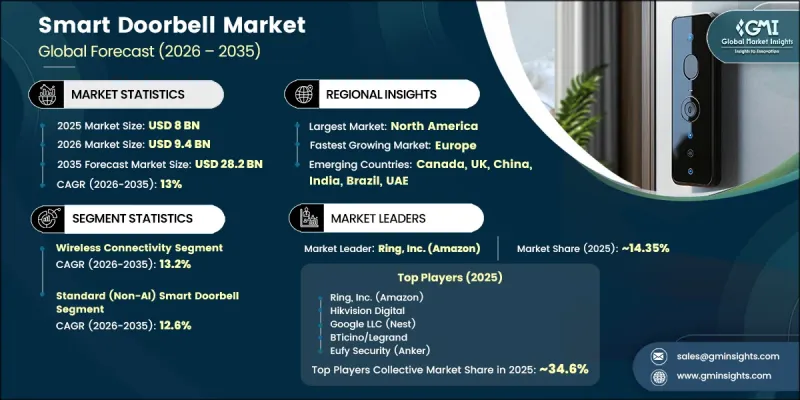
Market expansion is fueled by rising investments in residential security solutions, growing adoption of connected home ecosystems, and sustained demand for parcel monitoring technologies driven by the rapid growth of online shopping. The industry is benefiting from long-term structural demand across both developed and developing economies as advancements in artificial intelligence, seamless wireless deployment, and enhanced device interoperability continue to expand the consumer base. Declining hardware costs combined with broader broadband availability across Asia Pacific, Latin America, and the Middle East & Africa are reducing historical barriers to adoption and accelerating market penetration. As a result, smart doorbells are emerging as one of the most resilient categories within the connected home security industry. The incorporation of AI and machine learning has transformed device functionality from basic motion alerts to advanced situational awareness. Modern platforms can identify different object types, recognize familiar individuals, and prioritize notifications based on risk levels, significantly improving accuracy while reducing unnecessary alerts. These technological advancements continue to strengthen the value proposition of smart doorbell systems and support long-term market growth.
| Market Scope | |
|---|---|
| Start Year | 2025 |
| Forecast Year | 2026-2035 |
| Start Value | $8 Billion |
| Forecast Value | $28.2 Billion |
| CAGR | 13% |
The wireless connectivity segment accounted for USD 4.8 billion share in 2025. The segment continues to experience strong momentum because it aligns closely with the preferences of key customer groups, including renters, first-time smart home users, and operators of multi-unit residential properties. Wireless solutions primarily consist of Wi-Fi-enabled devices, which remain the leading connectivity option, while cellular-connected models are gaining traction in locations where fixed broadband availability remains limited. The convenience of installation and flexibility of deployment continue to make wireless smart doorbells the preferred choice among consumers.
The Standard (Non-AI) Smart Doorbell segment represented 54.6% share in 2025 and is anticipated to grow at a CAGR of 12.6% through 2035. This category includes products equipped with essential capabilities such as video surveillance, two-way communication, motion sensing, and local or cloud-based storage without advanced AI-powered visual analytics. The segment maintains a dominant position due to its affordability and broad appeal among cost-conscious consumers seeking reliable home security functionality. Demand remains particularly strong among first-time buyers and customers in emerging economies where value-oriented products continue to drive volume sales.
North America Smart Doorbell Market held a 42.8% share, equivalent to approximately generating USD 3.4 billion in 2025. Strong market penetration, widespread awareness of residential security technologies, and high adoption of connected home devices continue to support regional leadership. Consumer interest in monitoring deliveries, enhancing property security, and integrating smart devices into unified home ecosystems remains a major factor driving demand throughout the region.
Key companies operating in the global smart doorbell market include Xiaomi Corporation, Arlo Technologies, Inc., Google LLC (Nest), Ring, Inc. (Amazon), SimpliSafe, Inc., EZVIZ Inc., Aiphone Co., Ltd., Eufy Security (Anker Innovations), Vivint Smart Home, SkyBell Technologies, Netatmo (Legrand), Remo+ (RemoBell), Amcrest Technologies, Imou (Dahua Technology), and Lorex Technology. Companies operating in the smart doorbell market are focusing on several strategic initiatives to strengthen their competitive position and expand market share. Product innovation remains a primary focus, with manufacturers integrating artificial intelligence, enhanced video resolution, advanced analytics, and seamless smart home compatibility into their offerings. Strategic partnerships with smart home platform providers, telecom operators, and security service companies are helping brands broaden distribution channels and improve ecosystem integration. Many companies are investing heavily in research and development to improve battery performance, cybersecurity, cloud services, and user experience. Expansion into emerging markets through localized pricing strategies and region-specific product portfolios is also gaining importance.
Table of Contents
Chapter 1 Methodology & Scope
- 1.1 Market scope and definition
- 1.2 Research design
- 1.2.1 Research approach
- 1.2.2 Data collection methods
- 1.3 Data mining sources
- 1.3.1 Global
- 1.3.2 Regional/Country
- 1.4 Base estimates and calculations
- 1.4.1 Base year calculation
- 1.4.2 Key trends for market estimation
- 1.5 Primary research and validation
- 1.5.1 Primary sources
- 1.6 Forecast model
- 1.7 Research assumptions and limitations
Chapter 2 Executive Summary
- 2.1 Industry 360° synopsis
- 2.2 Key market trends
- 2.2.1 Regional
- 2.2.2 Product type
- 2.2.3 Connectivity
- 2.2.4 Technology
- 2.2.5 Resolution
- 2.2.6 End use
- 2.2.7 Distribution channel
Chapter 3 Industry Insights
- 3.1 Industry ecosystem analysis
- 3.1.1 Supplier landscape
- 3.1.2 Profit margin
- 3.1.3 Value addition at each stage
- 3.1.4 Factor affecting the value chain
- 3.2 Industry impact forces
- 3.2.1 Growth drivers
- 3.2.1.1 AI and machine learning integration
- 3.2.1.2 Matter protocol and smart home platform integration
- 3.2.1.3 Growing consumer demand for video security
- 3.2.2 Industry pitfalls & challenges
- 3.2.2.1 Privacy and data security concerns
- 3.2.2.2 High subscription costs and consumer resistance to recurring fees
- 3.2.2.3 Interoperability and platform fragmentation across ecosystems
- 3.2.3 Opportunities
- 3.2.3.1 Growth of subscription-based services
- 3.2.3.2 Adoption in multi-dwelling and commercial spaces
- 3.2.3.3 Development of energy-efficient and wireless solutions
- 3.2.1 Growth drivers
- 3.3 Growth potential analysis
- 3.4 Future market trends
- 3.5 Technology and innovation landscape
- 3.5.1 Current technological trends
- 3.5.2 Emerging technologies
- 3.6 Regulatory landscape
- 3.6.1 Standards and compliance requirements
- 3.6.2 Regional regulatory frameworks
- 3.6.3 Certification standards
- 3.7 Trade data analysis (HS Code 8531.80)
- 3.7.1 Import/export volume & value trends
- 3.7.2 Key trade corridors & tariff impact
- 3.8 Pricing analysis
- 3.8.1 Historical price trend analysis (driven by primary research)
- 3.8.2 Pricing strategy by player type (premium / value / mass market)
- 3.9 Impact of AI & generative AI on the market
- 3.9.1 AI-driven disruption of existing business models
- 3.9.2 GenAI use cases & adoption roadmap by segment
- 3.9.3 Risks, limitations & regulatory considerations
- 3.10 Porter's analysis
- 3.11 PESTEL analysis
Chapter 4 Competitive Landscape, 2025
- 4.1 Introduction
- 4.2 Company market share analysis
- 4.2.1 By Region
- 4.2.1.1 North America
- 4.2.1.2 Europe
- 4.2.1.3 Asia Pacific
- 4.2.1.4 Latin America
- 4.2.1.5 Middle East & Africa
- 4.2.1 By Region
- 4.3 Company matrix analysis
- 4.4 Competitive analysis of major market players
- 4.5 Competitive positioning matrix
- 4.6 Key developments
- 4.6.1 Mergers & acquisitions
- 4.6.2 Partnerships & collaborations
- 4.6.3 New product launches
- 4.6.4 Expansion plans
Chapter 5 Market Estimates & Forecast, By Product Type, 2022 - 2035, (USD Billion) (Million Units)
- 5.1 Key trends
- 5.2 Video smart doorbell
- 5.2.1 With cloud storage
- 5.2.2 With local storage
- 5.3 Non-video smart doorbell
Chapter 6 Market Estimates & Forecast, By Connectivity, 2022 - 2035, (USD Billion) (Million Units)
- 6.1 Key trends
- 6.2 Wired
- 6.3 Wireless
- 6.3.1 Wi-Fi enabled (2.4GHz and Dual-Band 5GHz)
- 6.3.2 Battery-powered wireless
- 6.3.3 Multi-Protocol (Wi-Fi + Bluetooth + Zigbee / Matter-Compatible)
Chapter 7 Market Estimates & Forecast, By Technology, 2022 - 2035, (USD Billion) (Million Units)
- 7.1 Key trends
- 7.2 AI-enabled smart doorbell
- 7.2.1 Facial recognition and person detection
- 7.2.2 Package and delivery detection
- 7.2.3 Motion zone customization and intelligent alerts
- 7.2.4 Radar-based presence detection
- 7.3 Standard (Non-AI) smart doorbell
Chapter 8 Market Estimates & Forecast, By Resolution, 2022 - 2035, (USD Billion) (Million Units)
- 8.1 Key trends
- 8.2 HD (720p)
- 8.3 Full HD (1080p)
- 8.4 Ultra HD / 4K
Chapter 9 Market Estimates & Forecast, By End-Use, 2022 - 2035, (USD Billion) (Million Units)
- 9.1 Key trends
- 9.2 Residential
- 9.2.1 Single-family homes
- 9.2.2 Multi-family / apartment buildings
- 9.3 Commercial
- 9.3.1 Small & medium businesses (SMBs)
- 9.3.2 Enterprise / large commercial installations
Chapter 10 Market Estimates & Forecast, By Distribution Channel, 2022 - 2035, (USD Billion) (Million Units)
- 10.1 Key trends
- 10.2 Online
- 10.2.1 E-commerce website
- 10.2.2 Company owned website
- 10.3 Offline
- 10.3.1 Big-box retail (Walmart, home depot, best buy, Costco)
- 10.3.2 Specialty electronics stores
- 10.3.3 Telecom / ISP bundles (AT&T, comcast, Verizon smart home packages)
Chapter 11 Market Estimates & Forecast, By Region, 2022 - 2035, (USD Billion) (Million Units)
- 11.1 Key trends
- 11.2 North America
- 11.2.1 U.S.
- 11.2.2 Canada
- 11.3 Europe
- 11.3.1 Germany
- 11.3.2 UK
- 11.3.3 France
- 11.3.4 Italy
- 11.3.5 Spain
- 11.4 Asia Pacific
- 11.4.1 China
- 11.4.2 India
- 11.4.3 Japan
- 11.4.4 South Korea
- 11.4.5 Australia
- 11.4.6 Indonesia
- 11.4.7 Malaysia
- 11.5 Latin America
- 11.5.1 Brazil
- 11.5.2 Mexico
- 11.5.3 Argentina
- 11.6 MEA
- 11.6.1 Saudi Arabia
- 11.6.2 UAE
- 11.6.3 South Africa
Chapter 12 Company Profiles
- 12.1 Global Players
- 12.1.1 Ring, Inc. (Amazon)
- 12.1.2 Google LLC (Nest)
- 12.1.3 Arlo Technologies, Inc.
- 12.1.4 Eufy Security (Anker Innovations)
- 12.1.5 Vivint Smart Home
- 12.2 Regional Champions
- 12.2.1 SkyBell Technologies
- 12.2.2 SimpliSafe, Inc.
- 12.2.3 Xiaomi Corporation
- 12.2.4 Aiphone Co., Ltd.
- 12.2.5 EZVIZ Inc.
- 12.3 Emerging Players
- 12.3.1 Netatmo (Legrand)
- 12.3.2 Amcrest Technologies
- 12.3.3 Remo+ (RemoBell)
- 12.3.4 Lorex Technology
- 12.3.5 Imou (Dahua Technology)

