PUBLISHER: Global Market Insights Inc. | PRODUCT CODE: 2083390

PUBLISHER: Global Market Insights Inc. | PRODUCT CODE: 2083390
LiDAR Market Opportunity, Growth Drivers, Industry Trend Analysis, and Forecast 2026 - 2035
The Global LiDAR Market was valued at USD 3.3 billion in 2025 and is estimated to grow at a CAGR of 21.4% to reach USD 22.7 billion by 2035.
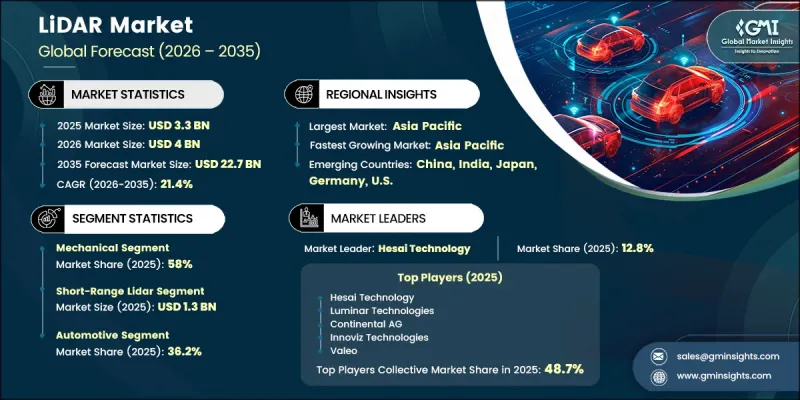
Rapid advancements in sensing technologies and the expanding use of high-precision spatial data are creating strong growth opportunities for the global LiDAR market. Increasing adoption of LiDAR systems in autonomous mobility, advanced driver assistance systems (ADAS), geospatial mapping, industrial automation, renewable energy projects, and infrastructure development continues to drive market expansion. Rising public investments in smart city initiatives and digital infrastructure are further accelerating deployment across multiple sectors. Continuous innovation is also improving sensor performance, increasing detection accuracy, extending operational range, and reducing overall implementation costs, making LiDAR technology more accessible for commercial applications. In addition, the growing demand for real-time environmental analysis, terrain modeling, and precision measurement solutions is strengthening adoption across public and private organizations. As industries increasingly rely on highly accurate three-dimensional imaging and spatial intelligence, the LiDAR market is expected to witness sustained growth throughout the forecast period.
| Market Scope | |
|---|---|
| Start Year | 2025 |
| Forecast Year | 2026-2035 |
| Start Value | $3.3 Billion |
| Forecast Value | $22.7 Billion |
| CAGR | 21.4% |
Growing deployment of autonomous mobility solutions and advanced driver assistance technologies continues to strengthen demand across the LiDAR market. High-precision LiDAR sensors enable accurate real-time three-dimensional mapping, object detection, distance measurement, and environmental perception, making them an essential component of next-generation mobility solutions. Increasing investments in smart infrastructure, geospatial surveying, renewable energy developments, and industrial automation are also expanding the technology's application landscape. At the same time, ongoing technological advancements are improving sensor capabilities while lowering production and deployment costs, supporting wider commercial adoption across multiple industries.
The mechanical segment held 58% share in 2025. Its leadership is supported by superior long-range detection performance, high point-cloud density, and proven reliability in applications requiring highly accurate three-dimensional mapping and environmental awareness. Mechanical LiDAR systems continue to be widely adopted across surveying, industrial automation, autonomous mobility, and infrastructure monitoring due to their ability to generate highly detailed spatial information over extended distances. Their established commercial deployment and dependable operational performance continue to reinforce demand across both government and private sectors.
The short-range LiDAR segment generated USD 1.3 billion in 2025, making it the largest range category in the market. Increasing demand for accurate short-distance sensing has accelerated adoption across driver assistance technologies, industrial automation, autonomous mobile systems, and intelligent infrastructure projects. Growth within this segment is driven by rising requirements for collision avoidance, object detection, parking assistance, and safe navigation in automated environments. Continued expansion of intelligent transportation networks and warehouse automation is expected to further support demand for short-range LiDAR solutions throughout the forecast period.
North America LiDAR Market accounted for 31.1% share in 2025, maintaining its position as the leading regional market. The region continues to benefit from strong investments in autonomous mobility technologies, advanced driver assistance systems, digital infrastructure modernization, and high-precision geospatial mapping. Ongoing funding from automotive manufacturers, technology companies, and public agencies aimed at improving transportation safety, environmental monitoring, and intelligent infrastructure development continues to create favorable conditions for sustained market growth across North America.
Major companies operating in the global LiDAR market include Luminar Technologies, Innoviz Technologies, Hesai Technology, Ouster, RoboSense (Suteng Innovation Technology), Leica Geosystems (Hexagon), Aeva, AEye, Cepton, Continental AG, LeddarTech, RIEGL Laser Measurement Systems, SICK AG, Teledyne Optech, Trimble Inc., Valeo, YellowScan, and Quanergy Systems. Companies participating in the LiDAR market are strengthening their competitive position by investing heavily in sensor innovation, improving detection accuracy, extending operational range, and lowering manufacturing costs. Strategic partnerships with automotive manufacturers, industrial equipment providers, and technology companies are helping expand commercial deployment across multiple applications. Market participants are also focusing on developing compact, energy-efficient, and software-integrated LiDAR solutions to improve performance and simplify system integration. Expanding production capacity, strengthening global distribution networks, and increasing investments in research and development remain key priorities.
Table of Contents
Chapter 1 Methodology and Scope
- 1.1 Market scope and definition
- 1.2 Research design
- 1.2.1 Research approach
- 1.2.2 Data collection methods
- 1.3 Data mining sources
- 1.3.1 Global
- 1.3.2 Regional/Country
- 1.4 Base estimates and calculations
- 1.4.1 Base year calculation
- 1.4.2 Key trends for market estimation
- 1.5 Primary research and validation
- 1.5.1 Primary sources
- 1.6 Forecast model
- 1.7 Research assumptions and limitations
Chapter 2 Executive Summary
- 2.1 Industry 360° synopsis, 2022 - 2035
- 2.2 Key market trends
- 2.2.1 Type trends
- 2.2.2 Installation trends
- 2.2.3 Range trends
- 2.2.4 Application trends
- 2.2.5 Regional trends
- 2.3 TAM Analysis, 2026-2035
- 2.4 CXO perspectives: Strategic imperatives
Chapter 3 Industry Insights
- 3.1 Industry ecosystem analysis
- 3.1.1 Supplier Landscape
- 3.1.2 Profit Margin
- 3.1.3 Cost structure
- 3.1.4 Value addition at each stage
- 3.1.5 Factor affecting the value chain
- 3.1.6 Disruptions
- 3.2 Industry impact forces
- 3.2.1 Growth drivers
- 3.2.1.1 Increasing adoption of autonomous vehicles and ADAS
- 3.2.1.2 Government investments in smart cities and infrastructure development
- 3.2.1.3 Growing demand for geospatial mapping and environmental monitoring
- 3.2.1.4 Expansion of renewable energy and industrial automation projects
- 3.2.1.5 Technological advancements and declining sensor costs
- 3.2.2 Industry pitfalls and challenges
- 3.2.2.1 High deployment and implementation costs
- 3.2.2.2 Performance limitations under adverse weather conditions
- 3.2.3 Market opportunities
- 3.2.3.1 Expansion of autonomous mobility and intelligent transportation systems
- 3.2.3.2 Growing adoption of LiDAR-equipped drones and digital twin technologies
- 3.2.1 Growth drivers
- 3.3 Growth potential analysis
- 3.4 Regulatory landscape
- 3.4.1 North America
- 3.4.2 Europe
- 3.4.3 Asia Pacific
- 3.4.4 Latin America
- 3.4.5 Middle East & Africa
- 3.5 Porter's analysis
- 3.6 PESTEL analysis
- 3.7 Technology and Innovation landscape
- 3.7.1 Current technological trends
- 3.7.2 Emerging technologies
- 3.8 Price trends
- 3.8.1 By region
- 3.8.2 By product
- 3.9 Pricing Strategies
- 3.10 Emerging Business Models
- 3.11 Compliance Requirements
- 3.12 Patent and IP analysis
Chapter 4 Competitive Landscape, 2025
- 4.1 Introduction
- 4.2 Company market share analysis
- 4.2.1 By region
- 4.2.1.1 North America
- 4.2.1.2 Europe
- 4.2.1.3 Asia Pacific
- 4.2.1.4 Latin America
- 4.2.1.5 Middle East & Africa
- 4.2.2 Market concentration analysis
- 4.2.1 By region
- 4.3 Competitive benchmarking of key players
- 4.3.1 Financial performance comparison
- 4.3.1.1 Revenue
- 4.3.1.2 Profit margin
- 4.3.1.3 R&D
- 4.3.2 Product portfolio comparison
- 4.3.2.1 Product range breadth
- 4.3.2.2 Technology
- 4.3.2.3 Innovation
- 4.3.3 Geographic presence comparison
- 4.3.3.1 Global footprint analysis
- 4.3.3.2 Service network coverage
- 4.3.3.3 Market penetration by region
- 4.3.4 Competitive positioning matrix
- 4.3.4.1 Leaders
- 4.3.4.2 Challengers
- 4.3.4.3 Followers
- 4.3.4.4 Niche players
- 4.3.5 Strategic outlook matrix
- 4.3.1 Financial performance comparison
- 4.4 Key developments
- 4.4.1 Mergers and acquisitions
- 4.4.2 Partnerships and collaborations
- 4.4.3 Technological advancements
- 4.4.4 Expansion and investment strategies
- 4.4.5 Digital transformation initiatives
- 4.5 Emerging/ startup competitors landscape
Chapter 5 Market Estimates and Forecast, By Type, 2022 - 2035 (USD Million)
- 5.1 Key trends
- 5.2 Mechanical
- 5.3 Solid-state
- 5.4 Others
Chapter 6 Market Estimates and Forecast, By Installation Type, 2022 - 2035 (USD Million)
- 6.1 Key trends
- 6.2 Ground-based
- 6.2.1 Mobile
- 6.2.2 Static
- 6.3 Airborne
Chapter 7 Market Estimates and Forecast, By Application, 2022 - 2035 (USD Million)
- 7.1 Key trends
- 7.2 Automotive
- 7.2.1 ADAS
- 7.2.2 Autonomous driving
- 7.2.3 Parking assist and safety systems
- 7.2.4 Others
- 7.3 Aerospace & Defense
- 7.3.1 Terrain mapping and reconnaissance
- 7.3.2 Target detection and tracking
- 7.3.3 Navigation
- 7.3.4 ISR systems
- 7.3.5 Missile guidance
- 7.3.6 Others
- 7.4 Agriculture & Forestry
- 7.4.1 Precision agriculture
- 7.4.2 Canopy analysis
- 7.4.3 Forestry management
- 7.4.4 Others
- 7.5 Mapping & Surveying
- 7.5.1 Topographic mapping
- 7.5.2 Corridor mapping
- 7.5.3 Mining surveys
- 7.5.4 Utility mapping
- 7.5.5 Others
- 7.6 Industrial & Manufacturing
- 7.6.1 Factory automation and robotics
- 7.6.2 Warehousing and logistics automation
- 7.6.3 Others
Chapter 8 Market Estimates and Forecast, By Region, 2022 - 2035 (USD Million)
- 8.1 Key trends
- 8.2 North America
- 8.2.1 U.S.
- 8.2.2 Canada
- 8.3 Europe
- 8.3.1 Germany
- 8.3.2 UK
- 8.3.3 France
- 8.3.4 Spain
- 8.3.5 Italy
- 8.4 Asia Pacific
- 8.4.1 China
- 8.4.2 India
- 8.4.3 Japan
- 8.4.4 Australia
- 8.4.5 South Korea
- 8.5 Latin America
- 8.5.1 Brazil
- 8.5.2 Mexico
- 8.5.3 Argentina
- 8.6 Middle East and Africa
- 8.6.1 South Africa
- 8.6.2 Saudi Arabia
- 8.6.3 UAE
Chapter 9 Company Profiles
- 9.1 Global Key Players
- 9.1.1 Luminar Technologies
- 9.1.2 Continental AG
- 9.1.3 Innoviz Technologies
- 9.1.4 Valeo
- 9.1.5 Hesai Technology
- 9.2 Regional key players
- 9.2.1 North America
- 9.2.1.1 Ouster
- 9.2.1.2 Aeva
- 9.2.1.3 AEye
- 9.2.1.4 Cepton
- 9.2.1.5 Quanergy Systems
- 9.2.2 Asia Pacific
- 9.2.2.1 RoboSense
- 9.2.3 Europe
- 9.2.3.1 Leica Geosystems (Hexagon)
- 9.2.3.2 SICK AG
- 9.2.1 North America
- 9.3 Niche Players/Disruptors
- 9.3.1 LeddarTech
- 9.3.2 RIEGL Laser Measurement Systems
- 9.3.3 Teledyne Optech
- 9.3.4 YellowScan
- 9.3.5 Trimble Inc.

