PUBLISHER: Global Market Insights Inc. | PRODUCT CODE: 2101529

PUBLISHER: Global Market Insights Inc. | PRODUCT CODE: 2101529
Cryogenic Battery Recycling Market Opportunity, Growth Drivers, Industry Trend Analysis, and Forecast 2026 - 2035
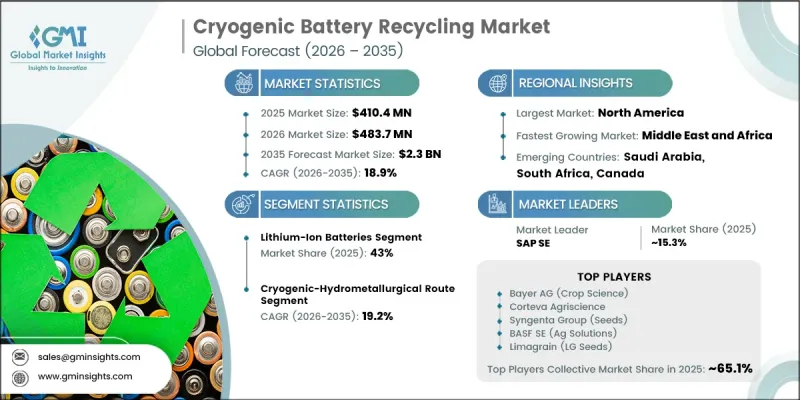
The Global Cryogenic Battery Recycling Market was valued at USD 410.4 million in 2025 and is estimated to grow at a CAGR of 18.9% to reach USD 2.3 billion by 2035.
The cryogenic battery recycling market represents a specialized segment within the broader battery recycling industry, distinguished by its use of cryogenic pretreatment technology that enhances material recovery efficiency while improving operational safety and supporting regulatory compliance. As electric vehicle adoption continues to mature globally, an increasing number of battery packs are approaching the end of their operational lifespan, creating a steady supply of recyclable materials. Growing battery retirement volumes across major automotive markets are making commercial-scale cryogenic recycling operations increasingly viable. The process offers significant advantages for recovering valuable battery materials while preserving material quality throughout downstream recycling stages. Long-term market growth is supported by structural industry trends rather than short-term economic fluctuations, positioning cryogenic battery recycling as an increasingly important solution for sustainable battery lifecycle management and resource recovery over the forecast period.
| Market Scope | |
|---|---|
| Start Year | 2025 |
| Forecast Year | 2026-2035 |
| Start Value | $410.4 Million |
| Forecast Value | $2.3 Billion |
| CAGR | 18.9% |
The lithium-ion batteries segment accounted for 43% share in 2025. Its market leadership is supported by the expanding number of retired electric vehicle batteries, the high economic value of recoverable materials, and the strong compatibility between lithium-ion battery chemistry and cryogenic pretreatment technology. The cryogenic process effectively neutralizes temperature-sensitive battery components while preserving electrode integrity, enabling more efficient downstream separation processes and supporting the recovery of high-purity materials compared with conventional recycling approaches.
The cryogenic-hydrometallurgical route represented 41.5% share in 2025 and is anticipated to grow at a CAGR of 19.2% throughout 2035. This processing route continues to lead the market because it delivers an effective balance of operational scalability, material recovery performance, and product purity. Its ability to produce recycled materials that satisfy the quality requirements of battery manufacturing applications has strengthened its adoption, making it one of the preferred processing methods for commercial-scale recycling facilities seeking high recovery efficiency and consistent operational performance.
North America Cryogenic Battery Recycling Market accounted for 30.5% share in 2025 and is expected to grow at a CAGR of 17% through 2035. The region maintains its leading position due to continued investment in battery collection networks, expanding recycling infrastructure, increasing manufacturing activity related to electric mobility, and the growing deployment of advanced battery processing technologies. The rising integration of cryogenic pretreatment systems into commercial recycling operations is further supporting regional market growth while enhancing material recovery capabilities and operational efficiency.
Major companies operating in the global cryogenic battery recycling market include Retriev Technologies, Umicore N.V., Redwood Materials, Fortum Battery Recycling, Glencore plc, BRUNP Recycling, Duesenfeld GmbH, SungEel HiTech, Accurec Recycling GmbH, Cirba Solutions, Green Li-ion, cylib GmbH, American Battery Technology Company (ABTC), Ascend Elements, Nth Cycle, and Primobius. Companies participating in the cryogenic battery recycling market are strengthening their competitive position by expanding processing capacity, investing in advanced recycling technologies, and improving material recovery efficiency. Industry participants continue to prioritize research and development to enhance cryogenic pretreatment processes, increase operational safety, and maximize the recovery of valuable battery materials. Strategic collaborations, technology partnerships, and acquisitions are helping companies broaden their capabilities while expanding their geographic presence. Businesses are also focusing on automation, process optimization, and sustainable recycling practices to improve productivity and reduce operating costs.
Table of Contents
Chapter 1 Methodology & Scope
- 1.1 Market scope and definition
- 1.2 Research design
- 1.2.1 Research approach
- 1.2.2 Data collection methods
- 1.3 Data mining sources
- 1.3.1 Global
- 1.3.2 Regional/Country
- 1.4 Base estimates and calculations
- 1.4.1 Base year calculation
- 1.4.2 Key trends for market estimation
- 1.5 Primary research and validation
- 1.5.1 Primary sources
- 1.6 Forecast model
- 1.7 Research assumptions and limitations
Chapter 2 Executive Summary
- 2.1 Industry 360° synopsis
- 2.2 Key market trends
- 2.2.1 Regional
- 2.2.2 Battery Chemistry
- 2.2.3 Recycling process route
- 2.2.4 Battery source
- 2.3 TAM Analysis, 2026-2035
- 2.4 CXO perspectives: Strategic imperatives
- 2.4.1 Executive decision points
- 2.4.2 Critical success factors
- 2.5 Future Outlook and Strategic Recommendations
Chapter 3 Industry Insights
- 3.1 Industry ecosystem analysis
- 3.1.1 Supplier Landscape
- 3.1.2 Profit Margin
- 3.1.3 Value addition at each stage
- 3.1.4 Factor affecting the value chain
- 3.1.5 Disruptions
- 3.2 Industry impact forces
- 3.2.1 Growth drivers
- 3.2.1.1 First-Generation EV Battery End-of-Life Wave Accelerating Spent Battery Volumes Globally
- 3.2.1.2 EU Battery Regulation 2023/1542 Mandating Minimum Recycled Content & Recovery Rate Thresholds
- 3.2.1.3 Critical Mineral Supply Security Imperatives - Lithium, Cobalt & Nickel Designated as Strategic Raw Materials
- 3.2.2 Industry pitfalls and challenges
- 3.2.2.1 High Liquid Nitrogen Consumption Costs Elevating Cryogenic Process OPEX vs. Conventional Alternatives
- 3.2.2.2 Regulatory Fragmentation & Cross-Border Battery Waste Classification Barriers under Basel Convention & UN 38.3
- 3.2.3 Market opportunities
- 3.2.3.1 Increasing Demand for Sustainable EV Battery Disposal & Material Recovery
- 3.2.3.2 Rising Regulatory Focus on Circular Economy & Hazardous Waste Management
- 3.2.1 Growth drivers
- 3.3 Growth potential analysis
- 3.4 Regulatory landscape
- 3.4.1 North America
- 3.4.2 Europe
- 3.4.3 Asia Pacific
- 3.4.4 Latin America
- 3.4.5 Middle East & Africa
- 3.5 Porter's analysis
- 3.6 PESTEL analysis
- 3.7 Price trends
- 3.7.1 By region
- 3.8 Future market trends
- 3.9 Technology and Innovation Landscape
- 3.9.1 Current technological trends
- 3.9.2 Emerging technologies
- 3.10 Patent Landscape
- 3.11 Trade statistics (HS code) (Note: the trade statistics will be provided for key countries only)
- 3.11.1 Major importing countries
- 3.11.2 Major exporting countries
- 3.12 Sustainability and environmental aspects
- 3.12.1 Sustainable practices
- 3.12.2 Waste reduction strategies
- 3.12.3 Energy efficiency in production
- 3.12.4 Eco-friendly initiatives
- 3.13 Carbon footprint considerations
Chapter 4 Competitive Landscape, 2025
- 4.1 Introduction
- 4.2 Company market share analysis
- 4.2.1 By region
- 4.2.1.1 North America
- 4.2.1.2 Europe
- 4.2.1.3 Asia Pacific
- 4.2.1.4 LATAM
- 4.2.1.5 MEA
- 4.2.1 By region
- 4.3 Company matrix analysis
- 4.4 Competitive analysis of major market players
- 4.5 Competitive positioning matrix
- 4.6 Key developments
- 4.6.1 Mergers & acquisitions
- 4.6.2 Partnerships & collaborations
- 4.6.3 New product launches
- 4.6.4 Expansion plans
Chapter 5 Market Estimates and Forecast, By Battery Chemistry, 2022 - 2035 (USD Million) (Kilo Tons)
- 5.1 Key trends
- 5.2 Lithium-ion (Li-ion)
- 5.2.1 NMC (Nickel Manganese Cobalt) - High Cobalt & Nickel Recovery Value
- 5.2.2 NCA (Nickel Cobalt Aluminum) - EV-Grade High-Density Packs
- 5.2.3 LFP (Lithium Iron Phosphate) - Fastest-Growing Sub-Segment, Cobalt-Free
- 5.2.4 LMO (Lithium Manganese Oxide) & Other Li-ion Variants
- 5.3 Lead-Acid
- 5.3.1 Flooded Lead-Acid
- 5.3.2 VRLA/AGM (Valve-Regulated Lead-Acid & Absorbent Glass Mat)
- 5.4 Nickel-Based
- 5.4.1 Nickel-Cadmium (Ni-Cd)
- 5.4.2 Nickel-Metal Hydride (Ni-MH)
- 5.5 Solid-State & Emerging Chemistries
- 5.5.1 Solid-State Batteries (Sulfide, Oxide & Polymer Electrolyte)
- 5.5.2 Sodium-Ion (Na-ion) Batteries
- 5.5.3 Lithium-Sulfur (Li-S) & Other Emerging Chemistries
Chapter 6 Market Estimates and Forecast, By Recycling Process Route, 2022 - 2035 (USD million) (Kilo Tons)
- 6.1 Key trends
- 6.2 Cryogenic-Mechanical Route
- 6.3 Cryogenic-Hydrometallurgical Route
- 6.4 Cryogenic-Pyrometallurgical Route
- 6.5 Cryogenic-Direct Recycling Route
Chapter 7 Market Estimates and Forecast, By Battery Source, 2022 - 2035 (USD million) (Kilo Tons)
- 7.1 Key trends
- 7.2 EV & e-Mobility Batteries
- 7.3 Stationary Energy Storage Batteries
- 7.4 Industrial & Commercial Batteries
- 7.5 Consumer Electronics Batteries
- 7.6 Aerospace, Defense & Specialty Batteries
Chapter 8 Market Estimates and Forecast, By Region, 2022 - 2035 (USD million) (Kilo Tons)
- 8.1 Key trends
- 8.2 North America
- 8.2.1 U.S.
- 8.2.2 Canada
- 8.3 Europe
- 8.3.1 Germany
- 8.3.2 UK
- 8.3.3 France
- 8.3.4 Spain
- 8.3.5 Italy
- 8.3.6 Rest of Europe
- 8.4 Asia Pacific
- 8.4.1 China
- 8.4.2 India
- 8.4.3 Japan
- 8.4.4 Australia
- 8.4.5 South Korea
- 8.4.6 Rest of Asia Pacific
- 8.5 Latin America
- 8.5.1 Brazil
- 8.5.2 Mexico
- 8.5.3 Rest of Latin America
- 8.6 Middle East and Africa
- 8.6.1 Saudi Arabia
- 8.6.2 South Africa
- 8.6.3 UAE
- 8.6.4 Rest of Middle East and Africa
Chapter 9 Company Profiles
- 9.1 Retriev Technologies
- 9.2 Umicore N.V.
- 9.3 Redwood Materials
- 9.4 Fortum Battery Recycling
- 9.5 Glencore plc
- 9.6 BRUNP Recycling
- 9.7 Duesenfeld GmbH
- 9.8 SungEel HiTech
- 9.9 Accurec Recycling GmbH
- 9.10 Cirba Solutions
- 9.11 Green Li-ion
- 9.12 cylib GmbH
- 9.13 American Battery Technology Company (ABTC)
- 9.14 Ascend Elements
- 9.15 Nth Cycle
- 9.16 Primobius

