PUBLISHER: Global Market Insights Inc. | PRODUCT CODE: 2101551

PUBLISHER: Global Market Insights Inc. | PRODUCT CODE: 2101551
Lithium Metal Anode Foil Market Opportunity, Growth Drivers, Industry Trend Analysis, and Forecast 2026 - 2035
The Global Lithium Metal Anode Foil Market was valued at USD 1 billion in 2025 and is estimated to grow at a CAGR of 19.4% to reach USD 5.9 billion by 2035.
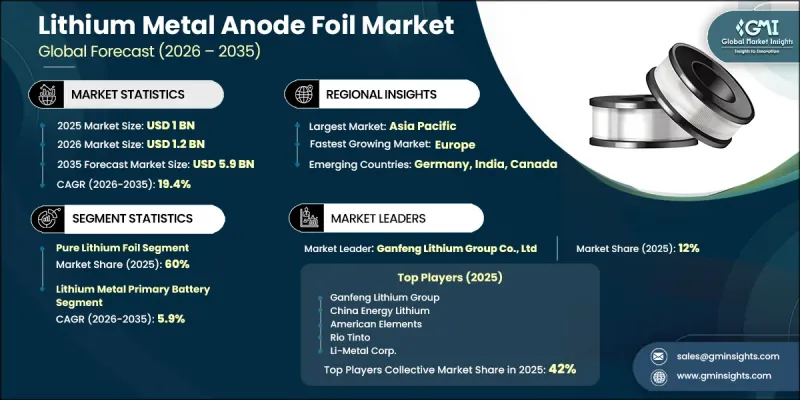
Market expansion is supported by the rapid commercialization of solid-state battery technologies, increasing demand for prelithiation in conventional lithium-ion production, and emerging opportunities in lithium-sulfur battery systems. The shift from graphite-based anodes to lithium metal architectures is one of the most significant material transitions in next-generation energy storage. Lithium metal anodes offer a theoretical specific capacity of 3,860 mAh/g, nearly ten times higher than graphite, enabling energy density targets of 400-500 Wh/kg required for advanced electric vehicle platforms. Solid-state battery development remains the primary structural growth driver, as these systems require ultra-thin lithium metal foils, typically at or below 20 µm, to achieve the required volumetric efficiency. As solid-state technologies progress from laboratory validation to pre-commercial scaling, demand for high-precision lithium metal foil is expected to accelerate significantly across the battery supply chain.
| Market Scope | |
|---|---|
| Start Year | 2025 |
| Forecast Year | 2026-2035 |
| Start Value | $1 Billion |
| Forecast Value | $5.9 Billion |
| CAGR | 19.4% |
The pure lithium foil segment is expected to reach USD 2.24 billion by 2035. This segment serves two primary application categories, including high-purity grades used in solid-state battery development and aerospace systems, as well as lower-purity grades used in prelithiation processes and primary battery systems. Higher-grade materials require strict surface quality control, low defect density, and specialized inert handling and packaging processes, which distinguish them from standard industrial lithium foil production.
The lithium metal primary battery segment held 51% share in 2025 owing to its mature stage of development. This segment includes lithium-based primary battery systems used in defense, aerospace, and medical device applications. These systems rely on lithium metal foil in thickness ranges of 50-150 µm and purity levels between 2N and 3N, supporting long-life, high-reliability energy storage requirements in critical operational environments.
North America Lithium Metal Anode Foil Market accounted for USD 147.6 million in 2025, representing nearly 18% of the global market. The United States remains the primary demand hub, while Canada is emerging as an important production base. Regulatory and policy frameworks focused on strengthening domestic critical mineral supply chains have encouraged investment in lithium metal foil manufacturing. New production approaches, including electrodeposition-based methods that reduce dependence on conventional dry-room rolling systems, are contributing to the development of regionally compliant and strategically independent supply chains.
Major companies operating in the global lithium metal anode foil market include Ganfeng Lithium Group Co., Ltd., China Energy Lithium Co., Ltd., American Elements, Rio Tinto (LIOVIX(R)), Li-Metal Corp., Fuji Chemi Trading Co., Ltd., SMI Ltd. (Strategic Metal Investments Ltd.), Techinstro, Goodfellow, MTI Corporation, Nanoshel LLC, YDL Battery, and TOB New Energy (Xiamen TOB New Energy Technology Co., Ltd.). Companies operating in the lithium metal anode foil market are strengthening their position by expanding production capabilities and investing in advanced manufacturing technologies that improve foil uniformity, purity, and thickness control. Many firms are focusing on scaling up solid-state battery supply readiness by aligning product specifications with emerging OEM requirements. Strategic investments in electrodeposition technologies, automated production systems, and inert-atmosphere processing environments are helping reduce production variability and improve yield efficiency. Companies are also forming partnerships with battery manufacturers, automotive OEMs, and research institutions to accelerate commercialization timelines.
Table of Contents
Chapter 1 Methodology & Scope
- 1.1 Market scope and definition
- 1.2 Research design
- 1.2.1 Research approach
- 1.2.2 Data collection methods
- 1.3 Data mining sources
- 1.3.1 Global
- 1.3.2 Regional/Country
- 1.4 Base estimates and calculations
- 1.4.1 Base year calculation
- 1.4.2 Key trends for market estimation
- 1.5 Primary research and validation
- 1.5.1 Primary sources
- 1.6 Forecast model
- 1.7 Research assumptions and limitations
Chapter 2 Executive Summary
- 2.1 Industry 360° synopsis
- 2.2 Key market trends
- 2.2.1 Foil Type
- 2.2.2 Application
- 2.2.3 End-user
- 2.2.4 Regional
- 2.3 TAM Analysis, 2026-2035
- 2.4 CXO perspectives: Strategic imperatives
- 2.5 Future outlook and strategic recommendations
Chapter 3 Industry Insights
- 3.1 Industry ecosystem analysis
- 3.1.1 Supplier landscape
- 3.1.2 Profit margin
- 3.1.3 Value addition at each stage
- 3.1.4 Factor affecting the value chain
- 3.1.5 Disruptions
- 3.2 Industry impact forces
- 3.2.1 Growth drivers
- 3.2.1.1 Accelerating commercialization of solid-state batteries driving structural demand for lithium metal anode foil
- 3.2.1.2 Rapid ev adoption creating large-scale requirement for high-energy-density anode materials
- 3.2.1.3 Prelithiation technology adoption expanding lithium foil use in conventional li-ion manufacturing lines
- 3.2.2 Industry pitfalls and challenges
- 3.2.2.1 Technical complexity of manufacturing defect-free ultra-thin foil (20 µM) at commercial scale
- 3.2.2.2 Persistent dendrite formation & cycling stability challenges delaying mass-market deployment
- 3.2.3 Market opportunities
- 3.2.3.1 Emergence of lithium-sulfur (li-s) battery platforms creating new anode foil demand vectors
- 3.2.3.2 Supply chain diversification drive in europe & north america opening new regional production hubs
- 3.2.1 Growth drivers
- 3.3 Growth potential analysis
- 3.4 Regulatory landscape
- 3.4.1 North America
- 3.4.2 Europe
- 3.4.3 Asia Pacific
- 3.4.4 Latin America
- 3.4.5 Middle East & Africa
- 3.5 Porter’s analysis
- 3.6 PESTEL analysis
- 3.7 Technology and innovation landscape
- 3.7.1 Current technological trends
- 3.7.2 Emerging technologies
- 3.8 Price trends
- 3.8.1 By region
- 3.8.2 By foil type
- 3.9 Future market trends
- 3.10 Patent landscape
- 3.11 Trade statistics (HS code)
- 3.11.1 Major importing countries
- 3.11.2 Major exporting countries
- 3.12 Sustainability and environmental aspects
- 3.12.1 Sustainable practices
- 3.12.2 Waste reduction strategies
- 3.12.3 Energy efficiency in production
- 3.12.4 Eco-friendly initiatives
- 3.13 Carbon footprint consideration
Chapter 4 Competitive Landscape, 2025
- 4.1 Introduction
- 4.2 Company market share analysis
- 4.2.1 By region
- 4.2.1.1 North America
- 4.2.1.2 Europe
- 4.2.1.3 Asia Pacific
- 4.2.1.4 LATAM
- 4.2.1.5 MEA
- 4.2.1 By region
- 4.3 Company matrix analysis
- 4.4 Competitive analysis of major market players
- 4.5 Competitive positioning matrix
- 4.6 Key developments
- 4.6.1 Mergers & acquisitions
- 4.6.2 Partnerships & collaborations
- 4.6.3 New product launches
- 4.6.4 Expansion plans
Chapter 5 Market Estimates and Forecast, By Foil Type, 2022–2035 (USD Million) (Kilo Tons)
- 5.1 Key trends
- 5.2 Pure Lithium Foil
- 5.3 Li-Cu Composite Foil
- 5.4 Lithium Alloy Foil
Chapter 6 Market Estimates and Forecast, By Application, 2022–2035 (USD Million) (Kilo Tons)
- 6.1 Key trends
- 6.2 Solid-State Batteries
- 6.3 Semi-Solid Batteries
- 6.4 Lithium Metal Primary Batteries
- 6.5 Li-Ion Batteries (Prelithiation)
- 6.6 Li-S Batteries
- 6.7 Others
Chapter 7 Market Estimates and Forecast, By End-user, 2022–2035 (USD Million) (Kilo Tons)
- 7.1 Key trends
- 7.2 Automotive & EV
- 7.3 Consumer Electronics
- 7.4 Energy Storage Systems
- 7.5 Aerospace & Defense
- 7.6 Medical Devices
- 7.7 Others
Chapter 8 Market Estimates and Forecast, By Region, 2022–2035 (USD Million) (Kilo Tons)
- 8.1 Key trends
- 8.2 North America
- 8.2.1 U.S.
- 8.2.2 Canada
- 8.3 Europe
- 8.3.1 Germany
- 8.3.2 UK
- 8.3.3 France
- 8.3.4 Spain
- 8.3.5 Italy
- 8.3.6 Rest of Europe
- 8.4 Asia Pacific
- 8.4.1 China
- 8.4.2 India
- 8.4.3 Japan
- 8.4.4 Australia
- 8.4.5 South Korea
- 8.4.6 Rest of Asia Pacific
- 8.5 Latin America
- 8.5.1 Brazil
- 8.5.2 Mexico
- 8.5.3 Argentina
- 8.5.4 Rest of Latin America
- 8.6 Middle East and Africa
- 8.6.1 Saudi Arabia
- 8.6.2 South Africa
- 8.6.3 UAE
- 8.6.4 Rest of Middle East and Africa
Chapter 9 Company Profiles
- 9.1 Ganfeng Lithium Group Co., Ltd
- 9.2 China Energy Lithium Co., Ltd.
- 9.3 American Elements
- 9.4 Rio Tinto
- 9.5 Li-Metal Corp.
- 9.6 Fuji Chemi Trading Co., Ltd.
- 9.7 SMI Ltd. (Strategic Metal Investments Ltd.)
- 9.8 Techinstro
- 9.9 Goodfellow
- 9.10 Nanoshel LLC
- 9.11 YDL Battery
- 9.12 TOB New Energy (Xiamen TOB New Energy Technology Co., Ltd.)

