PUBLISHER: Global Market Insights Inc. | PRODUCT CODE: 2101553

PUBLISHER: Global Market Insights Inc. | PRODUCT CODE: 2101553
Herbicide-Resistant Weed Solutions Market Opportunity, Growth Drivers, Industry Trend Analysis, and Forecast 2026 - 2035
The Global Herbicide-Resistant Weed Solutions Market was valued at USD 11.9 billion in 2025 and is estimated to grow at a CAGR of 6.2% to reach USD 21.9 billion by 2035.
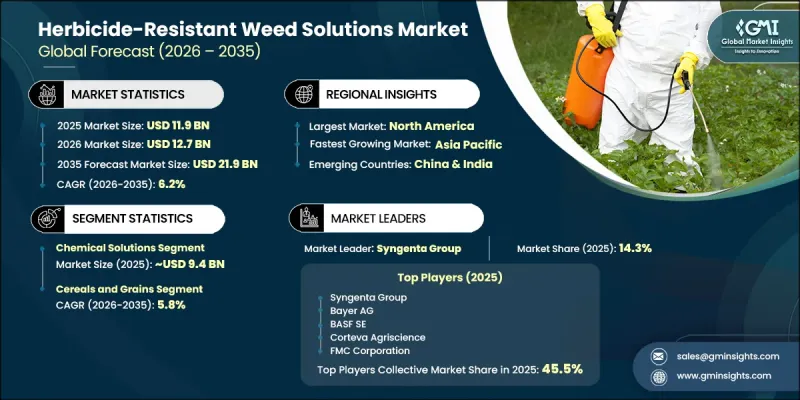
The herbicide-resistant weed solutions market is expanding steadily as growers increasingly adopt integrated weed management strategies to address the growing challenge of herbicide-resistant weed populations across major agricultural regions. Conventional herbicide programs are becoming less effective against resistant weed species, encouraging farmers to adopt a broader combination of biological, chemical, mechanical, and technology-driven solutions to protect crop productivity. This transition is reshaping purchasing patterns, strengthening investment in agricultural research, and accelerating the development of advanced weed management technologies. The continued rise in documented herbicide-resistant weed biotypes is creating long-term demand for alternative control methods, as resistance within weed populations cannot be easily reversed through standard farming practices. As a result, agricultural producers are placing greater emphasis on diversified weed control programs that combine multiple modes of action and integrated management techniques. Growing awareness of sustainable crop protection, improved farm productivity, and resistance management continues to support the long-term expansion of the global herbicide-resistant weed solutions market.
| Market Scope | |
|---|---|
| Start Year | 2025 |
| Forecast Year | 2026-2035 |
| Start Value | $11.9 Billion |
| Forecast Value | $21.9 Billion |
| CAGR | 6.2% |
The chemicals segment accounted for 79.2% share in 2025, representing USD 9.4 billion, and is projected to grow at a CAGR of 4.4% from 2026 to 2035. The segment includes a broad portfolio of registered synthetic herbicide technologies and multiple modes of action designed to improve weed control effectiveness. Although conventional herbicide products continue to maintain substantial treatment volumes, increasing weed resistance is driving greater demand for higher-value formulations, combination products, and diversified chemical solutions that offer improved long-term performance.
The cereals and grains segment represented 38.5% share in 2025 and is expected to grow at a CAGR of 5.8% through 2035. The segment maintains its leading position due to the extensive cultivation of cereal crops worldwide and the increasing need for advanced weed management solutions in large-scale farming systems. Growing concerns regarding herbicide resistance across major grain-producing regions continue to encourage farmers to adopt integrated weed control strategies that improve productivity while protecting long-term crop performance.
North America Herbicide-Resistant Weed Solutions Market accounted for 35.6% share in 2025. Market growth is supported by widespread adoption of advanced agricultural technologies, increasing implementation of integrated weed management practices, and growing regulatory emphasis on resistance management. Expanding demand for multi-mode weed control programs continues to strengthen the regional market as growers seek more effective and sustainable crop protection solutions.
Major companies operating in the global herbicide-resistant weed solutions market include BASF SE, Bayer AG, Syngenta Group, Corteva Agriscience, and FMC Corporation. Companies operating in the herbicide-resistant weed solutions market are strengthening their market position through continuous investment in research and development, advanced formulation technologies, and integrated weed management solutions. Manufacturers are expanding product portfolios with innovative herbicide combinations and multiple modes of action to improve weed control effectiveness while addressing resistance challenges. Strategic collaborations with agricultural research organizations, distributors, and farming communities are supporting wider adoption of sustainable crop protection practices.
Table of Contents
Chapter 1 Methodology & Scope
- 1.1 Research approach
- 1.2 Quality Commitments
- 1.2.1 GMI AI policy & data integrity commitment
- 1.2.1.1 Source consistency protocol
- 1.2.1 GMI AI policy & data integrity commitment
- 1.3 Research Trail & Confidence Scoring
- 1.3.1 Research Trail Components
- 1.3.2 Scoring Components
- 1.4 Data Collection
- 1.4.1 Partial list of primary sources
- 1.5 Data mining sources
- 1.5.1 Paid sources
- 1.5.1.1 Sources, by region
- 1.5.1 Paid sources
- 1.6 Base estimates and calculations
- 1.6.1 Base year calculation for any one approach
- 1.7 Forecast model
- 1.7.1 Quantified market impact analysis
- 1.7.1.1 Mathematical impact of growth parameters on forecast
- 1.7.1 Quantified market impact analysis
- 1.8 Research transparency addendum
- 1.8.1 Source attribution framework
- 1.8.2 Quality assurance metrics
- 1.8.3 Our commitment to trust
Chapter 2 Executive Summary
- 2.1 Industry 360° synopsis
- 2.2 Key market trends
- 2.2.1 Regional
- 2.2.2 By Solution Type
- 2.2.3 By Crop Type
- 2.2.4 By End User
- 2.3 TAM Analysis, 2026 - 2035
- 2.4 CXO perspectives: Strategic imperatives
Chapter 3 Industry Insights
- 3.1 Industry ecosystem analysis
- 3.1.1 Supplier landscape
- 3.1.2 Profit margin
- 3.1.3 Value addition at each stage
- 3.1.4 Factor affecting the value chain
- 3.1.5 Disruptions
- 3.2 Industry impact forces
- 3.2.1 Growth drivers
- 3.2.2 Industry pitfalls and challenges
- 3.2.3 Market opportunities
- 3.3 Growth potential analysis
- 3.4 Regulatory landscape
- 3.4.1 North America
- 3.4.2 Europe
- 3.4.3 Asia Pacific
- 3.4.4 Latin America
- 3.4.5 Middle East & Africa
- 3.5 Porter's analysis
- 3.6 PESTEL analysis
- 3.7 Price trends
- 3.7.1 By region
- 3.7.2 By Solution Type
- 3.8 Future market trends
- 3.9 Technology and Innovation landscape
- 3.9.1 Current technological trends
- 3.9.2 Emerging technologies
- 3.10 Patent Landscape
- 3.11 Trade statistics (HS code)
- 3.11.1 Major importing countries
- 3.11.2 Major exporting countries
- 3.12 Sustainability and environmental aspects
- 3.12.1 Sustainable practices
- 3.12.2 Waste reduction strategies
- 3.12.3 Energy efficiency in production
- 3.12.4 Eco friendly initiatives
Chapter 4 Competitive Landscape, 2025
- 4.1 Introduction
- 4.2 Company market share analysis
- 4.2.1 By region
- 4.2.1.1 North America
- 4.2.1.2 Europe
- 4.2.1.3 Asia Pacific
- 4.2.1.4 LATAM
- 4.2.1.5 MEA
- 4.2.1 By region
- 4.3 Company matrix analysis
- 4.4 Competitive analysis of major market players
- 4.5 Competitive positioning matrix
- 4.6 Key developments
- 4.6.1 Mergers & acquisitions
- 4.6.2 Partnerships & collaborations
- 4.6.3 New Product Launches
- 4.6.4 Expansion Plans
Chapter 5 Market Estimates and Forecast, By Solution Type, 2022 to 2035 (USD Million) (Tons)
- 5.1 Key trends
- 5.2 Chemical Solutions
- 5.2.1 Single MOA Herbicides
- 5.2.2 Multiple MOA Tank Mixtures
- 5.2.3 Pre-Packaged Sequential Systems
- 5.2.4 Herbicide-Tolerant Crop Trait Systems
- 5.3 Mechanical/Physical Solutions
- 5.3.1 HWSC Equipment (Total)
- 5.3.2 Tillage Systems
- 5.3.3 Cultivation & Mowing Equipment
- 5.4 Cultural/Agronomic Solutions
- 5.4.1 Cover Crop Seeds for Weed Suppression
- 5.4.2 Competitive Crop Varieties
- 5.4.3 Crop Rotation Programs & Services
- 5.4.4 Allelopathic Interference Methods
- 5.5 Biological Solutions
- 5.5.1 Microbial-Based Bioherbicides
- 5.5.2 Biochemical Herbicides
- 5.5.3 Naturally-Derived Herbicides
- 5.6 Integrated/Technology-Enabled Solutions
Chapter 6 Market Estimates and Forecast, By Crop Type, 2022 to 2035 (USD Million) (Tons)
- 6.1 Key trends
- 6.2 Cereals & Grains
- 6.2.1 Corn
- 6.2.2 Wheat
- 6.2.3 Rice
- 6.2.4 Barley & Sorghum
- 6.3 Oilseeds & Pulses
- 6.3.1 Soybeans
- 6.3.2 Canola
- 6.3.3 Sunflower
- 6.3.4 Dry Beans
- 6.4 Fruits & Vegetable
- 6.4.1 Specialty Crops
- 6.4.2 Orchards & Vineyards
- 6.5 Turf & Ornamental
- 6.5.1 Golf Courses
- 6.5.2 Sod Farms
- 6.5.3 Ornamental Production
- 6.5.4 Landscaping
- 6.6 Non-Crop Applications
Chapter 7 Market Estimates and Forecast, By End User, 2022 to 2035 (USD Million) (Tons)
- 7.1 Key trends
- 7.2 Large-Scale Commercial Farms
- 7.3 Small & Medium-Sized Farms
- 7.4 Non-Agricultural Users
Chapter 8 Market Estimates and Forecast, By Region, 2022 to 2035 (USD Million) (Tons)
- 8.1 Key trends
- 8.2 North America
- 8.2.1 U.S.
- 8.2.2 Canada
- 8.3 Europe
- 8.3.1 Germany
- 8.3.2 UK
- 8.3.3 France
- 8.3.4 Spain
- 8.3.5 Italy
- 8.3.6 Rest of Europe
- 8.4 Asia Pacific
- 8.4.1 China
- 8.4.2 India
- 8.4.3 Japan
- 8.4.4 Australia
- 8.4.5 South Korea
- 8.4.6 Rest of Asia Pacific
- 8.5 Latin America
- 8.5.1 Brazil
- 8.5.2 Mexico
- 8.5.3 Argentina
- 8.5.4 Rest of Latin America
- 8.6 Middle East and Africa
- 8.6.1 Saudi Arabia
- 8.6.2 South Africa
- 8.6.3 UAE
- 8.6.4 Rest of Middle East and Africa
Chapter 9 Company Profiles
- 9.1 Syngenta Group
- 9.2 Bayer AG
- 9.3 BASF SE
- 9.4 Corteva Agriscience
- 9.5 FMC Corporation
- 9.6 ADAMA Agricultural Solutions
- 9.7 Nufarm Limited
- 9.8 John Deere (See & Spray)
- 9.9 CNH Industrial (Case IH/NH)
- 9.10 Redekop Manufacturing
- 9.11 De Bruin Engineering / IHSD
- 9.12 AFGRI (Seed Terminator)
- 9.13 Certis Biologicals
- 9.14 Verdesian Life Sciences
- 9.15 Blue River Technology (JD)

