PUBLISHER: Global Market Insights Inc. | PRODUCT CODE: 2101567

PUBLISHER: Global Market Insights Inc. | PRODUCT CODE: 2101567
RNA Interference (RNAi) Crop Sprays Market Opportunity, Growth Drivers, Industry Trend Analysis, and Forecast 2026 - 2035
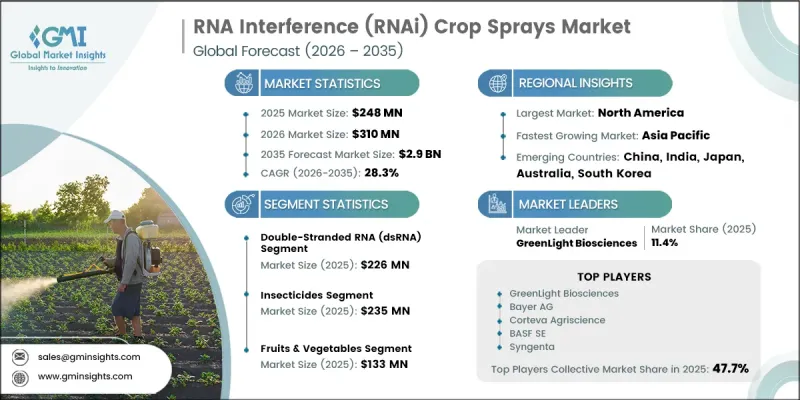
The Global RNA Interference (RNAi) Crop Sprays Market was valued at USD 248 million in 2025 and is estimated to grow at a CAGR of 28.3% to reach USD 2.9 billion by 2035.
The RNA interference (RNAi) crop sprays market is gaining momentum as agriculture increasingly shifts toward precision crop protection technologies that offer targeted pest and disease management while reducing reliance on conventional chemical pesticides. RNAi crop sprays utilize double-stranded RNA (dsRNA) molecules to regulate gene expression in specific pests, pathogens, or weeds by activating a natural biological process that suppresses essential genes responsible for growth, reproduction, or survival. Unlike traditional crop protection products, these solutions are designed to selectively affect target organisms while minimizing the impact on beneficial species and the surrounding environment. Applied through conventional foliar spraying methods, the RNA molecules are absorbed by target organisms after contact with treated plants, initiating gene silencing within their cells. This highly precise biological mechanism is supporting broader adoption as agricultural producers seek sustainable, environmentally responsible solutions that improve crop protection while reducing ecological impact. Continuous innovation in RNA delivery technologies and growing acceptance of precision agriculture are expected to further accelerate expansion of the global RNA interference (RNAi) crop sprays market.
| Market Scope | |
|---|---|
| Start Year | 2025 |
| Forecast Year | 2026-2035 |
| Start Value | $248 Million |
| Forecast Value | $2.9 Billion |
| CAGR | 28.3% |
The double-stranded RNA (dsRNA) segment generated USD 226 million in 2025. The market continues to focus primarily on dsRNA and small interfering RNA (siRNA) technologies because of their effectiveness in delivering gene-silencing activity. Double-stranded RNA remains the leading technology due to its broad applicability and strong biological performance across multiple target organisms. At the same time, small interfering RNA is gaining attention for applications requiring greater targeting precision, while short hairpin RNA (shRNA) is gradually attracting interest for controlled delivery systems designed to achieve extended gene suppression.
The fruits and vegetables segment accounted for USD 133 million in 2025. Adoption remains strongest within high-value horticultural crops where maintaining crop quality and minimizing pest damage are critical priorities. Demand for targeted biological crop protection continues to rise across fruit and vegetable production because of stringent quality requirements and the need for effective pest management. Meanwhile, cereals and grains are gradually adopting RNAi technologies as growers seek scalable and economically viable crop protection solutions suitable for large cultivation areas.
North America RNA Interference (RNAi) Crop Sprays Market is projected to increase from USD 158 million in 2025 to USD 614 million by 2035, reflecting strong regional growth throughout the forecast period. Market expansion is supported by continued investment in agricultural biotechnology, increasing research activities, and growing adoption of sustainable farming practices. Commercialization efforts continue to advance through collaboration between biotechnology companies and agricultural producers, while increasing interest in precision crop protection technologies is supporting broader market adoption across the region.
Major companies operating in the RNA interference (RNAi) crop sprays market include Bayer AG, BASF SE, Syngenta Group, Corteva Agriscience, GreenLight Biosciences, Pebble Labs, Invaio Sciences, RNAissance Ag, SenseUP Biosciences, and Agriterna. Companies operating in the RNA interference (RNAi) crop sprays market are strengthening their market position by investing heavily in research and development, advanced RNA delivery technologies, and next-generation biological crop protection solutions. Industry participants are expanding strategic collaborations with biotechnology firms, research institutions, and agricultural organizations to accelerate product development and commercialization. Companies are also focusing on improving formulation stability, delivery efficiency, and target specificity to enhance field performance and broaden application across multiple crop types. Investments in regulatory approvals, manufacturing capabilities, and global distribution networks are further supporting market expansion.
Table of Contents
Chapter 1 Methodology & Scope
- 1.1 Market scope and definition
- 1.2 Research design
- 1.2.1 Research approach
- 1.2.2 Data collection methods
- 1.3 Data mining sources
- 1.3.1 Global
- 1.3.2 Regional/Country
- 1.4 Base estimates and calculations
- 1.4.1 Base year calculation
- 1.4.2 Key trends for market estimation
- 1.5 Primary research and validation
- 1.5.1 Primary sources
- 1.6 Forecast model
- 1.7 Research assumptions and limitations
Chapter 2 Executive Summary
- 2.1 Industry 360° synopsis
- 2.2 Key market trends
- 2.2.1 RNA Technology
- 2.2.2 Target Pest
- 2.2.3 Crop Type
- 2.2.4 Regional
- 2.3 TAM Analysis, 2026-2035
- 2.4 CXO perspectives: Strategic imperatives
- 2.5 Future outlook and strategic recommendations
Chapter 3 Industry Insights
- 3.1 Industry ecosystem analysis
- 3.1.1 Supplier landscape
- 3.1.2 Profit margin
- 3.1.3 Value addition at each stage
- 3.1.4 Factor affecting the value chain
- 3.1.5 Disruptions
- 3.2 Industry impact forces
- 3.2.1 Growth drivers
- 3.2.1.1 Rising demand for sustainable pest control
- 3.2.1.2 Increasing restrictions on chemical pesticides
- 3.2.1.3 Growing focus on precision agriculture solutions
- 3.2.2 Industry pitfalls and challenges
- 3.2.2.1 Expansion in high-value crop segments
- 3.2.2.2 Advancements in RNA delivery technologies
- 3.2.3 Market opportunities
- 3.2.3.1 Stability issues under field conditions
- 3.2.3.2 High production and formulation costs
- 3.2.3.3 Regulatory uncertainties across regions
- 3.2.1 Growth drivers
- 3.3 Growth potential analysis
- 3.4 Regulatory landscape
- 3.4.1 North America
- 3.4.2 Europe
- 3.4.3 Asia Pacific
- 3.4.4 Latin America
- 3.4.5 Middle East & Africa
- 3.5 Porter's analysis
- 3.6 PESTEL analysis
- 3.7 Technology and innovation landscape
- 3.7.1 Current technological trends
- 3.7.2 Emerging technologies
- 3.8 Price trends
- 3.8.1 By region
- 3.8.2 By crop type
- 3.9 Future market trends
- 3.10 Patent landscape
- 3.11 Trade statistics (HS code)
- 3.11.1 Major importing countries
- 3.11.2 Major exporting countries
- 3.12 Sustainability and environmental aspects
- 3.12.1 Sustainable practices
- 3.12.2 Waste reduction strategies
- 3.12.3 Energy efficiency in production
- 3.12.4 Eco-friendly initiatives
- 3.13 Carbon footprint consideration
Chapter 4 Competitive Landscape, 2025
- 4.1 Introduction
- 4.2 Company market share analysis
- 4.2.1 By region
- 4.2.1.1 North America
- 4.2.1.2 Europe
- 4.2.1.3 Asia Pacific
- 4.2.1.4 LATAM
- 4.2.1.5 MEA
- 4.2.1 By region
- 4.3 Company matrix analysis
- 4.4 Competitive analysis of major market players
- 4.5 Competitive positioning matrix
- 4.6 Key developments
- 4.6.1 Mergers & acquisitions
- 4.6.2 Partnerships & collaborations
- 4.6.3 New product launches
- 4.6.4 Expansion plans
Chapter 5 Market Estimates and Forecast, By RNA Technology, 2022-2035 (USD Million) (Kilo Tons)
- 5.1 Key trends
- 5.2 dsRNA
- 5.3 siRNA
- 5.4 shRNA
- 5.5 miRNA & SIGS
- 5.6 Others
Chapter 6 Market Estimates and Forecast, By Target Pest, 2022-2035 (USD Million) (Kilo Tons)
- 6.1 Key trends
- 6.2 Insecticides
- 6.3 Fungicides
- 6.4 Herbicides
- 6.5 Virucides
Chapter 7 Market Estimates and Forecast, By Crop Type, 2022-2035 (USD Million) (Kilo Tons)
- 7.1 Key trends
- 7.2 Cereals & Grains
- 7.3 Fruits & Vegetables
- 7.4 Oilseeds & Pulses
- 7.5 Specialty & HV Crops
- 7.6 Others
Chapter 8 Market Estimates and Forecast, By Region, 2022-2035 (USD Million) (Kilo Tons)
- 8.1 Key trends
- 8.2 North America
- 8.2.1 U.S.
- 8.2.2 Canada
- 8.3 Europe
- 8.3.1 Germany
- 8.3.2 UK
- 8.3.3 France
- 8.3.4 Spain
- 8.3.5 Italy
- 8.3.6 Rest of Europe
- 8.4 Asia Pacific
- 8.4.1 China
- 8.4.2 India
- 8.4.3 Japan
- 8.4.4 Australia
- 8.4.5 South Korea
- 8.4.6 Rest of Asia Pacific
- 8.5 Latin America
- 8.5.1 Brazil
- 8.5.2 Mexico
- 8.5.3 Argentina
- 8.5.4 Rest of Latin America
- 8.6 Middle East and Africa
- 8.6.1 Saudi Arabia
- 8.6.2 South Africa
- 8.6.3 UAE
- 8.6.4 Rest of Middle East and Africa
Chapter 9 Company Profiles
- 9.1 GreenLight Biosciences
- 9.2 Bayer AG
- 9.3 Corteva Agriscience
- 9.4 BASF SE
- 9.5 Syngenta Group
- 9.6 Pebble Labs
- 9.7 Invaio Sciences
- 9.8 RNAissance Ag
- 9.9 SenseUP Biosciences
- 9.10 Agriterna

