
PUBLISHER: Global Market Insights Inc. | PRODUCT CODE: 2101572

PUBLISHER: Global Market Insights Inc. | PRODUCT CODE: 2101572
Automotive Rear Seat Infotainment Market Opportunity, Growth Drivers, Industry Trend Analysis, and Forecast 2026 - 2035
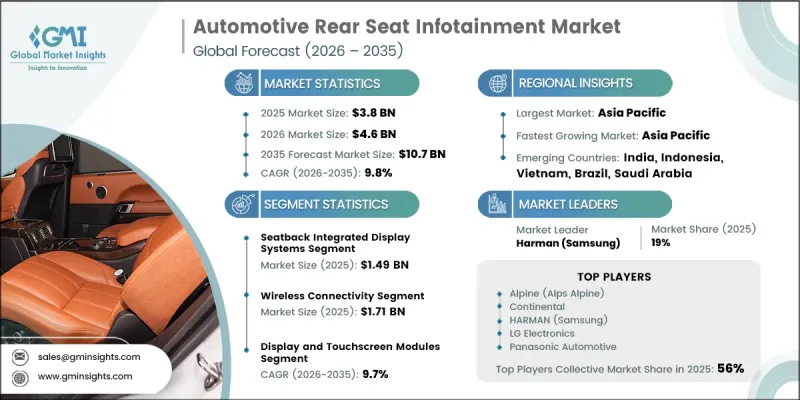
The Global Automotive Rear Seat Infotainment Market was valued at USD 3.8 billion in 2025 and is estimated to grow at a CAGR of 9.8% to reach USD 10.7 billion by 2035.
Market growth is fueled by the rapid evolution of electric vehicle interiors, software-defined vehicle platforms, and changing consumer expectations for seamless digital experiences inside the cabin. Rear seat infotainment systems are becoming an important feature across a broader range of vehicle categories as manufacturers seek to enhance passenger comfort and differentiate their offerings. Consumers increasingly expect uninterrupted access to digital content, mobile applications, streaming services, and connected experiences comparable to those available on personal electronic devices. Automakers are responding by introducing advanced display technologies, intelligent user interfaces, multi-user entertainment capabilities, and improved connectivity that support a wide range of multimedia and productivity applications. Continued advancements in vehicle architecture and digital integration are also creating additional opportunities to incorporate sophisticated rear seat entertainment systems, supporting sustained long-term growth across the global automotive rear seat infotainment market.
| Market Scope | |
|---|---|
| Start Year | 2025 |
| Forecast Year | 2026-2035 |
| Start Value | $3.8 Billion |
| Forecast Value | $10.7 Billion |
| CAGR | 9.8% |
The seatback integrated display systems segment generated USD 1.49 billion in 2025. Strong growth is supported by increasing demand for integrated, high-resolution display solutions that improve passenger comfort and enhance the overall in-vehicle experience. Manufacturers continue to incorporate advanced display systems as standard platform components, allowing greater flexibility through modular hardware designs, software upgrades, and improved long-term functionality while supporting a wide range of entertainment and information services.
The wireless connectivity accounted for USD 1.71 billion in 2025. The segment continues to benefit from increasing consumer preference for cable-free connectivity, simplified system integration, and seamless connectivity across multiple passenger devices. Growing adoption of advanced wireless communication technologies enable faster data transfer, improved content streaming, enhanced gaming experiences, and efficient software updates.
North America Automotive Rear Seat Infotainment Market generated USD 794.3 million in 2025, accounting for 21.1% share. Continued growth is supported by increasing adoption of premium vehicles, rising demand for electric vehicles, and expanding investment in software-defined vehicle technologies. Ongoing innovation in connected vehicle ecosystems and digital cabin experiences is expected to strengthen regional market expansion over the coming years.
Major companies operating in the global automotive rear seat infotainment market include Panasonic Automotive Systems, Robert Bosch, Continental, HARMAN (Samsung), LG Electronics, Mitsubishi Electric, Hyundai Mobis, Alpine Electronics (Alps Alpine), Visteon, JVCKenwood, Forvia / Clarion, and Desay. Companies operating in the automotive rear seat infotainment market are strengthening their competitive position by investing in advanced display technologies, software-defined vehicle platforms, and intelligent connectivity solutions. Manufacturers continue to enhance user experience through larger high-resolution displays, artificial intelligence-enabled interfaces, seamless wireless connectivity, and continuous software upgrades. Strategic collaborations with automotive manufacturers, increased investment in research and development, and expansion of integrated digital ecosystems are helping companies broaden their market presence. Businesses are also focusing on modular product architectures, improved cybersecurity capabilities, and cloud-based service integration to deliver greater flexibility and long-term value.
Table of Contents
Chapter 1 Methodology
- 1.1 Research approach
- 1.2 Quality Commitments
- 1.2.1 GMI AI policy & data integrity commitment
- 1.2.1.1 Source consistency protocol
- 1.2.1 GMI AI policy & data integrity commitment
- 1.3 Research Trail & Confidence Scoring
- 1.3.1 Research Trail Components
- 1.3.2 Scoring Components
- 1.4 Data Collection
- 1.4.1 Partial list of primary sources
- 1.5 Data mining sources
- 1.5.1 Paid sources
- 1.5.1.1 Sources, by region
- 1.5.1 Paid sources
- 1.6 Base estimates and calculations
- 1.6.1 Base year calculation
- 1.7 Forecast model
- 1.7.1 Quantified market impact analysis
- 1.7.1.1 Mathematical impact of growth parameters on forecast
- 1.7.1 Quantified market impact analysis
- 1.8 Research transparency addendum
- 1.8.1 Source attribution framework
- 1.8.2 Quality assurance metrics
- 1.8.3 Our commitment to trust
Chapter 2 Executive Summary
- 2.1 Industry 360° synopsis
- 2.2 Key market trends
- 2.2.1 Regional
- 2.2.2 System
- 2.2.3 Sales channel
- 2.2.4 Component
- 2.2.5 Vehicle
- 2.2.6 Connectivity
- 2.2.7 Operating system
- 2.3 TAM analysis, 2026-2035
- 2.4 CXO perspectives: Strategic imperatives
Chapter 3 Industry Insights
- 3.1 Industry ecosystem analysis
- 3.1.1 Supplier landscape
- 3.1.2 Profit margin
- 3.1.3 Cost structure
- 3.1.4 Value addition at each stage
- 3.1.5 Factor affecting the value chain
- 3.1.6 Disruptions
- 3.2 Industry impact forces
- 3.2.1 Growth drivers
- 3.2.1.1 Premium connected entertainment demand
- 3.2.1.2 EV & autonomous cabin innovation
- 3.2.1.3 5G-enabled streaming and cloud gaming
- 3.2.1.4 Luxury & premium vehicle growth
- 3.2.2 Industry pitfalls and challenges
- 3.2.2.1 High integration and development costs
- 3.2.2.2 Cybersecurity and privacy compliance challenges
- 3.2.3 Market opportunities
- 3.2.3.1 Subscription-based content revenue models
- 3.2.3.2 AR/VR immersive cabin experiences
- 3.2.3.3 Aftermarket retrofit market expansion
- 3.2.3.4 Educational and productivity content integration
- 3.2.1 Growth drivers
- 3.3 Growth potential analysis
- 3.4 Technology and innovation landscape
- 3.4.1 Current technological trends
- 3.4.1.1 Display technology evolution
- 3.4.1.2 Voice & gesture-based control interface advancements
- 3.4.2 Emerging technologies
- 3.4.2.1 Augmented Reality (AR) Integration in Rear Cabin Systems
- 3.4.2.2 OTA (Over-the-Air) Software Update Architecture for Rear-Seat Units
- 3.4.1 Current technological trends
- 3.5 Regulatory landscape
- 3.5.1 North America
- 3.5.1.1 National Highway Traffic Safety Administration (NHTSA)
- 3.5.1.2 Federal Communications Commission (FCC), U.S.
- 3.5.2 Europe
- 3.5.2.1 European Commission (EU Vehicle Regulations, GDPR, Cybersecurity Act)
- 3.5.2.2 United Nations Economic Commission for Europe (UNECE)
- 3.5.3 Asia Pacific
- 3.5.3.1 Ministry of Industry and Information Technology (MIIT), China
- 3.5.3.2 China Compulsory Certification (CCC)
- 3.5.4 Latin America
- 3.5.4.1 National Institute of Metrology, Quality and Technology (INMETRO), Brazil
- 3.5.4.2 NOM (Normas Oficiales Mexicanas)
- 3.5.5 Middle East & Africa
- 3.5.5.1 Saudi Standards, Metrology and Quality Organization (SASO)
- 3.5.5.2 Telecommunications and Digital Government Regulatory Authority (TDRA), UAE
- 3.5.1 North America
- 3.6 Porter's analysis
- 3.7 PESTEL analysis
- 3.8 Pricing Analysis (Driven by Primary Research)
- 3.8.1 Historical Price Trend Analysis System-Level & Component-Level
- 3.8.2 Pricing Strategy by Player Type (Premium / Value / Cost-plus)
- 3.9 Patent analysis (Driven by Primary Research)
- 3.10 Cost breakdown analysis
- 3.11 Trade data analysis (Driven by paid database)
- 3.11.1 Import/export volume & value trends
- 3.11.2 Key trade corridors & tariff impact
- 3.12 Capacity & Production Landscape (Driven by Primary Research)
- 3.12.1 Installed Capacity by Region & Key Producer
- 3.12.2 Capacity Utilization Rates & Expansion Pipelines
- 3.13 Sustainability and environmental aspects
- 3.13.1 Sustainable practices
- 3.13.2 Waste reduction strategies
- 3.13.3 Energy efficiency in production
- 3.13.4 Eco-friendly Initiatives
- 3.13.5 Carbon footprint considerations
- 3.14 Impact of AI & Generative AI on the Market
- 3.14.1 AI-driven disruption of existing business models
- 3.14.2 Gen AI use cases & adoption roadmap by segment
- 3.14.3 Risks, limitations & regulatory considerations
- 3.15 Forecast assumptions & scenario analysis (Driven by primary research)
- 3.15.1 Base Case key macro & industry variables driving CAGR
- 3.15.2 Optimistic Scenarios Favorable macro and industry tailwinds
- 3.15.3 Pessimistic Scenario Macroeconomic slowdown or industry headwinds
Chapter 4 Competitive Landscape, 2025
- 4.1 Introduction
- 4.2 Company market share analysis
- 4.2.1 North America
- 4.2.2 Europe
- 4.2.3 Asia Pacific
- 4.2.4 LATAM
- 4.2.5 MEA
- 4.3 Competitive analysis of major market players
- 4.4 Competitive positioning matrix
- 4.5 Key developments
- 4.5.1 Mergers & acquisitions
- 4.5.2 Partnerships & collaborations
- 4.5.3 New product launches
- 4.5.4 Expansion plans and funding
- 4.6 Company tier benchmarking
- 4.6.1 Tier classification criteria & qualifying thresholds
- 4.6.2 Tier positioning matrix by revenue, geography & innovation
Chapter 5 Market Estimates & Forecast, By System, 2022 - 2035 ($Mn, Units)
- 5.1 Key trends
- 5.2 Headrest mounted display systems
- 5.3 Overhead/roof mounted display systems
- 5.4 Seatback integrated display systems
- 5.5 Tablet-based rear seat systems
- 5.6 Portable/plug-and-play systems
- 5.7 Others
Chapter 6 Market Estimates & Forecast, By Sales channel, 2022 - 2035 ($Mn, Units)
- 6.1 Key trends
- 6.2 OEM
- 6.3 Aftermarket
Chapter 7 Market Estimates & Forecast, By Component, 2022 - 2035 ($Mn, Units)
- 7.1 Key trends
- 7.2 Display & touchscreen modules
- 7.2.1 LCD
- 7.2.2 OLED
- 7.2.3 TFT
- 7.2.4 Others
- 7.3 Audio systems & amplifiers
- 7.4 Connectivity & communication modules
- 7.5 Software & infotainment platforms
- 7.6 Remote control & input devices
- 7.7 Others
Chapter 8 Market Estimates & Forecast, By Vehicle, 2022 - 2035 ($Mn, Units)
- 8.1 Key trends
- 8.2 Sedan
- 8.3 SUV
- 8.4 Hatchback
- 8.5 MPVs
Chapter 9 Market Estimates & Forecast, By Connectivity, 2022 - 2035 ($Mn, Units)
- 9.1 Key trends
- 9.2 Wired connectivity
- 9.3 Wireless connectivity
- 9.4 Cellular connectivity
Chapter 10 Market Estimates & Forecast, By Operating system, 2022 - 2035 ($Mn, Units)
- 10.1 Key trends
- 10.2 Android Automotive OS / AOSP
- 10.3 Linux-Based Systems
- 10.4 QNX-Based Systems
- 10.5 Proprietary OEM Operating Systems
- 10.6 Other Operating Systems
Chapter 11 Market Estimates & Forecast, By Region, 2022 - 2035 ($Mn, Units)
- 11.1 Key trends
- 11.2 North America
- 11.2.1 U.S.
- 11.2.2 Canada
- 11.3 Europe
- 11.3.1 Germany
- 11.3.2 UK
- 11.3.3 France
- 11.3.4 Italy
- 11.3.5 Spain
- 11.3.6 Nordics
- 11.3.7 Russia
- 11.3.8 Netherlands
- 11.4 Asia Pacific
- 11.4.1 China
- 11.4.2 India
- 11.4.3 Japan
- 11.4.4 South Korea
- 11.4.5 Australia
- 11.4.6 Singapore
- 11.4.7 Malaysia
- 11.5 Latin America
- 11.5.1 Brazil
- 11.5.2 Mexico
- 11.5.3 Argentina
- 11.6 MEA
- 11.6.1 South Africa
- 11.6.2 Saudi Arabia
- 11.6.3 UAE
Chapter 12 Company Profiles
- 12.1 Global players
- 12.1.1 Alpine Electronics
- 12.1.2 Continental
- 12.1.3 Denso
- 12.1.4 Harman (Samsung)
- 12.1.5 LG Electronics
- 12.1.6 Panasonic Automotive Systems
- 12.1.7 Robert Bosch
- 12.1.8 Visteon
- 12.2 Regional players
- 12.2.1 Desay Automotive
- 12.2.2 Forvia / Clarion
- 12.2.3 Foryou
- 12.2.4 Hangsheng Electronics
- 12.2.5 Hyundai Mobis
- 12.2.6 JVCKenwood
- 12.2.7 Mitsubishi Electric
- 12.2.8 VOXX International
- 12.3 Emerging players
- 12.3.1 3SS (Three Screen Solutions)
- 12.3.2 Huawei Technologies
- 12.3.3 Vestel Mobility
- 12.3.4 Xperi (TiVo Automotive)

