PUBLISHER: Global Market Insights Inc. | PRODUCT CODE: 2101575

PUBLISHER: Global Market Insights Inc. | PRODUCT CODE: 2101575
Spore-Based Probiotics Market Opportunity, Growth Drivers, Industry Trend Analysis, and Forecast 2026 - 2035
The Global Spore-Based Probiotics Market was valued at USD 2.98 billion in 2025 and is estimated to grow at a CAGR of 9.4% to reach USD 7.48 billion by 2035.
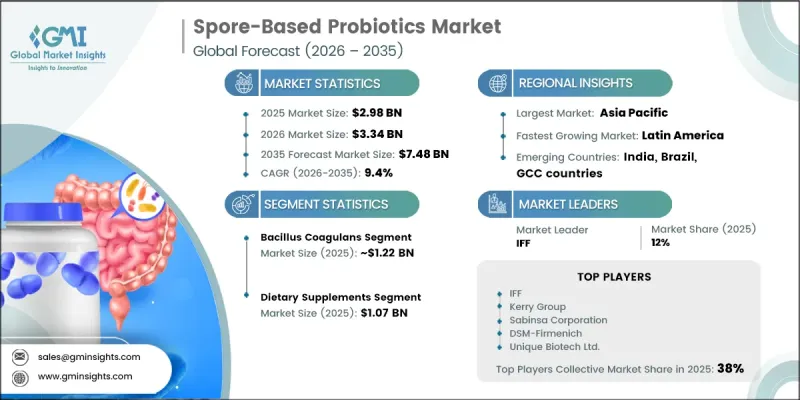
Market expansion continues to accelerate as demand rises across dietary supplements, functional food formulations, and direct-fed microbial applications in animal nutrition. Growth is supported by the unique formulation characteristics of spore-forming probiotic strains, which provide superior resistance to heat, acidic environments, and extended shelf storage under ambient conditions. These attributes make them well suited for commercial manufacturing processes that require greater product stability throughout production, transportation, and storage. Regulatory support has further strengthened market development through established safety assessment pathways in the United States and Europe, creating a more favorable environment for ingredient commercialization and encouraging continued investment in strain innovation, clinical research, and large-scale production capabilities. At the same time, manufacturers remain focused on developing advanced formulations that improve stability and delivery efficiency while meeting evolving consumer demand for convenient probiotic products. Although regulatory frameworks have simplified safety evaluations for qualified strains, obtaining authorized health claims still requires extensive scientific substantiation, making clinical evidence essential for long-term product differentiation and commercialization in the global spore-based probiotics market.
| Market Scope | |
|---|---|
| Start Year | 2025 |
| Forecast Year | 2026-2035 |
| Start Value | $2.98 Billion |
| Forecast Value | $7.48 Billion |
| CAGR | 9.4% |
The Bacillus coagulans segment held 41% share, generating USD 1.22 billion in 2025. Its market leadership is supported by a long-established regulatory acceptance profile, broad commercial utilization, and an extensive body of scientific research evaluating its role across multiple health-related applications. Continued confidence from manufacturers and ingredient suppliers has strengthened its adoption across a wide range of probiotic formulations, reinforcing its competitive position within the global market.
The dietary supplements segment generated USD 1.07 billion in 2025, representing 36% share. Demand continues to increase as consumers seek shelf-stable probiotic supplements available in capsule and powder formats that offer reliable storage characteristics and improved gastrointestinal delivery. Manufacturers are also emphasizing formulation technologies that optimize probiotic survival in the digestive system while maintaining consistent potency throughout the product's shelf life, further supporting segment expansion.
North America Spore-Based Probiotics Market captured 27% share in 2025, reaching USD 805 million. The United States remained the region's largest contributor, supported by a well-established probiotic supplement industry, strong consumer spending on nutritional products, and a favorable regulatory environment that continues to facilitate commercialization opportunities for qualified probiotic strains. Ongoing regulatory developments have expanded opportunities for ingredient manufacturers while encouraging innovation, product diversification, and broader market participation throughout the industry.
Major participants operating in the global spore-based probiotics market include IFF, DSM-Firmenich, Sabinsa Corporation, Unique Biotech Ltd., Sanzyme Biologics, Wecare Probiotics Co. Ltd., ILDONG Bioscience, Kerry Group, Chambio Co. Ltd., Probiotical S.p.A., Sporegen Limited, Microbiome Labs, and Deerland Probiotics & Enzymes. Companies operating in the spore-based probiotics market continue to strengthen their competitive position by investing in research and development to expand proprietary strain portfolios and improve formulation performance. Many manufacturers prioritize product innovation through advanced delivery technologies that enhance stability, shelf life, and targeted gastrointestinal release. Strategic collaborations with ingredient suppliers, contract manufacturers, and distribution partners help broaden commercial reach across dietary supplements, functional foods, and animal nutrition applications. Businesses are also expanding production capacity to support growing global demand while improving supply chain efficiency. Regulatory compliance, quality certifications, and continuous clinical validation remain key priorities for building customer confidence and supporting product differentiation.
Table of Contents
Chapter 1 Methodology & Scope
- 1.1 Market scope and definition
- 1.2 Research design
- 1.2.1 Research approach
- 1.2.2 Data collection methods
- 1.3 Data mining sources
- 1.3.1 Global
- 1.3.2 Regional/Country
- 1.4 Base estimates and calculations
- 1.4.1 Base year calculation
- 1.4.2 Key trends for market estimation
- 1.5 Primary research and validation
- 1.5.1 Primary sources
- 1.6 Forecast model
- 1.7 Research assumptions and limitations
Chapter 2 Executive Summary
- 2.1 Industry 360° synopsis
- 2.2 Key market trends
- 2.2.1 Active Ingredient
- 2.2.2 Crop Type
- 2.2.3 Form
- 2.2.4 Application
- 2.2.5 Regional
- 2.3 TAM Analysis, 2026-2035
- 2.4 CXO perspectives: Strategic imperatives
- 2.5 Future outlook and strategic recommendations
Chapter 3 Industry Insights
- 3.1 Industry ecosystem analysis
- 3.1.1 Supplier landscape
- 3.1.2 Profit margin
- 3.1.3 Value addition at each stage
- 3.1.4 Factor affecting the value chain
- 3.1.5 Disruptions
- 3.2 Industry impact forces
- 3.2.1 Growth drivers
- 3.2.1.1 Superior Thermal & Acid Stability Enabling Ambient-Temperature Formulation
- 3.2.1.2 Rising Global Gut Health & Preventive Wellness Demand
- 3.2.1.3 AGP Bans Accelerating Animal Feed & Aquaculture Adoption
- 3.2.2 Industry pitfalls and challenges
- 3.2.2.1 Fragmented Multi-Jurisdictional Regulatory Frameworks
- 3.2.2.2 High Clinical Trial Costs for Efficacy Substantiation
- 3.2.3 Market opportunities
- 3.2.3.1 LBP regulatory pathway opening pharmaceutical-grade market
- 3.2.3.2 Functional bakery and beverage fortification expansion
- 3.2.1 Growth drivers
- 3.3 Growth potential analysis
- 3.4 Regulatory landscape
- 3.4.1 North America
- 3.4.2 Europe
- 3.4.3 Asia Pacific
- 3.4.4 Latin America
- 3.4.5 Middle East & Africa
- 3.5 Porter's analysis
- 3.6 PESTEL analysis
- 3.7 Technology and innovation landscape
- 3.7.1 Current technological trends
- 3.7.2 Emerging technologies
- 3.8 Price trends
- 3.8.1 By region
- 3.8.2 By Strain Type
- 3.9 Future market trends
- 3.10 Patent landscape
- 3.11 Trade statistics (HS code)
- 3.11.1 Major importing countries
- 3.11.2 Major exporting countries
- 3.12 Sustainability and environmental aspects
- 3.12.1 Sustainable practices
- 3.12.2 Waste reduction strategies
- 3.12.3 Energy efficiency in production
- 3.12.4 Eco-friendly initiatives
- 3.13 Carbon footprint consideration
Chapter 4 Competitive Landscape, 2025
- 4.1 Introduction
- 4.2 Company market share analysis
- 4.2.1 By region
- 4.2.1.1 North America
- 4.2.1.2 Europe
- 4.2.1.3 Asia Pacific
- 4.2.1.4 LATAM
- 4.2.1.5 MEA
- 4.2.1 By region
- 4.3 Company matrix analysis
- 4.4 Competitive analysis of major market players
- 4.5 Competitive positioning matrix
- 4.6 Key developments
- 4.6.1 Mergers & acquisitions
- 4.6.2 Partnerships & collaborations
- 4.6.3 New product launches
- 4.6.4 Expansion plans
Chapter 5 Market Estimates and Forecast, By Strain Type, 2022-2035 (USD Million) (Kilo Tons)
- 5.1 Key trends
- 5.2 Bacillus coagulans
- 5.3 Bacillus subtilis
- 5.4 Bacillus clausii
- 5.5 Bacillus licheniformis
- 5.6 Multi-Strain Blends
- 5.7 Others (Emerging Strains)
Chapter 6 Market Estimates and Forecast, By Application, 2022-2035 (USD Million) (Kilo Tons)
- 6.1 Key trends
- 6.2 Dietary Supplements
- 6.3 Functional Food & Beverages
- 6.4 Animal Feed & Aquaculture
- 6.5 Pharmaceuticals & Clinical Nutrition
- 6.6 Others
Chapter 7 Market Estimates and Forecast, By Dosage Form, 2022-2035 (USD Million) (Kilo Tons)
- 7.1 Key trends
- 7.2 Capsules & Softgels
- 7.3 Tablets
- 7.4 Powders
- 7.5 Gummies & Chews
- 7.6 Liquids & Drops
- 7.7 Others
Chapter 8 Market Estimates and Forecast, By Region, 2022-2035 (USD Million) (Kilo Tons)
- 8.1 Key trends
- 8.2 North America
- 8.2.1 U.S.
- 8.2.2 Canada
- 8.3 Europe
- 8.3.1 Germany
- 8.3.2 UK
- 8.3.3 France
- 8.3.4 Spain
- 8.3.5 Italy
- 8.3.6 Rest of Europe
- 8.4 Asia Pacific
- 8.4.1 China
- 8.4.2 India
- 8.4.3 Japan
- 8.4.4 Australia
- 8.4.5 South Korea
- 8.4.6 Rest of Asia Pacific
- 8.5 Latin America
- 8.5.1 Brazil
- 8.5.2 Mexico
- 8.5.3 Argentina
- 8.5.4 Rest of Latin America
- 8.6 Middle East and Africa
- 8.6.1 Saudi Arabia
- 8.6.2 South Africa
- 8.6.3 UAE
- 8.6.4 Rest of Middle East and Africa
Chapter 9 Company Profiles
- 9.1 IFF
- 9.2 DSM-Firmenich
- 9.3 Kerry Group
- 9.4 Lallemand Inc.
- 9.5 Sabinsa Corporation
- 9.6 Novonesis
- 9.7 Sanzyme Biologics
- 9.8 Unique Biotech Ltd.
- 9.9 Wecare Probiotics
- 9.10 ILDONG Bioscience
- 9.11 Kaneka Probiotics
- 9.12 Sporegen Limited
- 9.13 Chambio Co., Ltd.
- 9.14 Deerland Probiotics & Enzymes

