PUBLISHER: Global Market Insights Inc. | PRODUCT CODE: 2101578

PUBLISHER: Global Market Insights Inc. | PRODUCT CODE: 2101578
Automotive Side Window Sunshades Market Opportunity, Growth Drivers, Industry Trend Analysis, and Forecast 2026 - 2035
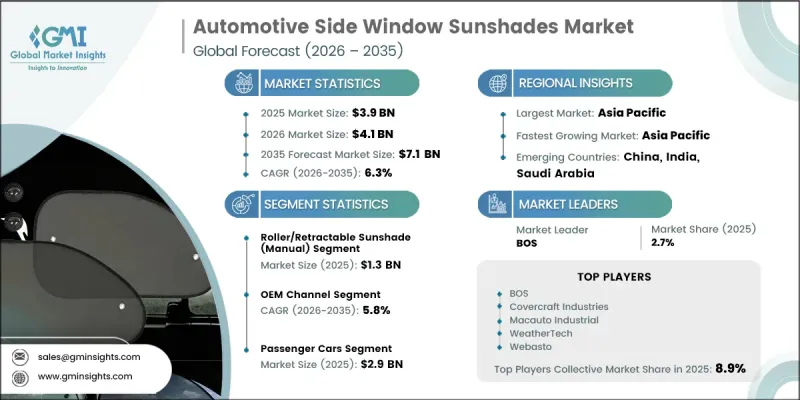
The Global Automotive Side Window Sunshades Market was valued at USD 3.9 billion in 2025 and is estimated to grow at a CAGR of 6.3% to reach USD 7.1 billion by 2035.
The automotive side window sunshades market is evolving beyond traditional cabin-comfort applications as increasing awareness of ultraviolet protection, changing vehicle designs, and the growing adoption of electric vehicles continue to influence product development. Demand remains strong across the aftermarket, particularly in developing economies where easy-to-install and vehicle-specific products provide greater convenience and broader compatibility. The increasing popularity of electric vehicles has further expanded the functional importance of side window sunshades by supporting improved thermal management and reducing cabin heat buildup, which can contribute to greater energy efficiency. At the same time, factory-installed glazing solutions with enhanced solar protection are creating competitive pressure for aftermarket products. Premium sunshade systems featuring advanced technologies continue to face affordability challenges across several price-sensitive regions, where lower-cost alternatives remain the preferred choice. In response, manufacturers are focusing on modular product designs, localized manufacturing strategies, and cost-efficient production methods to improve accessibility while maintaining product quality, performance, and competitive pricing across global markets.
| Market Scope | |
|---|---|
| Start Year | 2025 |
| Forecast Year | 2026-2035 |
| Start Value | $3.9 Billion |
| Forecast Value | $7.1 Billion |
| CAGR | 6.3% |
The manual roller and retractable sunshade segment generated USD 1.3 billion in 2025, accounting for 32.5% share. Its market leadership is supported by widespread adoption across original equipment manufacturers and the aftermarket, where demand continues to benefit from durable construction, ease of operation, and compatibility with a broad range of passenger vehicles. Manufacturers continue refining product designs by improving durability, appearance, and installation convenience to address evolving consumer expectations.
The OEM distribution channel accounted for USD 2.6 billion in 2025, representing 67.6% share. Demand through OEM channels is supported by long-term vehicle production programs that require suppliers to meet stringent quality standards, dimensional accuracy, material specifications, and seamless vehicle integration requirements. Products supplied through OEM partnerships generally command higher average selling prices than aftermarket alternatives due to additional engineering, validation, certification, and manufacturing requirements associated with factory-installed components.
North America Automotive Side Window Sunshades Market generated USD 948.5 million in 2025. Market growth across the region is moderated by the widespread availability of factory-installed glazing technologies that already provide enhanced protection from heat and ultraviolet exposure, reducing demand for aftermarket products. As a result, regional demand is increasingly supported by replacement purchases and specialized consumer requirements rather than large-scale adoption across newly manufactured vehicles.
Major companies operating in the global automotive side window sunshades market include Webasto, Grupo Antolin, WeatherTech, Inteva Products, Ashimori Industry, BOS, Macauto, Yanfeng Automotive Interiors, Intro-Tech Automotive, and Yashow Industrial. Companies participating in the automotive side window sunshades market are strengthening their competitive position by expanding product portfolios, improving material quality, and developing innovative designs that enhance durability, ease of installation, and vehicle compatibility. Manufacturers are investing in research and development to introduce lightweight, customizable, and energy-efficient products that address evolving customer preferences and changing vehicle designs. Strategic collaborations with automotive manufacturers help secure long-term OEM supply agreements while expanding global market reach. Many companies are also increasing localized production and optimizing supply chains to reduce manufacturing costs and improve product availability across key regional markets.
Table of Contents
Chapter 1 Methodology
- 1.1 Research approach
- 1.2 Quality Commitments
- 1.2.1 GMI AI policy & data integrity commitment
- 1.2.1.1 Source consistency protocol
- 1.2.1 GMI AI policy & data integrity commitment
- 1.3 Research Trail & Confidence Scoring
- 1.3.1 Research Trail Components
- 1.3.2 Scoring Components
- 1.4 Data Collection
- 1.4.1 Partial list of primary sources
- 1.5 Data mining sources
- 1.5.1 Paid sources
- 1.5.1.1 Sources, by region
- 1.5.1 Paid sources
- 1.6 Base estimates and calculations
- 1.6.1 Base year calculation
- 1.7 Forecast model
- 1.7.1 Quantified market impact analysis
- 1.7.1.1 Mathematical impact of growth parameters on forecast
- 1.7.1 Quantified market impact analysis
- 1.8 Research transparency addendum
- 1.8.1 Source attribution framework
- 1.8.2 Quality assurance metrics
- 1.8.3 Our commitment to trust
Chapter 2 Executive Summary
- 2.1 Industry 360° synopsis
- 2.2 Key market trends
- 2.2.1 Regional
- 2.2.2 Product
- 2.2.3 Sales channel
- 2.2.4 Vehicle
- 2.2.5 Material
- 2.2.6 Window position
- 2.3 TAM analysis, 2026-2035
- 2.4 CXO perspectives: Strategic imperatives
Chapter 3 Industry Insights
- 3.1 Industry ecosystem analysis
- 3.1.1 Supplier landscape
- 3.1.2 Profit margin
- 3.1.3 Cost structure
- 3.1.4 Value addition at each stage
- 3.1.5 Factor affecting the value chain
- 3.1.6 Disruptions
- 3.2 Industry impact forces
- 3.2.1 Growth drivers
- 3.2.1.1 Rising UV exposure driving cabin shading demand
- 3.2.1.2 SUV and crossover growth increasing shade demand
- 3.2.1.3 EV thermal needs boosting integrated sunshades
- 3.2.1.4 Child safety rules driving rear shade adoption
- 3.2.2 Industry pitfalls and challenges
- 3.2.2.1 Factory-tinted glass reducing shade demand
- 3.2.2.2 Price sensitivity limiting premium adoption
- 3.2.3 Market opportunities
- 3.2.3.1 Smart IoT sunshades in premium EVs
- 3.2.3.2 Fleet and ride-share bulk procurement demand
- 3.2.3.3 Emerging hot-climate vehicle ownership growth
- 3.2.3.4 Sustainable materials meeting OEM ESG goals
- 3.2.1 Growth drivers
- 3.3 Growth potential analysis
- 3.4 Pricing analysis (Driven by Primary Research)
- 3.4.1 Historical price trend analysis (2022-2025)
- 3.4.2 Pricing strategy by player type (premium OEM / value aftermarket / cost-plus mass market)
- 3.4.3 Price differential vs. electric/motorized sunshades by vehicle segment
- 3.5 Technology and innovation landscape
- 3.5.1 Current technological trends
- 3.5.1.1 Smart textile & solar-reflective coating technologies
- 3.5.1.2 Electric/motorized actuation systems & integration with vehicle electronics
- 3.5.2 Emerging technologies
- 3.5.2.1 IoT-enabled & automated climate-responsive sunshades
- 3.5.2.2 Nano-coating & UV-blocking film innovations
- 3.5.1 Current technological trends
- 3.6 Regulatory landscape
- 3.6.1 North America
- 3.6.1.1 National Highway Traffic Safety Administration
- 3.6.1.2 Transport Canada
- 3.6.2 Europe
- 3.6.2.1 United Nations Economic Commission for Europe
- 3.6.2.2 European Commission
- 3.6.3 Asia Pacific
- 3.6.3.1 Ministry of Road Transport and Highways
- 3.6.3.2 Ministry of Land, Infrastructure, Transport and Tourism
- 3.6.4 Latin America
- 3.6.4.1 National Traffic Secretariat
- 3.6.4.2 Secretariat of Infrastructure, Communications and Transportation
- 3.6.5 Middle East & Africa
- 3.6.5.1 Saudi Standards, Metrology and Quality Organization
- 3.6.5.2 Emirates Authority for Standardization and Metrology
- 3.6.1 North America
- 3.7 Porter's analysis
- 3.8 PESTEL analysis
- 3.9 Patent analysis (Driven by Primary Research)
- 3.10 Trade Data Analysis (Driven by Primary Research)
- 3.10.1 Import/Export Volume & Value Trends
- 3.10.2 Key Trade Corridors & Tariff Impact
- 3.11 Capacity & Production Landscape (Driven by Primary Research)
- 3.11.1 Installed Capacity by Region & Key Producer
- 3.11.2 Capacity Utilization Rates & Expansion Pipelines
- 3.12 Sustainability and environmental aspects
- 3.12.1 Sustainable practices
- 3.12.2 Waste reduction strategies
- 3.12.3 Energy efficiency in production
- 3.12.4 Eco-friendly initiatives
- 3.12.5 Carbon footprint considerations
- 3.13 Impact of AI & Generative AI on the Market
- 3.13.1 AI-driven disruption of existing business models
- 3.13.2 Gen AI use cases & adoption roadmap by segment
- 3.13.3 Risks, limitations & regulatory considerations
- 3.14 Forecast assumptions & scenario analysis (Driven by primary research)
- 3.14.1 Base Case key macro & industry variables driving CAGR
- 3.14.2 Optimistic Scenarios Favorable macro and industry tailwinds
- 3.14.3 Pessimistic Scenario Macroeconomic slowdown or industry headwinds
Chapter 4 Competitive Landscape, 2025
- 4.1 Introduction
- 4.2 Company market share analysis
- 4.2.1 North America
- 4.2.2 Europe
- 4.2.3 Asia Pacific
- 4.2.4 LATAM
- 4.2.5 MEA
- 4.3 Competitive analysis of major market players
- 4.4 Competitive positioning matrix
- 4.5 Key developments
- 4.5.1 Mergers & acquisitions
- 4.5.2 Partnerships & collaborations
- 4.5.3 New product launches
- 4.5.4 Expansion plans and funding
- 4.6 Company tier benchmarking
- 4.6.1 Tier classification criteria & qualifying thresholds
- 4.6.2 Tier positioning matrix by revenue, geography & innovation
Chapter 5 Market Estimates & Forecast, By Product, 2022 - 2035 ($Mn, Million units)
- 5.1 Key trends
- 5.2 Roller/retractable sunshades (manual)
- 5.3 Electric/motorized retractable sunshades
- 5.4 Magnetic sunshades
- 5.5 Suction-cup sunshades
- 5.6 Static cling/clip-on sunshades
Chapter 6 Market Estimates & Forecast, By Sales Channel, 2022 - 2035 ($Mn, Million units)
- 6.1 Key trends
- 6.2 OEM
- 6.3 Aftermarket
Chapter 7 Market Estimates & Forecast, By Vehicle, 2022 - 2035 ($Mn, Million units)
- 7.1 Key trends
- 7.2 Passenger cars
- 7.2.1 Sedan
- 7.2.2 Hatchback
- 7.2.3 SUV
- 7.3 Commercial vehicles
- 7.3.1 Light commercial vehicles (LCV)
- 7.3.2 Medium commercial vehicles (MCV)
- 7.3.3 Heavy commercial vehicles (HCV)
Chapter 8 Market Estimates & Forecast, By Material, 2022 - 2035 ($Mn, Million units)
- 8.1 Key trends
- 8.2 Fabric/Polyester
- 8.3 Mesh/Net
- 8.4 Plastic/Vinyl
- 8.5 Foam
- 8.6 Others
Chapter 9 Market Estimates & Forecast, By Window Position, 2022 - 2035 ($Mn, Million units)
- 9.1 Key trends
- 9.2 Rear side windows
- 9.3 Front side windows
- 9.4 Quarter windows
Chapter 10 Market Estimates & Forecast, By Region, 2022 - 2035 ($Mn, Million units)
- 10.1 Key trends
- 10.2 North America
- 10.2.1 U.S.
- 10.2.2 Canada
- 10.3 Europe
- 10.3.1 Germany
- 10.3.2 UK
- 10.3.3 France
- 10.3.4 Italy
- 10.3.5 Spain
- 10.3.6 Sweden
- 10.3.7 Switzerland
- 10.3.8 Netherlands
- 10.4 Asia Pacific
- 10.4.1 China
- 10.4.2 India
- 10.4.3 Japan
- 10.4.4 South Korea
- 10.4.5 Australia
- 10.4.6 Singapore
- 10.4.7 Malaysia
- 10.5 Latin America
- 10.5.1 Brazil
- 10.5.2 Mexico
- 10.5.3 Argentina
- 10.6 MEA
- 10.6.1 South Africa
- 10.6.2 Saudi Arabia
- 10.6.3 UAE
Chapter 11 Company Profiles
- 11.1 Global players
- 11.1.1 BOS
- 11.1.2 Grupo Antolin
- 11.1.3 Inteva Products
- 11.1.4 Intro-Tech Automotive
- 11.1.5 Macauto Industrial
- 11.1.6 WeatherTech
- 11.1.7 Webasto
- 11.1.8 Yanfeng Automotive Interiors
- 11.2 Regional players
- 11.2.1 Auto Ventshade (AVS)
- 11.2.2 Car Shades
- 11.2.3 EcoNour
- 11.2.4 Hayashi Telempu
- 11.2.5 NDR Auto Components
- 11.2.6 Shevron Auto Accessories (Window Sox)
- 11.2.7 Snap Shades
- 11.2.8 STE Car Sunshade
- 11.3 Emerging players
- 11.3.1 BYD Auto
- 11.3.2 Feigeer Tech
- 11.3.3 NIO
- 11.3.4 QuikSnap

