PUBLISHER: Global Market Insights Inc. | PRODUCT CODE: 2101585

PUBLISHER: Global Market Insights Inc. | PRODUCT CODE: 2101585
North America Insect Repellent Market Opportunity, Growth Drivers, Industry Trend Analysis, and Forecast 2026 - 2035
North America Insect Repellent Market was valued at USD 1.43 billion in 2025 and is estimated to grow at a CAGR of 6.5% to reach USD 2.71 billion by 2035.
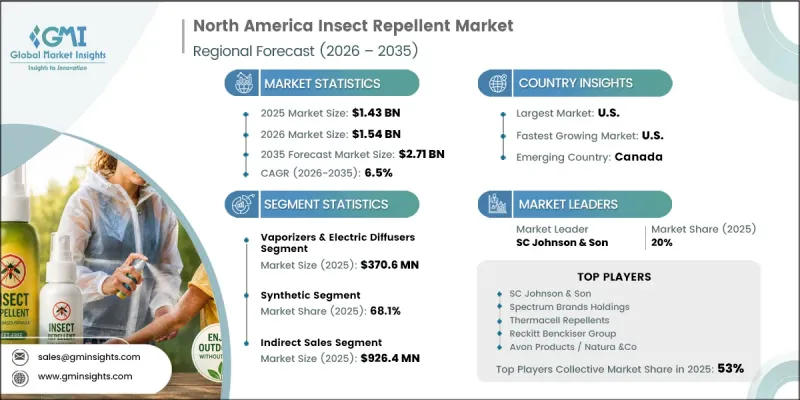
North America insect repellent market continues to expand as rising awareness of insect-borne health risks encourages consumers to adopt preventive personal care products as part of their daily routines. Growing public health initiatives promoting personal protection against biting insects have strengthened product demand across households, outdoor workers, travelers, and recreational users. Increasing consumer awareness of health and wellness, combined with greater participation in outdoor activities, is further supporting market growth. At the same time, evolving consumer preferences are driving demand for natural, botanical, and DEET-free formulations that offer effective protection while addressing concerns regarding ingredient safety. Manufacturers are responding by expanding product portfolios with plant-based alternatives and innovative formulations that meet changing regulatory standards and consumer expectations. Continuous product innovation, favorable regulatory support for safer ingredient profiles, and increasing emphasis on sustainable personal care solutions are expected to create long-term growth opportunities for the North America insect repellent market throughout the forecast period.
| Market Scope | |
|---|---|
| Start Year | 2025 |
| Forecast Year | 2026-2035 |
| Start Value | $1.43 Billion |
| Forecast Value | $2.71 Billion |
| CAGR | 6.5% |
North America insect repellent market is undergoing a gradual shift as consumers increasingly seek products formulated with naturally derived ingredients alongside traditional chemical-based solutions. Rising health consciousness, growing preference for cleaner product labels, and evolving safety expectations are encouraging manufacturers to introduce innovative formulations that balance effectiveness with consumer confidence. The availability of recognized safety certifications for qualifying products has further strengthened market acceptance of alternative formulations, creating additional opportunities for product differentiation and brand expansion.
The synthetic segment accounted for 68.1% share in 2025, maintaining its position as the leading product category. Its dominance is supported by decades of proven performance, extensive regulatory approvals, well-established safety profiles, and widespread consumer familiarity. Synthetic formulations continue to be preferred by many consumers due to their consistent effectiveness, broad product availability, and strong reputation for providing dependable protection against a wide range of insects.
The vaporizers and electric diffusers segment generated USD 370.6 million in 2025, making it the largest product category within the North America insect repellent market. Demand for these products continues to grow because they provide continuous indoor protection, convenient operation, and long-lasting performance. Their increasing adoption across residential settings reflects consumer preference for easy-to-use solutions that offer consistent insect control without requiring frequent reapplication.
U.S. Insect Repellent Market accounted for 78.7% share in 2025, generating USD 1.1 billion in 2025. The country's leadership is supported by strong consumer awareness of insect-borne health concerns, well-established public health initiatives promoting preventive protection, and continuous product innovation across both synthetic and naturally derived formulations. Growing participation in outdoor activities, expanding consumer demand for effective personal protection products, and increasing interest in advanced formulation technologies continue to strengthen market growth. Rising awareness of vector-borne diseases and sustained demand for preventive healthcare products further reinforce the long-term outlook for the U.S. market.
Key companies operating in the North America insect repellent market include Sawyer Products, SC Johnson & Son, Thermacell Repellents, Spectrum Brands Holdings, Murphy's Naturals, PIC Corporation, Reckitt Benckiser Group, Wondercide, Avon Products / Natura &Co, Wisconsin Pharmacal Company, Newell Brands / Coleman Company, Adventure Ready Brands, 3M Company, Quantum Health, All Terrain Company, KUUS Inc. / PiACTIVE, Ranger Ready Repellents, Cedarcide, Kinfield, Proven Repellent, and Nantucket Spider. Companies operating in the North America insect repellent market are strengthening their competitive positions by expanding product portfolios with both synthetic and plant-based formulations that address evolving consumer preferences. Manufacturers continue investing in research and development to improve product efficacy, extend protection duration, and enhance ingredient safety while complying with changing regulatory requirements. Businesses are also expanding retail distribution, strengthening e-commerce capabilities, and forming strategic partnerships to improve product accessibility and brand visibility. Product innovation focused on convenient delivery formats, environmentally responsible formulations, and premium personal care solutions remains a key growth strategy.
Table of Contents
Chapter 1 Methodology and Scope
- 1.1 Research approach
- 1.2 Quality Commitments
- 1.2.1 GMI AI policy & data integrity commitment
- 1.2.1.1 Source consistency protocol
- 1.2.1 GMI AI policy & data integrity commitment
- 1.3 Research Trail & Confidence Scoring
- 1.3.1 Research Trail Components
- 1.3.2 Scoring Components
- 1.4 Data Collection
- 1.4.1 Partial list of primary sources
- 1.5 Data mining sources
- 1.5.1 Paid sources
- 1.5.1.1 Sources, by region
- 1.5.1 Paid sources
- 1.6 Base estimates and calculations
- 1.6.1 Base year calculation for any one approach
- 1.7 Forecast model
- 1.7.1 Quantified market impact analysis
- 1.7.1.1 Mathematical impact of growth parameters on forecast
- 1.7.1 Quantified market impact analysis
- 1.8 Research transparency addendum
- 1.8.1 Source attribution framework
- 1.8.2 Quality assurance metrics
- 1.8.3 Our commitment to trust
Chapter 2 Executive Summary
- 2.1 Industry 360° synopsis
- 2.2 Key market trends
- 2.2.1 Country
- 2.2.2 Product type
- 2.2.3 Ingredient
- 2.2.4 Insect type
- 2.2.5 Price
- 2.2.6 End use
- 2.2.7 Distribution channel
Chapter 3 Industry Insights
- 3.1 Industry ecosystem analysis
- 3.1.1 Supplier landscape
- 3.1.2 Profit margin
- 3.1.3 Value addition at each stage
- 3.1.4 Factor affecting the value chain
- 3.2 Industry impact forces
- 3.2.1 Growth drivers
- 3.2.1.1 Rising vector-borne disease risk
- 3.2.1.2 Strong outdoor lifestyle culture
- 3.2.1.3 Shift toward preventive healthcare behavior
- 3.2.2 Industry pitfalls & challenges
- 3.2.2.1 Regulatory complexity
- 3.2.2.2 Seasonal and weather dependency
- 3.2.3 Opportunities
- 3.2.3.1 Premium & dermatology-focused segment
- 3.2.3.2 Smart & wearable protection solutions
- 3.2.1 Growth drivers
- 3.3 Growth potential analysis
- 3.4 Regulatory framework
- 3.4.1 EPA registration & minimum risk pesticide guidelines (north america)
- 3.4.2 Who prequalification & vector control guidelines
- 3.4.3 Regulatory trends & upcoming policy changes
- 3.5 Pricing analysis (driven by primary research)
- 3.5.1 Historical price trend analysis (2022-2025)
- 3.5.2 Pricing strategy by player type (premium / value / cost-plus)
- 3.5.3 Price benchmarking across product formats & ingredient types
- 3.6 Trade data analysis (driven by paid database)
- 3.6.1 Import/export volume & value trends
- 3.6.2 Key trade corridors & tariff impact
- 3.7 Impact of AI & generative AI on the market
- 3.7.1 AI-driven disruption of existing business models
- 3.7.2 GenAI use cases & adoption roadmap by segment
- 3.7.3 Risks, limitations & regulatory considerations
- 3.8 Distribution infrastructure & channel penetration landscape (driven by primary research)
- 3.8.1 Channel coverage by region & format (modern trade vs. Traditional trade)
- 3.8.2 Last-mile infrastructure gaps & emerging channel shifts (e-commerce penetration)
Chapter 4 Competitive Landscape, 2025
- 4.1 Introduction
- 4.2 Company market share analysis
- 4.2.1 By country
- 4.2.1.1 U.S.
- 4.2.1.2 Canada
- 4.2.1 By country
- 4.3 Company matrix analysis
- 4.4 Competitive analysis of major market players
- 4.5 Competitive positioning matrix
- 4.6 Key developments
- 4.6.1 Mergers & acquisitions
- 4.6.2 Partnerships & collaborations
- 4.6.3 New product launches
- 4.6.4 Expansion plans
Chapter 5 Market Estimates and Forecast, By Product Type, 2022 - 2035 (USD Million) (Thousand Units)
- 5.1 Key trends
- 5.2 Vaporizers & electric diffusers
- 5.3 Sprays & aerosols
- 5.4 Creams, lotions & gels
- 5.5 Oils & roll-ons
- 5.6 Mats
- 5.7 Coils
- 5.8 Sticks
- 5.9 Wipes
- 5.10 Wearables, patches & treated accessories
- 5.11 Others (candles, baits, ultrasonic devices)
Chapter 6 Market Estimates and Forecast, By Ingredient, 2022 - 2035 (USD Million) (Thousand Units)
- 6.1 Key trends
- 6.2 Synthetic
- 6.3 Natural
Chapter 7 Market Estimates and Forecast, By Insect Type, 2022 - 2035 (USD Million) (Thousand Units)
- 7.1 Key trends
- 7.2 Mosquito repellents
- 7.3 Tick repellents
- 7.4 Bug & general biting insect repellents
- 7.5 Fly repellents
- 7.6 Gnat & midge repellents
- 7.7 Multi-insect / broad-spectrum repellents
- 7.8 Others (flea, wasp, ant)
Chapter 8 Market Estimates and Forecast, By Price, 2022 - 2035 (USD Million) (Thousand Units)
- 8.1 Key trends
- 8.2 Low
- 8.3 Medium
- 8.4 High
Chapter 9 Market Estimates and Forecast, By End Use, 2022 - 2035 (USD Million) (Thousand Units)
- 9.1 Key trends
- 9.2 Residential
- 9.3 Commercial (hospitality, food service & tourism)
- 9.4 Healthcare & institutional
- 9.5 Industrial & professional (agriculture, forestry, construction)
- 9.6 Livestock & animal husbandry
- 9.7 Military & defense
- 9.8 Outdoor & recreational (camping, hiking, sports)
Chapter 10 Market Estimates and Forecast, By Distribution Channel, 2022 - 2035 (USD Million) (Thousand Units)
- 10.1 Key trends
- 10.2 Online
- 10.2.1 E-commerce websites
- 10.2.2 Company websites
- 10.3 Offline
- 10.3.1 Supermarkets & hypermarkets
- 10.3.2 Pharmacies & drug stores
- 10.3.3 Others
Chapter 11 Market Estimates and Forecast, By Country, 2022 - 2035 (USD Million) (Thousand Units)
- 11.1 Key trends
- 11.2 U.S.
- 11.3 Canada
Chapter 12 Company Profiles
- 12.1 Global players
- 12.1.1 SC Johnson & Son
- 12.1.2 Spectrum Brands Holdings
- 12.1.3 Reckitt Benckiser Group
- 12.1.4 3M Company
- 12.1.5 Wisconsin Pharmacal Company
- 12.1.6 Avon Products / Natura &Co
- 12.1.7 Newell Brands / Coleman Company
- 12.2 Regional players
- 12.2.1 Sawyer Products
- 12.2.2 Thermacell Repellents
- 12.2.3 Adventure Ready Brands
- 12.2.4 Quantum Health
- 12.2.5 PIC Corporation
- 12.2.6 All Terrain Company
- 12.2.7 KUUS Inc. / PiACTIVE
- 12.3 Emerging players
- 12.3.1 Murphy's Naturals
- 12.3.2 Wondercide
- 12.3.3 Ranger Ready Repellents
- 12.3.4 Cedarcide
- 12.3.5 Kinfield
- 12.3.6 Proven Repellent
- 12.3.7 Nantucket Spider

