PUBLISHER: Global Market Insights Inc. | PRODUCT CODE: 2101587

PUBLISHER: Global Market Insights Inc. | PRODUCT CODE: 2101587
C4 Rice Engineering Market Opportunity, Growth Drivers, Industry Trend Analysis, and Forecast 2026 - 2035
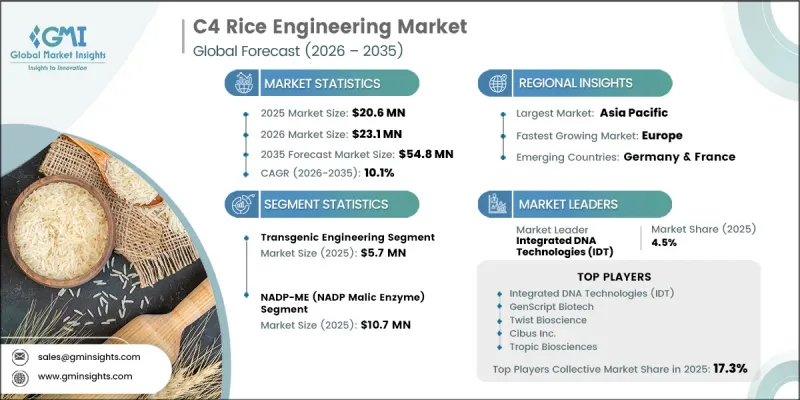
The Global C4 Rice Engineering Market was valued at USD 20.6 million in 2025 and is estimated to grow at a CAGR of 10.1% to reach USD 54.8 million by 2035.
The market is gaining momentum as advancements in photosynthesis engineering, gene editing, and synthetic biology create new opportunities to improve rice productivity and strengthen global food security. Increasing pressure to address climate-related agricultural challenges and rising food demand is encouraging researchers and organizations to explore advanced approaches beyond conventional crop improvement methods. Traditional rice breeding techniques are approaching productivity limitations, creating greater interest in C4 pathway engineering as a potential solution for enhancing crop efficiency. Recent progress in molecular biology tools has accelerated development timelines by enabling more precise genetic modifications. Advanced cloning platforms, synthetic transcription technologies, and improved promoter systems are supporting more accurate cell-specific and multi-gene expression strategies, strengthening the foundation for future C4 rice development.
| Market Scope | |
|---|---|
| Start Year | 2025 |
| Forecast Year | 2026-2035 |
| Start Value | $20.6 Million |
| Forecast Value | $54.8 Million |
| CAGR | 10.1% |
The transgenic engineering technology segment held 28% share in 2025 and reaching USD 5.7 million. The segment maintains a leading position due to its essential role in validating the integration and expression of C4 pathway components in rice plants. Transgenic approaches have supported the introduction of key C4-related enzymes, including carbonic anhydrase, phosphoenolpyruvate carboxylase (PEPC), malate dehydrogenase (MDH), NADP-malic enzyme (NADP-ME), and pyruvate orthophosphate dikinase (PPDK). A major advancement was achieved in 2021 when researchers successfully incorporated all five C4 enzymes through a single genetic construct, representing an important milestone in pathway engineering efforts.
The NADP-ME (NADP Malic Enzyme) pathway segment accounted for 52% share, generating USD 10.7 million in 2025. This strong position is linked to the pathway's importance as a preferred engineering model within C4 rice research programs. The NADP-ME pathway, naturally observed in crops such as maize and sorghum, offers a well-established biochemical framework compared with other C4 pathway variations. Its extensive research base provides access to advanced enzyme characterization, promoter resources, and metabolic modeling capabilities, supporting its application in rice pathway modification initiatives.
North America C4 Rice Engineering Market accounted for 24% share in 2025, reaching USD 4.95. The United States represents the leading contributor to regional market growth due to strong academic research activity, agricultural biotechnology initiatives, and continued support for advanced crop improvement programs. The region benefits from extensive research networks, institutional collaborations, and funding mechanisms that support the advancement of C4 rice engineering technologies.
Major players operating in the global C4 rice engineering market include: GenScript Biotech, Cibus Inc., Integrated DNA Technologies (IDT), Tropic Biosciences, and Twist Bioscience. Companies operating in the C4 rice engineering market are strengthening their market presence by investing in advanced biotechnology platforms, expanding research collaborations, and developing innovative genetic engineering solutions. Key strategies include improving gene editing capabilities, enhancing synthetic biology expertise, and forming partnerships with academic institutions and agricultural research organizations to accelerate technology development. Companies are also focusing on expanding their molecular biology service offerings, improving research efficiency, and supporting large-scale crop improvement programs.
Table of Contents
Chapter 1 Methodology & Scope
- 1.1 Research approach
- 1.2 Quality Commitments
- 1.2.1 GMI AI policy & data integrity commitment
- 1.2.1.1 Source consistency protocol
- 1.2.1 GMI AI policy & data integrity commitment
- 1.3 Research Trail & Confidence Scoring
- 1.3.1 Research Trail Components
- 1.3.2 Scoring Components
- 1.4 Data Collection
- 1.4.1 Partial list of primary sources
- 1.5 Data mining sources
- 1.5.1 Paid sources
- 1.5.1.1 Sources, by region
- 1.5.1 Paid sources
- 1.6 Base estimates and calculations
- 1.6.1 Base year calculation for any one approach
- 1.7 Forecast model
- 1.7.1 Quantified market impact analysis
- 1.7.1.1 Mathematical impact of growth parameters on forecast
- 1.7.1 Quantified market impact analysis
- 1.8 Research transparency addendum
- 1.8.1 Source attribution framework
- 1.8.2 Quality assurance metrics
- 1.8.3 Our commitment to trust
Chapter 2 Executive Summary
- 2.1 Industry 360° synopsis
- 2.2 Key market trends
- 2.2.1 Regional
- 2.2.2 By Engineering Technology
- 2.2.3 By C4 Pathway
- 2.2.4 By Application
- 2.2.5 By End User
- 2.3 TAM Analysis, 2026 2035
- 2.4 CXO perspectives: Strategic imperatives
Chapter 3 Industry Insights
- 3.1 Industry ecosystem analysis
- 3.1.1 Supplier landscape
- 3.1.2 Profit margin
- 3.1.3 Value addition at each stage
- 3.1.4 Factor affecting the value chain
- 3.1.5 Disruptions
- 3.2 Industry impact forces
- 3.2.1 Growth drivers
- 3.2.2 Industry pitfalls and challenges
- 3.2.3 Market opportunities
- 3.3 Growth potential analysis
- 3.4 Regulatory landscape
- 3.4.1 North America
- 3.4.2 Europe
- 3.4.3 Asia Pacific
- 3.4.4 Latin America
- 3.4.5 Middle East & Africa
- 3.5 Porter’s analysis
- 3.6 PESTEL analysis
- 3.7 Price trends
- 3.7.1 By region
- 3.7.2 By technology
- 3.8 Future market trends
- 3.9 Technology and Innovation landscape
- 3.9.1 Current technological trends
- 3.9.2 Emerging technologies
- 3.10 Patent Landscape
- 3.11 Trade statistics (HS code)
- 3.11.1 Major importing countries
- 3.11.2 Major exporting countries
- 3.12 Sustainability and environmental aspects
- 3.12.1 Sustainable practices
- 3.12.2 Waste reduction strategies
- 3.12.3 Energy efficiency in production
- 3.12.4 Eco friendly initiatives
Chapter 4 Competitive Landscape, 2025
- 4.1 Introduction
- 4.2 Company market share analysis
- 4.2.1 By region
- 4.2.1.1 North America
- 4.2.1.2 Europe
- 4.2.1.3 Asia Pacific
- 4.2.1.4 LATAM
- 4.2.1.5 MEA
- 4.2.1 By region
- 4.3 Company matrix analysis
- 4.4 Competitive analysis of major market players
- 4.5 Competitive positioning matrix
- 4.6 Key developments
- 4.6.1 Mergers & acquisitions
- 4.6.2 Partnerships & collaborations
- 4.6.3 New Product Launches
- 4.6.4 Expansion Plans
Chapter 5 Market Estimates and Forecast, By Engineering Technology, 2022 to 2035 (USD Million) (Tons)
- 5.1 Key trends
- 5.2 Transgenic Engineering
- 5.3 Gene Editing
- 5.4 Synthetic Biology & Modular Cloning
- 5.5 Phenotypic & Anatomical Engineering
- 5.6 Bioinformatics & Computational
Chapter 6 Market Estimates and Forecast, By C4 Pathway, 2022 to 2035 (USD Million) (Tons)
- 6.1 Key trends
- 6.2 NADP-ME
- 6.3 NAD-ME
- 6.4 PCK
- 6.5 Single-Cell C4
Chapter 7 Market Estimates and Forecast, By Application, 2022 to 2035 (USD Million) (Tons)
- 7.1 Key trends
- 7.2 Yield Enhancement
- 7.3 Water-Use Efficiency
- 7.4 Climate Resilience
- 7.5 Nitrogen-Use Efficiency
- 7.6 Food Security Programs
Chapter 8 Market Estimates and Forecast, By End-User, 2022 to 2035 (USD Million) (Tons)
- 8.1 Key trends
- 8.2 Public International Research Institutions
- 8.3 Agri-Biotech Companies
- 8.4 Seed Companies & Breeders
- 8.5 CROs & Biotech Services
Chapter 9 Market Estimates and Forecast, By Region, 2022 to 2035 (USD Million) (Tons)
- 9.1 Key trends
- 9.2 North America
- 9.2.1 U.S.
- 9.2.2 Canada
- 9.3 Europe
- 9.3.1 Germany
- 9.3.2 UK
- 9.3.3 France
- 9.3.4 Spain
- 9.3.5 Italy
- 9.3.6 Rest of Europe
- 9.4 Asia Pacific
- 9.4.1 China
- 9.4.2 India
- 9.4.3 Japan
- 9.4.4 Australia
- 9.4.5 South Korea
- 9.4.6 Rest of Asia Pacific
- 9.5 Latin America
- 9.5.1 Brazil
- 9.5.2 Mexico
- 9.5.3 Argentina
- 9.5.4 Rest of Latin America
- 9.6 Middle East and Africa
- 9.6.1 Saudi Arabia
- 9.6.2 South Africa
- 9.6.3 UAE
- 9.6.4 Rest of Middle East and Africa
Chapter 10 Company Profiles
- 10.1 Integrated DNA Technologies (IDT)
- 10.2 GenScript Biotech
- 10.3 Twist Bioscience
- 10.4 Cibus Inc.
- 10.5 Tropic Biosciences
- 10.6 Wimi Biotechnology Co., Ltd.
- 10.7 Pairwise Plants
- 10.8 KeyGene
- 10.9 Camena Bioscience
- 10.10 Madeinplant
- 10.11 Constructive Bio
- 10.12 GeneNeer Ltd.
- 10.13 Hudson River Biotechnology
- 10.14 Elo Life Systems

