PUBLISHER: Global Market Insights Inc. | PRODUCT CODE: 2101617

PUBLISHER: Global Market Insights Inc. | PRODUCT CODE: 2101617
China Biosimilars Market Opportunity, Growth Drivers, Industry Trend Analysis, and Forecast 2026 - 2035
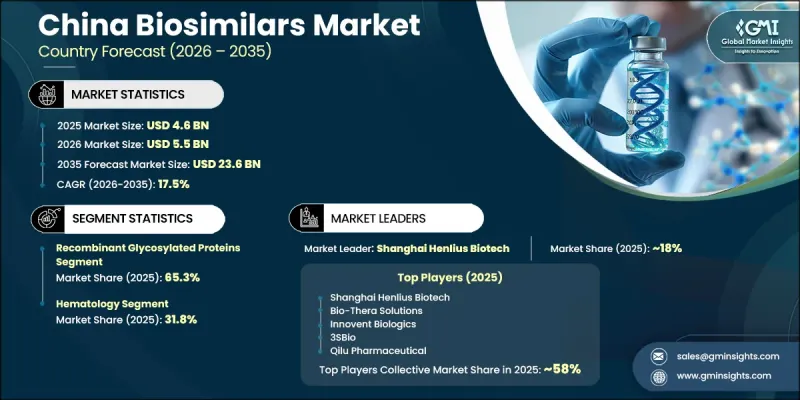
China Biosimilars Market was valued at USD 4.6 billion in 2025 and is estimated to grow at a CAGR of 17.5% to reach USD 23.6 billion by 2035.
The market is experiencing rapid development as healthcare providers, patients, and policymakers increasingly focus on improving access to affordable biologic therapies. The growing incidence of chronic and complex health conditions across China is creating a stronger need for cost-efficient treatment options that can deliver comparable therapeutic benefits to established biologic medicines. A combination of a large patient population, expanding healthcare infrastructure, urban development, and increasing demand for long-term disease management solutions is supporting biosimilar adoption across the country. Government initiatives focused on healthcare affordability, broader reimbursement coverage, and ongoing medical system improvements are further strengthening market penetration. Biosimilars are becoming an important part of China's pharmaceutical landscape by helping reduce treatment expenses while expanding access to advanced biologic therapies. Their increasing acceptance among healthcare professionals, hospitals, specialty treatment centers, and outpatient facilities is creating a favorable environment for continued market expansion.
| Market Scope | |
|---|---|
| Start Year | 2025 |
| Forecast Year | 2026-2035 |
| Start Value | $4.6 Billion |
| Forecast Value | $23.6 Billion |
| CAGR | 17.5% |
Biosimilars are biologic medicines designed to closely match already approved reference products while maintaining comparable standards for safety, effectiveness, and quality. In China, these alternatives are improving availability of advanced biologic treatments by offering more affordable options compared with original biologic therapies, supporting wider patient access.
The recombinant glycosylated proteins segment held a 65.3% share in 2025. The strong performance of this segment is supported by increasing utilization of glycosylated biologic therapies across major treatment areas. Recombinant glycosylated proteins, including therapies based on monoclonal antibodies and erythropoietin, continue to experience strong demand due to their importance in managing serious and long-term medical conditions. Their established clinical value and growing use within hospitals and specialized healthcare facilities have contributed significantly to segment growth. The increasing requirement for effective treatments in areas such as oncology, anemia management, and immune-related disorders continues to support the adoption of these biosimilar products throughout China's healthcare system.
The in-house manufacturing segment reached USD 2.8 billion in 2025. The segment's strong position is linked to the growing number of vertically integrated biopharmaceutical companies that prefer maintaining internal manufacturing capabilities to improve quality management, regulatory alignment, and production control. Expanding investments in domestic production facilities, advanced bioprocessing technologies, and manufacturing infrastructure are helping companies enhance operational efficiency, reduce production costs, shorten development timelines, and strengthen supply chain stability. These advantages continue to encourage greater reliance on internal manufacturing models across China's biosimilars sector.
Major players operating in the China biosimilars industry include Shanghai Henlius Biotech, BeiGene, Qilu Pharmaceutical, Innovent Biologics, Tonghua Dongbao Pharmaceutical, Akeso, Mabwell Bioscience, Hengrui Medicine, Bio-Thera Solutions, Junshi Biosciences, 3SBio, RemeGen, Hisun Pharmaceutical, and Gan & Lee Pharmaceuticals. Companies operating in the China biosimilars market are focusing on expanding production capacity, strengthening research and development capabilities, and improving manufacturing efficiency to secure a stronger market position. Leading organizations are investing in advanced biotechnology platforms, regulatory expertise, and quality control systems to accelerate product approvals and commercialization. Strategic collaborations, licensing agreements, and partnerships are also being used to expand product portfolios and access new therapeutic areas. Companies are increasingly prioritizing domestic manufacturing expansion to improve supply reliability and cost competitiveness.
Table of Contents
Chapter 1 Methodology and Scope
- 1.1 Market scope and definition
- 1.2 Research approach
- 1.3 Quality commitments
- 1.3.1 GMI AI policy and data integrity commitment
- 1.3.1.1 Source consistency protocol
- 1.3.1 GMI AI policy and data integrity commitment
- 1.4 Research trail and confidence scoring
- 1.4.1 Research trail components
- 1.4.2 Scoring components
- 1.5 Data collection
- 1.5.1 Partial list of primary sources
- 1.6 Data mining sources
- 1.6.1 Paid sources
- 1.7 Base estimates and calculations
- 1.7.1 Revenue share analysis
- 1.7.2 Base year calculation
- 1.8 Forecast model
- 1.9 Research transparency addendum
- 1.9.1 Source attribution framework
- 1.9.2 Quality assurance metrics
- 1.9.3 Our commitment to trust
Chapter 2 Executive Summary
- 2.1 Industry 360° synopsis
- 2.2 Key market trends
- 2.2.1 Business trends
- 2.2.2 Product trends
- 2.2.3 Application trends
- 2.2.4 Manufacturing type trends
- 2.2.5 Technology trends
- 2.2.6 Distribution channel trends
- 2.3 CXO perspectives: Strategic imperatives
Chapter 3 Industry Insights
- 3.1 Industry ecosystem analysis
- 3.2 Industry impact forces
- 3.2.1 Growth drivers
- 3.2.1.1 Rising chronic disease burden in China
- 3.2.1.2 Strong government support & reimbursement expansion
- 3.2.1.3 Growing biologics patent expirations
- 3.2.1.4 Rapid expansion of domestic biomanufacturing capabilities
- 3.2.2 Industry pitfalls and challenges
- 3.2.2.1 Complex regulatory and approval pathways
- 3.2.2.2 High development and manufacturing costs
- 3.2.3 Market opportunities
- 3.2.3.1 Expansion into global markets (EU, Asia, emerging regions)
- 3.2.3.2 Advancements in AI-driven bioprocessing and manufacturing
- 3.2.3.3 Increasing focus on high-value monoclonal antibody biosimilars
- 3.2.1 Growth drivers
- 3.3 Growth potential analysis
- 3.4 Regulatory landscape (Driven by primary research)
- 3.5 Technology landscape
- 3.5.1 Current technological trends
- 3.5.2 Emerging technologies
- 3.6 Porter's analysis
- 3.7 PESTEL analysis
- 3.8 Impact of AI and generative AI on the market (Driven by primary research)
- 3.9 Reimbursement landscape
- 3.10 Biosimilar litigation landscape
- 3.11 Future market trends (Driven by primary research)
- 3.12 Biosimilar factor analysis
- 3.12.1 Access
- 3.12.2 Regulations
- 3.12.3 Payer assessment and access
- 3.12.4 Physician acceptance
- 3.12.5 Patient acceptance
- 3.13 Biosimilar product pipeline analysis
- 3.14 Biosimilars approval scenario, 2022 - 2025
- 3.15 Biologics patent expiry scenario
- 3.16 International policies on the use of biosimilar drugs
- 3.16.1 Interchangeability, switching and substitution
- 3.16.2 Supply side policies
- 3.16.3 Prescribing incentives
Chapter 4 Competitive Landscape, 2025
- 4.1 Introduction
- 4.2 Company market share analysis
- 4.3 Company matrix analysis
- 4.4 Competitive analysis of major market players
- 4.5 Competitive positioning matrix
- 4.6 Key developments
- 4.6.1 Mergers and acquisitions
- 4.6.2 Partnerships and collaborations
- 4.6.3 New product launches
- 4.6.4 Expansion plans
Chapter 5 Market Estimates and Forecast, By Product, 2022-2035 ($ Mn)
- 5.1 Key trends
- 5.2 Recombinant non-glycosylated proteins
- 5.2.1 Human growth hormone
- 5.2.2 Granulocyte colony-stimulating factor (filgrastim)
- 5.2.3 Insulin
- 5.2.4 Interferon
- 5.2.4.1 Alfa
- 5.2.4.2 Beta
- 5.3 Recombinant glycosylated proteins
- 5.3.1 Monoclonal antibodies
- 5.3.1.1 Infliximab
- 5.3.1.2 Rituximab
- 5.3.1.3 Adalimumab
- 5.3.1.4 Trastuzumab
- 5.3.1.5 Bevacizumab
- 5.3.2 Erythropoietin
- 5.3.2.1 Alfa
- 5.3.2.2 Beta
- 5.3.3 Follitropin
- 5.3.3.1 Alfa
- 5.3.3.2 Beta
- 5.3.4 Fusion proteins
- 5.3.1 Monoclonal antibodies
- 5.4 Other products
Chapter 6 Market Estimates and Forecast, By Application, 2022-2035 ($ Mn)
- 6.1 Key trends
- 6.2 Hematology
- 6.2.1 Neutropenia
- 6.2.2 Anemia
- 6.2.3 Other hematology applications
- 6.3 Oncology
- 6.3.1 Lung cancer
- 6.3.2 Brain cancer
- 6.3.3 Breast cancer
- 6.3.4 Cervical cancer
- 6.3.5 Colorectal cancer
- 6.3.6 Leukemia
- 6.3.7 Other Oncology applications
- 6.4 Autoimmune disease
- 6.4.1 Arthritis
- 6.4.1.1 Rheumatoid arthritis
- 6.4.1.2 Psoriatic arthritis
- 6.4.1.3 Juvenile arthritis
- 6.4.1.4 Ankylosing spondylitis
- 6.4.1.5 Other arthritis
- 6.4.2 Inflammatory bowel disease (IBD)
- 6.4.2.1 Ulcerative colitis
- 6.4.2.2 Crohn's disease
- 6.4.2.3 Other IBD
- 6.4.3 Psoriasis
- 6.4.4 Other autoimmune diseases
- 6.4.1 Arthritis
- 6.5 Ophthalmology
- 6.6 Growth hormone deficiency
- 6.7 Diabetes
- 6.8 Other applications
Chapter 7 Market Estimates and Forecast, By Manufacturing Type, 2022-2035 ($ Mn)
- 7.1 Key trends
- 7.2 Contract research and manufacturing services
- 7.3 In-house
Chapter 8 Market Estimates and Forecast, By Technology, 2022-2035 ($ Mn)
- 8.1 Key trends
- 8.2 Recombinant DNA technology
- 8.3 Mammalian cell culture systems
- 8.4 Other technologies
Chapter 9 Market Estimates and Forecast, By Distribution Channel, 2022-2035 ($ Mn)
- 9.1 Key trends
- 9.2 Hospital pharmacies
- 9.3 Specialty pharmacies
- 9.4 Other distribution channels
Chapter 10 Company Profiles
- 10.1 3SBio
- 10.2 Akeso
- 10.3 BeiGene
- 10.4 Bio-Thera Solutions
- 10.5 Gan & Lee Pharmaceuticals
- 10.6 Hengrui Medicine
- 10.7 Hisun Pharmaceutical
- 10.8 Innovent Biologics
- 10.9 Junshi Biosciences
- 10.10 Mabwell Bioscience
- 10.11 Qilu Pharmaceutical
- 10.12 RemeGen
- 10.13 Shanghai Henlius Biotech
- 10.14 Tonghua Dongbao Pharmaceutical

