PUBLISHER: Global Market Insights Inc. | PRODUCT CODE: 2101618

PUBLISHER: Global Market Insights Inc. | PRODUCT CODE: 2101618
Mine Countermeasure (MCM) Systems Market Opportunity, Growth Drivers, Industry Trend Analysis, and Forecast 2026 - 2035
The Global Mine Countermeasure (MCM) Systems Market was valued at USD 2.4 billion in 2025 and is estimated to grow at a CAGR of 5.7% to reach USD 4.3 billion in 2035.
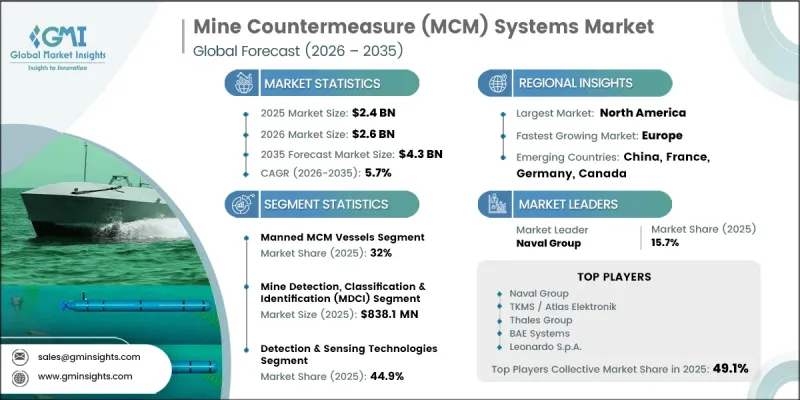
The Mine Countermeasure (MCM) Systems Market is expanding as maritime security requirements continue to rise and naval forces focus on strengthening capabilities against underwater mine threats. Increasing concerns regarding the protection of strategic waterways, maritime trade routes, offshore facilities, and critical underwater infrastructure are encouraging governments to invest in advanced mine warfare solutions. The market is benefiting from ongoing naval fleet modernization programs, rising adoption of autonomous technologies, and advancements in underwater detection and response systems. The transition toward unmanned platforms is reshaping traditional mine countermeasure operations by improving mission safety, operational efficiency, and threat detection capabilities. Advanced sensing technologies, artificial intelligence-based analysis, and next-generation sonar systems are supporting more accurate identification and neutralization of underwater hazards. As maritime environments become increasingly complex, defense organizations are prioritizing flexible and technologically advanced solutions to improve operational readiness. The growing requirement for reliable mine detection, classification, and disposal capabilities is expected to create sustained opportunities for market participants. Increased investments in autonomous systems, naval modernization initiatives, and maritime defense infrastructure are likely to support the continued expansion of the global mine countermeasure (MCM) systems market.
| Market Scope | |
|---|---|
| Start Year | 2025 |
| Forecast Year | 2026-2035 |
| Start Value | $2.4 Billion |
| Forecast Value | $4.3 Billion |
| CAGR | 5.7% |
The Mine Countermeasure (MCM) Systems Market is witnessing strong growth due to increasing naval modernization efforts aimed at addressing changing underwater security challenges. Governments worldwide are investing in advanced maritime defense technologies, including autonomous surface platforms, underwater vehicles, and remotely controlled systems, to improve operational effectiveness while reducing personnel exposure during high-risk missions. The growing focus on securing important maritime corridors, ports, offshore assets, and underwater facilities is further increasing demand for advanced mine warfare capabilities. These developments are encouraging defense organizations to adopt more efficient and technology-driven mine countermeasure solutions.
The manned MCM vessels segment accounted for 32% share in 2025. The segment maintains a leading position due to its ability to support multiple mission requirements, including mine hunting, mine sweeping, command and control operations, and explosive ordnance disposal activities. Equipped with advanced sonar systems, mine disposal technologies, and integrated combat management capabilities, manned MCM vessels continue to serve as essential assets for complex mine warfare operations. Their operational flexibility and ability to coordinate with other defense platforms make them an important component of naval modernization programs worldwide.
The mine detection, classification & identification (MDCI) segment captured USD 838.1 million in 2025. This segment plays a critical role in identifying underwater mine threats before neutralization activities are conducted. Growing adoption of advanced detection technologies, improved sonar capabilities, autonomous underwater vehicles, and artificial intelligence-supported image processing systems is strengthening segment growth. These solutions enhance detection accuracy, reduce unnecessary alerts, and enable faster threat assessment, making MDCI capabilities a fundamental part of modern naval mine warfare strategies.
North America Mine Countermeasure (MCM) Systems Market is experiencing notable expansion due to rising naval modernization investments, increasing adoption of autonomous mine warfare technologies, and growing efforts to secure important maritime assets. Increased spending by defense organizations, including the U.S. Department of Defense (DoD) and the U.S. Navy, is supporting the development and deployment of advanced mine countermeasure solutions. The regional market is strengthened by greater integration of autonomous underwater vehicles, unmanned surface vehicles, advanced sonar technologies, and mine neutralization systems. These investments are expected to enhance maritime security capabilities and support continued growth across North America.
Prominent companies operating in the Global Mine Countermeasure (MCM) Systems Market include Lockheed Martin, BAE Systems plc, Elbit Systems, Exail Holding, General Dynamics (Bluefin Robotics), HII (Huntington Ingalls Industries - Mission Technologies), Israel Aerospace Industries (IAI), Kongsberg Defence & Aerospace, Kraken Robotics, L3Harris Technologies, Leonardo S.p.A., Naval Group, Northrop Grumman, RTX Corporation, Saab AB (Underwater Systems & Seaeye), Saab Seaeye, ST Engineering, Textron Systems, Thales Group, and TKMS / Atlas Elektronik. Companies operating in the Mine Countermeasure (MCM) Systems Market are strengthening their market position through continuous technology development, strategic collaborations, and expansion of advanced maritime defense solutions. Industry participants are investing in autonomous platforms, enhanced detection technologies, and integrated command systems to address evolving naval requirements. Companies are also focusing on research and development initiatives to improve underwater sensing accuracy, operational efficiency, and mission safety. Partnerships with defense organizations and naval forces are helping manufacturers expand their capabilities and increase global presence. In addition, businesses are enhancing product portfolios, developing customized solutions, and investing in next-generation unmanned technologies to gain a stronger competitive advantage in the evolving mine countermeasure systems market.
Table of Contents
Chapter 1 Methodology and Scope
- 1.1 Market scope and definition
- 1.2 Research design
- 1.2.1 Research approach
- 1.2.2 Data collection methods
- 1.3 Data mining sources
- 1.3.1 Global
- 1.3.2 Regional/Country
- 1.4 Base estimates and calculations
- 1.4.1 Base year calculation
- 1.4.2 Key trends for market estimation
- 1.5 Primary research and validation
- 1.5.1 Primary sources
- 1.6 Forecast model
- 1.7 Research assumptions and limitations
Chapter 2 Executive Summary
- 2.1 Industry 360° synopsis, 2022 - 2035
- 2.2 Key market trends
- 2.2.1 Platform type trends
- 2.2.2 Operation type trends
- 2.2.3 Technology trends
- 2.2.4 End-user trends
- 2.2.5 Regional trends
- 2.3 TAM Analysis, 2026-2035
- 2.4 CXO perspectives: Strategic imperatives
Chapter 3 Industry Insights
- 3.1 Industry ecosystem analysis
- 3.1.1 Supplier Landscape
- 3.1.2 Profit Margin
- 3.1.3 Cost structure
- 3.1.4 Value addition at each stage
- 3.1.5 Factor affecting the value chain
- 3.1.6 Disruptions
- 3.2 Industry impact forces
- 3.2.1 Growth drivers
- 3.2.1.1 Rising naval modernization programs focused on advanced mine warfare capabilities
- 3.2.1.2 Growing adoption of autonomous and unmanned mine countermeasure platforms
- 3.2.1.3 Increasing protection of critical maritime infrastructure and strategic sea lanes
- 3.2.1.4 Advancements in underwater sensing, AI-enabled target recognition, and sonar technologies
- 3.2.1.5 Increasing multinational naval exercises and maritime security cooperation
- 3.2.2 Industry pitfalls and challenges
- 3.2.2.1 High procurement and lifecycle costs of advanced MCM systems
- 3.2.2.2 Complex underwater operating environments and evolving mine threats
- 3.2.3 Market opportunities
- 3.2.3.1 Advancements in AI-enabled autonomous mine hunting and underwater robotics
- 3.2.3.2 Growing investments in protecting critical maritime infrastructure and strategic waterways
- 3.2.1 Growth drivers
- 3.3 Growth potential analysis
- 3.4 Regulatory landscape
- 3.4.1 North America
- 3.4.2 Europe
- 3.4.3 Asia Pacific
- 3.4.4 Latin America
- 3.4.5 Middle East & Africa
- 3.5 Porter's analysis
- 3.6 PESTEL analysis
- 3.7 Technology and Innovation landscape
- 3.7.1 Current technological trends
- 3.7.2 Emerging technologies
- 3.8 Price trends
- 3.8.1 By region
- 3.8.2 By product
- 3.9 Pricing Strategies
- 3.10 Emerging Business Models
- 3.11 Compliance Requirements
- 3.12 Patent and IP analysis
Chapter 4 Competitive Landscape, 2025
- 4.1 Introduction
- 4.2 Company market share analysis
- 4.2.1 By region
- 4.2.1.1 North America
- 4.2.1.2 Europe
- 4.2.1.3 Asia Pacific
- 4.2.1.4 Latin America
- 4.2.1.5 Middle East & Africa
- 4.2.2 Market concentration analysis
- 4.2.1 By region
- 4.3 Competitive benchmarking of key players
- 4.3.1 Financial performance comparison
- 4.3.1.1 Revenue
- 4.3.1.2 Profit margin
- 4.3.1.3 R&D
- 4.3.2 Product portfolio comparison
- 4.3.2.1 Product range breadth
- 4.3.2.2 Technology
- 4.3.2.3 Innovation
- 4.3.3 Geographic presence comparison
- 4.3.3.1 Global footprint analysis
- 4.3.3.2 Service network coverage
- 4.3.3.3 Market penetration by region
- 4.3.4 Competitive positioning matrix
- 4.3.4.1 Leaders
- 4.3.4.2 Challengers
- 4.3.4.3 Followers
- 4.3.4.4 Niche players
- 4.3.5 Strategic outlook matrix
- 4.3.1 Financial performance comparison
- 4.4 Key developments
- 4.4.1 Mergers and acquisitions
- 4.4.2 Partnerships and collaborations
- 4.4.3 Technological advancements
- 4.4.4 Expansion and investment strategies
- 4.4.5 Digital transformation initiatives
- 4.5 Emerging/ startup competitors landscape
Chapter 5 Market Estimates and Forecast, By Platform Type, 2022 - 2035 (USD Million)
- 5.1 Key trends
- 5.2 Autonomous underwater vehicles (AUVs)
- 5.3 Remotely operated vehicles (ROVs)
- 5.4 Unmanned surface vehicles (USVs)
- 5.5 Airborne MCM systems
- 5.6 Manned MCM vessels
Chapter 6 Market Estimates and Forecast, By Operation Type, 2022 - 2035 (USD Million)
- 6.1 Key trends
- 6.2 Mine detection, Classification & identification (MDCI)
- 6.3 Mine sweeping (Influence & mechanical)
- 6.4 Mine disposal & neutralization
- 6.5 Navigation safety & route survey
Chapter 7 Market Estimates and Forecast, By Technology, 2022 - 2035 (USD Million)
- 7.1 Key trends
- 7.2 Detection & Sensing Technologies
- 7.3 Mine Neutralization & Disposal Systems
- 7.4 Mission Management, C2 & Autonomous Systems
Chapter 8 Market Estimates and Forecast, By End-User, 2022 - 2035 (USD Million)
- 8.1 Key trends
- 8.2 Naval forces (blue-water & littoral Combat)
- 8.3 Coast guard & port/harbor security forces
- 8.4 Special operations maritime forces
Chapter 9 Market Estimates and Forecast, By Region, 2022 - 2035 (USD Million)
- 9.1 Key trends
- 9.2 North America
- 9.2.1 U.S.
- 9.2.2 Canada
- 9.3 Europe
- 9.3.1 France
- 9.3.2 United Kingdom
- 9.3.3 Germany
- 9.3.4 Norway
- 9.3.5 Italy
- 9.3.6 Sweden
- 9.4 Asia Pacific
- 9.4.1 China
- 9.4.2 India
- 9.4.3 Japan
- 9.4.4 Australia
- 9.4.5 South Korea
- 9.5 Latin America
- 9.5.1 Brazil
- 9.5.2 Chile
- 9.5.3 Mexico
- 9.6 Middle East and Africa
- 9.6.1 South Africa
- 9.6.2 Saudi Arabia
- 9.6.3 UAE
Chapter 10 Company Profiles
- 10.1 Global Key Players
- 10.1.1 Naval Group
- 10.1.2 TKMS / Atlas Elektronik
- 10.1.3 Thales Group
- 10.1.4 BAE Systems
- 10.1.5 Leonardo S.p.A.
- 10.2 Regional key players
- 10.2.1 North America
- 10.2.1.1 Northrop Grumman
- 10.2.1.2 Lockheed Martin
- 10.2.1.3 L3Harris Technologies
- 10.2.1.4 RTX Corporation
- 10.2.2 Asia Pacific
- 10.2.2.1 ST Engineering
- 10.2.2.2 IAI (Israel Aerospace Industries)
- 10.2.2.3 Elbit Systems
- 10.2.3 Europe
- 10.2.3.1 Exail Holding
- 10.2.3.2 Kongsberg Defence & Aerospace
- 10.2.3.3 Saab AB
- 10.2.1 North America
- 10.3 Niche Players/Disruptors
- 10.3.1 Kraken Robotics
- 10.3.2 Saab Seaeye
- 10.3.3 General Dynamics
- 10.3.4 HII (Huntington Ingalls Industries - Mission Technologies)
- 10.3.5 Textron Systems

