PUBLISHER: Global Market Insights Inc. | PRODUCT CODE: 2101623

PUBLISHER: Global Market Insights Inc. | PRODUCT CODE: 2101623
North America Helical Screw Blower Market Opportunity, Growth Drivers, Industry Trend Analysis, and Forecast 2026 - 2035
North America Helical Screw Blower Market was valued at USD 352.8 million in 2025 and is estimated to grow at a CAGR of 5.8% to reach USD 620.9 million by 2035.
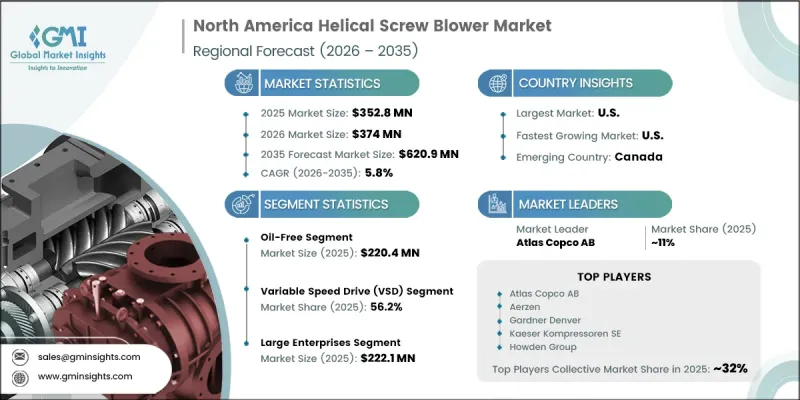
North America helical screw blower market is expanding as infrastructure modernization, stricter environmental regulations, and growing industrial energy-efficiency initiatives continue to reshape equipment demand. Ongoing investments in wastewater treatment infrastructure are encouraging the replacement of aging aeration and pneumatic systems with advanced helical screw blowers that offer improved energy efficiency and better compatibility with variable-speed operation. Regulatory compliance requirements for municipal and industrial wastewater facilities are also driving equipment upgrades, prompting operators to adopt modern blower technologies that support environmental standards while lowering long-term operating costs. At the same time, the increasing implementation of variable speed drive and variable frequency drive technologies across industrial facilities is strengthening demand for energy-efficient blower systems. Government-supported industrial modernization programs and clean energy incentive frameworks continue to encourage capital investment in advanced equipment, making high-performance helical screw blowers an attractive solution for organizations seeking operational efficiency, regulatory compliance, and reduced lifecycle costs across a wide range of industrial applications.
| Market Scope | |
|---|---|
| Start Year | 2025 |
| Forecast Year | 2026-2035 |
| Start Value | $352.8 Million |
| Forecast Value | $620.9 Million |
| CAGR | 5.8% |
The oil-free segment generated USD 220.4 million in 2025. Strong demand for oil-free systems is supported by strict regulatory requirements governing compressed air quality across industries where contamination control is essential. Food processing, pharmaceutical manufacturing, life sciences, and advanced manufacturing facilities continue to prioritize oil-free blower technologies to maintain product quality, comply with industry standards, and support clean production environments. Growing emphasis on operational reliability and contamination prevention is expected to sustain demand for oil-free equipment throughout the forecast period.
The variable speed drive (VSD) segment accounted for 56.2% share in 2025. Adoption continues to increase as industrial facilities seek greater energy efficiency, improved operational flexibility, and lower electricity consumption. Government-supported energy efficiency initiatives, financial incentives for industrial equipment modernization, and utility rebate programs are encouraging organizations to invest in VSD-equipped blower systems. These solutions help reduce operating expenses, shorten investment payback periods, and improve overall process efficiency across wastewater treatment and numerous industrial applications.
U.S. Helical Screw Blower Market was valued at USD 72 million in 2025 and is projected to grow at a CAGR of 5.9% between 2026 and 2035. Demand is supported by extensive municipal wastewater treatment infrastructure, continuous investment in industrial processing facilities, a large pharmaceutical manufacturing sector, and ongoing expansion of advanced domestic manufacturing capabilities. Regulatory compliance requirements, infrastructure modernization programs, and sustained capital investments in industrial efficiency continue to reinforce long-term demand for advanced helical screw blower technologies across the United States.
Key companies operating in the North America helical screw blower market include Ingersoll Rand, Atlas Copco AB, Kaeser Kompressoren SE, Aerzener Maschinenfabrik GmbH, Sullair LLC, Howden Group, Busch Vacuum Solutions, Tuthill Corporation, Spencer Turbine Company, Neuman & Esser Group, Continental Blower LLC, Airtech International, Universal Blower Pac, FS-Elliott Co., LLC, Piller Blowers & Compressors GmbH, Dresser-Rand, Elliott Group, Gardner Denver Nash, Twin City Fan & Blower, Chicago Blower Corporation, and Great Lakes Air Products. Companies operating in the North America helical screw blower market are strengthening their competitive position by investing in energy-efficient technologies, expanding oil-free product portfolios, and enhancing variable speed drive capabilities to meet evolving customer requirements. Manufacturers are focusing on product innovation that improves operational efficiency, reduces maintenance costs, and supports compliance with increasingly stringent environmental regulations. Strategic partnerships with industrial customers, engineering firms, and infrastructure contractors are helping companies expand market reach and secure long-term supply opportunities. Businesses are also increasing investments in manufacturing capacity, digital monitoring technologies, aftermarket service networks, and research and development to improve customer support and equipment performance.
Table of Contents
Chapter 1 Methodology and Scope
- 1.1 Market scope and definition
- 1.2 Research design
- 1.2.1 Research approach
- 1.2.2 Data collection methods
- 1.3 Data mining sources
- 1.3.1 Global
- 1.3.2 Regional/Country
- 1.4 Base estimates and calculations
- 1.4.1 Base year calculation
- 1.4.2 Key trends for market estimation
- 1.5 Primary research and validation
- 1.5.1 Primary sources
- 1.6 Forecast model
- 1.7 Research assumptions and limitations
Chapter 2 Executive Summary
- 2.1 Industry 360° synopsis
- 2.2 Key market trends
- 2.3 Country
- 2.4 Lubrication type
- 2.5 Drive configuration
- 2.6 Rotor type
- 2.7 Capacity
- 2.8 Motor power range
- 2.9 Speed control
- 2.10 Application
- 2.11 End user scale
- 2.12 Distribution channel
Chapter 3 Industry Insights
- 3.1 Industry Ecosystem Analysis
- 3.1.1 Supplier landscape
- 3.1.2 Factor affecting the value chain
- 3.1.3 Profit margin analysis by value chain stage
- 3.1.4 Disruptions
- 3.1.5 Future outlook
- 3.2 Industry impact forces
- 3.2.1 Growth drivers
- 3.2.1.1 EPA-driven wastewater infrastructure upgrades fueling high-efficiency aeration demand
- 3.2.1.2 IRA clean energy incentives accelerating adoption of energy-efficient blower systems
- 3.2.1.3 DOE better plants program mandates driving TCO-based equipment procurement
- 3.2.2 Market Restraints
- 3.2.2.1 High upfront capital investment relative to legacy lobe blower replacement costs
- 3.2.2.2 Availability of qualified service technicians limited in rural & tier-II industrial regions
- 3.2.2.3 Market Opportunities
- 3.2.2.4 Municipal wastewater treatment plant upgrades great lakes & gulf coast regions
- 3.2.2.5 Industrial automation & smart factory expansion driving IoT-integrated blower demand
- 3.2.1 Growth drivers
- 3.3 Growth potential analysis
- 3.4 Future market trends
- 3.5 Technology and innovation landscape
- 3.5.1 Current technological trends
- 3.5.2 Emerging technologies
- 3.5.3 Emerging rotor profile technologies (3X5, VHX, hybrid profiles)
- 3.5.4 VFD/VSD integration & variable speed control trends
- 3.5.5 Smart blower systems
- 3.5.6 Acoustic enclosure & noise reduction innovations
- 3.6 Pricing analysis (driven by primary research)
- 3.6.1 Historical price trend analysis
- 3.6.2 Pricing strategy by player type (premium / value / cost-plus)
- 3.7 Regulatory landscape
- 3.7.1 United States
- 3.7.1.1 EPA effluent limitation guidelines & aeration equipment standards
- 3.7.1.2 DOE better plants program
- 3.7.1.3 Inflation Reduction Act (IRA)
- 3.7.1.4 OSHA industrial noise & equipment safety standards
- 3.7.1.5 NFPA & UL equipment certification requirements
- 3.7.2 Canada
- 3.7.2.1 Canadian standards association (CSA) equipment certification
- 3.7.2.2 Environment & climate change canada
- 3.7.2.3 NRCan (Natural Resources Canada) energy efficiency regulations
- 3.7.1 United States
- 3.8 Trade data analysis (driven by paid database) (HS Code- 84145930)
- 3.8.1 Key trade corridors & tariff impact
- 3.8.2 Trade policy changes & regional trade agreements
- 3.9 Supply chain analysis
- 3.9.1 Raw material sourcing
- 3.9.2 Key Tier-1 & Tier-2 supplier landscape
- 3.9.3 Nearshoring & reshoring trends impacting blower manufacturing
- 3.9.4 Supply chain risk & disruption assessment
- 3.10 Impact of AI & generative AI on the market
- 3.10.1 AI-driven disruption of existing business models
- 3.10.2 GenAI use cases & adoption roadmap by segment
- 3.10.3 Risks, limitations & regulatory considerations
- 3.11 Capacity & production landscape (driven by primary research)
- 3.11.1 Installed capacity by region & key producer
- 3.11.2 Capacity utilization rates & expansion pipelines
- 3.12 Porter's five forces analysis
- 3.13 PESTEL analysis
Chapter 4 Competitive Landscape, 2025
- 4.1 Introduction
- 4.2 Company market share analysis
- 4.2.1 By country
- 4.2.1.1 U.S.
- 4.2.1.2 Canada
- 4.2.1 By country
- 4.3 Company matrix analysis
- 4.4 Competitive analysis of major market players
- 4.5 Competitive positioning matrix
- 4.6 Key developments
- 4.6.1 Mergers & acquisitions
- 4.6.2 Partnerships & collaborations
- 4.6.3 New product launches
- 4.6.4 Expansion plans
Chapter 5 Market Estimates & Forecast, By Lubrication Type, 2022-2035 (USD Million) (Thousand Units)
- 5.1 Key trends
- 5.2 Oil-Free
- 5.3 Oil-Injected
Chapter 6 Market Estimates & Forecast, By Drive Configuration, 2022-2035 (USD Million) (Thousand Units)
- 6.1 Key trends
- 6.2 Direct drive
- 6.3 Belt drive
Chapter 7 Market Estimates & Forecast, By Rotor Type, 2022-2035 (USD Million) (Thousand Units)
- 7.1 Key trends
- 7.2 Standard Twin-Screw (2X4 Profile)
- 7.3 High-Efficiency Twin-Screw (3X5 Profile)
- 7.4 Variable Helix Profile (VHX)
- 7.5 Tri-Lobe Helical (3+4 Hybrid Profile)
Chapter 8 Market Estimates & Forecast, By Capacity, 2022-2035 (USD Million) (Thousand Units)
- 8.1 Key trends
- 8.2 Low flow (Up to 500 cfm / 14 m3/min)
- 8.3 Medium flow (500-2,500 cfm / 14-71 m3/min)
- 8.4 High flow (2,500-6,000 cfm / 71-170 m3/min)
Chapter 9 Market Estimates & Forecast, By Motor Power Range, 2022-2035 (USD Million) (Thousand Units)
- 9.1 Key trends
- 9.2 Small power (Up to 37 kW)
- 9.3 Medium power (37-160 kW)
- 9.4 Large power (Above 160 kW)
Chapter 10 Market Estimates & Forecast, By Speed Control, 2022-2035 (USD Million) (Thousand Units)
- 10.1 Key trends
- 10.2 Fixed speed
- 10.3 Variable speed drive (VSD/VFD)
Chapter 11 Market Estimates & Forecast, By Application, 2022-2035 (USD Million) (Thousand Units)
- 11.1 Key trends
- 11.2 Wastewater treatment
- 11.3 Chemicals & petrochemicals
- 11.4 Food & beverage
- 11.5 Pharmaceuticals
- 11.6 Power generation
- 11.7 Cement
- 11.8 Steel plants
- 11.9 Mining & ventilation
- 11.10 Others (aquaculture, horticulture, general industrial conveying)
Chapter 12 Market Estimates & Forecast, By End User Scale, 2022-2035 (USD Million) (Thousand Units)
- 12.1 Key trends
- 12.2 Large enterprises
- 12.3 Small & medium enterprises (SMEs)
Chapter 13 Market Estimates & Forecast, By Distribution Channel, 2022-2035 (USD Million) (Thousand Units)
- 13.1 Key trends
- 13.2 Direct sales
- 13.3 Indirect sales
Chapter 14 Market Estimates & Forecast, By Country, 2022-2035 (USD Million) (Thousand Units)
- 14.1 Key trends
- 14.2 North America
- 14.2.1 U.S.
- 14.2.2 Canada
Chapter 15 Company Profiles
- 15.1 Global Players
- 15.1.1 Atlas Copco AB
- 15.1.2 Aerzener Maschinenfabrik GmbH
- 15.1.3 Kaeser Kompressoren SE
- 15.1.4 Ingersoll Rand
- 15.1.5 Sullair LLC
- 15.2 Regional Champions
- 15.2.1 Busch Vacuum Solutions
- 15.2.2 Spencer Turbine Company
- 15.2.3 Tuthill Corporation
- 15.2.4 Howden Group
- 15.2.5 Neuman & Esser Group
- 15.2.6 Continental Blower LLC
- 15.3 Emerging Players
- 15.3.1 Universal Blower Pac
- 15.3.2 Airtech International
- 15.3.3 Piller Blowers & Compressors GmbH
- 15.3.4 FS-Elliott Co., LLC
- 15.3.5 Dresser-Rand
- 15.3.6 Elliott Group
- 15.3.7 Gardner Denver Nash
- 15.3.8 Twin City Fan & Blower
- 15.3.9 Chicago Blower Corporation
- 15.3.10 Great Lakes Air Products

