PUBLISHER: Global Market Insights Inc. | PRODUCT CODE: 2101628

PUBLISHER: Global Market Insights Inc. | PRODUCT CODE: 2101628
High-Pressure Processing (HPP) Equipment and Services Market Opportunity, Growth Drivers, Industry Trend Analysis, and Forecast 2026 - 2035
The Global High-Pressure Processing Equipment & Services Market was valued at USD 1.18 billion in 2025 and is estimated to grow at a CAGR of 12.4% to reach USD 3.72 billion by 2035.
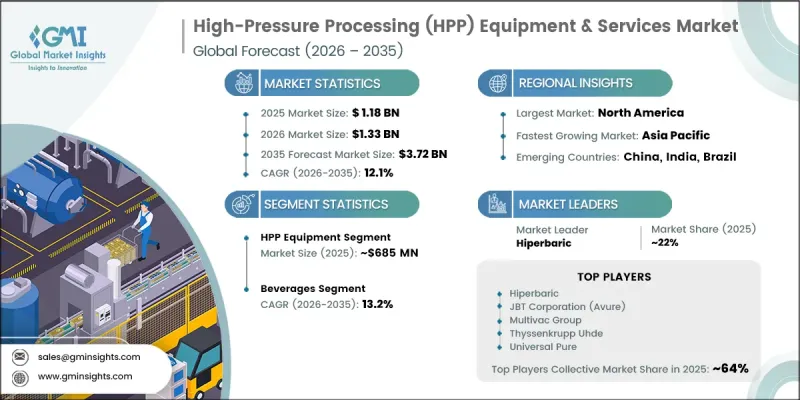
The industry is undergoing a structural transformation in food preservation practices as manufacturers increasingly move away from thermal pasteurization and synthetic preservatives toward non-thermal, clean-label preservation technologies. This shift is driven by rising consumer demand for minimally processed foods with simpler ingredient lists and higher nutritional retention. High-pressure processing (HPP) enables extended shelf life while maintaining food safety by delivering significant pathogen reduction, including organisms such as Listeria monocytogenes, E. coli O157:H7, and Salmonella spp., without exposing products to heat damage. This allows manufacturers to preserve vitamins, pigments, and flavor compounds that are typically degraded in conventional heat-based methods. The technology is increasingly aligned with the expansion of premium and natural food categories, which continue to outperform conventional processed foods across major retail markets. As a result, HPP is becoming a critical enabling technology for clean-label product innovation and shelf-life optimization across global food and beverage supply chains.
| Market Scope | |
|---|---|
| Start Year | 2025 |
| Forecast Year | 2026-2035 |
| Start Value | $1.18 Billion |
| Forecast Value | $3.72 Billion |
| CAGR | 12.4% |
The horizontal HPP systems segment held 70% share, growing at a CAGR of 12.2% through 2035. Their leadership is supported by higher operational efficiency, seamless integration into automated production lines, and flexible vessel configurations that accommodate diverse industrial throughput requirements. These systems are widely preferred in large-scale processing environments due to their ability to support continuous production workflows and improved handling efficiency.
The beverages application segment held 25.2% in 2025, valued at USD 283 million and growing at a CAGR of 13.2% through 2035. The strong adoption in this category is driven by the ability of HPP to preserve freshness and nutritional value while extending shelf life without chemical preservatives. This enables premium beverage brands to command significantly higher retail pricing compared to conventionally processed alternatives, improving margin absorption of processing costs and supporting category expansion in health-focused beverage segments.
North America High-Pressure Processing Equipment & Services Market accounted for 36% share in 2025, making it the most developed regional market. The region benefits from a highly advanced food processing infrastructure, widespread adoption of contract processing services, and deep integration of HPP technology within mainstream retail supply chains. The United States leads regional demand, supported by regulatory frameworks that recognize HPP as an approved post-packaging intervention for ready-to-eat meat and poultry products under established food safety compliance systems. This regulatory acceptance played a foundational role in the early commercialization and widespread adoption of HPP technology across North America.
Key companies operating in the global high-pressure processing equipment & services market include Hiperbaric, JBT Corporation (Avure Technologies), Multivac Group, Thyssenkrupp Uhde, Universal Pure, HPP Italia, American Pasteurization Company, Safe Pac Pasteurization, Motivatit Seafoods, Espuna, Cold Pressure Council, NEXT HPP, Stansted Fluid Power, Bao Tou KeFa High Pressure Technology, and Kobe Steel Ltd. Companies operating in the high-pressure processing equipment & services market are strengthening their competitive position through continuous innovation in system design, higher-capacity vessel engineering, and automation integration to improve processing efficiency. Many firms are expanding service-based business models, including toll processing and contract processing partnerships, to increase recurring revenue streams. Strategic collaborations with food and beverage manufacturers are helping accelerate adoption across new product categories. Companies are also investing in energy-efficient pressure systems and modular equipment designs to reduce operational costs and improve scalability for mid-sized processors.
Table of Contents
Chapter 1 Methodology & Scope
- 1.1 Market scope and definition
- 1.2 Research design
- 1.2.1 Research approach
- 1.2.2 Data collection methods
- 1.3 Data mining sources
- 1.3.1 Global
- 1.3.2 Regional/Country
- 1.4 Base estimates and calculations
- 1.4.1 Base year calculation
- 1.4.2 Key trends for market estimation
- 1.5 Primary research and validation
- 1.5.1 Primary sources
- 1.6 Forecast model
- 1.7 Research assumptions and limitations
Chapter 2 Executive Summary
- 2.1 Industry 360° synopsis
- 2.2 Key market trends
- 2.2.1 Regional
- 2.2.2 Product Type / Technology
- 2.2.3 Crop Type
- 2.2.4 Application Method
- 2.2.5 Form
- 2.3 TAM Analysis, 2026-2035
- 2.4 CXO perspectives: Strategic imperatives
- 2.4.1 Executive decision points
Chapter 3 Industry Insights
- 3.1 Industry ecosystem analysis
- 3.1.1 Supplier landscape
- 3.1.2 Profit margin
- 3.1.3 Value addition at each stage
- 3.1.4 Factor affecting the value chain
- 3.1.5 Disruptions
- 3.2 Industry impact forces
- 3.2.1 Growth drivers
- 3.2.2 Industry pitfalls and challenges
- 3.2.3 Market opportunities
- 3.3 Growth potential analysis
- 3.4 Regulatory landscape
- 3.4.1 North America
- 3.4.2 Europe
- 3.4.3 Asia Pacific
- 3.4.4 Latin America
- 3.4.5 Middle East & Africa
- 3.5 Porter's analysis
- 3.6 PESTEL analysis
- 3.7 Price trends
- 3.7.1 By region
- 3.7.2 By type
- 3.8 Future market trends
- 3.9 Technology and Innovation landscape
- 3.9.1 Current technological trends
- 3.9.2 Emerging technologies
- 3.10 Patent Landscape
- 3.11 Trade statistics (HS code)
- 3.11.1 Major importing countries
- 3.11.2 Major exporting countries
- 3.12 Sustainability and environmental aspects
- 3.12.1 Sustainable practices
- 3.12.2 Waste reduction strategies
- 3.12.3 Energy efficiency in production
- 3.12.4 Eco-friendly initiatives
- 3.13 Carbon footprint consideration
Chapter 4 Competitive Landscape, 2025
- 4.1 Introduction
- 4.2 Company market share analysis
- 4.2.1 By region
- 4.2.1.1 North America
- 4.2.1.2 Europe
- 4.2.1.3 Asia Pacific
- 4.2.1.4 LATAM
- 4.2.1.5 MEA
- 4.2.1 By region
- 4.3 Company matrix analysis
- 4.4 Competitive analysis of major market players
- 4.5 Competitive positioning matrix
- 4.6 Key developments
- 4.6.1 Mergers & acquisitions
- 4.6.2 Partnerships & collaborations
- 4.6.3 New Product Launches
- 4.6.4 Expansion Plans
Chapter 5 Market Estimates and Forecast, By Product Type / Technology, 2022-2035 (USD Billion)
- 5.1 Key trends
- 5.2 Water-Soluble Fertilizers
- 5.3 Micronutrient Fertilizers
- 5.4 Controlled-Release Fertilizers (CRF)
- 5.5 Slow-Release Fertilizers (SRF)
- 5.6 Inhibitor-Based Fertilizers (Urease & Nitrification)
- 5.7 Liquid Fertilizers
Chapter 6 Market Estimates and Forecast, By Crop Type, 2022-2035 (USD Billion)
- 6.1 Key trends
- 6.2 Fruits & Vegetables
- 6.3 Cereals & Grains
- 6.4 Oilseeds & Pulses
- 6.5 Turf & Ornamentals
- 6.6 Other Crops
Chapter 7 Market Estimates and Forecast, By Application Method, 2022-2035 (USD Billion)
- 7.1 Key trends
- 7.2 Fertigation
- 7.3 Foliar Application
- 7.4 Soil Application
Chapter 8 Market Estimates and Forecast, By Form, 2022-2035 (USD Billion)
- 8.1 Key trends
- 8.2 Dry
- 8.3 Liquid
Chapter 9 Market Estimates and Forecast, By Region, 2022-2035 (USD Billion)
- 9.1 Key trends
- 9.2 North America
- 9.2.1 U.S.
- 9.2.2 Canada
- 9.3 Europe
- 9.3.1 Germany
- 9.3.2 UK
- 9.3.3 France
- 9.3.4 Spain
- 9.3.5 Italy
- 9.3.6 Rest of Europe
- 9.4 Asia Pacific
- 9.4.1 China
- 9.4.2 India
- 9.4.3 Japan
- 9.4.4 Australia
- 9.4.5 South Korea
- 9.4.6 Rest of Asia Pacific
- 9.5 Latin America
- 9.5.1 Brazil
- 9.5.2 Mexico
- 9.5.3 Argentina
- 9.5.4 Rest of Latin America
- 9.6 Middle East and Africa
- 9.6.1 Saudi Arabia
- 9.6.2 South Africa
- 9.6.3 UAE
- 9.6.4 Rest of Middle East and Africa
Chapter 10 Company Profiles
- 10.1 ICL Group
- 10.2 Yara International ASA
- 10.3 Nutrien Ltd.
- 10.4 The Mosaic Company
- 10.5 Sociedad Quimica y Minera (SQM)
- 10.6 CF Industries Holdings
- 10.7 EuroChem Group
- 10.8 Coromandel International
- 10.9 Sinochem Fertilizer
- 10.10 Grupa Azoty SA
- 10.11 Wilbur-Ellis Agribusiness
- 10.12 Haifa Group
- 10.13 Compo Expert GmbH
- 10.14 Valagro SpA (Syngenta Group)
- 10.15 Agroliquid

